
Samuel O. Clarke and Peter E. Sokolove
Despite the introduction of a safe and effective vaccine in 1982, hepatitis B (HBV) remains a potential occupational hazard among healthcare workers. Between 804,000 and 1.4 million Americans are infected with HBV, the majority of whom are unaware of their infection status (1). As of 2011, the majority of healthcare providers in the United States have received vaccination against Hepatitis B, and between 93% to 95% are thought to be protected based on vaccination efficacy data (2). Though the incidence of hepatitis B infection in 2007 has declined by 82% since 1990, unvaccinated healthcare workers remain at significant risk (1,3). HBV vaccination plays the central role in prevention of disease among healthcare workers and has reduced the number of HBV cases, hospitalizations, and deaths by about 80% since prevaccine levels (4).
Although the acquired immunodeficiency syndrome (AIDS) accounts for a much smaller number of cases than does hepatitis B, it often causes more concern among healthcare workers. It is estimated that over 380,000 needle stick exposures to blood occur annually among US healthcare workers, equating to roughly 1 in 10 healthcare workers having a significant exposure each year (5). A recent study of patients with penetrating trauma presenting to an urban emergency department (ED) found an incidence of seropositivity for HIV, HBV, or HCV of more than 9%, and the majority of cases were in patients who were unaware of their seropositive status (6). Despite these risks, as of December 2010, there were only 57 confirmed and 143 possible occupational human immunodeficiency virus (HIV) infections among healthcare workers in the United States (7). Emergency physicians must be well versed in the management of HIV exposures, as both healthcare workers and non-healthcare workers visit the ED for exposure management.
Previously known as non-A non-B hepatitis, hepatitis C virus (HCV) is now the most common chronic blood-borne infection in the United States. Between 3.2 and 5.4 million Americans are chronically infected with this virus, with about 20,000 new infections each year (8,9). Though the overall prevalence of HCV in healthcare workers is similar to that of the general population (1% to 2%), ED personnel are at high risk of exposure. In a recent study from a Midwestern ED, the prevalence of HCV infection among patients was 4% (10). In 2005, about 8% of persons with new HCV infections in the United States reported occupational exposure to blood (8).
CLINICAL PRESENTATION
Healthcare workers frequently present to the ED after exposure to material potentially infected with HBV, HCV, or HIV. First, the exposure must be assessed. Although blood is the single most important source of infection, other fluids may also transmit disease. Semen or vaginal secretions; cerebrospinal, synovial, pleural, peritoneal, pericardial, or amniotic fluid; and tissue are capable of transmitting HIV, HBV, and probably HCV. Unless blood is visible in them, feces, nasal secretions, sputum, sweat, and tears have not been identified as vehicles of transmission for HBV, HCV, or HIV infection. Transmission occurs most effectively through direct percutaneous exposure (e.g., needlestick); although far less likely, exposure through mucous membranes or open skin lesions can also result in HBV, HCV, and HIV transmission. Casual contact, airborne, and fecal–oral transmission have not been documented (8). The factors associated with the greatest risk of HIV transmission after percutaneous exposure are: deeply penetrating injury, presence of visible blood on the injuring object, prior placement of the object in a patient’s vein or artery, and end-stage AIDS in the source patient (11).
ED EVALUATION
An initial evaluation should be made to assess the risk of disease transmission. Information about the injury should be gathered, including the infectious material, instrument procedure performed, depth of penetration, and volume of blood transferred. The source person should be evaluated for HIV and hepatitis risk factors, clinical signs of disease, previous HIV therapy, and viral load or CD4 count, if known.
The healthcare worker should be evaluated for his or her medical history and immunization status for hepatitis B and tetanus. The source blood should be tested for hepatitis B surface antigen (HBsAg), HCV, and HIV antibodies. If the source is found to be positive for HBsAg, the source should also then be tested for hepatitis B e antigen (HBeAg) and direct measurement of viral DNA, as some patients do no exhibit e antigen despite high viral burden (2).
The exposed healthcare worker should be tested for hepatitis B surface antibody (HBsAb), HCV, and HIV. Baseline complete blood count, basic metabolic profile, and liver function tests should be obtained along with urine pregnancy screening, as appropriate (12,13).
The circumstance of testing source patients who are unable or unwilling to consent to testing deserves special mention. There is considerable heterogeneity in state laws regarding unconsented testing, with some states (e.g., Arizona, Maine, New Mexico, Oregon) requiring a court order for any unconsented test, and others (e.g., California, South Carolina, Rhode Island) allowing unconsented testing even in patients with full capacity who refuse voluntary testing (14). Emergency physicians should be familiar with and adhere to laws governing unconsented testing for the state in which they practice. Every attempt should be made to explain the risks and benefits of testing to source patients, as well as the possibility of unconsented testing in certain circumstances.
KEY TESTING
• Source patient: Hepatitis B surface antigen (HBsAg), HCV antibody, HIV antibody, HBeAg, and Hepatitis B viral DNA if source patient is found to be positive for HBsAg
• Exposed worker: Hepatitis B surface antibody (HBsAb)*, HCV antibody, HIV antibody, complete blood count, basic metabolic profile, liver function tests, urine pregnancy
*Unless worker known to be immune against Hepatitis B
ED MANAGEMENT
Hepatitis B Virus Exposure
Two types of products are available for the management of the exposed healthcare worker. Hepatitis B immune globulin (HBIG), derived from plasma containing high titers of antibody to HBsAg, confers passive immunity. Side effects are minimal, and there is no evidence of HBV or HIV transmission with this product. For postexposure prophylaxis, the dose is 0.06 mL/kg intramuscularly. It should be administered within 72 hours of exposure (preferably within 24 hours) and is probably not useful beyond 7 days. The wholesale cost of HBIG in 2010 ranged from $640 to $804 (15).
Hepatitis B vaccine is available for active immunization. It is a recombinant vaccine that is very safe, even in pregnancy. For postexposure prophylaxis of nonvaccinated individuals, 1 mL of vaccine is administered intramuscularly in the deltoid within 7 days of exposure and repeated at 1 month and 6 months. Because about 10% of adults will not initially achieve the recommended antibody titer after this series, antibody levels should be checked 4 to 6 weeks after the series is completed. Nonresponders should be given a second three-dose series of vaccine and retested for antibody levels (16). For healthcare workers who achieve a level of at least 10 mIU/mL, the vaccine is essentially 100% effective in preventing subsequent HBV infection. The wholesale price in 2013 for HBV vaccine ranges from $52.50 to $61.22 per dose (17).
Whether to administer HBIG, HBV vaccine, both, or neither is based on the HBsAg status of the source person and the vaccination status of the exposed healthcare worker (Fig. 194.1) (16). A source person can transmit HBV if HBsAg is present, but the degree of infectivity is best correlated with HBeAg positivity. The risk of seroconversion after a percutaneous injury ranges from 23% to 62% in unvaccinated persons and depends on the HBeAg status of the source (18). Overall, about 25% of those infected with HBV develop acute hepatitis, and 6% to 10% develop chronic infection. These patients are at increased risk of cirrhosis and hepatocellular carcinoma.
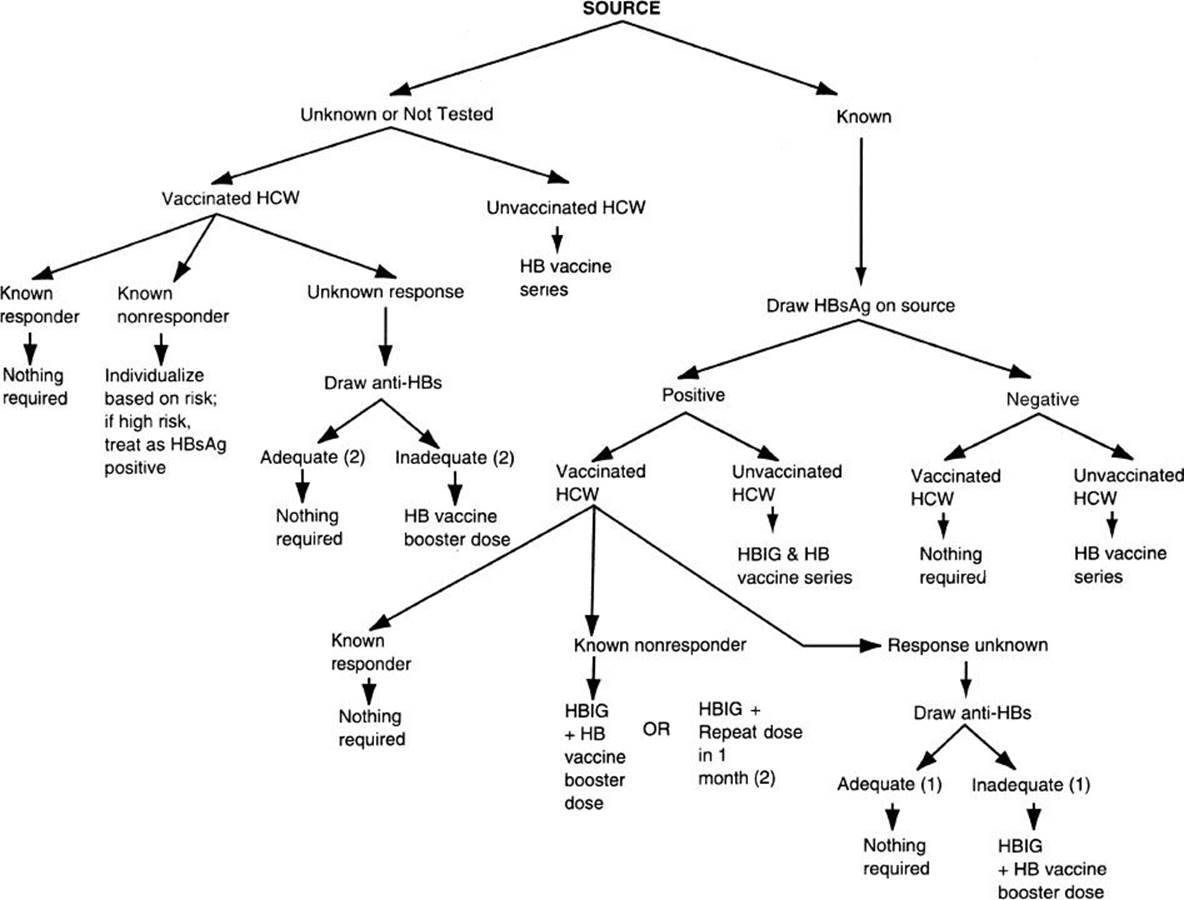
FIGURE 194.1 Hepatitis B exposure algorithm. 1: Adequate antibody ≥10 mIU/mL. 2: Preferred for those who have failed to respond to a second three-dose series of vaccine. (Adapted from CDC. Updated U.S. Public Health Service guidelines for the management of occupational exposures to HBV, HCV, and HIV and recommendations for postexposure prophylaxis. MMWR Morb Mortal Wkly Rep.2001;50(RR-11):22.)
Hepatitis C Virus Exposure
There are currently no agents available for managing exposure of the healthcare worker to HCV (16). Immune globulin is not useful for postexposure prophylaxis of HCV for a number of reasons. In contrast to HBsAb, HCV antibody is only a marker antibody, not a neutralizing antibody. Even if a neutralizing antibody did exist among the donor population, immune globulin is derived from plasma donors that are excluded from donation if they test positive for HCV. Finally, HCV mutates rapidly, and new variants may be unaffected by neutralizing antibodies.
There is currently no vaccine against HCV, as this virus demonstrates great genetic heterogeneity and a high mutation rate. The combination of pegylated interferon and ribavirin is commonly used successfully to treat patients with chronic hepatitis due to HCV (19). Unfortunately, there is currently no postexposure prophylaxis available for HCV, though recently marketed HCV protease inhibitors may play a future role (2). Thus, the use of standard precautions and medical devices with safety features is crucial for preventing HCV exposures (18).
The average risk of acquiring HCV infection after percutaneous exposure is 1.8% and ranges from 0% to 7% (16,18). This risk is similar to the risk of HBV transmission after percutaneous exposure to HBsAg-negative blood. Of those who acquire HCV infection, 55% to 85% will remain infected. The risk of developing cirrhosis ranges between 5% to 25% over periods of 25 to 30 years, and the risk of developing hepatocellular carcinoma is between 1% and 3% per year (19).
Human Immunodeficiency Virus Exposure
ED management of potential exposure to HIV materials consists of serologic testing of the exposed healthcare worker and exposure source, counseling the healthcare worker on the risk for infection, and consideration of postexposure prophylaxis. Though the use of antiviral agents to prevent HIV seroconversion in exposed healthcare workers was once considered highly controversial, an accumulation of evidence supports the use of certain drugs in many cases. The theoretical basis for postexposure prophylaxis is that antiretroviral agents may prevent or limit the replication of HIV in dendritic cells or regional lymph nodes, which appear to be the initial targets and route of spread of HIV (16). Animal studies as well as studies of prophylactic administration of antiretroviral medications to HIV-infected mothers have demonstrated a significant protective effect from initiation of prophylactic antiretroviral treatment (16). Though transmission during pregnancy is different from percutaneous exposure, these data clearly demonstrate that antiviral agents can be used to prevent blood-borne infection in an HIV-negative individual. The most compelling evidence of postexposure prophylaxis efficacy, however, was a multinational case-control study, performed by the CDC (11). In this study of healthcare workers who had HIV exposures, mostly as a result of hollow-bore needlesticks, the risk for HIV infection was reduced by 81% if AZT was given after exposure. These data prompted the Public Health Service in 1998 to first recommend postexposure prophylaxis for healthcare workers exposed to HIV (16). These recommendations were updated and reaffirmed in 2001 and 2005, and a new revision of the CDC guidelines is currently underway (16,20).
Though AZT is the only drug with clinical data supporting its use for HIV postexposure prophylaxis in humans, multidrug regimens are now employed because of concerns about AZT-resistant strains of HIV and a demonstrated synergistic effect of certain antiviral agents in the treatment of patients for AIDS.
There are now six classes of medications that can be used for HIV postexposure prophylaxis. Most commonly used are the nucleoside reverse transcriptase inhibitors and protease inhibitors. Other choices include nonnucleoside reverse transcriptase inhibitors, nucleotide reverse transcriptase inhibitors, integrase inhibitors, and fusion inhibitors (2). Each of these medications has associated risks, including various side effects, drug interactions, and oncogenic or teratogenic potential. The drug regimen chosen depends upon the exposure severity, the suspicion for antiviral resistance in the source, and the exposed patient’s medical history. Expert consultation should be sought to assist with drug selection whenever source resistance is suspected (20). All of the regimens recommend a 28-day course of treatment for a known HIV-positive source or high-risk exposure (2).
When determining whether to initiate postexposure prophylaxis and which agents to choose, the physician must consider a number of factors. The route and severity of exposure help determine the risk of seroconversion and thus the potential benefit of postexposure prophylaxis. If the skin integrity is compromised or if mucous membranes are exposed, transmission is unlikely but can occur. The risk of transmission after a mucous membrane exposure to blood is about 0.1% (1 in 1,000). The risk of transmission can be higher if a large volume of blood is involved or if prolonged contact occurs. The average risk for HIV transmission after percutaneous blood exposure is about 0.3% (1 in 300) but depends on the severity of the exposure (16). Table 194.1 lists the risk factors for HIV transmission after percutaneous blood exposure, as reported in the previously described CDC case-control study (11).
TABLE 194.1
Risk Factors for HIV Transmission after Percutaneous Blood Exposure

The HIV status of the source person is also important when assessing the risk of transmission and choice of antiviral agents. If the source person is currently HIV-negative and has not had a recent retroviral-like illness (symptoms similar to those of acute mononucleosis), postexposure prophylaxis is not indicated. For HIV-positive source persons, the degree of infectivity is related to the patient’s viral load. HIV-positive source patients can be categorized as either lower risk (class 1) or higher risk (class 2). Class 1 patients include those with asymptomatic HIV infection and a viral load of <1,500 RNA copies/mL. Class 2 patients include those with either symptomatic HIV, AIDS, acute seroconversion, or a viral load above 1,500 RNA copies/mL (20).
Based upon the severity of an exposure and the source HIV status (class 1 or 2), either a basic (two-drug) or an expanded (≥three-drug) regimen is recommended by the CDC (20). The most commonly used basic regimencombines AZT and lamivudine (3TC). Other recommended basic regimens are AZT plus emtricitabine (FTC); tenofovir (TDF) plus 3TC; and TDF plus FTC. Alternative basic regimens, to be considered in special circumstances, include 3TC plus stavudine (d4 T); FTC plus d4 T. The preferred expanded regimen, used for higher-risk exposures, is made by adding lopinavir/ritonavir (a combination of two protease inhibitors) to the basic regimen. Alternative expanded regimens, to be considered in special circumstances, can be made by substituting other medications in place of lopinavir/ritonavir. The choices include atazanavir (ATV) ± ritonavir (RTV); fosamprenavir (FOSAPV) ± RTV; indinavir (IDV) ± RTV; saquinavir (SQV) ± RTV, or efavirenz (EFV). Antiviral agents that are generally notrecommended for postexposure prophylaxis include nevirapine (NVP), delavirdine (DLV), abacavir (ABC), and zalcitabine (ddC). Finally, the HIV fusion inhibitor enfuvirtide can be considered for postexposure prophylaxis but only with expert consultation (2,20).
For skin and mucous membrane exposures, the postexposure prophylaxis regimen chosen falls into three general categories (Table 194.3). For small volume exposures (few drops of blood) from an HIV class 1 source, a basic regimen (two drugs) should be considered. If either the exposure is of large volume (major blood splash) or the source is HIV class 2, a basic regimen should be recommended. In cases where there is both a large volume exposure and an HIV class 2 source, an expanded regimen (at least three drugs) should be recommended (20).
At times, emergency physicians need to make postexposure prophylaxis recommendations to patients who have sustained an exposure from either an unknown source (e.g., needle left on an open counter) or, more commonly, from a known source with unknown HIV status. In such circumstances, the need for HIV postexposure prophylaxis should be decided on a case-by-case basis. In cases of an unknown source, postexposure prophylaxis is generally not recommended, but a two-drug regimen should be considered for exposures occurring in an HIV-likely setting (e.g., exposure to a discarded needle on an AIDS ward). For a source of unknown HIV status, rapid HIV testing can be used to quickly determine the need for postexposure prophylaxis (16). Postexposure prophylaxis can be withheld pending HIV test results but only if a 1-hour rapid HIV test is available. Although this test is now used in more than half of academic EDs, it is not available in all practice settings (21). In such circumstances, the decision to start postexposure prophylaxis should be made via discussion of risks and benefits with the exposed person, based upon the source person’s likelihood of HIV infection. Postexposure prophylaxis can always be initiated and then stopped or modified once the source person’s HIV status has been determined (20).
Animal studies have demonstrated that the efficacy of postexposure prophylaxis is related to the time from exposure to initiation of treatment. Potential HIV exposures should be treated as true emergencies, and postexposure prophylaxis should be initiated within 2 hours of exposure if possible (22). It is unclear how long after exposure treatment can be initiated and still be effective, but animal data suggest that some benefits may persist up to 36 hours (22).
Once HIV postexposure prophylaxis has been initiated, medications are optimally administered for a 4-week course. This can be challenging, because adverse symptoms are very common, causing about one-third of healthcare workers to discontinue therapy. Thus, patients should be prescribed medications (e.g., antiemetics, antidiarrheal agents) to mitigate the side effects of the selected treatment regimen. Alternative basic regimens are becoming increasingly popular due to the belief that their more favorable side effect profiles result in better rates of compliance (22,23). The New York State Department of Health AIDS institute currently recommends a three-drug regimen of tenofovir, emtricitabine, and raltegravir for initial postexposure prophylaxis (22). All patients sustaining an HIV exposure should be referred for follow-up and re-evaluation, even if postexposure prophylaxis was not initiated, to allow for counseling, postexposure testing, and medical evaluation. When initiating postexposure prophylaxis, follow-up should probably occur within 72 hours. Prompt follow-up is most important if new information about the source becomes available (e.g., viral load, medication resistance), as this may warrant a change in medication regimen (20).
Summary of Acute Management
Acute management includes thorough washing of the exposed area with soap and warm water or flushing of mucous membranes. As with all wounds, the need for tetanus toxoid administration should be considered. HBIG or hepatitis B vaccine or both should be administered as indicated (Fig. 194.1). HIV postexposure prophylaxis should be recommended based on the exposure type and the source HIV status (see Tables 194.2 and 194.3). The healthcare worker should be counseled regarding the risks of HBV, HCV, and HIV infection and modifications of behavior (e.g., abstinence or condom use) to prevent secondary infection of others.
TABLE 194.2
Recommended HIV Postexposure Prophylaxis for Percutaneous Injuries
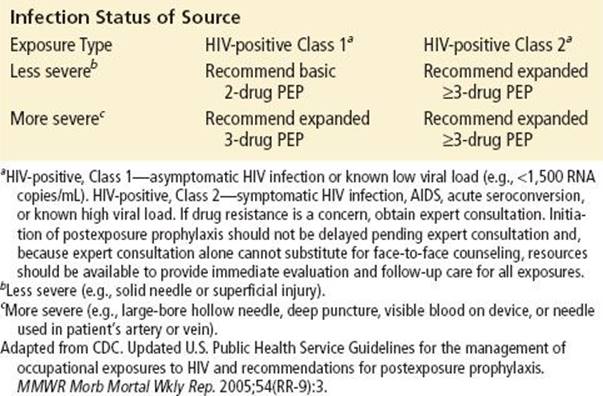
TABLE 194.3
Recommended HIV Postexposure Prophylaxis for Mucous Membrane Exposures and Non-Intact Skin Exposuresa

CRITICAL INTERVENTIONS
• Initiate therapy for post-HIV exposure within 2 hours.
• Administer postexposure prophylaxis HBIG within 72 hours of exposure (preferably within 24 hours) and hepatitis B vaccine within 7 days of exposure and repeated at 1 month and 6 months to unvaccinated healthcare workers who are exposed to an HbsAg-positive source.
Common Pitfalls
• A common error in the management of healthcare worker exposures is to provide either unnecessary or inadequate treatment. Unnecessary treatment usually results from an overestimation of the infectious potential of an exposure, such as providing three-drug antiretroviral therapy for a blood splash onto intact skin. Undertreatment can occur if the treating physician is unaware of the benefit of postexposure prophylaxis or if treatment for HIV exposure is delayed. These pitfalls can be avoided by applying a standardized protocol, such as the algorithms presented here. In uncertain or complex cases, consultation with an employee health service or an infectious disease specialist is advised.
REFERENCES
1. Centers for Disease Control and Prevention. Viral Hepatitis Surveillance, United States, 2010. Available online at http://www.cdc.gov/hepatitis/Statistics/2010Surveillance/PDFs/2010HepSurveillanceRpt.pdf . Accessed on October 5, 2013.
2. Henderson DK. Management of needlestick injuries: A house officer who has a needlestick. JAMA. 2012;307(1):75–84.
3. Daniels DGS, Wasley A. Surveillance for acute viral hepatitis – United States, 2007. MMWR Surveill Summ. 2009;58(3):1–27.
4. Roush SW, Murphy TV, et al. Historical comparisons of morbidity and mortality for vaccine-preventable diseases in the United States. JAMA. 2007;298(18): 2155–2163.
5. Panlilio AL, Orelien JG, Srivastava PU, et al. Estimate of the annual number of percutaneous injuries among hospital-based healthcare workers in the United States, 1997–1998. Infect Control Hosp Epidemiol. 2004;25(7):556–562.
6. Seamon MJ, Ginwalla R, Kulp H, et al. HIV and hepatitis in an urban penetrating trauma population: Unrecognized and untreated. J Trauma. 2011;71(2):306–310.
7. Centers for disease control and prevention (2011). Surveillance of occupationally acquired HIV/AIDS in healthcarepersonnel, as of December 2010. Available online at http://www.cdc.gov/HAI/organisms/hiv/Surveillance-Occupationally-Acquired-HIV-AIDS.html. Accessed on October 5, 2013.
8. Centers for Disease Control and Prevention. Surveillance for acute viral hepatitis United States, 2005. MMWR Morbid and Mortal Wkly Rep. 2007;56(SS-3): 1–24.
9. Chak E, Sherman KE, Schiff ER, et al. Hepatitis C virus infection in USA: An estimate of true prevalence. Liver Int. 2011;31(8):1090–1101.
10. Hall MR, Ray D, Payne JA. Prevalence of hepatitis C, hepatitis B, and human immunodeficiency virus in a Grand Rapids, Michigan emergency department. J Emerg Med. 2010;38(3):401–405.
11. Cardo DM, Culver DH, Ciesielski CA, et al. A case-control study of HIV seroconversion in health care workers after percutaneous exposure. Centers for Disease Control and Prevention Needlestick Surveillance Group. N Engl J Med. 1997;337:1485–1490.
12. Landovitz RJ, Currier JS. Postexposure prophylaxis for HIV infection. N Engl J Med. 2009;361(18):1768–75.
13. Chin RL. Postexposure prophylaxis for HIV. Emerg Med Clin N Am. 2010;28: 421–429
14. Cowan E, Macklin R. Unconsented HIV testing in cases of occupational exposure: Ethics, law and policy. Acad Emerg Med. 2012;19:1181–1187.
15. Centers for Disease Control and Prevention. HBIG Product Information (U.S. Market), updated June 2010. Available online at http://www.cdc.gov/hepatitis/PDFs/HBIG_Products&Distributors.pdf. Accessed on October 5, 2013.
16. Centers for Disease Control and Prevention. Updated U.S. Public Health Service guidelines for the management of occupational exposures to HBV, HCV, and HIV and recommendations for postexposure prophylaxis. MMWR Morbid and Mortal Wkly Rep. 2001;50(RR-11):1–52.
17. Centers for Disease Control and Prevention. Vaccine Price List (April 19, 2013). Available online at http://www.cdc.gov/vaccines/programs/vfc/awardees/vaccine-management/price-list/index.html. Accessed on October 5, 2013.
18. MacCannell T, Laramie AK, Gomaa A, et al. Occupational exposure of health care personnel to hepatitis B and hepatitis C: Prevention and surveillance strategies. Clin Liver Dis 2010;14(1):23–36.
19. Ghany MG, Strader DB, Thomas DL, et al. Diagnosis, management, and treatment of hepatitis C: An update. Hepatology. 2009;49(4):1335–1374.
20. Centers for Disease Control and Prevention. Updated U.S. Public Health Service Guidelines for the management of occupational exposures to HIV and recommendations for postexposure prophylaxis. MMWR Morbid and Mortal Wkly Rep. 2005;54(RR-9):1–17.
21. Ehrenkranz PD, Ahn CJ, Metlay JP, et al. Availability of rapid human immunodeficiency virus testing in academic emergency departments. Acad Emerg Med. 2008;15(2):144–150
22. New York State Department of Health AIDS Institute. HIV prophylaxis following occupational exposure. 1–39. Available online at www.hivguidelines.org. Accessed on October 5, 2013.
23. Gallant JE, DeJesus E, Arribas JR, et al. Tenofovir DF, emtricitabine, and efavirenzs vs. zidovudine, lamivudine, and efavirenz for HIV. N Engl J Med. 2006; 354:251–260