
Samantha L. Rosman
In the United States, with a few exceptions that will be noted, minors (defined as under age 18 in most states) are unable to consent to their own medical care and require a surrogate such as a parent or guardian to consent on their behalf (1). While the majority of children are brought into the emergency department (ED) by their parents and consent is easily obtained, emergency physicians regularly encounter children brought in by an adult who is not a parent or legal guardian, or adolescents who are seeking care on their own. In these situations physicians must decide what care can and should be provided immediately and what care should be withheld until appropriate consent can be obtained.
UNACCOMPANIED MINORS
The American College of Emergency Physicians (ACEP) states in its policy on the treatment of minors that “the evaluation and necessary treatment of a minor in the ED should not be delayed because of consent issues” (2). Indeed, under the federal Emergency Medical Treatment and Active Labor Act (EMTALA), any hospital that receives federal funding for any of its programs must perform an initial medical screening examination (MSE) for every patient seeking treatment. This examination is required regardless of the patient’s ability to pay or the availability of consent for treatment. The screening must determine whether an emergency medical condition exists, defined as life- or limb-threatening, severe pain, or conditions with potential for serious impairment or dysfunction if left untreated (3). A MSE may be as simple as a physician’s examination in triage or may require extensive laboratory testing, imaging, and subspecialty consultation to rule out an emergency medical condition. The ACEP policy also states that an emergency is not only a condition that can cause death or disability but may also include urgent conditions that, if not treated immediately, may result in further complications, pain, fever, disease transmission, etc. (2). Consequently, if the parents of a child with an uncomplicated forearm fracture cannot be reached in a timely manner, physicians can in most cases act in the child’s best interest to reduce and splint the fracture if it will decrease the risk of future complications. The understanding is that a reasonable parent or guardian would consent to emergency care if able to do so. In other words, under these circumstances physicians may act with “implied consent” and invoke the emergency exception rule to parental consent for treatment of an unaccompanied minor (Table 294.1) (1).
TABLE 294.1
Conditions of Emergency Exception Rule

If the emergency exception rule is invoked, the following should be clearly documented in the chart: (1) The emergent nature of the condition, (2) the reason immediate care was required, and (3) the unsuccessful efforts made to obtain consent. Courts are almost universally supportive of physicians in these situations if they are perceived as acting in the child’s best interest (1).
ADOLESCENT CONSENT ISSUES
Many adolescents seen in the ED remain minors in the eyes of the law and thus require parental consent for treatment. There are several situations, however, in which the law allows adolescents to consent for themselves (Table 294.2).
TABLE 294.2
Adolescent “Minors” Able to Consent for Themselves
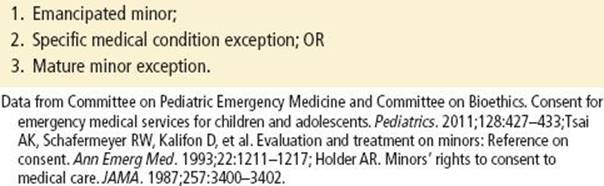
Emancipated minor laws vary by state, and it is important to be familiar with the particular laws that apply. Minors are often defined to be “emancipated” when they (1) are legally married, (2) are economically self-sufficient and not living with parents or guardians, (3) are on active duty military, or (4) are pregnant or a parent themselves. Some states require a court to legally declare a minor emancipated rather than allowing circumstances alone to define the minor’s status (1,2,4).
Most states allow minors to consent on their own for care for specific medical conditions such as drug or alcohol abuse, mental health issues, sexually transmitted infection testing and treatment, or pregnancy-related issues (1,4). The specific situations vary as to where, and the ages at which, minor consent is allowed for these or similar conditions.
Most states also provide for a mature minor exception. Although in some jurisdictions the court must declare such an exception, the physician is empowered to make the decision in others. A mature minor is generally an adolescent—age 14 or older—with the maturity and capacity to understand the risks and benefits of a proposed treatment and the ability to make a reasonable decision after considering the information given. Generally, in cases where the physician is empowered to decide whether the minor is mature, the treatment must (1) be to the minor’s benefit, (2) be acutely necessary, and (3) not involve serious risks (1,4).
ADOLESCENT CONFIDENTIALITY
Confidentiality from parents is often a very important issue for adolescents seeking care of their own accord. On the federal level, The Health Insurance Portability and Accountability Act (HIPAA) Privacy Rule protects the confidentiality of personal health information from disclosure to third parties. Under HIPAA, however, parents or guardians are considered representatives for their minor children and thus generally have access to their children’s health information. There are two major exceptions. First, a parent can agree to a confidential relationship between the physician and the adolescent, thereby transferring the right of disclosure to the minor. Second, the parent can lose the right to the minor’s health information in cases in which the state law does not require parental consent for treatment (5,6).
Except for information protected from disclosure by the federal Family Planning Act (FPA), the issue of parental access to a minor’s health information is not otherwise covered by federal law (1). Consequently, adolescent consent issues are governed by state law. Some states explicitly require parental notification—depending on the circumstances—while others specifically guarantee confidentiality in cases that permit adolescent consent. Once again, it is critical for physicians to be familiar with applicable parental disclosure and confidentiality laws in the jurisdictions in which they practice.
Physician must be honest and candid with their adolescent patients as to what can be kept confidential and what cannot (see Chapter 289). In most states, parents have a legal right to request their minor child’s medical record unless the parents’ possession of the records would put the child in danger or the parent has previously agreed to waive the right to such access. In addition, parents, as the primary insurance holders, often receive bills for services that may disclose diagnoses, procedures, or other aspects of the adolescent’s care that may at least partially betray confidentiality. Thus, confidentiality can often only be reliably maintained if the adolescent takes on financial accountability for his or her care, and it is important to identify a confidential way of contacting the patient with the results of pending studies or the need for return visits (1,2).
PARENTAL REFUSAL OF TREATMENT
Parents and guardians generally have the authority to make decisions on behalf of their children and, therefore, to consent to or refuse medical care. In most cases, the parents’ decision should be honored, but parental authority is not absolute and is limited by parents’ duty to ensure the safety and health of their children. If the parent or guardian acts in such a way that the child’s health, well-being or life is in jeopardy, the state may intervene under the doctrine of parens patriae. Based on society’s obligation to protect its most vulnerable members, this doctrine grants the state the right to act in loco parentis, in place of the parent, when it is necessary to protect the life and health of those who cannot take care of themselves, including children (1,2,7,8).
The issue often arises with parents of certain religious groups that are opposed to lifesaving medical interventions. For example, this occurs when Jehovah’s Witnesses refuse blood products for their children. In the United States, Jehovah’s Witness parents often argue that they have the right to refuse blood on their child’s behalf under the Free Exercise Clause of the First Amendment. However, American courts have almost universally ruled in favor of child welfare and have rejected the First Amendment argument in these circumstances. The majority of courts hold that while the freedom to believe is absolute, the right to practice religion freely does not include the right to put a child at risk of serious illness, injury, or death (8).
Similarly, when the state determines medical neglect, it can act in loco parentis and assume temporary custody to authorize medical care if this is being done to protect the “health or safety of the child” (1,8–12).
If a physician believes that a parent’s decision places a child’s life or health in significant danger, every effort should be made to persuade the parent to consent to the proposed lifesaving treatment. If this is unsuccessful, or the situation does not allow for delay, the physician may need to notify both the police and child protective services and have the child placed in temporary protective custody. In these cases, the doctrine of parens patriae allows the state to interfere on behalf of the child’s welfare. Such authorization extends only to conditions that are serious or life-threatening (1,2,8).
SUSPECTED CHILD ABUSE AND NEGLECT
In cases where there is suspected child abuse or neglect and the parents refuse to consent to evaluation and treatment, the physician’s primary duty is to protect the child’s safety and well-being. In addition to the mandated reporting of the suspected abuse or neglect, the physician will need to involve state child protective services or local law enforcement to obtain parens patriae consent to evaluation and treatment (1,2).
REFERENCES
1. Committee on Pediatric Emergency Medicine and Committee on Bioethics. Consent for emergency medical services for children and adolescents. Pediatrics. 2011;128;427–433.
2. Tsai AK, Schafermeyer RW, Kalifon D, et al. Evaluation and treatment on minors: Reference on consent. Ann Emerg Med. 1993;22:1211–1217.
3. Emergency Medical Treatment and Labor Act, 42 U.S.C. §1395 dd(a) (2003).
4. Holder AR. Minors’ rights to consent to medical care. JAMA. 1987;257:3400–3402.
5. Health Insurance Portability and Accountability Act of 1996 (HIPAA), 42 U.S.C. §1320 d et seq.
6. McGuire AL, Bruce CR. Keeping children’s secrets: Confidentiality in the physician-patient relationship. J Health Law. 2008;8(2):315–333.
7. Diekema DS. Parental refusals of medical treatment: The harm principle as threshold for state intervention. Theor Med Bioeth. 2004;25:243–264.
8. Woolley S. Children of Jehovah’s Witnesses and adolescent Jehovah’s Witnesses: What are their rights? Arch Dis Child. 2005;90:715–719.
9. U.S. Const. amend. I (“Congress shall make no law respecting an establishment of religion, or prohibiting the free exercise thereof.…”).
10. American Academy of Pediatrics Committee on Bioethics. Religious objections to medical care. Pediatrics. 1997;99;279–281.
11. Prince VM. 321 U.S. 158 1944 (emphasis added).
12. Wisconsin VY. et al., 406 U.S. 205, 233–34 1972 (emphasis added).