
Marco L.A. Sivilotti
Nonsteroidal anti-inflammatory drugs (NSAIDs) are a heterogeneous group of agents that have anti-inflammatory, analgesic, and antipyretic activity. There are a variety of NSAIDs, which can be classified by target specificity and structure (Table 304.1). With widespread use and over-the-counter availability, it is not surprising that NSAIDs constitute one of the most common medications encountered in intentional overdose. Three-fourths of these ingestions involve ibuprofen, the first nonsalicylate NSAID to be approved for over-the-counter use in the United States. Despite their frequency, most NSAID overdoses result in minimal symptoms, and death is rare. Major complications such as gastrointestinal (GI) bleeding during therapeutic use are a much greater health problem.
TABLE 304.1
Pharmacokinetics of NSAIDs after Therapeutic Doses

The primary pharmacologic effects of NSAIDs result from the inhibition of cyclooxygenase (COX), the enzyme family involved in the initial step of prostaglandin (PG) synthesis. Two isoforms, termed COX-1 (constitutive) and COX-2 (inducible), have been identified. Because the anti-inflammatory properties of NSAIDs result primarily from COX-2 inhibition, NSAIDs with selective COX-2 inhibition were developed with the promise of fewer side effects (1), but some of these agents were subsequently withdrawn due to increased cardiovascular risk. In overdose, selectivity for COX-2 may be lost, and the acute toxicity resembles that of nonselective NSAIDs.
Inhibition of COX shunts arachidonic acid to leukotrienes, at times precipitating severe allergic reactions. The adverse GI effects of gastritis and ulceration result from the inhibition of PGD2, PGE2, and PGF2, which maintain the gastric mucosal barrier, and direct irritation. Acute renal failure with salt and water retention is attributed to inhibition of PGI2 and PGE2, which have vasodilatory and natriuretic activity in the kidney (2). The cardiovascular toxicity of the selective COX-2 agents appears to result from decreased PGI2 in the vascular endothelium (COX-2), coupled with minimal effects on platelet thromboxane A2 (COX-1).
Most NSAIDs are rapidly and almost completely absorbed (3). They are weak acids with pKa values ranging from 3.5 to 5.6 and have small volumes of distribution (0.08 to 0.4 L/kg) from extensive protein binding (celecoxib, at 6 L/kg, is an exception). Elimination is primarily via hepatic CYP2 C, with subsequent renal excretion of glucuronide conjugates. As much as 50% of ketorolac and 30% of indomethacin is excreted unchanged in the urine (3). Only small quantities (<10%) of other NSAIDs are excreted unchanged in the urine, limiting the efficacy of urinary alkalinization in promoting elimination. Indomethacin, sulindac, etodolac, phenylbutazone, meloxicam, and piroxicam undergo enterohepatic recirculation. The renal clearance of naproxen and oxaprozin is increased at high plasma concentrations owing to saturation of protein binding. Phenylbutazone exhibits dose-dependent Michaelis–Menten elimination. Pharmacokinetic data are summarized in Table 304.1.
Except for pyrazolones and fenamic acids, NSAIDs seldom cause serious toxicity, even in large doses (4). There is inadequate information to determine the minimum toxic or lethal dose for most NSAIDs. In a series of ibuprofen overdoses, all children who ingested <100 mg/kg remained asymptomatic, whereas those who ingested >400 mg/kg were at risk of developing significant toxicity (5). In adults, the correlation between the amount ingested and subsequent development of symptoms was poor, with those ingesting between 6 and 54 g of ibuprofen at risk for potentially serious toxicity (6). In contrast, seizures have been reported with mefenamic acid ingestions of as little as 2.5 g in a 12-year-old child (4). Phenylbutazone has caused death with as little as 2 g in a 1-year-old child and 2.5 g in an alcoholic adult (4,7).
CLINICAL PRESENTATION
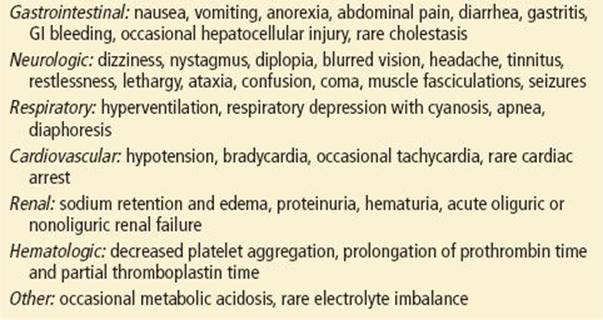
Most patients remain asymptomatic or develop only mild GI or neurologic symptoms following acute overdose. Specific signs and symptoms are summarized in Table 304.2. Death is rare and usually results from secondary complications such as aspiration or sepsis. In the absence of acute renal failure or secondary complications, full recovery can be expected within 6 to 24 hours. The elderly are more likely to develop adverse effects with therapeutic doses and toxicity with overdoses.
TABLE 304.2
Signs and Symptoms of Nonsteroidal Anti-Inflammatory Drug Overdose
In contrast, the pyrazolones and fenamic acids can cause severe toxicity. Phenylbutazone and its active metabolite oxyphenbutazone can cause coma, seizures, dysrhythmias, cardiogenic shock, respiratory alkalosis, and metabolic acidosis (4,8,9). Tinnitus, deafness, and a rash may be present. Hepatic necrosis, without other symptoms, may develop 24 hours after overdose. A red discoloration of the urine caused by the metabolite rubazonic acid may be observed. Mefenamic acid can cause muscle twitching and tonic–clonic seizures within 12 hours of ingestion (4). Respiratory and cardiac arrest may follow seizures.
Propionic and acetic acid derivatives are associated with relatively low toxicity. Of these agents, fenoprofen appears to be the most toxic (4). Metabolic acidosis after ibuprofen overdose is probably caused by high levels of the acidic parent drug and metabolites (10). Indomethacin frequently causes headaches and tinnitus, even at therapeutic doses.
After piroxicam overdose, dizziness with blurred vision and brief coma are reported (4). Because of the long elimination half-life of piroxicam, overdose symptoms can be prolonged. Multisystem toxicity (with GI, neurologic, renal, hepatic, and hematopoietic effects) was noted in a 2-year-old child who ingested 100 mg of piroxicam (11). Prolonged toxicity should be anticipated after overdose of oxaprozin and nabumetone, which also have long half-lives. NSAID plasma levels are not routinely available and are not necessary for the treatment of acute ingestion (5).
DIFFERENTIAL DIAGNOSIS
The diagnosis of NSAID overdose is made on the basis of history and the exclusion of other etiologies. The possibility of acetaminophen, colchicine, and salicylate ingestion should be considered in patients with overdose of an unknown arthritis medication or analgesic.
The central nervous system (CNS) depression that occurs with NSAID overdose is usually mild; coma unresponsive to stimulation is uncommon. Deep coma, marked hypotension, and severe respiratory depression suggest the presence of other drugs. The high anion-gap metabolic acidosis caused by ibuprofen is relatively mild and short-lived compared with that caused by salicylates, ethylene glycol, and methanol (10).
ED EVALUATION
A detailed history including available medications may provide the only clue to NSAID overdose. The amount and time of ingestion and the onset, nature, and progression of symptoms should be noted. The physical examination should include complete vital signs, oxygen saturation measurement, and assessment of mental status and cardiorespiratory function. Evaluation for occult GI bleeding should be considered for patients with abdominal pain.
Accidental ingestions of a nontoxic dose need no laboratory testing. For symptomatic patients, those with underlying kidney dysfunction, and the elderly, a urinalysis, blood urea nitrogen (BUN) and creatinine, electrolytes and glucose, and perhaps a complete blood count (CBC) should be obtained. Etodolac may cause a false-positive urine bilirubin and a false-positive urine ketone test on dipstick. Although the time of onset of renal failure is poorly defined, urinalysis, serum BUN, and creatinine may be useful in adults who ingest >6 g of ibuprofen (5). Arterial or venous blood gases should be monitored in patients with significant mental status changes or respiratory depression. After pyrazolone overdose, liver function tests should be obtained. As with other ingestions, serum acetaminophen and possibly salicylate concentrations should be measured in patients with intentional overdose. Toxicology screens of urine and blood rarely detect or correctly identify most NSAIDs other than salicylates and are not useful.
KEY TESTING
• There are no specific tests for NSAID overdose.
• Symptomatic patients, those with underlying kidney dysfunction, and the elderly may need a urinalysis, CBC, electrolytes with anion gap, BUN, creatinine, glucose.
ED MANAGEMENT
Management consists of supportive care. The rare severely ill patient may need mechanical ventilation, especially if respiratory acidosis is present. Hypotension can be managed with intravenous crystalloids. Vasopressors are seldom necessary. Benzodiazepines should be given for seizures. Sodium bicarbonate should be given to patients with significant metabolic acidosis. GI bleeding should be treated by standard measures. Coagulopathy can be corrected by administering fresh-frozen plasma and vitamin K1.
Activated charcoal should be considered in patients with recent intentional overdose of more than 10 therapeutic doses, and children who present within 4 hours of accidentally ingesting more than 5 adult doses (8). Fenamic acids or pyrazolones may cause serious toxicity with even a twofold overdose, and decontamination is appropriate for all these patients. Multiple-dose activated charcoal (MDAC) therapy has not been studied with most NSAIDs. Although the elimination half-life of therapeutic doses of phenylbutazone was decreased by 30% using MDAC (12), the effectiveness of this treatment is likely to be minimal, even for NSAIDs that undergo enterohepatic recirculation. Because most NSAIDs are highly protein-bound and rapidly metabolized, diuresis or dialysis is not useful, except perhaps for severe phenylbutazone poisoning.
CRITICAL INTERVENTIONS
• Establish intravenous access, initiate cardiac monitoring, and provide supportive care as clinically indicated.
• Consider other ingestions, including acetaminophen and salicylates, in patients with intentional overdose.
DISPOSITION
Most patients will be observed for 4 to 6 hours after ingestion or until minor symptoms resolve and then are discharged (5,8). After the ingestion of fenamic acids or pyrazolones, symptomatic patients should be monitored for at least 12 hours. Patients with coma, respiratory depression, seizures, or renal failure should be admitted to a medical intensive care unit.
Patients with an abnormal urinalysis or underlying renal dysfunction should have follow-up kidney function tests. A CBC and kidney and liver function tests should be repeated 24 to 48 hours after pyrazolone overdose. Follow-up liver function tests should be obtained in symptomatic piroxicam overdose patients.
Transfer would rarely be necessary. If acute renal failure develops, a nephrologist should be consulted. Intentional ingestions should be evaluated for ongoing suicidal risk.
Common Pitfalls
• Failure to consider other ingestions in patients with significant CNS depression, metabolic acidosis, or vital sign abnormalities.
• Failure to consider acetaminophen, salicylate, or colchicine ingestion in patients who overdose on an unknown arthritis medicine.
• Failure to appreciate that phenylbutazone and mefenamic acid can cause serious toxicity after overdose.
ACKNOWLEDGMENT
The author gratefully acknowledges the contributions of Paula L. Townsend as author of this chapter in previous editions.
REFERENCES
1. Fitzgerald GA. Coxibs and cardiovascular disease. N Engl J Med. 2004;351(17):1709–1711.
2. Perazella MA. Drug-induced renal failure: Update on new medications and unique mechanisms of nephrotoxicity. Am J Med Sci. 2003;325(6):349–362.
3. Brater DC. Clinical pharmacology of NSAIDs. J Clin Pharmacol. 1988;28(6):518–523.
4. Court H, Volans GN. Poisoning after overdose with non-steroidal anti-inflammatory drugs. Adverse Drug React Acute Poisoning Rev. 1984;3(1):1–21.
5. Hall AH, Smolinske SC, Kulig KW, et al. Ibuprofen overdose–A prospective study. West J Med. 1988;148(6):653–656.
6. Marciniak KE, Thomas IH, Brogan TV, et al. Massive ibuprofen overdose requiring extracorporeal membrane oxygenation for cardiovascular support. Pediatr Crit Care Med. 2007;8(2):180–182.
7. Okonek S, Reinecke HJ. Acute toxicity of pyrazolones. Am J Med. 1983;75(5 A):94–98.
8. Vale JA, Meredith TJ. Acute poisoning due to non-steroidal anti-inflammatory drugs. Clinical features and management. Med Toxicol. 1986;1(1):12–31.
9. Virji MA, Venkataraman ST, Lower DR, et al. Role of laboratory in the management of phenylbutazone poisoning. J Toxicol Clin Toxicol. 2003;41(7):1013–1024.
10. Linden CH, Townsend PL. Metabolic acidosis after acute ibuprofen overdosage. J Pediatr. 1987;111(6 Pt 1):922–925.
11. MacDougall LG, Taylor-Smith A, Rothberg AD, et al. Piroxicam poisoning in a 2-year-old child. A case report. S Afr Med J. 1984;66(1):31–33.
12. Neuvonen PJ, Elonen E. Effect of activated charcoal on absorption and elimination of phenobarbitone, carbamazepine and phenylbutazone in man. Eur J Clin Pharmacol. 1980;17(1):51–57.