
Jennifer Cullen and Richard F. Clark
Dystonic reactions are seldom life-threatening, but the discomfort of the bodily contortions and panic that can develop prompt the victim to seek help in the emergency department (ED).In addition, iatrogenic dystonic reactions and akathisia are common with the administration of antiemetic and antipsychotic medications in the ED. These effects appear early and are reversible with reduction or discontinuation of the offending agent. Tardive dyskinesia refers to the sometimes irreversible involuntary movements that develop later and results from withdrawal of the antipsychotic agent. Primary dystonia, abnormal movements that occur spontaneously in the absence of drug treatment, is a separate neurologic diagnosis with similar manifestations. Dystonias may begin at any age, for both the primary and secondary or drug-induced types (1).
Dystonias of all types likely result from an abnormality in neurotransmitter function in the basal ganglia. Proposed mechanisms include (a) direct blockade of central dopaminergic receptors, (b) an imbalance of dopamine and acetylcholine, resulting in excessive cholinergic activity, and (c) a combination of dopamine blockade and dopamine activation in the nigrostriatal system (2). Dopamine synthesis and release increase in response to an initial blockade of dopamine receptors. A single dose of an antipsychotic drug increases the sensitivity of dopamine receptors for 24 to 48 hours after drug administration. This occurs at a time when plasma and red blood cell drug concentrations are usually falling. Therefore, enhanced dopamine release, occurring simultaneously with the unblocking of supersensitive receptors, may result in acute dystonias.
The true prevalence of acute dystonic reaction is unknown, but is estimated to occur in 2.3% to 60% of patients treated with typical antipsychotic agents, and 2% to 3% of patients treated with atypical antipsychotics (3). Most acute dystonic reactions occur within 5 days of starting therapy with neuroleptics and are more common in men than in women. Although less common, dystonias have been reported with other neurologic agents such as lamotrigine (4).
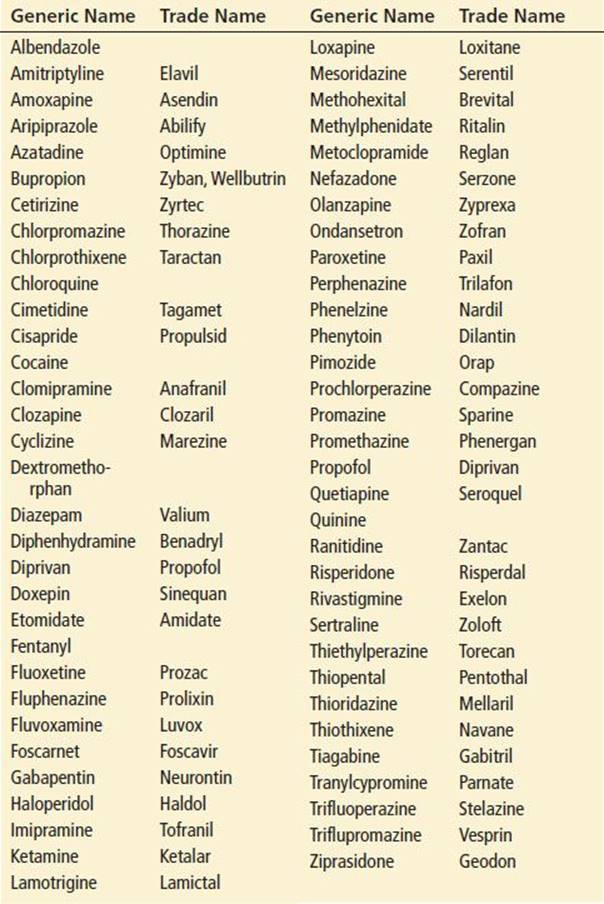
Symptoms seem to develop earlier with haloperidol than other neuroleptics. The development of a dystonic reaction depends more on individual susceptibility than on the chemical structure, milligram potency, dosage, or duration of treatment. The drugs currently known or suspected to produce acute dystonic reactions are listed in Table 340.1.
TABLE 340.1
Drugs Reported or Suspected to have Caused Acute Dystonic Reactions
Although also seen in the elderly, patients younger than age 15, those with a family history of dystonia, and a history of drug or alcohol use are at greatest risk of developing drug-induced dystonias (5).
Akathisia is an uncomfortable condition of motor restlessness and agitation that occurs in association with the same drugs that induce dystonic reactions and probably with the same pathophysiology. Prochlorperazine (Compazine), commonly used as an antiemetic and for the treatment of migraine, frequently induces akathisia. When patients are carefully monitored for signs and symptoms, prochlorperazine may induce akathisia in up to 44% of patients within 1 hour of administration and, in a few percent more, in a delayed fashion up to 48 hours later (6). The rate of IV administration (15-minute infusion vs. 2-minute bolus) does not appear to significantly affect the incidence of akathisia. The use of adjuvant diphenhydramine (50 mg IV) in association with prochlorperazine (10 mg IV) reduces the incidence of akathisia from 36% to 14% in one study but also causes more sedation (7). Akathisia and dystonia are rarely reported with ondansetron (8).
CLINICAL PRESENTATION
Any striated muscle group may be involved in a dystonic movement. Blepharospasm, progressing to oculogyric crisis, is the most common form of dystonia in the upper face. It usually begins with increased blinking of the eyelids. In the lower face, the muscles of the pharynx and tongue are most commonly involved. Oromandibular dystonia describes the involvement of any combination of the jaw muscles. Specifically, mandibular dystonia is manifested as a pulling down or up of the jaw, and lingual dystonia is either a sustained protrusion of the tongue or an upward deflection so that the tongue curves and touches the hard palate. In the neck, torticollis is most common, although retrocollis and anterocollis may also occur. In most cases, the shoulder is elevated on the side toward which the chin is pointing. Jerking, rhythmic movements of the head may also occur. When the trunk is involved, twisting movements and postures such as lordosis, scoliosis, kyphosis, tortipelvis, and opisthotonos develop. Dystonic movements may begin focally but become segmental as they spread in a contiguous manner. Generalized dystonia refers to involvement of the leg plus other body parts, with or without the trunk. Dystonic movements are usually continual, repetitive, and twisting, varying in speed from rapid to slow and being sustained from seconds to minutes at the height of the involuntary contraction.
The prognosis is excellent for patients with drug-induced dystonias when promptly and correctly treated. While the symptoms can result is significant distress and anxiety, the vast majority of patients will improve with treatment. Though rare, cardiorespiratory arrest and death have been reported in acute drug-induced laryngeal dystonia (2).
DIFFERENTIAL DIAGNOSIS
Dystonic reactions have been misdiagnosed as generalized anxiety, hysterical conversion, tetanus, and even seizure disorders. Children with such abnormal movements have been thought to have encephalitis or meningitis (9). Strychnine poisoning and the choreiform movements sometimes seen with sympathomimetic abuse (“crack dancing”) or with rheumatic fever may appear similar to dystonic reactions as well. Some rigid patients with serotonin syndrome may also appear dystonic.
Patients taking antipsychotic agents are also at risk for neuroleptic malignant syndrome (NMS), which presents with muscle rigidity that may be mistaken for a dystonic reaction. It is critical to distinguish this life-threatening condition from acute dystonia. For further discussion of NMS, please see Chapter 338.
ED EVALUATION
The patient, family, or friends should be asked about the recent use of medications. Physical examination is remarkable for typical abnormal posturing or movements. Response to antimuscarinic treatment supports the diagnosis.
KEY TESTING
• There is no relevant laboratory or imaging testing for dystonic reactions.
ED MANAGEMENT
As dystonic reactions are not usually associated with an acute drug overdose, gastrointestinal decontamination is not necessary. Administration of an antimuscarinic medication rapidly reverses the symptoms of dystonia in most cases, presumably because of restoration of the cholinergic–dopaminergic balance in nigrostriatal neurons. Diphenhydramine (Benadryl) and benztropine mesylate (Cogentin) are the two medications most frequently used. IV administration is preferable to IM or oral administration and symptoms typically abate within 2 minutes and completely resolve within 15 minutes when the IV route is used. Muscle relaxation begins within 30 minutes but may not be complete for 90 minutes when the treatment is given IM or orally. Benztropine has been advocated over diphenhydramine because of less sedation and more rapid improvement of both objective and subjective findings, regardless of route of administration. Diphenhydramine should be used in children younger than age 3, as the greater antimuscarinic effects of benztropine are considered contraindicated in children this age, who may be more sensitive. Drowsiness should be anticipated as a side effect of antimuscarinic drug administration, especially with diphenhydramine.
After reversal of the reaction, some clinicians advocate an oral agent be continued for 72 hours to prevent a relapse (10). However, extended therapy may not be needed in all cases.
The usual dose of benztropine is 1 to 2 mg for adults and 0.02 to 0.05 mg/kg for children age 3 years or older, given IV over 2 minutes, followed by the same dose orally twice a day for 3 days if needed. The dose of diphenhydramine is 50 to 100 mg for adults and 1 to 2 mg/kg for children, given IV over 2 minutes, followed by 12.5 to 50.0 mg orally three or four times a day for 3 days if needed. Some patients may require more than one dose of IV medication to control the reaction.
Rare cases of dystonia may not respond to antimuscarinic therapy, and benzodiazepines should be used as a second-line agent. Unlike diphenhydramine and benztropine, side effects from the benzodiazepines are limited to drowsiness. Antimuscarinic sequelae such as dry mouth, blurred vision, and urinary retention are not expected. Although any benzodiazepine should be effective, diazepam and lorazepam are favored because of their longer duration of action. Diazepam can be administered IV in 5-mg increments every 5 minutes as needed for reversal, or lorazepam 2 mg IV may be given every 5 minutes as needed.
Prophylactic use of benztropine and diphenhydramine has reduced the incidence of dystonic reactions in patients receiving either antiemetic or antipsychotic medications (10). Sedation may be increased, however, and should be considered.
CRITICAL INTERVENTIONS
• Recognize acute dystonia as an adverse drug reaction rather than another medical or psychiatric disorder.
• Treating dystonic reactions with antimuscarinic medications, such as benztropine or diphenhydramine, can be diagnostic and therapeutic.
• Prescribe oral antimuscarinic medication for 3 days after acute treatment to prevent relapse.
DISPOSITION
The patient may be discharged after the acute dystonia resolves. Notifying the prescribing psychiatrist may be advisable if the patient is to remain on neuroleptic medication. When antimuscarinics are prescribed, patients should be advised not to drive or perform potentially dangerous activities for 72 hours. They should be instructed to return if symptoms recur.
Common Pitfalls
• Dystonic reactions may be delayed 12 to 24 hours from the time of drug ingestion.
• Dystonic reactions are not usually from an overdose; so gastrointestinal decontamination is seldom indicated and may be dangerous in patients with head or neck involvement.
ACKNOWLEDGMENTS
The authors gratefully acknowledge the contributions of Megan Demott, Michael C. Young, to previous editions of this chapter.
REFERENCES
1. Tarsy D, Simon DK. Dystonia. N Engl J Med. 2006;355(8):818–829.
2. Yagmur F, Ulusoy HB, Buyukoglan H, et al. Acute respiratory distress due to antipsychotic drugs. Pharmacopsychiatry. 2010;43(3):118–119.
3. Burkhard PR. Acute and subacute drug-induced movement disorders. Parkinsonism Relat Disord. 2014;20(suppl 1):S108–S1012.
4. Veerapandiyan A, Gallentine WB, Winchester SA, et al. Oculogyric crises secondary to lamotrigine overdosage. Epilepsia. 2011;52(3):e4–e6.
5. Kasten M, Bruggemann N, Konig IR, et al. Risk for antipsychotic-induced extrapyramidal symptoms: Influence of family history and genetic susceptibility. Psychopharmacology (Berl). 2011;214(3):729–736.
6. Drotts DL, Vinson DR. Prochlorperazine induces akathisia in emergency patients. Ann Emerg Med. 1999;34:469–475.
7. Vinson DR, Drotts DL. Diphenhydramine for the prevention of akathisia induced by prochlorperazine: A randomized, controlled trial. Ann Emerg Med. 2001;37:125–131.
8. Patka J, Wu DT, Abraham P, et al. Randomized controlled trial of ondansetron vs. prochlorperazine in adults in the emergency department. West J Emerg Med. 2011;12(1):1–5.
9. Arumugam J, Vijayalakshmi AM. Metoclopramide-induced oculogyric crisis presenting as encephalitis in a young girl. Indian J Pharmacol. 2012;44(2):266–267.
10. Pierre JM. Extrapyramidal symptoms with atypical antipsychotics: Incidence, prevention and management. Drug Saf. 2005;28(3):191–208.