|
|
|
Rectal bleeding |
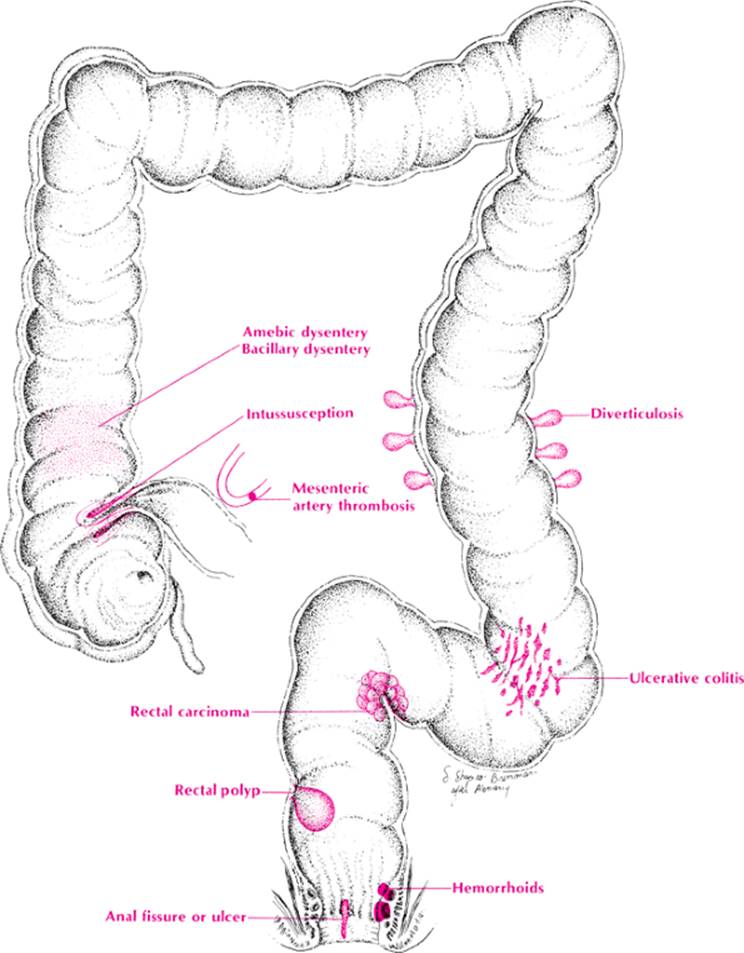
This discussion considers the causes of bright red or maroon stools. (The causes of melena or black stools are the same as the causes of hematemesis; the differential diagnosis is given on page 215.) Bright-red blood may occasionally result from an upper GI lesion if there is associated diarrhea.
A list of the causes of rectal bleeding of fresh blood is best developed with the use of the mnemonic VINDICATE.
· V—Vascular conditions prompt the recall of hemorrhoids, but one cannot forget mesenteric infarctions.
· I—Inflammation suggests perirectal abscess, anal fissure or ulcer, amebic colitis, or condyloma latum and acuminatum.
· N—Neoplasms call to mind polyps and carcinomas of the rectum and anus.
· D—Degenerative disorders do not suggest anything in particular.
· I—Intoxication suggests pseudomembranous colitis complicating gentamicin, clindamycin, and other antibiotic therapy. Jejunal ulcers from potassium chloride tablets should be considered here.
· C—Congenital and acquired anomalies suggest fistula in ano, bleeding Meckel diverticulum, and bleeding colonic diverticula, among other congenital conditions. Intussusception would fall in this category also.
· A—Autoimmune diseases recall granulomatous colitis and ulcerative colitis.
· T—Trauma suggests the bleeding from any foreign body inserted into the rectum, including the male organ.
· E—Endocrine disorders do not suggest anything other than the Zollinger–Ellison syndrome, which, because it causes ulceration of the jejunum, may be associated with maroon stools.
In disorders of the upper colon and small intestines, the blood is older and thus a maroon color is likely. In addition, the blood is mixed with the stool and may indeed be so well mixed that it will not be discovered without a test for occult blood. Other features are more prominent in bacillary dysentery and salmonellosis.
Approach to the Diagnosis
Armed with a more comprehensive list of causes of rectal bleeding, the clinician is ready to eliminate some of them as he or she asks appropriate questions during the history and performs the examination with all the causes in mind. The diagnosis may be pinned down by the presence or absence of other symptoms and signs. The principal diagnostic procedures are stool cultures, stool examination for ova and parasites, proctoscopy, barium enema, and colonoscopy.
Other Useful Tests
1. CBC (infection)
2. Urinalysis (systemic disease)
3. Sedimentation rate (infection, granulomatous, or ulcerative colitis)
4. Chemistry panel (liver disease)
5. Frei test (lymphogranuloma venereum)
6. Rectal biopsy (colitis, neoplasm)
7. Small-bowel series (neoplasm)
8. Angiogram (mesenteric thrombosis)
Case Presentation #77
A 72-year-old white woman presents to your office with the chief complaint of blood in her stool for several weeks. She also has noted intermittent constipation and diarrhea during that time. She denies painful bowel movements.
Question #1. Utilizing the mnemonic VINDICATE, what is your differential diagnosis?
General physical examination was unremarkable. Rectal examination failed to reveal the cause of her rectal bleeding, but the stool was positive for occult blood. A barium enema revealed a napkin ring constriction in the sigmoid colon.
Question #2. What is your diagnosis now?