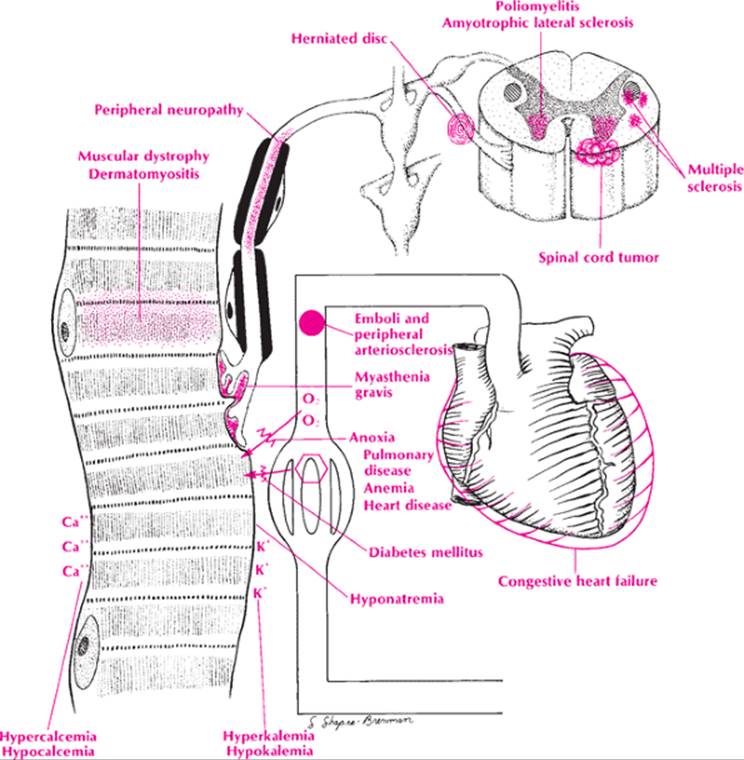
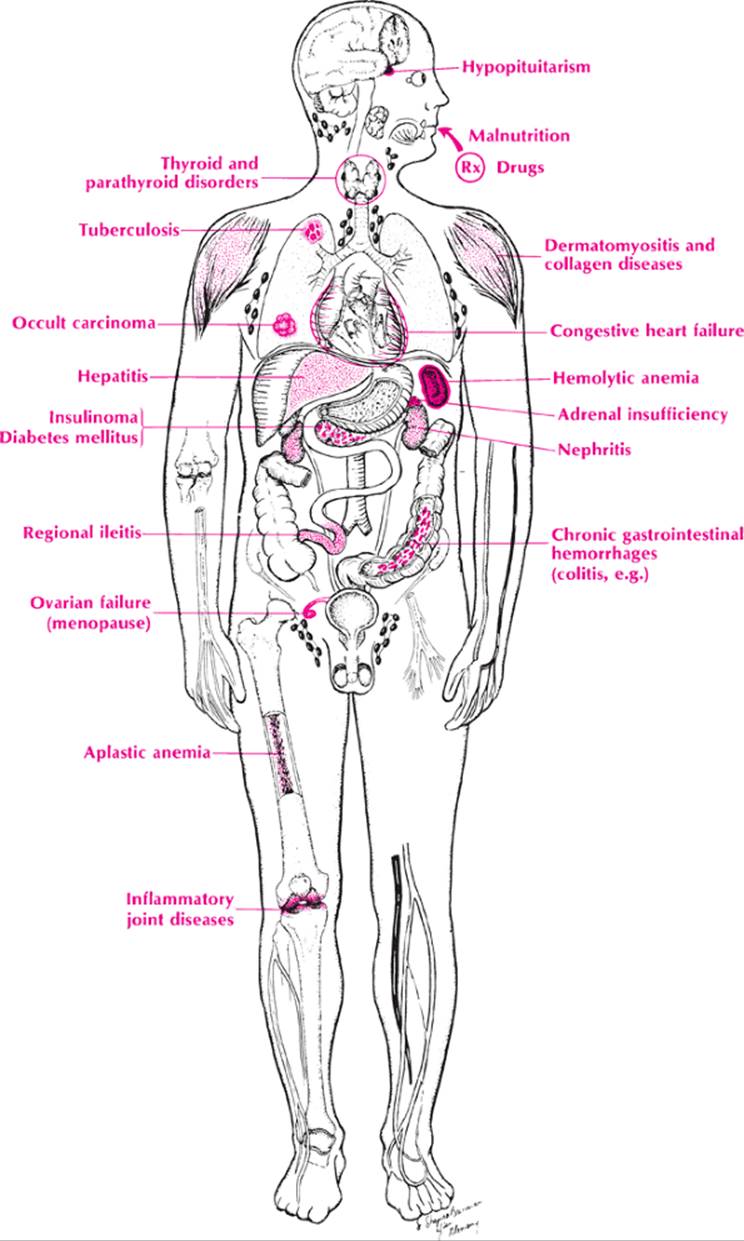
The analysis of the causes of weakness depends on a knowledge of both anatomy and biochemistry. Strength depends on an intact healthy muscle, peripheral nerve, and lower and upper motor neuron pathways and a functioning myoneural junction. Thus, general weakness may develop in muscle disease(analyzed according to etiologic categories in Table 60), myoneural junction disease (myasthenia gravis), peripheral neuropathies (Table 60), anterior horn disease (poliomyelitis, lead poisoning, and spinal muscular atrophy), and diffuse disease of the pyramidal tracts, such as multiple sclerosis. Parkinson disease fatigues the muscles by the tremor and spasticity it induces.
However, this is only half the story. A muscle cannot be strong unless there is adequate intake and absorption of glucose or proper tissue use of glucose (insulin action). Malnutrition and malabsorption syndrome are excellent examples of the former, whereas diabetes mellitus, acromegaly, Cushing disease, and insulinomas are good examples of the latter. The muscle must also have an adequate supply of oxygen. Thus chronic lung disease (see page 110) of any cause, congestive heart failure (CHF) of any cause, and chronic anemia may all produce weakness because of decreased supply of oxygen to the muscles. It is also vital to have the proper minerals surrounding the muscle fiber. Most important are proper sodium, potassium, and calcium balance. Thus, any condition causing a low-sodium syndrome (CHF or diuretics), a high- or low-potassium syndrome (Addison disease, diuretics, aldosterone tumors), or a high or low calcium balance (hyperparathyroidism, metastatic carcinoma of the bone, and hypoparathyroidism) may produce weakness.
Weakness develops in liver disease because of intermittent hypoglycemia or inability to dispose of toxins. In uremia, the problem is not only poor ability to get rid of toxins, but the altered electrolyte media of sodium, potassium, calcium, and magnesium. In hypermetabolic states, there may be a breakdown of muscle to release protein for nutrition when intake is not adequate to meet demands of vital organs. Thus, in hyperthyroidism, chronic inflammatory and febrile diseases, and diffuse neoplastic disease, weakness is a common manifestation.
No discussion of weakness would be complete without mentioning the psychogenic causes of weakness such as depression and chronic anxiety states. Finally, smoking and chronic ingestion of caffeine, toxins, and various proprietary drugs (e.g., aspirin) are, of course, related to psychogenic disturbances and should always be considered in the differential diagnosis.
Approach to the Diagnosis
The association of other symptoms and signs with generalized weakness and fatigue is very important in pinning down a diagnosis. Generalized lymphadenopathy and fatigue suggest infectious mononucleosis, lymphoma, or tuberculosis or other chronic infection such as acquired immunodeficiency syndrome (AIDS). Weakness, weight loss, and polyphagia with polyuria and polydipsia would suggest hyperthyroidism or diabetes mellitus. Generalized weakness with polyuria and no significant weight loss suggests hyperparathyroidism. Weakness with pallor suggests some type of anemia. Weakness and weight loss without polyuria or polyphagia suggest malignancy or malabsorption syndrome. Weakness with other significant neurologic signs and symptoms prompts the consideration of muscular dystrophy, amyotrophic lateral sclerosis, or multiple sclerosis. Weakness with drug or alcohol use prompts the investigation of drug or alcohol abuse. Caffeine, especially in large quantities, can also cause significant weakness and chronic fatigue.
The initial workup of weakness and fatigue requires a CBC, sedimentation rate, drug screen, chemistry panel, thyroid profile, ANA, chest x-ray, and echocardiogram (ECG). If muscular dystrophy or dermatomyositis is suspected, urine tests for creatinine, creatine, and myoglobin can be done. Ultimately, a muscle biopsy may be indicated. If myasthenia gravis is suspected, serum for acetylcholine receptor antibody may be done. If Addison disease is suspected, a serum cortisol test may be done. A 24-hour urine aldosterone level may be done to exclude primary aldosteronism. Serum parathyroid hormone (PTH) may be done to exclude hyperparathyroidism.
It would be wise to consult an infectious disease specialist before ordering an expensive workup. It would also be wise to consult an oncologist when searching for a malignancy before ordering an expensive workup.
When all tests have negative findings, many clinicians have been tempted to make a diagnosis of chronic fatigue syndrome. It is questionable whether this is truly a disease or not.
Other Useful Tests
1. Serum luteinizing hormone (LH), follicle-stimulating hormone (FSH), and growth hormone levels (hypopituitarism)
2. Febrile agglutinins (infectious disease)
3. Brucellin antibody titer (brucellosis)
|
|
|
Weakness and fatigue, generalized |
4. Monospot test (mononucleosis)
5. Serial blood cultures (septicemia, subacute bacterial endocarditis [SBE])
6. Tuberculin test (tuberculosis)
7. Human immunodeficiency virus (HIV) antibody titer (AIDS)
8. D-Xylose absorption test (malabsorption syndrome)
9. Bone scan (metastatic malignancy)
10. CT scan of abdomen (malignancy)
11. X-ray of long bones and skull (metastasis)
12. Urine porphobilinogen (porphyria)
13. Polysomnogram (sleep apnea)
14. Neurology consult
15. Endocrinology consult
16. Psychiatry consult
17. Myositis specific antibodies (polymyositis)
Case Presentation #86
A 62-year-old black man complained of generalized weakness and fatigue and a chronic cough. He had smoked two packs of cigarettes a day for several years.
Question #1. Utilizing anatomy and biochemistry, what would be your list of possible causes of this man's problem?
Physical examination revealed sibilant and sonorous rales over the right lower lobe, and chest x-ray revealed consolidation in the right lower lobe. A Tensilon test was weakly positive.
Question #2. What is your most likely diagnosis?
|
|
|
Weakness and fatigue, generalized |