
DOORWAY INFORMATION
Opening Scenario
Julia Melton, a 25-year-old female, comes to the ED after being assaulted.
Vital Signs
BP: 120/85 mm Hg Temp: 98.0°F (36.7°C)
RR: 17/minute HR: 90/minute, regular
Examinee Tasks
1. Take a focused history.
2. Perform a focused physical exam (do not perform rectal, genitourinary, or female breast exam).
3. Explain your clinical impression and workup plan to the patient.
4. Write the patient note after leaving the room.
Checklist/SP Sheet
Patient Description
Patient is a 25 yo F.
Notes for the SP
■ Look depressed and tearful.
■ Start weeping when asked about physical and/or sexual assaults.
■ Pretend to have right chest pain with deep inspiration, cough, and palpation.
Challenging Questions to Ask
“This is all my fault, doctor. Do you think my friends will ever accept me again?”
Sample Examinee Response
“I am so sorry for what happened to you; it is horrific and must be very difficult for you to handle. However, it is not your fault by any means. Whoever did this to you should be held accountable.”
Examinee Checklist
Building the Doctor-Patient Relationship Entrance
□ Examinee knocked on the door before entering.
□ Examinee introduced self by name.
□ Examinee identified his/her role or position.
□ Examinee correctly used patient’s name.
□ Examinee made eye contact with the SP.
Reflective Listening
□ Examinee asked an open-ended question and actively listened to the response.
□ Examinee asked the SP to list his/her concerns and listened to the response without interrupting.
□ Examinee summarized the SP’s concerns, often using the SP’s own words.
Information Gathering
□ Examinee elicited data efficiently and accurately.

Connecting with the Patient
□ Examinee recognized the SP’s emotions and responded with PEARLS.
Physical Examination
□ Examinee washed his/her hands.
□ Examinee asked permission to start the exam.
□ Examinee used respectful draping.
□ Examinee did not repeat painful maneuvers.

Closure
□ Examinee discussed initial diagnostic impressions.
□ Examinee discussed initial management plans:
□ Follow-up tests: Examinee mentioned the need for a pelvic exam.
□ Examinee asked if the SP had any other questions or concerns.
Sample Closure
Ms. Melton, I am really sorry for what happened to you. I want to emphasize that it is not your fault, and you should not feel guilty about it. I recommend that you report the incident to the police. In the meantime, I will need to do a pelvic examination to make sure you have no injuries in the genital area. In addition, I will need to collect some specimens and swabs from your body and genital area so that they can be used as evidence if you choose to file charges, and also to look for STDs. We will run some blood tests for potential STDs and will order a pregnancy test and some x-rays. If your pregnancy test is negative, we will offer you some options for emergency contraception. It would also be prudent to give you some antibiotics to protect you from infections. Finally, I can have our social worker come talk to you and provide you with phone numbers for support groups and other resources. Do you have any questions for me?

History
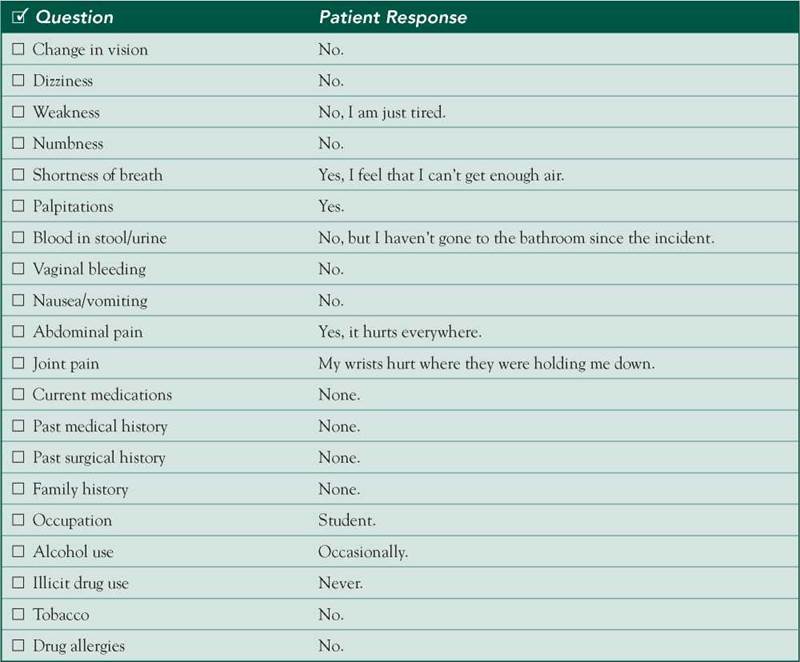
HPI: 25 yo F comes to the ED after being sexually and physically assaulted. The event happened about 3 hours ago as she was leaving a bar. She was beaten and raped by 2 unknown men. They had vaginal intercourse with her without using condoms, and she is unsure if ejaculation occurred. Her LMP was 3 weeks ago. She does not use any form of contraception. She also c/o shortness of breath, palpitations, and right chest pain that is nonradiating. The chest pain is exacerbated by movement and deep breaths and is relieved by sitting still. No nausea or vomiting. No dizziness or headache. No weakness or numbness in her extremities; no vaginal, rectal, or urinary bleeding.
ROS: Negative except as above.
Allergies: NKDA.
Medications: None.
PMH: None.
PSH: None.
SH: No smoking, occasional EtOH, no illicit drugs.
FH: Noncontributory.
Physical Examination
Patient is anxious and in acute distress.
VS: WNL.
HEENT: No JVD, PERRLA, EOMI.
Chest: Clear breath sounds bilaterally; tenderness on palpation of right chest wall.
Heart: Normal S1/S2; no murmurs, rubs, or gallops.
Abdomen: Soft, nontender, nondistended, BS, no rebound or organomegaly.
Neuro: Mental status: Alert and oriented x 3. Cranial nerves: 2-12 grossly intact. Motor: Strength 5/5 in all muscle groups.
Differential Diagnosis

CASE DISCUSSION
Patient Note Differential Diagnoses
■ Rib fracture: This can result from any insult to the chest wall. A simple fracture can cause pain on inspiration and cough.
■ STDs: Sexual assault victims may acquire a variety of pathogens during the incident, including trichomoniasis, chlamydia, gonorrhea, HIV, and hepatitis B.
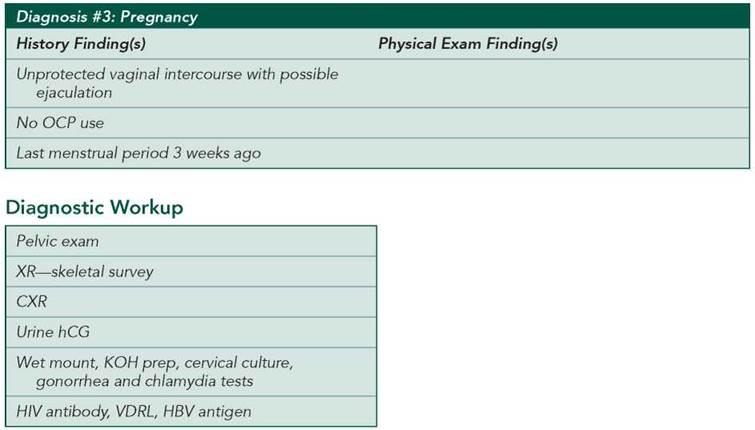
■ Pregnancy: All sexual assault victims should be evaluated for possible existing pregnancy and should be offered emergency contraception.
Additional Differential Diagnoses
■ Pneumothorax/hemothorax: Defined as the presence of air or blood in the pleural space between the visceral and parietal pleurae. Physical findings include unilateral loss of breath sounds with hyperresonance, shifting of the trachea away from the injured side, and JVD. Because this patient suffered physical trauma, she may have a traumatic pneumothorax. A CXR is a fast and easy tool with which to evaluate patients for a pneumothorax.
■ Muscle rupture: Chest pain in trauma victims may be musculoskeletal in origin.
Diagnostic Workup
■ Pelvic exam: To evaluate for any possible physical injury of the genital or anal area and to collect specimens for medical and forensic purposes.
■ XR—skeletal survey: To detect possible bone or rib fractures.
■ CXR: To detect rib fractures, pneumothorax, and pleural effusions.
■ Urine hCG: To rule out pregnancy.
■ Wet mount, KOH prep, cervical culture, gonorrhea and chlamydia tests: The vaginal discharge is examined microscopically to evaluate for infection. The presence of epithelial cells covered with bacteria (clue cells) suggests bacterial vaginosis, and the presence of hyphae and spores points to candidal infection. Motile organisms are seen in trichomonal infection. A “fishy” odor after the addition of KOH to the discharge is indicative of bacterial vaginosis. If sperm are detected in the victim, testing of sperm DNA may aid in the identification of the assailants.
■ HIV antibody, VDRL, HBV antigen: To rule out HIV, syphilis, and hepatitis B infection.
■ Evidence collection using rape kit: Rape kits are available to facilitate and guide the evidence collection process. Tissue swabs should be collected from the victim as soon as possible to assist in evidence collection. Careful consideration should be given to maintaining a set chain of custody of the evidence collected.