
Doorway Information
Opening Scenario
Frank Emanuel, a 32-year-old male, comes to the office for a preemployment medical checkup as requested by his prospective employer.
Vital Signs
BP: 130/85 mm Hg Temp: 98.3°F (36.8°C)
RR: 15/minute HR: 70/minute, regular
Examinee Tasks
1. Take a focused history.
2. Perform a focused physical exam (do not perform rectal, genitourinary, or female breast exam).
3. Explain your clinical impression and workup plan to the patient.
4. Write the patient note after leaving the room.
Checklist/SP Sheet
Patient Description
Patient is a 32 yo M.
Notes for the SP
■ Sit up on the bed.
■ Hold the physical exam request form in your hand.
Challenging Questions to Ask
“Do you think they are going to give me the job?”
Sample Examinee Response
“Employers routinely request medical examinations to ensure that potential employees are fit for the job, as well as to determine if they have any medical conditions that may prove hazardous to others in the work environment. I will ask you a few questions and perform a physical examination, and on the basis of what I find, I may or may not order further tests. Hopefully everything will be fine.”
Examinee Checklist
Building the Doctor-Patient Relationship
Entrance
□ Examinee knocked on the door before entering.
□ Examinee introduced self by name.
□ Examinee identified his/her role or position.
□ Examinee correctly used patient’s name.
□ Examinee made eye contact with the SP.
Reflective Listening
□ Examinee asked an open-ended question and actively listened to the response.
□ Examinee asked the SP to list his/her concerns and listened to the response without interrupting.
□ Examinee summarized the SP’s concerns, often using the SP’s own words.
Information Gathering
□ Examinee elicited data efficiently and accurately.

Connecting with the Patient
□ Examinee recognized the SP’s emotions and responded with PEARLS.
Physical Examination
□ Examinee washed his/her hands.
□ Examinee asked permission to start the exam.
□ Examinee used respectful draping.
□ Examinee did not repeat painful maneuvers.

Closure
□ Examinee discussed initial diagnostic impressions.
□ Examinee discussed initial management plans:
□ Follow-up tests.
□ Examinee asked if the SP had any other questions or concerns.
Sample Closure
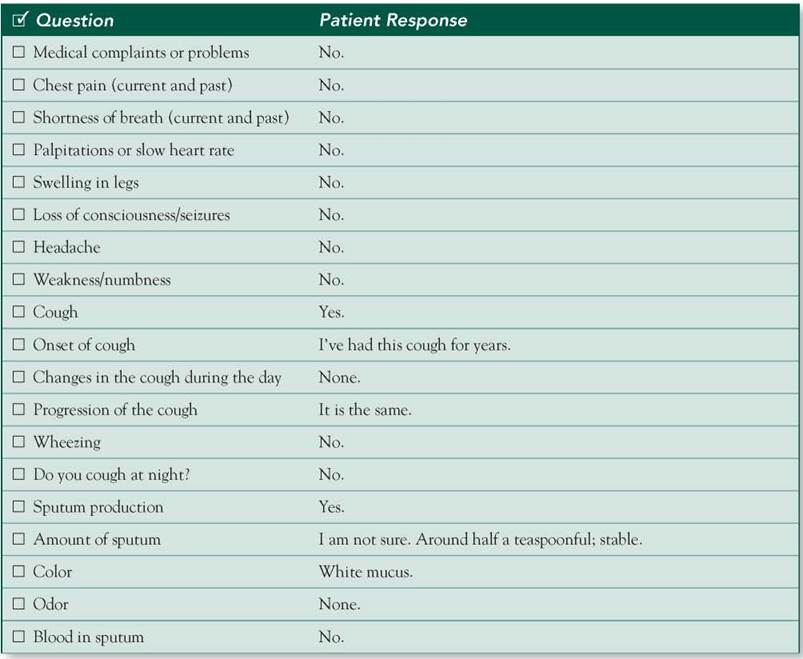
Mr. Emanuel, your physical examination is normal, but your cough may raise concern for some possible medical problems. We need to order some tests to make sure you are free of any serious medical conditions, and if we find anything, we will treat it right away. Since you just came here from Africa and you have never been tested for TB, we need to rule out pulmonary tuberculosis, not only because it is harmful to you but also because you may transmit it to your future coworkers. The other issue I want to talk to you about is your smoking. It puts you at increased risk of heart and lung disease, and I strongly urge you to quit. Do you have any questions?

History
HPI: 32 yo M with no PMH presents for a preemployment medical examination. He has no medical complaints or problems. Nevertheless, he mentioned having a chronic cough for many years with no recent change in frequency or severity. The cough is productive of half a teaspoonful of white mucus with no blood. The patient denies any dyspnea, fever or chills, chest pain, or wheezing and has had no appetite or weight changes. The patient is an African immigrant who came to the United States 1 month ago and reports no TB exposure. He has never had a PPD test. However, he states that his immunizations are up to date, and he will be faxing us the report to review.
ROS: Negative except as above.
Allergies: NKDA.
Medications: None.
PMH: Per HPI.
PSH: None.
SH: 1 PPD for 10 years, no EtOH, no illicit drugs. Sexually active with wife only.
FH: Noncontributory.
Physical Examination
VS: WNL.
HEENT: Mouth and pharynx WNL.
Neck: No JVD, no lymphadenopathy.
Chest: Clear breath sounds bilaterally; no rhonchi, rales, or wheezing; tactile fremitus normal.
Heart: RRR; normal S1/S2; no murmurs, rubs, or gallops.
Abdomen: Soft, nontender, nondistended, BS, no hepatosplenomegaly
Extremities: No clubbing, cyanosis, or edema.
Neuro: Cranial nerves: 2-12 intact. Motor: Strength 5/5 in all muscle groups. DTRs: Symmetric. Gait: Normal.
Differential Diagnosis


CASE DISCUSSION
Patient Note Differential Diagnoses
■ COPD/chronic bronchitis: This patient’s chronic cough and sputum production might be due to COPD/ chronic bronchitis secondary to his smoking history and occupational exposure. Patients who are smokers and work in coal mines are more likely to develop COPD in addition to inhalant-induced restrictive lung diseases. CXR and pulmonary function tests can help distinguish these causes of lung pathology and assess their severity.
■ Pneumoconiosis: Considering his occupational history as a coal miner, this patient has been exposed to coal dust and crystalline silica and is at increased risk of coal worker’s pneumoconiosis and pulmonary silicosis.
■ Pulmonary tuberculosis: Active TB infection is unlikely, as the patient denies systemic symptoms, blood- tinged sputum, dyspnea, chest pain, or exposure to TB. However, TB infection should be ruled out in this patient before he starts a new job, as he is an immigrant and has never been tested for TB. Latent infection should be treated to decrease the risk of progression to active TB.
Additional Differential Diagnoses
There are other possible causes of the patient’s chronic cough that may be benign, such as GERD and asthma.
Diagnostic Workup
■ CXR—PA and lateral: A good initial test in evaluating chronic cough. It may demonstrate cavitary lesions in TB or may show nodular calcification in silicosis. It is usually normal in benign causes of cough, such as asthma or GERD.
■ PPD (tuberculin skin test) or QuantiFERON Gold: The PPD test is a screening tool for determining if a patient has been infected with Mycobacterium tuberculosis. A QuantiFERON Gold test can also be considered in this case, as it is more specific for prior infection with M tuberculosis. However, its availability is variable and based on the testing center.
■ CBC: To identify leukocytosis in infection (nonspecific).
■ Sputum Gram stain, AFB smear, routine and mycobacterial sputum cultures: To identify a causative agent of possible infection. However, a PPD or QuantiFERON Gold test would typically be ordered as a screening test before the collection of a sputum sample or culture in an outpatient setting.
■ Pulmonary function tests: May distinguish obstructive from restrictive disease but is not diagnostic for pneumoconiosis. More often used as a test to determine the severity of disease.