
DOORWAY INFORMATION
Opening Scenario
The mother of Adam Davidson, an 8-year-old male child, comes to the office concerned that her son continues to wet the bed.
Examinee Tasks
1. Take a focused history.
2. Explain your clinical impression and workup plan to the mother.
3. Write the patient note after leaving the room.
Checklist/SP Sheet
Patient Description
The patient’s mother offers the history; her son is in the waiting room.
Notes for the SP
None.
Challenging Questions to Ask
■ “Did I do something wrong to cause this problem?”
■ “Is my child going to get better?”
Sample Examinee Response
“There are a few medical problems that can lead to your child’s condition, but it’s just as likely to be an isolated symptom. Bed-wetting is much more common than most people believe, and there is no reason for you or your child to feel embarrassed or guilty. There are a number of treatment options available for this condition, and after we have run a few tests to rule out any physiologic abnormalities, I will discuss them with you.”
Examinee Checklist
Building the Doctor-Patient Relationship Entrance
□ Examinee knocked on the door before entering.
□ Examinee introduced self by name.
□ Examinee identified his/her role or position.
□ Examinee correctly used patient’s name.
□ Examinee made eye contact with the SP.
Reflective Listening
□ Examinee asked an open-ended question and actively listened to the response.
□ Examinee asked the SP to list his/her concerns and listened to the response without interrupting.
□ Examinee summarized the SP’s concerns, often using the SP’s own words.
Information Gathering
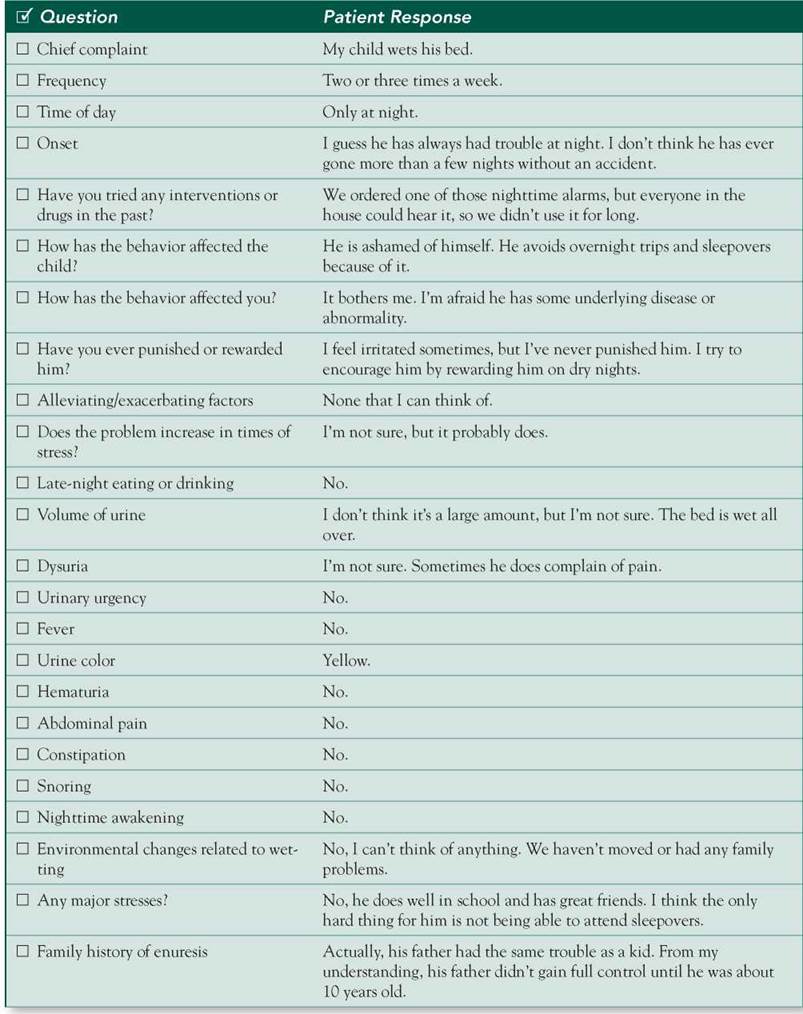
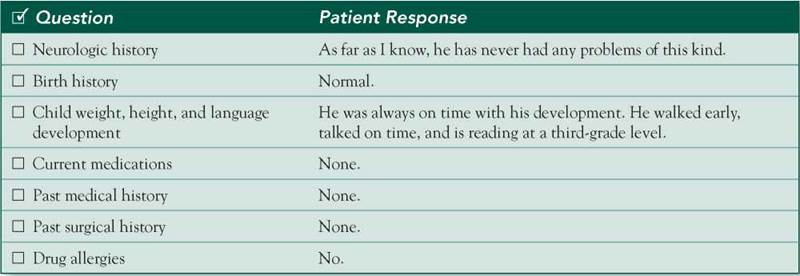
□ Examinee elicited data efficiently and accurately.
Connecting with the Patient
□ Examinee recognized the SP’s emotions and responded with PEARLS.
Physical Examination
None.
Closure
□ Examinee discussed initial diagnostic impressions.
□ Examinee discussed initial management plans:
□ Further examination.
□ Follow-up tests.
□ Examinee asked if the SP had any other questions or concerns.
Sample Closure
Mrs. Davidson, your son’s condition is probably an isolated symptom, but I would still like to examine him and run some tests to make sure he does not have an underlying infection or a more serious medical problem. We can then discuss his treatment options. Do you have any questions for me?
History
HPI: The source of the information is the patient's mother. The mother of an 8 yo M c/o her child continuing to wet the bed several times a week. The child has never had a significant period of continence at night. He has no hematuria, fever, or urgency. There is possible dysuria, although the mother is not sure. The mother denies that the child c/o abdominal pain or constipation. The child does not snore or wake up multiple times during the night. There are no exacerbating factors, and there have been no major lifestyle changes or stresses in the family. The problem is causing distress for the child, who has been avoiding sleepovers, as well as for the mother, who is worried about the possibility of an underlying medical condition.
ROS: Negative.
Allergies: NKDA.
Medications: None.
PMH: None.
PSH: None.
Birth history: Normal.
Developmental history: Normal.
FH: Positive family history of male nocturnal enuresis.
Physical Examination
None.
Differential Diagnosis
CASE DISCUSSION
Patient Note Differential Diagnoses
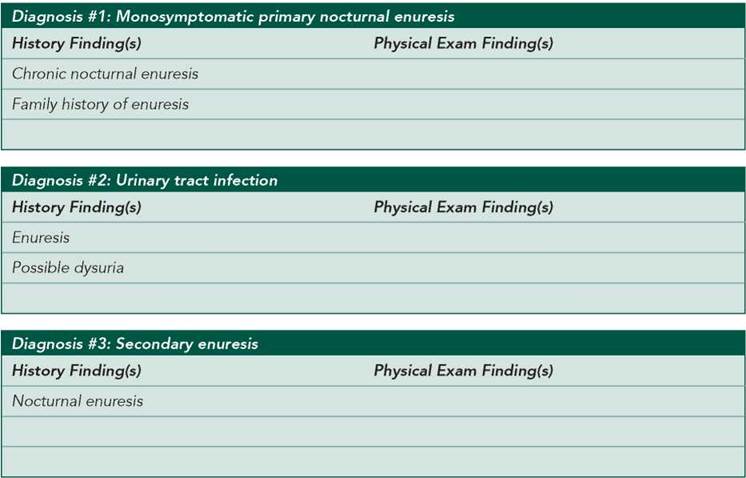
■ Monosymptomatic primary nocturnal enuresis: This is a diagnosis of exclusion. This patient’s history indicates a primary problem as opposed to a secondary one. The history and physical exam do not provide any related signs or symptoms, suggesting a monosymptomatic pathology. A urine sample must be taken to rule out infection, and old records should be evaluated to ensure that the presentation is not part of a global delay.
■ Urinary tract infection (UTI): Enuresis may be the only symptom of UTI in children, and screening for UTI should be part of the workup for childhood enuresis. This patient does not have frequency or urgency, but urinary incontinence alone should trigger an evaluation. Additionally, according to the mother, he may have dysuria. A positive UA is presumptive of UTI, and culturing urine can establish a definitive diagnosis and direct treatment.
■ Secondary enuresis: The patient’s mother does not report a major trauma or life or environmental change such as the divorce of parents, a major illness, or abuse that might result in regression to incontinence. This diagnosis is further unlikely because the child has not been continent for any significant period.
Additional Differential Diagnoses
■ Constipation: Infrequent or hard stools may indicate chronic constipation, which can put pressure on the urinary bladder and decrease its capacity. This may delay continence and look like a primary disorder. Physical examination can reveal impacted stool on the left side.
■ Sleep apnea: Wetting occurs in all stages of sleep but is associated with particular disorders, such as sleep apnea and narcolepsy. This patient does not present with snoring or upper airway obstruction, and thus there is no indication of apnea that might warrant further evaluation.
■ Functional bladder disorder: Children with functional disorders void several times a day, hold urine until the last moment, and wet small volumes almost every night, sometimes multiple times a night. This patient has normal voiding patterns during the day and remains continent a majority of nights.
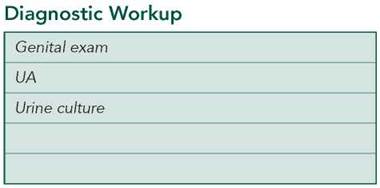
Diagnostic Workup
■ Genital exam: To evaluate for disorders such as abnormalities of the meatus, epispadias, and phimosis.
■ UA: To evaluate for a UTI. Clear urine, a negative dipstick, and a negative microscopic examination combined have a negative predictive value between 95% and 98%.
■ Urine culture: The only 100% specific test for UTI.
■ First-morning urine specific gravity: To evaluate for insufficient ADH levels as the cause of the patient’s nocturnal enuresis. An early-morning urine concentration of < 1.015 may indicate a lack of nighttime and early- morning ADH surges, which may predict a positive response to pharmacologic therapy with DDAVP.
■ U/S—renal: Should be pursued if bed-wetting continues with multiple treatments, abnormal voiding patterns, or recurrent UTIs confirmed by UA and urine culture.
■ BUN/Cr: Should be obtained before renal ultrasound to evaluate renal function. To avoid unnecessary blood draws in children, blood for BUN/Cr testing should not be drawn until results from a urine sample are obtained.