
DOORWAY INFORMATION
Opening Scenario
The mother of Michaela Weber, an 11-month-old female child, comes to the emergency department after her daughter has a seizure.
Examinee Tasks
1. Take a focused history.
2. Explain your clinical impression and workup plan to the mother.
3. Write the patient note after leaving the room.
Checklist/SP Sheet
Patient Description
The patient’s mother offers the history; she is a good historian.
Notes for the SP
Express anxiety about your daughter’s condition.
Challenging Questions to Ask
“Is my child going to have permanent brain damage from this?”
Sample Examinee Response
“The most likely explanation for your daughter’s seizure is her fever, in which case there should be no permanent damage. There are some causes of seizures that are more serious, though. We will run all the necessary tests to make sure one of those is not the cause.”
Examinee Checklist
Building the Doctor-Patient Relationship Entrance
□ Examinee knocked on the door before entering.
□ Examinee introduced self by name.
□ Examinee identified his/her role or position.
□ Examinee correctly used patient’s name.
□ Examinee made eye contact with the SP.
Reflective Listening
□ Examinee asked an open-ended question and actively listened to the response.
□ Examinee asked the SP to list his/her concerns and listened to the response without interrupting.
□ Examinee summarized the SP’s concerns, often using the SP’s own words.
Information Gathering
□ Examinee elicited data efficiently and accurately.

Connecting with the Patient
□ Examinee recognized the SP’s emotions and responded with PEARLS.
Physical Examination
None.
Closure
□ Examinee discussed initial diagnostic impressions.
□ Examinee discussed initial management plans:
□ Follow-up tests.
□ Examinee asked if the SP had any other questions or concerns.
Sample Closure
Mrs. Weber, it sounds as though your child has indeed had a seizure. The most likely cause is her high fevers; seizures caused by fevers happen in many young children. However, because there are many types of seizures, I would like to examine your child and also do some tests to make sure that the seizures are not being caused by something more serious, like meningitis. Do you have any questions for me?
History
HPI: The source of information is the patient's mother. Patient is an 11-month-old F with a tonic-clonic seizure.
■ Witnessed this a.m. by parents, lasted approx. 1 minute.
■ No tongue or body trauma.
■ Postictal drowsiness noted.
■ No history of prior seizures.
■ Patient has had rhinorrhea for past 2 days, fevers to 102.9°F with decreased PO intake, difficulty sleeping, and fewer wet diapers.
■ No rash, nausea/vomiting, lethargy, or inconsolability.
■ No sick contacts.
ROS: Negative except as above.
Allergies: NKDA.
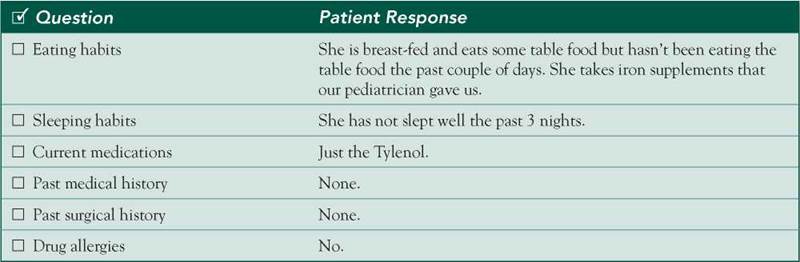
Medications: Tylenol.
PMH/PSH: None.
Birth history: Term uncomplicated vaginal delivery.
Dietary history: Breast milk, table foods, and supplemental vitamins.
Immunization history: Up to date.
Developmental history: Last checkup was 2 months ago and showed normal weight, height, and development.
Physical Examination
None.
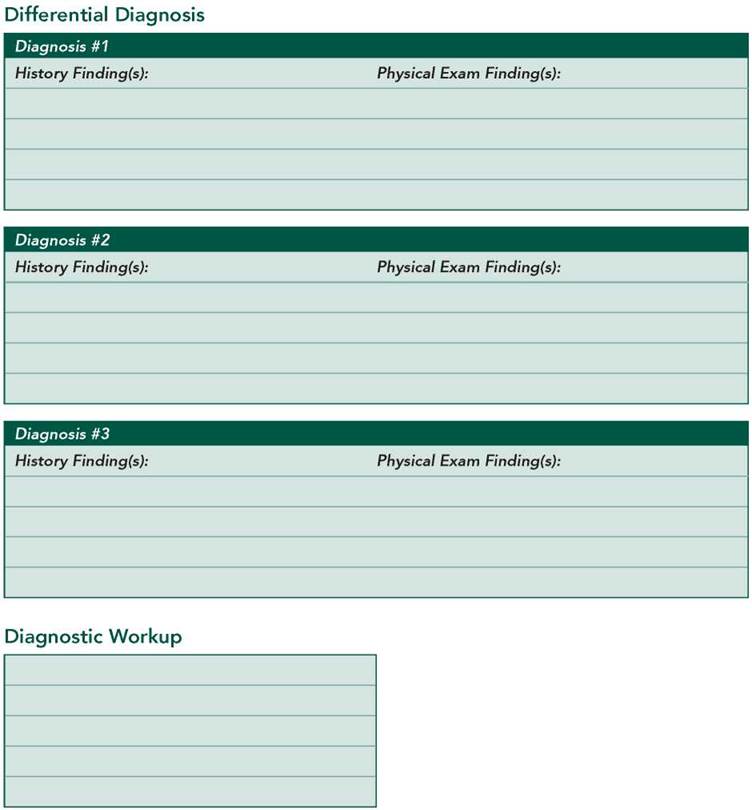
Differential Diagnosis
CASE DISCUSSION
Patient Note Differential Diagnoses
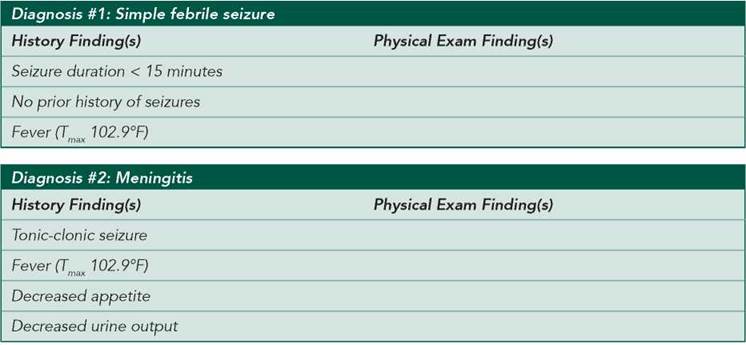
■ Simple febrile seizure: The most frequent cause of an isolated seizure in a child with a common febrile illness is a febrile seizure. These tend to be familial and may recur with subsequent febrile illnesses but disappear before adulthood. They do not require treatment and do not cause permanent neurologic damage.
■ Meningitis: In children younger than one year of age, meningitis findings can often be limited to fever and clinical symptoms. The infant might be irritable but is usually easily consolable. Viral meningitis is common in infants and could be likely in this patient considering the baby’s poor appetite, high fever, and decreased urine output. A seizure suggests neurologic involvement, and the most important cause to rule out is meningitis.
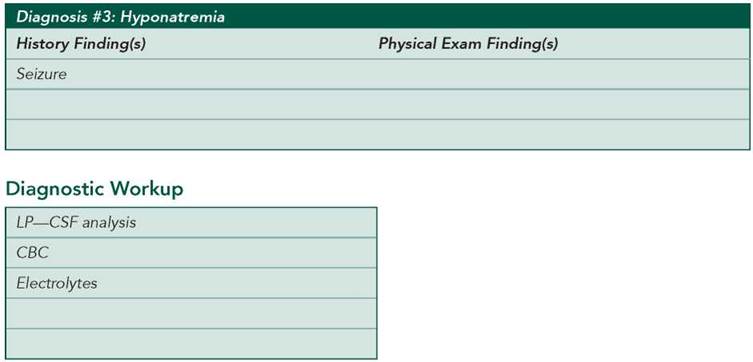
■ Hyponatremia: Hyponatremia from various causes can result in pediatric seizures; the classic case occurs when a poor family waters down their infant’s formula. There are also congenital causes of hyponatremia, such as congenital adrenal hyperplasia. The occurrence in the setting of fever makes this less likely than the infectious causes.
Additional Differential Diagnoses
■ UTI: Decreased urine output is not likely secondary to a UTI in this patient. However, given the patient’s high fever and gender, a UTI with subsequent pyelonephritis or bacteremia is a possibility.
■ Occult bacteremia: This child has a fever > 102°F (38.9°C) and no clear source of infection. Bacteremia and sepsis may present in this manner in children younger than one year of age; the incidence is highest in neonates and decreases with age.
Diagnostic Workup
■ LP—CSF analysis: A fever with seizures may be benign, or it may suggest meningitis. A lumbar puncture is the most definitive test with which to diagnose or rule out meningitis. It allows CSF analysis of cell count and differentials, glucose, protein, Gram stain, culture, viral cultures and PCR, and opening pressure.
■ CBC, electrolytes: To test for hyponatremia caused by any source. Potassium and glucose levels help in assessing adrenal function. A WBC count > 15,000/pL might be suggestive of occult bacteremia.
■ Blood culture, UA and urine culture: These tests constitute the sepsis or occult bacteremia workup in children with unexplained high fever. UTI may be occult and must be investigated.
■ CT—head: Used mainly to rule out brain abscess, encephalitis, or hemorrhage.
■ Electroencephalogram (EEG): Used to identify epileptiform activity, although a single febrile seizure does not warrant an EEG.