
DOORWAY INFORMATION
Opening Scenario
Brian Davis, a 21-year-old male, comes to the office complaining of a sore throat.
Vital Signs
BP: 120/80 mm Hg Temp: 99.5°F (37.5°C)
RR: 15/minute HR: 75/minute, regular
Examinee Tasks
1. Take a focused history.
2. Perform a focused physical exam (do not perform rectal, genitourinary, or female breast exam).
3. Explain your clinical impression and workup plan to the patient.
4. Write the patient note after leaving the room.
Checklist/SP Sheet
Patient Description
Patient is a 21 yo M.
Notes for the SP
■ Be rude and defensive.
■ Make most of your answers a curt “yes” or “no.”
■ Pretend that you have LUQ tenderness on abdominal palpation.
Challenging Questions to Ask
“Do you think I have AIDS?”
Sample Examinee Response
“What makes you think you might have AIDS? Do you believe that you have been exposed to HIV? It is a possibility, but I will not be able to tell until I have ordered some blood tests.”
Examinee Checklist
Building the Doctor-Patient Relationship Entrance
□ Examinee knocked on the door before entering.
□ Examinee introduced self by name.
□ Examinee identified his/her role or position.
□ Examinee correctly used patient’s name.
□ Examinee made eye contact with the SP.
Reflective Listening
□ Examinee asked an open-ended question and actively listened to the response.
□ Examinee asked the SP to list his/her concerns and listened to the response without interrupting.
□ Examinee summarized the SP’s concerns, often using the SP’s own words.
Information Gathering
□ Examinee elicited data efficiently and accurately.

Connecting with the Patient
□ Examinee recognized the SP’s emotions and responded with PEARLS.
Physical Examination
□ Examinee washed his/her hands.
□ Examinee asked permission to start the exam.
□ Examinee used respectful draping.
□ Examinee did not repeat painful maneuvers.
Closure
□ Examinee discussed initial diagnostic impressions.
□ Examinee discussed initial management plans:
□ Follow-up tests (including consent for HIV testing).
□ Safe sex practices.
□ Help with smoking cessation.
□ Recommendation to avoid contact sports because of the possible increased risk of traumatic splenic rupture.
□ Examinee asked if the SP had any other questions or concerns.
Sample Closure
Mr. Davis, it is likely that you have acquired the same infection your girlfriend had. This may be no more than a transient viral infection, or it may represent a more serious illness such as HIV. We will need to run a few tests to help us make the diagnosis. I recommend that we obtain an HIV test, and we will also need to obtain a throat swab and an ultrasound of your abdomen. In the meantime, I strongly recommend using condoms to avoid an unwanted pregnancy and to prevent STDs. Since infectious mononucleosis is one of the diseases that might account for your symptoms, I also recommend that you avoid contact sports for at least 3 weeks because of the possible risk of traumatic rupture of your spleen, which could be fatal. Also, since cigarette smoking is associated with a variety of diseases, I advise you to quit smoking; we have many ways to help you if you are interested. Do you have any questions for me?

History
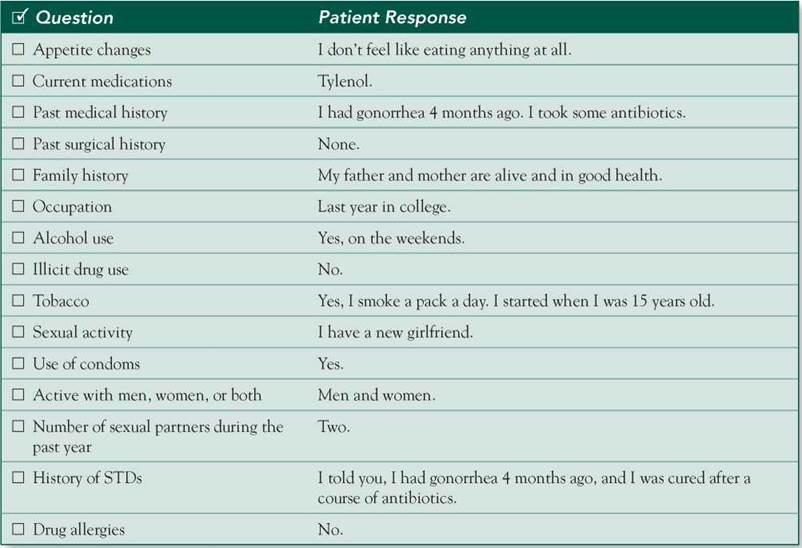
HPI: 21 yo M c/o sore throat for the past 2 weeks. Two weeks ago he had a mild fever and fatigue, but he denies any chills, runny nose, cough, night sweats, shortness of breath, or wheezing. The patient also notes LUQ abdominal pain since yesterday. The pain is 4/10 and constant with no radiation, no relation to food, and no alleviating or exacerbating factors. He has poor appetite and subjective weight loss. His exgirlfriend had the same symptoms 2 months ago.
ROS: Negative except as above.
Allergies: NKDA.
Medications: Tylenol.
PMH: Gonorrhea 4 months ago, treated with antibiotics.
PSH: None.
SH: 1 PPD since age 15; drinks heavily on weekends. Multiple female and male partners; uses condoms.
FH: Noncontributory.
Physical Examination
Patient is in no acute distress.
VS: WNL.
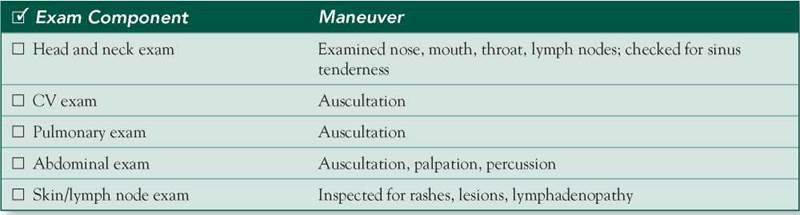
HEENT: Nose, mouth, and pharynx WNL.
Neck: Supple, bilateral cervical lymphadenopathy.
Chest: Clear breath sounds bilaterally.
Heart: RRR; normal S1/S2; no murmurs, rubs, or gallops.
Abdomen: Soft, nondistended, BS, no hepatosplenomegaly mild LUQ tenderness on palpation.
Skin: No rash.
Differential Diagnosis

CASE DISCUSSION
Patient Note Differential Diagnoses
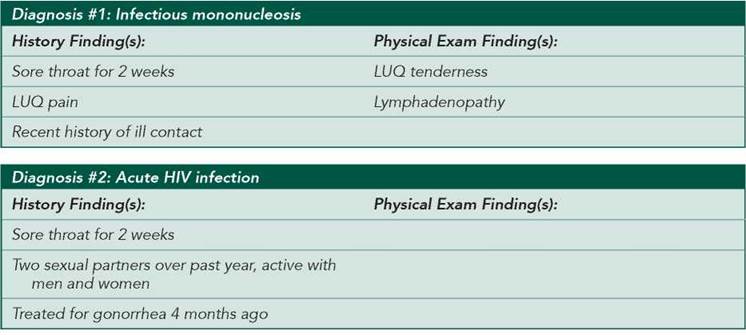
■ Infectious mononucleosis: The differential diagnosis for “sore throat” includes many pathogens. This patient’s LUQ pain suggests splenomegaly, which could limit the differential (for a unifying diagnosis) to an infectious mononucleosis caused by EBV or, less commonly, by CMV infection. The physical exam is notoriously insensitive for detecting splenomegaly and may be misleading, as in this case. This patient also presents with cervical lymphadenopathy, a typical feature of infectious mononucleosis. However, he does not exhibit exudative pharyngitis, another feature with which infectious mononucleosis is commonly associated.
■ Acute HIV infection: Acute HIV infection can be associated with fever, lymphadenopathy, sore throat, and a generalized maculopapular rash. This stage of disease typically occurs within one month of exposure to the virus and can last up to several weeks. Symptoms eventually resolve on their own.
■ Group A streptococcal pharyngitis: Clinical features in patients with sore throat that predict group A streptococcal pharyngitis include tonsillar exudates, tender anterior cervical lymphadenopathy, a history of fever (temperature > 100.4°F/38°C), and absence of cough. “Strep throat” must be recognized and treated to prevent acute rheumatic fever.
Additional Differential Diagnoses
■ CMV infection: CMV can mimic infectious mononucleosis or acute HIV infection. Patients can present with mild flulike symptoms, including fever, lymphadenopathy, and fatigue. However, patients may also be asymptomatic, requiring a high index of suspicion for clinical testing.
■ Other infectious etiologies: Other infections that can present with nonspecific symptoms include Neisseria gonorrhoeae, Mycoplasma (although lower respiratory symptoms usually predominate), rubella, and Chlamydia trachomatis.
Diagnostic Workup
■ CBC: Findings are nonspecific, but leukocytosis may be seen in bacterial infection, and a lymphocytosis may be seen in viral infection.
■ Peripheral smear: Can reveal atypical lymphocytes in infectious mononucleosis.
■ Monospot test (heterophil agglutination test): Usually becomes positive in EBV-associated mononucleosis within four weeks of onset of illness.
■ Anti-EBV antibodies: Antibodies to various EBV antigens can be detected, such as IgM antibody to viral capsid antigen (VCA) and to nuclear antigen (EBNA). There is also a PCR to detect EBV in serum.
■ HIV antibody and viral load: Check antibody via ELISA and Western blot to exclude preexisting HIV infection, and check viral load to document acute infection.
■ Throat culture: The gold standard for diagnosing bacterial pharyngitis.
■ Rapid streptococcal antigen: Has high negative predictive value (ie, it can accurately confirm the absence of group A streptococcal pharyngitis).
■ CMV antibody titers/CMV PCR: To check for CMV infection.