
Like intelligence, talents are not innate gifts, but the result of a slow, invisible accretion of skills developed from the moment of conception. Everyone is born with differences, and some with unique advantages for certain tasks. But no one is genetically designed into greatness and few are biologically restricted from attaining it.
In 1980, the young Swedish psychologist Anders Ericsson found himself working with the great William Chase, one of the pioneers of cognitive psychology. Chase, at Carnegie Mellon University in Pittsburgh, helped explore the implications of chunking, the memory technique used by all human beings to convert a scattered collection of details into a single distinct memory. Phone numbers, for example, are not stored in our brains as ten separate numbers but in three easy chunks: 513-673-8754. Remembering ten unrelated items in the right order is next to impossible; remembering three is no problem. The same notion applies to remembering words, music, chess positions, or any other constellation of symbols. Great minds don’t recall more raw data than others; rather, they recognize patterns faster and form chunks more efficiently.
Chunking had offered a major breakthrough in understanding how the mind works. Now Ericsson and Chase were interested in learning even more about the severe limits of short-term memory and how to circumvent them. While our long-term memory capacity is apparently limitless, new memories are almost pathetically fragile: the average healthy adult can reliably juxtapose only three or four new, unrelated items. Such a limit, noted Ericsson and Chase, “places severe constraints on the human ability to process information and solve problems.”
But what about apparent exceptions to this rule—the handful of famous memory experts (“mnemonists”) who’ve been able to recall prodigious amounts of new and disconnected information? Ericsson and Chase wanted to know if these remarkable performers had innate memory gifts or if they had somehow acquired their extraordinary skills. To answer that question, they embarked on an unusual and ambitious experiment.
They attempted to create a mnemonist from scratch.
Could an ordinary person’s short-term memory be trained, like a juggler, to handle a much larger amount of information? There was only one way to find out. Ericsson and Chase recruited an undistinguished college student for an epic experiment. The student, known by his initials, S.F., tested normal for intelligence and normal for short-term memory performance. Memory-wise, he was just like you or me. Then they began the training. It was grueling work. In one-hour sessions, three to five sessions per week, researchers read sequences of random numbers to S.F. at the rate of one digit per second: 2 … 5 … 3 … 5 … 4 … 9 … At intervals, they stopped and asked him to echo their list back. “If the sequence was reported correctly,” the researchers noted, “the next sequence was increased by one digit; otherwise it was decreased by one digit.” 2 … 5 … 3 … 5 … 4 … 9 … 7 … At the end of every session, S.F. was asked to recall as many of that day’s numbers as possible. 2 … 5 … 3 … 5 … 4 … 9 … 7 … 6 …
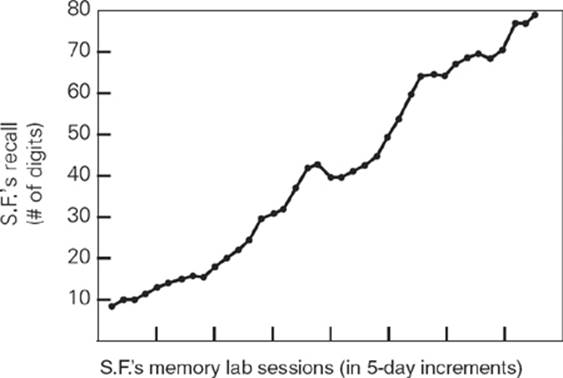
Instead of jumping off a bridge or transferring to another college, S.F. kept returning to the memory lab. In fact, he continued to participate most days of the week for more than two years—more than 250 hours of lab time. Why? Perhaps because he was seeing results. Almost immediately, his short-term memory performance started to improve: from seven digits to ten after a handful of sessions, then to an amazing twenty digits after several more dozen training hours. Already he had clearly escaped the normal bounds of short-term memory. From there, the improvements continued unabated: to thirty digits, forty, fifty, sixty, seventy, and finally to a staggering eighty-plus digits before the team concluded the experiment.
Courtesy of Hadel Studio
S.F.’s progress is represented on the graph above.
There was no indication as the sessions ended that he had reached any sort of boundary. “With practice,” Ericsson and Chase concluded, “there is seemingly no limit to memory performance.”
How did he do it? Through interviews with S.F., Ericsson and Chase realized that their subject had neither tapped into a hidden memory gift nor somehow transformed the brain circuitry of his short-term memory. Rather, he had simply employed clever strategies that enabled him to get around his—and all of our—natural limits.
Here’s how:
S.F. happened to be a competitive runner. Early on, after trying in vain simply to remember as many random numbers as possible, he realized that when he pictured an unconnected string of three or four digits as one single race time—for example, converting the numbers 5–2–3–4 into five minutes and twenty-three point four seconds—the numbers would come back to him quite easily.
This was not a new technique; attaching disconnected pieces of information to older memories goes back all the way to the Greek “memory palaces” of the fourth century B.C. The trick is to assign new information to some system or image that’s already in your head. For example, a classroom teacher could mentally “place” the face and name of each new student in a different room in her home: Lucas in the dining room; Oscar in the pantry; Malcolm standing by the kitchen sink. The advantage of this technique, explained Ericsson and Chase in their report, “is that it relieves the burden on short-term memory because recall can be achieved through a single association with an already-existing code in long-term memory.” S.F., like every impressive mnemonist before him, had not transformed his natural memory limit; instead he had changed the way he formed new memories to take advantage of a different, less restrictive memory system.
But how did the researchers know for sure that S.F. had not actually altered his short-term memory capacity? Simple: between number sessions, they also tested him with random alphabet letters: U … Q … B … Y … D … X … Whenever they did this, his memory performance immediately reverted to normal. Without special mnemonic tricks and lots of contextual practice, his short-term memory was again as ordinary as yours or mine.
Ericsson and Chase published their results in the prestigious journal Science, and their results were subsequently corroborated many times over. They concluded:
These data suggest that … it is not possible to increase the capacity of short-term memory with extended practice. Rather, increases in memory span are due to the use of mnemonic associations in long-term memory. With an appropriate mnemonic system and retrieval structure, there is seemingly no limit to improvement in memory skill with practice.
It was a double lesson: when it comes to memory skills, there is no escaping basic human biology—nor any need to. Remembering extraordinary amounts of new information simply requires the right strategies and the right amount of intensive practice, tools theoretically available to any functioning human being.
So began Anders Ericsson’s remarkable talent odyssey. He quickly suspected that the importance of his discovery went far beyond mind puzzles like geometry and chess. There were implications here, he imagined, for playing the cello, shooting a basketball, painting a canvas, brewing sake, reading a CT scan—any skill where real-time performance is dependent on one’s knowledge and experience. Though he couldn’t be sure at the time, Ericsson suspected he had just discovered the hidden key to the veiled domains of talent and genius.
He was right.

Truly great accomplishments are inherently mysterious, awe inspiring, even intimidating to witness. What daunting thoughts course through the mind of any listener as ten-year-old Midori plays Paganini’s Sauret cadenza with such startling grace and finesse? Beyond the feeling of amazement is the inevitable comparison with oneself—the acknowledgment that if you drew that same bow across those same strings on that exact same violin, such squeaks and squawks would fill the room as to make people run for cover.
By the same token, one watches David Beckham bend that ball into the goal, or Michael Jordan fly through the air toward the hoop, or Tiger Woods knock a tiny ball 325 yards to within inches of the hole, and one experiences an exhilarating but also deflating feeling: these extraordinary performers cannot possibly belong to the same species as you or me.
Call it the greatness gap—that sensation of an infinite and permanent chasm between ultra-achievers and mere mortals like us. Such feelings beg for a reassuring explanation: This person has something I do not have. They were born with something I wasn’t born with. They are gifted.
It is an assumption built right into our culture. “Talent” is defined in the Oxford English Dictionary as “mental endowment; natural ability” and is sourced all the way back to the parable of the talents in the book of Matthew. The words “gifted” and “giftedness” date back to the seventeenth century. The term “genius,” as it is currently defined, goes back to the tail end of the eighteenth century.
Recent centuries are peppered with evocative statements reinforcing the idea of inborn gifts:
· “Poets and musicians are born,” declared the poet Christian Friedrich Schubart in 1785.
· “Musical genius is that inborn, inexplicable gift of Nature,” insisted the composer Peter Lichtenthal in 1826.
· “Don’t ask, young artist, ‘what is genius?’” proclaimed Jean-Jacques Rousseau in 1768. “Either you have it—then you feel it yourself, or you don’t—then you will never know it.”
In the twentieth century, the presumed source of a person’s natural endowment shifted from God-given to gene-given, but the basic notion of giftedness remained substantially the same. Exceptional abilities were things bestowed upon a very lucky person.
Notably, Friedrich Nietzsche dissented along the way. In his 1878 book Menschliches, Allzumenschliches (Human, All-Too-Human), he described greatness as being steeped in a process, and of great artists being tireless participants in that process:
Artists have a vested interest in our believing in the flash of revelation, the so-called inspiration … [shining] down from heavens as a ray of grace. In reality, the imagination of the good artist or thinker produces continuously good, mediocre, and bad things, but his judgment, trained and sharpened to a fine point, rejects, selects, connects … All great artists and thinkers [are] great workers, indefatigable not only in inventing, but also in rejecting, sifting, transforming, ordering.
As a vivid illustration, Nietzsche cited Beethoven’s sketchbooks, which reveal the composer’s slow, painstaking process of testing and tinkering with melody fragments like a chemist constantly pouring different concoctions into an assortment of beakers.
Beethoven would sometimes run through as many as sixty or seventy different drafts of a phrase before settling on the final one. “I make many changes, and reject and try again, until I am satisfied,” the composer once remarked to a friend. “Only then do I begin the working-out in breadth, length, height and depth in my head.”
Alas, neither Nietzsche’s nuanced articulation nor Beethoven’s candid admission caught on with the general public. Instead, the simpler and more alluring idea of giftedness prevailed and has since been carelessly and breathlessly reinforced by biologists, psychologists, educators, and the media. Three essential ingredients have kept it alive:
1. The unexplained phenomena of child prodigies and “savants”: tiny Mozarts and Midoris in possession of spectacular abilities that seem to come from nowhere.
2. The myth of genes as blueprints: a simple and compelling account of where giftedness comes from, not substantially refuted until recently.
3. No compelling alternative: no sweeping contrary evidence from scientists, and no effective rhetorical substitutes from writers.
All of which left “giftedness” as the only acceptable explanation for exceptional ability. Few psychologists or educators resisted the temptation to use it as a shorthand when discussing talents.
But Anders Ericsson did resist.
After his 1980 memory experiments, the old giftedness dogma just didn’t seem to make sense anymore. Though he was not a geneticist and, at the time, had no way to know just how bankrupt the gene-blueprint myth truly was, he defied convention and proposed a radical new conception of talent: talent is not the causebut the result of something. It doesn’t create a process but is the end result of that process. If true, this would mean that high achievement in many physical and creative realms is much more attainable among human beings than is implied by the notion of giftedness.
Over the following three decades, Ericsson and colleagues invigorated the largely dormant field of expertise studies in order to test this idea, examining high achievement from every possible angle: memory, cognition, practice, persistence, muscle response, mentorship, innovation, attitude, response to failure, and on and on. They studied golfers, nurses, typists, gymnasts, violinists, chess players, basketball players, and computer programmers.
They also examined many of the vivid historical myths of talent and genius, poking through the clichés to see if any clear-eyed lessons could be drawn. Standing above all other giftedness legends, of course, was that of the mystifying boy genius Wolfgang Amadeus Mozart, alleged to be an instant master performer at age three and a brilliant composer at age five. His breathtaking musical gifts were said to have sprouted from nowhere, and his own father promoted him as the “miracle which God let be born in Salzburg.”
The reality about Mozart turns out to be far more interesting and far less mysterious. His early achievements—while very impressive, to be sure—actually make good sense considering his extraordinary upbringing. And his later undeniable genius turns out to be a wonderful advertisement for the power of process.
Mozart was bathed in music from well before his birth, and his childhood was quite unlike any other. His father, Leopold Mozart, was an intensely ambitious Austrian musician, composer, and teacher who had gained wide acclaim with the publication of the instruction book Versuch einer grüendlichen Violinschule (A Treatise on the Fundamental Principles of Violin Playing). For a while, Leopold had dreamed of being a great composer himself. But on becoming a father, he began to shift his ambitions away from his own unsatisfying career and onto his children—perhaps, in part, because his career had already hit a ceiling: he was vice-kapellmeister (assistant music director); the top spot would be unavailable for the foreseeable future.
Uniquely situated, and desperate to make some sort of lasting mark on music, Leopold began his family musical enterprise even before Wolfgang’s birth, focusing first on his daughter Nannerl. Leopold’s elaborate teaching method derived in part from the Italian instructor Giuseppe Tartini and included highly nuanced techniques:
[Leopold] advocated the so-called “Geminiani grip” for greater left hand facility and good intonation and … recommended that each finger be left in place until required to move—a procedure which would also have contributed to a more effective legato … he placed emphasis on the freedom of the right elbow and hand, stressing the need to keep the bowing arm low but recommending that the violin be tilted towards the E-string side—thereby allowing for a freer wrist action.
As a court composer, Leopold Mozart was an ordinary creature of his place and era. As a music teacher, though, he was centuries ahead of his time. Eventually, his focus on technique and his impulse to teach very young children would be widely adopted by Shinichi Suzuki and other twentieth-century instructors. But this was quite rare in the eighteenth century; only a handful of families in the world could have conceivably enjoyed the same level of in-family attention, expertise, and ambition. With first-rate home instruction and exceptional amounts of practice, Nannerl Mozart became, over the course of a few years, a dazzling pianist and violinist—for her age. (As a rule, child prodigies are not adult-level innovators but masters of technical skill; their spellbinding quality comes out of natural comparison with other children’s skills, not because they truly compare to the best adult performers in their field.)
Then came Wolfgang. Four and a half years younger than his sister, the tiny boy got everything Nannerl got—only much earlier and even more intensively. Literally from his infancy, he was the classic younger sibling soaking up his big sister’s singular passion. As soon as he was able, he sat beside her at the harpsichord and mimicked notes that she played. Wolfgang’s first pings and plucks were just that. But with a fast-developing ear, deep curiosity, and a tidal wave of family know-how, he was able to click into an accelerated process of development.
As Wolfgang became fascinated with playing music, his father became fascinated with his toddler son’s fascination—and was soon instructing him with an intensity that far eclipsed his efforts with Nannerl. Not only did Leopold openly give preferred attention to Wolfgang over his daughter; he also made a career-altering decision to more or less shrug off his official duties in order to build an even more promising career for his son. This was not a quixotic adventure. Leopold’s calculated decision made reasonable financial sense in two ways: First, Wolfgang’s youth made him a potentially lucrative attraction. Second, as a male, Wolfgang had a promising, open-ended future musical career. As a woman in eighteenth-century Europe, Nannerl was severely limited in this regard.
From the age of three, then, Wolfgang had an entire family driving him to excel with a powerful blend of instruction, encouragement, and constant practice. He was expected to be the pride and financial engine of the family, and he did not disappoint. In his performances from London to Mannheim between the ages of six and eight, he drew good receipts and high praise from noble patrons. He could play rehearsed minuets or sight-read études he had never seen before, could play the clavier with a thick cloth covering his hands and the keys, could improvise a coherent piece from a suggested theme.
Still, like his sister, the young Mozart was never a truly great adult-level instrumentalist. He was highly advanced for his age, but not compared with skillful adult performers. The tiny Mozart dazzled royalty and was at the time unusual for his early abilities. But today many young children exposed to Suzuki and other rigorous musical programs play as well as the young Mozart did—and some play even better. Inside the world of these intensive, child-centered programs, such achievements are now straightforwardly regarded by parents and teachers for what they are: the combined consequence of early exposure, exceptional instruction, constant practice, family nurturance, and a child’s intense will to learn. Like a brilliant soufflé, all of these ingredients must be present in just the right quantity and mixed with just the right timing and flair. Almost anything can go wrong. The process is far from predictable and never in anyone’s complete control.
It is a blessing for any person, at any age, to be able to bring grace and beauty into other people’s lives. But such feats among children tend to cloud the judgment of adult observers, leading to what neuroscientist and musicologist Daniel J. Levitin calls “the circular logic of talent.” “When we say that someone is talented,” he says, “we think we mean that they have some innate predisposition to excel, but in the end, we only apply the term retrospectively, after they have made significant achievements.”
Levitin is exactly right. A profound ambiguity swirls around the word, which perpetually confuses the issue for anyone using it. “Talent” can be used to describe your daughter’s strong interest in an activity, or what you regard as her undeveloped promise, or her developing skill, or her unexplained advantage over peers. In a culture where linguistic precision is paramount, where we have at least twenty-five different words for “delicious” and thirteen for “ridicule,” such ambiguity is the best possible indicator of a real gap in our understanding of this powerful force in our lives. Aside from love, talent may be the most important intangible in all of human society. It is a linguistic apparition.
But what if the intangible could be made tangible? Over the last three decades, Anders Ericsson’s research army has aimed to do just that. Like all good scientists, their approach has been to break down athletic, intellectual, and artistic achievements into tiny, measurable components in order to determine what separated the mediocre from the good, the good from the very good, the very good from the extraordinary. They’ve interviewed, taped, tabulated, and scanned. They’ve measured eye movements, muscle response, breaths, swings, strokes, torque, ventricular function, white matter, gray matter, and memory. They’ve watched people hone skills, or not, over many years’ time. Over time, a picture has emerged—not nearly complete, but vivid enough to begin to see a process, to actually witness the tiny moving parts driving individual improvement. For those on their way to greatness, several themes consistently come to light:
1. Practice changes your body. Researchers have recorded a constellation of physical changes (occurring in direct response to practice) in the muscles, nerves, hearts, lungs, and brains of those showing profound increases in skill level in any domain.
2. Skills are specific. Individuals becoming great at one particular skill do not serendipitously become great at other skills. Chess champions can remember hundreds of intricate chess positions in sequence but can have a perfectly ordinary memory for everything else. Physical and intellectual changes are ultraspecific responses to particular skill requirements.
3. The brain drives the brawn. Even among athletes, changes in the brain are arguably the most profound, with a vast increase in precise task knowledge, a shift from conscious analysis to intuitive thinking (saving time and energy), and elaborate self-monitoring mechanisms that allow for constant adjustments in real time.
4. Practice style is crucial. Ordinary practice, where your current skill level is simply being reinforced, is not enough to get better. It takes a special kind of practice to force your mind and body into the kind of change necessary to improve.
5. Short-term intensity cannot replace long-term commitment. Many crucial changes take place over long periods of time. Physiologically, it’s impossible to become great overnight.
Across the board, these last two variables—practice style and practice time—emerged as universal and critical. From Scrabble players to dart players to soccer players to violin players, it was observed that the uppermost achievers not only spent significantly more time in solitary study and drills, but also exhibited a consistent (and persistent) style of preparation that Ericsson came to call “deliberate practice.” First introduced in a 1993 Psychological Review article, the notion of deliberate practice went far beyond the simple idea of hard work. It conveyed a method of continual skill improvement. “Deliberate practice is a very special form of activity that differs from mere experience and mindless drill,” explains Ericsson. “Unlike playful engagement with peers, deliberate practice is not inherently enjoyable. It … does not involve a mere execution or repetition of already attained skills but repeated attempts to reach beyond one’s current levelwhich is associated with frequent failures. Aspiring performers therefore concentrate on improving specific aspects by engaging in practice activities designed to change and refine particular mediating mechanisms, requiring problem solving and successive refinement with feedback.”
In other words, it is practice that doesn’t take no for an answer; practice that perseveres; the type of practice where the individual keeps raising the bar of what he or she considers success.
How does deliberate practice actually improve one’s skills? In a nutshell, our muscles and brain regions adapt to the demands that we make of them. “Frequent intense engagement in certain types of practice activities,” writes Ericsson, “is shown to induce physiological strain which causes biochemical changes that stimulate growth and transformation of cells, which in turn leads to associated improved adaptations of physiological systems and the brain.”
Recall Eleanor Maguire’s 1999 brain scans of London cabbies, which revealed greatly enlarged representation in the brain region that controls spatial awareness. The same holds for any specific task being honed; the relevant brain regions adapt accordingly.
For deliberate practice to work, the demands have to be serious and sustained. Simply playing lots of chess or soccer or golf isn’t enough. Simply taking lessons from a wonderful teacher is not enough. Simply wanting it badly enough is not enough. Deliberate practice requires a mind-set of never, ever, being satisfied with your current ability. It requires a constant self-critique, a pathological restlessness, a passion to aim consistently just beyond one’s capability so that daily disappointment and failure is actually desired, and a never-ending resolve to dust oneself off and try again and again and again.
It also requires enormous, life-altering amounts of time—a daily grinding commitment to becoming better. In the long term, the results can be highly satisfying. But in the short term, from day to day and month to month, there’s nothing particularly fun about the process or the substantial sacrifices involved. In studies, Ericsson found a clear distinction between leisure players, who tend to enjoy themselves casually much of the time, and dedicated achievers, who become glued to the gritty process of getting better:
Whereas the amateur singers experienced the lesson as self-actualization and an enjoyable release of tension, the professional singers increased their concentration and focused on improving their performance during the lesson. In their research on chess expertise, Charness et al. (1996, 2005) found that the amount of solitary chess study was the best predictor of performance during chess tournaments … Similar findings of the unique effectiveness of deliberate solitary practice have been reported by Duffy et al., 2004, for dart throwing. A recent study by Ward et al. (2004) demonstrated that elite level youth soccer players spent less time in playful activities than less-skilled control participants, and accrued more time spent engaged in deliberate practice.
What about those who practice regularly and strenuously, pursuing their pursuits seriously, but who do not improve significantly? Are they just missing that magic genetic spark? Not as far as Ericsson and his team can tell. “A careful review of the published evidence on the heritability of acquisition of elite sports achievement,” he writes, “failed to reveal reproducible evidence for any genetic constraints for attaining elite levels by healthy individuals (excluding, of course, the evidence on body size).”
Rather, nonachievers seem to be missing something in their process—one or more aspects of style or intensity of practice, or technique, or mindset, or response to failure.
Genes are involved, of course. They’re a dynamic part of the process as they become activated. “When individuals deliberately push themselves beyond the zone of relative comfort and engage in sustained strenuous physical activity,” Ericsson explains, “they [induce] an abnormal state for cells in some physiological systems … These biochemical states will trigger the activation [of] dormant genes within the cells’ DNA. The activated genes in turn will stimulate and ‘turn on’ systems designed to cause bodily reorganization and adaptive change.”
The exact same thing happens with any sustained intellectual or creative activity—chess, for example. As it does for every London cabbie, the brain will physically adapt to any intellectual stretch its owner demands.
All of this nicely reinforces the original double lesson from Ericsson’s original 1980 memory experiment: there is no escaping basic human biology—nor is there any need to. Becoming great at something requires the right combination of resources, mentality, strategies, persistence, and time; these are tools theoretically available to any normal functioning human being. This does not mean, of course, that every person has the same resources and opportunity, or that anyone can be great at anything; biological and circumstantial differences and advantages/disadvantages abound. But in revealing talent to be a process, the simple idea of genetic giftedness is forever debunked. It is no longer reasonable to attribute talent or success to a specific gene or any other mysterious gift. The real gift, it turns out, belongs to virtually all of us: it is the plasticity and the extraordinary responsiveness built right into basic human biology. The real gift is the GxE dynamic.
The physiology of this process also requires extraordinary amounts of elapsed time—not just hours and hours of deliberate practice each day, Ericsson found, but also thousands of hours over the course of many years. Interestingly, a number of separate studies have turned up the same common number, concluding that truly outstanding skill in any domain is rarely achieved in less than ten thousand hours of practice over ten years’ time (which comes to an average of three hours per day). From sublime pianists to unusually profound physicists, researchers have been very hard-pressed to find any examples of truly extraordinary performers in any field who reached the top of their game before that ten-thousand-hour mark.3
In fact, contrary to long-standing myth, Mozart’s own career fits beautifully with this new insight. A precocious but by no means adult-level musician as a young boy, Mozart’s true greatness as a composer developed slowly and steadily over time. “People make a great mistake who think that my art has come easily to me,” Mozart himself once wrote to his father, as if to make this precise point. “Nobody has devoted so much time and thought to composition as I.”
As impressive as it was that little Amadeus attempted to compose at a very early age, his early work was far from extraordinary. In reality, his earliest compositions were mere imitations of other composers. His first seven piano concertos, written from ages eleven to sixteen, “contain almost nothing original,” reports Temple University’s Robert Weisberg, and “perhaps should not even be labeled as being by Mozart.” He was essentially arranging the works of others for performance on the piano and other instruments.
Over about ten years, Mozart voraciously incorporated different styles and motifs and developed his own voice. Critics consider his Symphony no. 29, written ten years after his first symphony, to be his first work of real stature. His first great piano concerto is widely considered to be the no. 9, “Jeunehomme,” written at age twenty-one. It was his 271st completed composition. Idomeneo, his first operatic masterpiece, written three years later, was his thirteenth opera. The most notable thing about his teenage years is not the quality of his work, but his breathtaking output. Given that, the quality seemed to—in due course—take care of itself. Looking at Mozart’s works chronologically, there is a clear trajectory of increasing originality and importance leading up to his final three symphonies, written at age thirty-two, which are generally considered his greatest.
Who else has the potential to scale such heights?
Conventional nature-versus-nurture wisdom says very few people, but the clear and exciting lesson from GxE and from Anders Ericsson’s research is this: no one knows. We do not—and cannot—know our own limits unless and until we push ourselves to them. Finding one’s true natural limit in any field takes many years and many thousands of hours of intense pursuit.
What are your limits?
3 This ten-thousand-hour phenomenon has recently attracted significant media attention and has become corrupted and confused. Critics have somehow understood it to be a claim that anyone can achieve anything by putting in ten thousand hours of practice. No serious researcher in expertise studies has ever made any such claim. Ericsson and others have merely observed that approximately ten thousand hours of deliberate practice seems to be one of the necessary components to extraordinary achievement.