
Genealogists are family historians, documenting known information about a family and using historical records to recreate and recover information that has been lost due to time and distance. As a result, personal possessions like family Bibles, wartime letters, and dusty daguerreotypes are among the most treasured items a genealogist can receive from an ancestor or relative. These possessions are often unique and reveal information that may otherwise be lost. Passing down these treasured family records and keepsakes is an important tradition that preserves memories for future generations.
However, prior generations have been passing down more than memories and keepsakes to their descendants. At every generation, our ancestors passed down indelible records through their DNA, pieces of themselves that they received from their own ancestors. That inheritance is the reason you have your great-aunt Millie’s curly hair, your grandfather’s heavy eyebrows, or your great-grandmother’s deep blue eyes.
You are the keeper of your ancestors’ DNA, and with a new tool called genetic genealogy, you can unlock that DNA and reveal the secrets it has safeguarded for generations. Indeed, even adoptees who have no knowledge of their biological ancestors can use this tool to find genetic relatives and learn about their biological heritage.
In this chapter, we’ll outline the history and basics of genetic genealogy to prep you for the rest of the book. As you read, you’ll learn more about the different types of genetic genealogy testing and how you can use your results to examine your heritage, answer genealogical questions, and solve family mysteries. You’ll learn about which test(s) you should take and what limitations you should keep in mind when reviewing your test results. You’ll also discover (among many other things) some of the third-party tools you can use to wring every bit of useful information from your DNA test.
The History of Genetic Genealogy
Before genealogists used it, genetic genealogy was utilized by scientists and historians to identify genealogical connections between high-profile historical figures. In 1994, for example, mitochondrial-DNA (mtDNA) testing—one of the first tests to become available—was used to identify skeletons found in 1991 in a shallow grave in Ekaterinburg, Russia, as those of the Romanov family who were killed in 1918. Using a low-resolution test, scientists discovered that mtDNA extracted from several of the skeletons (including those hypothesized to be the Tsarina Alexandra in image A—a maternal granddaughter of Queen Victoria—and several of the Tsarina’s children) matched mtDNA obtained from Prince Philip, Duke of Edinburgh, who is a great-great-grandchild of Queen Victoria. Since that early testing, both mtDNA testing and autosomal-DNA (atDNA) testing (another popular type of testing) have identified the remains of Tsar Nicholas II and his entire family, including the Tsarina and all five of their children.

Genetic genealogy was first used to examine historical and forensic questions, such as if certain remains belonged to the Tsarina Alexandra.
In a similar way, Y-chromosomal (Y-DNA) testing was used in 1998 to show a genetic match between a male relative of President Thomas Jefferson and a descendant of Eston Hemings, the youngest son of Thomas Jefferson’s slave Sally Hemings. The descendants of Eston Hemings had a strong oral tradition that Eston’s father was indeed Thomas Jefferson, and Eston was said to bear a strong resemblance to Jefferson. Many historians, however, believed that Eston’s father was one of the sons of Jefferson’s sister, which might explain the resemblance. Since the former president had no surviving legitimate sons to pass down Y-DNA to, researchers obtained a Y-DNA sample from five male-line descendants of Jefferson’s paternal uncle, Field Jefferson. Those samples were compared to Y-DNA samples obtained from a living descendant of Eston Hemings, and the two were a genetic match. Today, many historians accept that Jefferson fathered several children with Sally Hemings—including Eston.
CHARLES DARWIN AND GENETIC GENEALOGY
In the mid-1800s, Charles Darwin first proposed the groundbreaking theories of evolution and natural selection, upon which much of modern genetics is based. Nearly two hundred years later, Darwin’s own genetic roots were examined with a simple DNA test. In early 2010, National Geographic’s Genographic Project tested the Y-DNA of Darwin’s great-great-grandson Chris Darwin of Australia. The test revealed that Chris, and thus most likely Charles, belong to the R1bhaplogroup, the most common haplogroup in males of European descent. (We’ll discuss haplogroups in more detail later.)
Recognizing the power of DNA to examine genealogical relationships, genealogists began to investigate ways to use the tool. A few years after historians successfully used DNA testing to reveal Jefferson’s descendants, a group of scientists including a man named Bryan Sykes conducted a study examining the Y-DNA of forty-eight males in the United Kingdom with the last name Sykes. The low-resolution Y-DNA testing determined that almost half of the males were related through their paternal or (surname) line, suggesting a single surname founder for these males. The scientists noted that Y-DNA studies such as the one they had conducted could have numerous applications in forensics and genealogy.
Eventually, the practical implications of DNA testing for genealogists became clear. In early 2000, two companies began offering DNA testing to genealogists: Family Tree DNA <www.familytreedna.com>, based in Houston, Texas, and led by Bennett Greenspan, Max Blankfeld, and Jim Warren; and Oxford Ancestors <www.oxfordancestors.com>, based in Oxfordshire, England, and created by Bryan Sykes of the Sykes surname study. Both companies launched by offering Y-DNA and mtDNA testing to genealogists, the first such commercial products.
Over the next few years, genetic genealogy testing expanded widely, led by large projects that combined Y-DNA testing and surnames, similar to the Sykes study’s methodology. In the fall of 2007, genetic genealogy testing company 23andMe <www.23andme.com> began offering the first commercial atDNA test, and in 2012, AncestryDNA <dna.ancestry.com>officially launched its own atDNA test. Today, 23andMe, AncestryDNA, and Family Tree DNA still offer genetic testing to genealogists of all experience levels and are the leading genetic-genealogy companies. We’ll learn about these and other testing companies in a later chapter.
Genetic Genealogy Today
Genetic genealogy is an essential tool for genealogists. It is an important piece of evidence similar to a census record, will, or land record, and it might be the last piece of information available in locations where records have been lost or destroyed. Although DNA testing cannot answer (or even shed light) on every question, savvy genealogists should at least consider it as part of every genealogical research project.
In the summer of 2015, 23andMe and AncestryDNA each announced that they had tested their one millionth customer, and their customer base is growing with thousands of new tests being sold each month. Although the Family Tree DNA database has traditionally been smaller than 23andMe’s and AncestryDNA’s databases, it is undeniably large and continues to grow rapidly.
As the databases’ sizes grow, so does the power of genetic genealogy. New connections, tools, and discoveries will be made possible as more and more people take DNA tests.
A Little Genetics: What is DNA?
You don’t need to have an advanced degree in molecular biology or genetics to understand genetic genealogy. You don’t even need to remember anything from that biology course you took in the tenth grade. This brief introduction—and some details provided in each individual chapter—will be more than enough to help you understand how to use genetic genealogy testing for your research project.
The cell, the basic unit of life, uses genetic material called DNA to control the vast majority of its functions, beginning with the division of its parent cells and ending with its ultimate death. DNA (short for deoxyribonucleic acid) is a component of the cell that carries the instructions for the development and operation of all living things. A small percentage of the DNA comprises genes, short segments of DNA that are used as the blueprints to create a protein or an RNA (ribonucleic acid) molecule. Scientists also continue to find secondary functions for the non-coding regions of DNA, which don’t specifically create proteins or RNA.
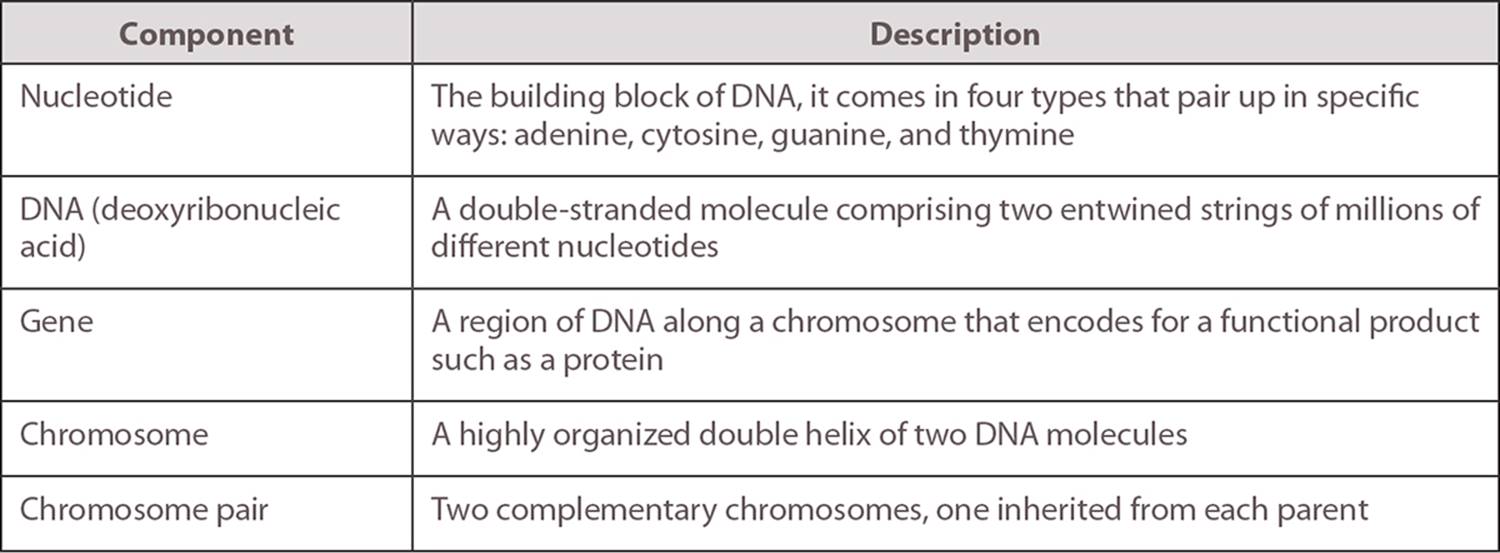
A molecule of DNA is composed of a string of millions of smaller units called nucleotides. Together, two intertwined DNA molecules interact to form a single double-helix structure called a chromosome in the nucleus—or control center—of the cell.
A normal human cell has ninety-two long molecules of DNA that pair up to form forty-six double-stranded chromosomes. Each of these, in turn, forms a chromosome pair with another similar—but not identical—chromosome, to create twenty-three different chromosome pairs.
Confused? Here’s a table that breaks down the different levels of organization of DNA:
View text version of this table
In addition to the DNA in the nucleus, hundreds or thousands of copies of a very small circular strand of DNA are found in the many mitochondria outside the nucleus. Mitochondria are tiny powerhouses of the cell responsible for, among other things, creating the energy our cells need to function.
Image B, a karyogram, is a photograph of a human’s karyotype, which is all of the chromosomes of the human cell arranged in pairs in a numbered sequence from longest to shortest. To make a karyogram, researchers stain chromosomes with a special chemical, then take a photograph of the stained chromosomes. The chromosomes are then digitally rearranged into pairs and organized into a specific numbered sequence. This karyogram also includes a ring of mtDNA for reference.
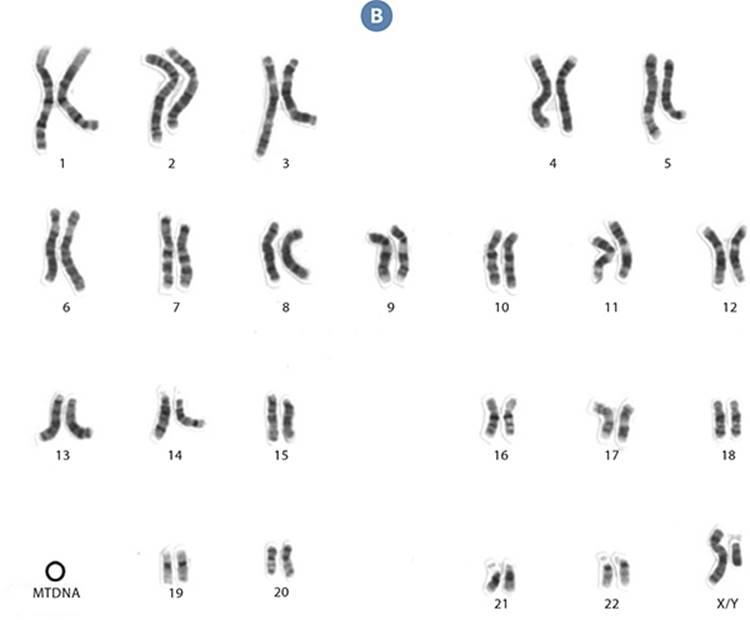
Each person has a unique genetic makeup, comprising twenty-two sets of chromosomes, a pair of sex chromosomes, and rings of mtDNA. These come together to form the human karyotype. This photo is courtesy of Darryl Leia of the National Human Genome Research Institute.
In this book, you will examine the four types of DNA used for genetic genealogy: mtDNA, Y-DNA, atDNA, and X-DNA.
1. Mitochondrial DNA (mtDNA) is a small, circular piece of DNA found in the cell’s energy factory, the mitochondria. This is the only DNA not found in the cell’s nucleus. mtDNA is passed exclusively from mother to child, and an mtDNA test reveals information about the test-taker’s direct maternal (or “umbilical”) line. Chapter 4 focuses on mtDNA testing.
2. Y-chromosomal DNA (Y-DNA) focuses on the Y chromosome, one of the two sex chromosomes that determine gender (the other being the X chromosome). Only men have a Y chromosome, and a Y-DNA test reveals information about the (male) test-taker’s Y chromosome, which is exclusively passed from fathers to sons. We’ll go into more detail about the Y-DNA test in chapter 5.
3. Autosomal DNA (atDNA) is composed of pairs of chromosomes found in the nucleus of the cell. Humans have twenty-three pairs of chromosomes (forty-six total), of which twenty-two are autosomal DNA (or “autosomes”) and one is sex chromosomes. One copy of each chromosome is inherited from the mother and one copy from the father. An atDNA test reveals information about both paternal and maternal lines, and we’ll discuss this test more in chapter 6.
4. X-chromosomal DNA (X-DNA) focuses on the X chromosome, one of the two sex chromosomes that determine gender (the other being the Y chromosome). Women have two X chromosomes, one from their father and one from their mother; men have one X chromosome from their mother. X-DNA is usually tested as part of an atDNA test. For men, the X-DNA test (the subject of chapter 7) reveals information about maternal lines. For women, the X-DNA test reveals information about both maternal and paternal lines.
Two Family Trees: One Genealogical and One Genetic
One of the most important aspects of understanding and interpreting DNA test results is that everyone has two very different (but overlapping) family trees: one that’s genealogical (reflecting familial relationships) and one that’s genetic (reflecting genetic makeup and patterns of inheritance). In short, your genealogical family tree will contain everyone in your genetic family, but not vice versa.
The Genealogical Family Tree
The first—and probably best-known and most-studied—family tree is the genealogical family tree, which contains every ancestor who had a child who had a child who had a child, and so on. A fully grown genealogical tree (image C) contains every parent, grandparent, and great-grandparent back through history. In most cases, this is the tree that genealogists spend their time researching, often using paper records such as birth and death certificates, census records, and newspapers to fill it in. Many genealogists find that the paper trail ends or becomes much more difficult to identify beyond the 1800s or 1700s, making it difficult to fill in many of the openings in the genealogical family tree.
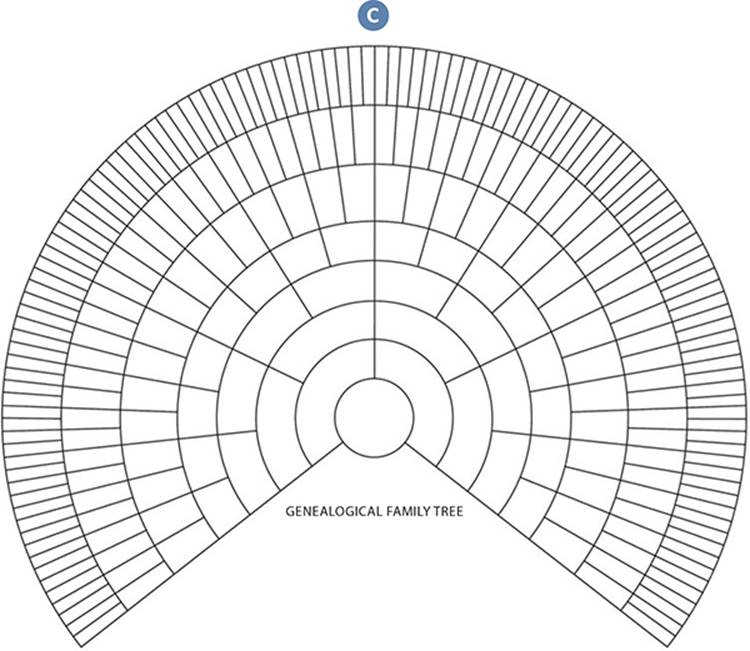
Your genealogical family tree comprises all of your known ancestors.
The Genetic Family Tree
The second family tree is the genetic family tree, which contains only those ancestors who contributed to your DNA. While this overlaps with your genealogical family tree, not every person in a genealogical family tree contributes a segment of his or her DNA sequence to the test-taker’s DNA sequence. A parent does not pass on all his DNA to his children (only about 50 percent); as a result, bits and pieces of DNA are lost in each generation. Your genetic family tree likely contains fewer ancestors than your genealogical family tree somewhere between five and nine generations back.
As shown in image D, where green cells indicate that the ancestor provided DNA to the test-taker and white cells indicate that the ancestor did not provide DNA to the test-taker, the genetic tree is actually just a subset of your genealogical tree. A genetic tree is guaranteed to contain both biological parents, who each contributed approximately 50 percent of the test-taker’s entire DNA sequence. The genetic tree also likely contains each of the test-taker’s four biological grandparents and eight biological great-grandparents, but it is much less likely with each generation that every person in the genealogical family tree contributed a piece of their DNA to the test-taker’s DNA.

Your genetic family tree (marked in green) comprises the ancestors who passed on their DNA to you, which will not include all the ancestors you know about (i.e., a genetic family tree is a subset of your genealogical family tree).
Since test-takers have a genetic family tree that is a subset of their genealogical family tree, a person will often share his genealogical family tree with another individual but their genetic family trees do not overlap. This simply means they did not both inherit the same DNA from their shared ancestor. These individuals are genealogical cousins but not genetic cousins, as genetic cousins share both a genealogical and a genetic link to one another (i.e., they share one or more recent individuals in their genetic family trees and therefore share detectable amounts of DNA from this common ancestor). Biological first cousins, for example, always share DNA and therefore will always be both genealogical cousins and genetic cousins.
Unfortunately, no one has yet been able to construct a very complete genetic family tree, due in part to the lack of extensive databases combining paper genealogy and genetics. With the recent development of tools that combine genetic testing with family trees, however, genetic genealogists are beginning to reconstruct portions of their genetic family trees.
CORE CONCEPTS: GENETIC GENEALOGY BASICS
Genetic genealogy started as a tool in history and forensic science. In the 1900s, DNA companies began offering genetic tests for use in genealogy.
Genealogists use four different kinds of DNA in testing: mitochondrial DNA (mtDNA), Y-chromosomal DNA (Y-DNA), autosomal DNA (atDNA), and X-chromosomal DNA (X-DNA). You’ll want to employ different tests depending on your research goals.
Everyone has two sets of ancestors: a genealogical family tree (ancestral family members) and a genetic family tree (ancestors who contributed DNA). The genetic family tree is a subset of the genealogical family tree and can sometimes be hard to pinpoint.