
DNA is a powerful tool for genealogists. It can confirm or correct family trees and pedigrees, find new relatives you never knew existed, and help you learn about your family’s ancient origins. However, DNA is not magic. Just as a census record or deed alone cannot provide all the answers to your genealogical questions, DNA is not a miracle solution to all research problems. To be successful, genetic genealogists must diligently work with their DNA test results and combine them with other types of records to reach a defensible conclusion.
In many ways, scientists, prosecutors, and genealogists have oversold DNA as a cure-all solution for understanding health, solving crimes, and breaking through brick walls. As a result, people have many misconceptions about how DNA can be used. For example, even if law enforcement has an excellent genetic sample, DNA cannot solve all crimes or identify all suspects or perpetrators. Even if researchers spend billions of dollars on genetic research, DNA cannot explain all causes of disease or provide a cure for all illnesses. And even if genealogists have the best tools and enormous databases of test-takers to draw from, DNA cannot break through every brick wall. Understanding the limitations of DNA is vital during all aspects of DNA testing, including when creating a testing plan, reviewing results, drawing conclusions, and writing about or sharing results. Mastering these tips will help you avoid the mistakes that genetic genealogists most often make.
In this chapter, we’ll address some of the most common misunderstandings about genetic genealogy and why they’re incorrect. As we examine each individual type of DNA tests in later chapters, you will gain an even more in-depth understanding of the benefits and limitations of genetic genealogy.
MISCONCEPTION #1: Genetic genealogy is just for fun.
There is no doubt that genetic genealogy is a fun and interesting new way to explore genealogy. Popular mainstream television shows like Finding Your Roots and Who Do You Think You Are? use DNA testing to support and augment the powerful family stories shared by celebrity guests. Print and online advertisements from 23andMe <www.23andme.com> and AncestryDNA <dna.ancestry.com>popularize ethnicity estimates, leading many thousands of people to purchase DNA tests and explore their roots. Young people in particular have been drawn to genealogy in greater numbers than ever before due in no small part to genetic genealogy. But can genetic genealogy only be used for entertainment?
A genealogist should examine every possible record that can shed light on a genealogical question. If you wonder whether Great-great-grandfather Ned owned land in rural New York (where he lived), you should of course check land records. But you should also check tax records, probate records, and any other records that might be helpful. Accordingly, a genealogist should use DNA testing whenever it may shed light on a question or whenever it can support an existing conclusion or hypothesis. The Smith line may be the most well-documented line you’ve ever reviewed or constructed, but have you tested your conclusions with DNA? Are you certain there weren’t any non-paternal events—breaks in the expected Y-DNA line due to adoption, infidelity, or other causes—that may not have shown up in the documentary evidence?
DNA testing is fun, but it’s much more than a form of entertainment. It is a piece of evidence, just like any census record, vital record, tax record, probate record, or land record, that should be evaluated as a potential tool for every research question. Eventually, considering DNA testing should become as reflexive to genealogists as checking an ancestor’s census returns and vital records.
MISCONCEPTION #2: I’m a woman, so I can’t take a genetic genealogy test myself.
Contrary to popular belief, women can take three of the four major genetic tests, and both male and female genealogists can benefit from the results of all four.
This misconception is due to technical limitations in early genetic genealogy. Back in the days when genetic genealogy was primarily basic Y-DNA and mitochondrial-DNA (mtDNA) testing, genealogists were repeatedly told that only men can take a Y-DNA test. Although women have always been able to take an mtDNA test, the early form of this test was not as genealogically informative as a Y-DNA test. Indeed, most of the emphasis was on Y-DNA testing for the first ten years of genetic genealogy (2000–2010), and so some women in the genealogy community felt excluded.
But women can even participate in Y-DNA testing, albeit not directly. For example, a woman interested in her Y-DNA line could find another living (and willing) source of that DNA. Fathers, brothers, uncles, or male cousins are all potential sources of Y-DNA for testing. In some cases in which you can’t find a father, uncle, or brother, the source may be several generations removed. But the secret to finding these sources is to do what every good genealogist does: Use documentary genealogical research to find a paternal line descendant who is willing to take a Y-DNA test.
Further, there is no limitation on who may take an autosomal-DNA (atDNA) test. atDNA examines many different lines of the family tree, rather than just the paternal (Y-DNA) and maternal (mtDNA) lines. Everyone has the same amount of atDNA and can take an atDNA test.
MISCONCEPTION #3: DNA testing will provide me with a family tree.
One of the biggest misconceptions surrounding genetic genealogy is that the results of a DNA test are a magic bullet for revealing your family tree. Unfortunately, a DNA test alone does not provide a family tree (or, at least, none of the tests that are currently available). The test-taker does not log into her DNA testing account and see a partial or complete family tree as part of the results. Instead, as we’ll see in chapter 6, the test-taker usually receives two categories of information: an ethnicity prediction and a list of genetic matches who share one or more segments of DNA with the test-taker.
DNA in conjunction with traditional research, however, is a powerful tool that can help you research and re-create your family tree. For example, the name of your great-grandmother is not directly encoded in your DNA, so simply analyzing your DNA with a test cannot reveal her name. However, clues to your great-grandmother’s identity are encoded in your DNA; she gave you some of her DNA, and you share some of that DNA with your genetic and genealogical cousins. Through DNA testing, documentary research, and hard work, you can collaborate with these genetic cousins to identify your shared ancestry, which may include your great-grandmother or your great-grandmother’s ancestor. This collaborative effort helps confirm branches of an existing family tree and helps break through brick walls.
Similarly, a genetic genealogy test can sometimes make it easy to find an existing family tree. Adoptees who take a DNA test and are able to connect with their biological families will also simultaneously receive biological family trees for one or both sides of their newly identified family. Although not all adoptees find their biological family after taking a DNA test, DNA testing increasingly is able to identify one or two parents of most adoptees.
To put it another way: Like most genealogical research, DNA testing cannot reach its full potential without context. In most cases, that context is the documentary research that the test-taker or the test-taker’s genetic matches have performed on their family trees.
MISCONCEPTION #4: DNA results are too narrow to be worthwhile.
This misconception is most commonly found in news articles writing about genealogy testing. For example, articles often highlight the fact that several types of DNA testing can only reveal information about a tiny percentage of your ancestry. Indeed, a Y-DNA test only examines the direct male line (your father’s father’s father, and so on). Similarly, an mtDNA test only examines the direct female line (your mother’s mother’s mother, and so on). A ten-generation family tree contains up to 1,024 ancestors at the tenth generation, but a Y-DNA or mtDNA test will reveal information about just one person out of those 1,024 ancestors.
However, the authors of these articles fail to understand the incremental nature of genealogical research. Most genealogists spend a great deal of resources—both time and money—attempting to uncover even the smallest piece of information about single individuals within their family tree. Further, as we’ll see in later chapters, being able to focus on one ancestor using DNA is incredibly valuable. The fact that the Y chromosome or mtDNA is found in just one of 1,024 ancestors at the tenth generation, for example, is part of what makes Y-DNA and mtDNA testing so powerful.
The authors of these articles also usually fail to understand atDNA testing, in which one DNA test examines many different lines of the family tree. Instead of obtaining information about just one ancestor in each generation, atDNA testing can potentially examine each of the many ancestors that provided DNA to our genomes. In the future, atDNA testing may even help identify ancestors who failed to provide DNA to us. (In other words, ancestors who are part of our genealogical family tree but not part of our genetic family tree; we’ll talk more about this in chapter 6.) This ability to examine multiple ancestors with a single test also makes atDNA testing more challenging, but that is part of genetic genealogy’s fun!
MISCONCEPTION #5: DNA testing will reveal my health information.
This misconception has its grounding in some truth. One of the driving forces behind sequencing the first human genome was to use the information to understand the causes of disease and to find cures or treatments, so most genetic testing was done for medical reasons before the advent of genetic genealogy and personal genomics. As a result, it’s not surprising that people anticipate the results of a genetic genealogy test will reveal their health information to both themselves and the testing company.
Indeed, there’s no question that a genetic genealogy test can reveal health information about the test-taker. The genetic genealogy testing company 23andMe, for example, tests hundreds or thousands of locations in the genome that can be health informative, then provides that information to test-takers. Additionally, some DNA testing may inadvertently reveal health information, perhaps because a new scientific discovery uncovers a previously unknown health-related implication of the small percentage of the genome analyzed by genetic genealogy testing. Or the analysis can uncover one of a very few rare conditions that are already known to be related to the test-taker’s health or other medical condition. For example, sequencing a commonly tested region (or marker) on the Y chromosome, DYS464, can reveal a serious deletion of a chromosome segment that results in male infertility. This deletion is very rare, occurring once in every four to eight thousand men. Some metabolic diseases can also be detected by full mtDNA sequencing.
However, you have several reasons not to be concerned about the possibility of revealing health information. While at one time, it was thought that sequencing a person’s DNA would reveal what illnesses they would contract in their lifetime, current DNA testing simply can’t lead to such dramatic conclusions. (Indeed, the 1997 movie Gattaca examined this now-erroneous prediction, with its main character, a man in the not-so-distant future with a DNA sequence that determines a short life expectancy, having to fight against the genetic-based discrimination he faces.) Scientists have discovered that the correlation between health and genetics is complex and that the environment plays a much larger role in determining our health. With the rare exception of individuals with serious genetic diseases that were already diagnosed before a genetic genealogy test, a test cannot reveal our major illnesses or eventual cause of death.
Further, with the exception of 23andMe, which intentionally offers health information as part of its test, most of the major genetic testing companies intentionally do not test health-related locations of the genome. And even if they do test for these locations, they scrub that information from the test results and do not provide it to the test-taker.
Accordingly, as this misconception has a strong basis in reality, test-takers should be aware of what they may learn about themselves before agreeing to take a test. Even though the correlation between our health and DNA is weak (and that even if armed with your entire DNA sequence of six billion nucleotides, a scientist can almost never predict your health, major illnesses, or cause of death), test-takers who remain worried about privacy and health can further alleviate their concerns by only testing at a company that intentionally does not provide health information.
MISCONCEPTION #6: My parents and grandparents are deceased, so genetic genealogy won’t help me.
Although the ability to test parents and grandparents is invaluable, it’s not necessary to successfully use DNA, and you can take advantage of some workarounds. Genetic genealogy is based on using DNA from today to understand and uncover the mysteries of yesterday; the DNA you walk around with today, which you inherited from your parents and grandparents, can be used to study your genetic family tree without testing any other relatives. Accordingly, don’t despair if the answer you seek requires DNA from someone other than yourself. In most cases, DNA can be found in other living people who can be identified using traditional genealogical methods.
For example, males carry the Y-DNA that was given to them by their fathers, who received it from their fathers, and so on. As a result, there’s usually no need to use Grandpa’s Y-DNA when you predict your (or a living male relative’s) Y-DNA to be the same. But testing can be more difficult if you’re looking for Y-DNA from someone in your family tree other than your direct paternal line. To obtain that Y-DNA, trace the ancestor’s male descendants and find a living direct male descendant willing to take a Y-DNA test. Similarly, first cousins received a huge amount of DNA from the shared grandparents, and second cousins received a significant amount of DNA from the shared great-grandparents.
The more family members you test, the easier it usually is to make discoveries and breakthroughs. At every generation, 50 percent of the previous generation can be lost if only one person tests. For example, you only carry half of your father’s DNA and half of your mother’s DNA, and on average you only carry 25 percent of the DNA from each of your four grandparents. If you can test your parents or grandparents, you can regain the 50 or 75 percent that might otherwise be lost. Similarly, testing aunts/uncles and siblings will regain an additional (though lesser) percentage since they inherited some of the same DNA and some unique DNA from your shared ancestors. We’ll learn much more about this in chapter 6.
MISCONCEPTION #7: Genetic genealogy testing is a violation of privacy.
Many people choose not to undergo DNA testing because they are afraid the results could be utilized for nefarious purposes, including by insurance companies and law enforcement agencies. Although the likelihood that your DNA will be used for an unintended purpose is extremely low, every genealogist must consider the implications of DNA testing before purchasing or taking a genetic genealogy test.
There is no question that we lose some control over our genetic information when we send away a saliva sample, although the three major DNA testing companies go to great lengths to project the genetic information in their databases. The pertinent question, therefore, is what a loss of control could potentially mean.
As we just learned, the correlation between our health and DNA is weak for most test-takers, and so you needn’t worry about having sensitive information about your health revealed through DNA. For the most part, your DNA test results will simply reveal that you need to eat better and exercise more—advice you have probably heard already. Although specialized DNA can reveal more serious diseases for a very small number of people, most commercial genetic genealogy testing is designed to avoid this information.
Additionally, US federal law grants some limited protection in the form of the Genetic Information Nondiscrimination Act of 2008 (or GINA). GINA prohibits the use of genetic information by employers (who have fifteen or more employees) to make hiring, firing, or promotion decisions, and prevents health insurers from using genetic information to deny coverage or increase premiums. GINA, however, is not an absolute bar, and thus genetic information could potentially still be utilized by entities offering life insurance, disability insurance, and long-term care insurance.
Additionally, while it is possible that law enforcement agencies could potentially obtain your DNA results from a testing company, it is unlikely. There is no chain of custody for DNA test results from a commercial genetic genealogy company, meaning that the law enforcement agency cannot reliably ascertain that the DNA came from you. Subpoenaing this information from a testing company is also an expensive and complicated mechanism by which to obtain your DNA. We leave a trail of DNA everywhere we go, and thus it is far easier and cheaper for an agency to analyze a cup you leave behind at a restaurant or a bag of garbage you leave at the curb than to obtain a sample from a private testing company.
Having considered this, many of the concerns you might have about the privacy of your information is unfounded. While sending away a DNA sample to a testing company necessarily relinquishes some control over your DNA sequence, you’re unlikely to face negative consequences from giving up that control.
MISCONCEPTION #8: Because my mother/father/sibling shares atDNA with a genetic match, I should also share atDNA with that person.
Unless you understand how DNA is transmitted from one generation to the next, it’s easy to believe that you share all of your parent’s or sibling’s matches. If my father shares DNA with his fourth cousin, shouldn’t I share DNA with that same cousin (my fourth cousin once removed)? And if I don’t, does that mean I’m actually not my father’s child?
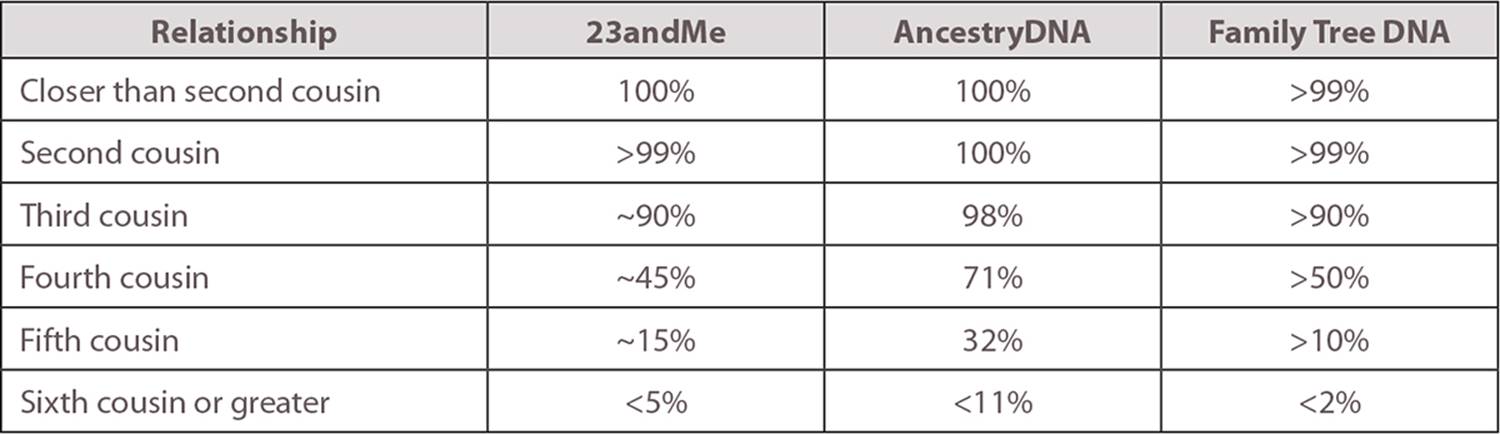
The answer depends on the genealogical relationship. As we’ll see in chapter 6 on atDNA, the likelihood of sharing DNA with genealogical relatives is very high for close matches and very low for distant matches. The table below provides estimates from 23andMe, AncestryDNA, and Family Tree DNA <www.familytreedna.com> of the likelihood that genealogical relatives will share a detectable amount of DNA in common.
View text version of this table
While your father may have had a 45-percent chance of sharing DNA with that fourth cousin, your likelihood of sharing DNA with that same cousin—who is your fourth cousin once removed—is significantly less. However, if your parent’s or sibling’s genetic match is predicted to be very close, such as a first cousin, you should still share DNA with that genetic match.
This relates back to the concept of a genealogical family tree and a genetic family tree. Unless your sibling is an identical twin with the same DNA, your genetic family tree and your sibling’s genetic family tree will be only partially overlapping. Your sibling will have some ancestors in his or her genetic family tree—and hence some genetic cousins and matches—who you don’t have, and vice versa.
The same is true for your parent’s genetic family tree. However, since you only inherited 50 percent of your parents’ DNA, you are a subset of each parent’s genetic family tree. As a result, you must share each and every one of your true genetic matches with one (or both) of your parents, but your parents do not need to share each of their genetic matches with you.
Image A shows the overlap of matches between two parents and their two children. Both the mother and father have matches who each of the children don’t have. Each child’s universe of possible genetic matches, however, is entirely within the father and mother’s match lists. The children share many of their matches in common (“Matches shared by father and both children” and “Matches shared by mother and both children”) but each share matches with a parent that the other does not share.

Remembering which of your ancestors share DNA (and which share DNA with you) can be confusing. The Venn diagram above displays the possible relationships between a father’s and mother’s lines and that of their children.
In many cases, the mother and father will share genetic matches as well, but the parents are shown as not sharing any DNA or genetic matches for the purposes of this diagram.
MISCONCEPTION #9: I should share DNA with my genealogical relatives.
This misconception is closely related to the previous misconception. Many test-takers purchase a DNA test expecting to receive a list of all genealogical relatives who have also taken a DNA test. However, because each generation receives only 50 percent of the DNA from the previous generation, you will actually fail to match most of your genealogical cousins, at least beyond about the fourth-cousin level. As the previous table shows, while you will match all your second cousins and closer relatives, the likelihood of matching fourth cousins and beyond gets exceedingly rare with each generation.
This does not mean, however, that you and a fourth cousin who does not share DNA with you can’t both have the same common ancestor in your genetic family trees. In order to share DNA with a genealogical relative, all of the following conditions must be met:
1. You inherited DNA from a certain ancestor.
2. Your genealogical cousin inherited DNA from that same ancestor.
3. You and your genealogical cousin inherited at least some of the same DNA from that shared ancestor.
If you and a genealogical cousin fail to share DNA in common, one or more of these three conditions have not been met. Another condition is that the shared segment(s) of DNA must be detectable, meaning it must be a sizeable enough segment of DNA to be identified by the testing company. We’ll talk more about company thresholds in chapter 6.
Understanding who you might share DNA with—and the many reasons you might not share DNA with them—is one of the most important aspects of genetic genealogy.
MISCONCEPTION #10: My ethnicity estimate from the testing company should match my known genealogy.
The ability to predict ethnicity based on the genealogical family tree is one of the biggest misconceptions in genetic genealogy. It is also one of the biggest complaints from test-takers, confusing and angering people who expect their ethnicity estimate to perfectly match their known genealogy.
However, it is impossible to predict an ethnicity estimate based on known genealogy for a number of reasons. First, as we’ll see in chapter 9, ethnicity estimates are inherently limited by several factors including the size and composition of the reference populations—the populations from all over the world to which every test-taker is compared—used for the analysis. The testing companies are continually adding to their reference populations, but they are still rather small. As a result of these factors, an ethnicity estimate is simply an estimate and thus should not be considered an absolute or final determination. Indeed, it should be expected that every ethnicity estimate will change at least slightly over time as reference populations continue to grow and the testing companies improve their ethnicity estimate algorithms.
In addition to the inherent limitations of ethnicity estimates, it’s impossible to predict an individual’s ethnicity due to the limited knowledge most people have about their genetic family tree. As we saw in the previous chapter, everyone has both a genealogical family tree and a genetic family tree, with the genetic tree being a small subset of the genealogical tree. However, the issue for ethnicity estimates is that you don’t know which subset of your genealogical tree makes up your genetic tree.
For example, image B shows a genetic family tree with a particular ethnicity of interest highlighted in blue. However, the individuals in the tree who actually provided DNA to the test-taker are highlighted in green. Since the individuals highlighted in blue failed to provide any DNA to this particular descendant, their ethnicity cannot be detected using only the descendant’s test results. And since this isn’t on the test-taker’s Y-DNA or mtDNA line, those tests will not detect this ethnicity either. There is no question that this ethnicity existed in the test-taker’s family tree, but it cannot be detected with the test-taker’s current test results.

Ethnicity estimates given by testing companies may not reflect all your ancestors’ ethnicities. Rather, they only roughly estimate the ethnicities of your genetic family tree (highlighted in green) and can leave out ethnicities of ancestors who didn’t pass on their DNA to you (such as the ancestors highlighted in blue).
This phenomenon will occur all across the test-taker’s family tree, meaning that the test-taker cannot predict which ancestors’ ethnicities might be detected. Further, as we’ll see in later chapters, even for ancestors who are located within the test-taker’s genetic family tree, such little DNA is passed down after a few generations and that some ethnicities may not be detected.
In some instances, the test-taker may have a family tree with roots in a single location for hundreds of years, such as in England or continental Europe. In this case, it is often possible to have a good approximation of this ethnicity estimate, although even these populations cannot exactly predict the ethnicities of the genetic family tree. Most people come from regions of the world where populations have not been completely stable and weren’t isolated for the hundreds or thousands of years it takes for ethnicity to be well defined.
MISCONCEPTION #11: The relationship prediction provided by the testing company is the actual genealogical relationship.
Each of the testing companies provides a relationship prediction based largely on the amount of DNA that the test-taker shares with the genetic match. The relationship predictions are usually a range of possible relationships rather than an exact relationship prediction. Each of the major genetic genealogy testing companies has a slightly different set of relationship predictions. Family Tree DNA provides a relationship range (image C), such as a range from second cousins to fourth cousins. AncestryDNA arranges matches into categories such as “1st Cousin” and “2nd Cousin,” but also provides a possible relationship range (image D). Clicking on the question mark next to each relationship range produces a pop-up with additional information. Testing company 23andMe also provides relationship ranges. In image E, the relationships range from second cousin to sixth cousin. Clicking on a match reveals a profile page with a more specific relationship prediction.

Family Tree DNA provides relationship ranges for DNA matches, such as from second cousins to fourth cousins.

Like Family Tree DNA, AncestryDNA provides a relationship range, as well as a confidence interval and a quick link to the match’s family tree.

The third major testing company, 23andMe, also provides test-takers with relationship range estimates for potential matches, along with a percentage of shared tested DNA.
We’ll also learn a lot more about these relationship predictions in chapter 6.
Accordingly, the testing companies provide a relationship prediction, but the test-taker is not guaranteed that the prediction is the exact genealogical relationship between those individuals. Similar relationships can result in similar amounts of DNA being shared by genetic matches, complicating relationship predictions. For example, a first cousin and a first cousin once removed may share similar amounts of DNA with a relative. Further, relationship predictions are complicated when there are multiple relationships within the family tree. As just one example, double first cousins (relatives who share both sets of grandparents in common; e.g., if a pair of brothers has children with a pair of sisters) can share an amount of DNA very similar to half-siblings. Other, more distant relationships can also impact the predictions. Additionally, relationship predictions cannot be accurate at more distant genealogical relationships. For example, a seventh cousin and a tenth cousin typically share very small but possibly similar amounts of DNA with their relatives.
Even with these limitations and misconceptions, genetic genealogy can be an informative and exciting addition to traditional research that can often be used to answer specific genealogical mysteries. There are many—even hundreds—of genealogical success stories thanks to the proper use of genetic genealogy. To read about just a few of these inspiring success stories, see the International Society of Genetic Genealogy (ISOGG) Success Stories <www.isogg.org/successstories.htm>. In part two of this book, we’ll dive into the different types of DNA testing and how they may be used to advance your genealogical research.
CORE CONCEPTS: COMMON MISCONCEPTIONS
Genetic genealogy can be entertaining, but it is also an essential research tool for every genealogist.
Anyone can take an atDNA or mtDNA test. Although only men can take a Y-DNA test, women can find a male relative to take a Y-DNA test for their research.
DNA testing, alone, does not provide the test-taker with a completed family tree. Although mtDNA and Y-DNA tests examine just one person in each generation, that is part of what makes them such powerful research tools.
DNA testing can potentially reveal health information, but understanding the different company offerings and how the tests can reveal health information can help prevent most issues.
Although testing parents and grandparents can be useful, those relatives are not necessary to utilize genetic genealogy.
Since your genetic family tree is just a small subset of your genealogical family tree, you will not share DNA with all of your genealogical relatives. In fact, you will not share all of your parent’s or sibling’s genetic matches, as you inherit only 50 percent of your parent’s DNA, and you only share about 50 percent of your DNA with your sibling.
You cannot accurately predict your ethnicity estimate based on your known genealogy. Similarly, relationship predictions from testing companies are just estimates and should only be considered as possible relationships requiring additional research.