EQUIPMENT
 Gloves
Penlight
EXAMINATION
Have patient lying or standing to start examination.
|
TECHNIQUE |
FINDINGS |
|
Wear gloves on both hands |
|
|
Inspect pubic hair |
|
|
|
EXPECTED:Coarser than scalp hair. |
|
|
EXPECTED:Male hair distribution. Abundant in pubic region, continuing around scrotum to anal orifice, possibly continuing in narrowing midline to umbilicus. Penis without hair, scrotum with scant hair. |
|
UNEXPECTED:Alopecia. |
|
|
Inspect glans penis |
|
|
Retract foreskin or ask patient to do so. |
EXPECTED:Dorsal vein apparent. Foreskin easily retracted. White, cheesy smegma visible over glans. |
|
UNEXPECTED:Tight foreskin (phimosis). Lesions or discharge. |
|
|
|
EXPECTED:Dorsal vein apparent. Exposed glans erythematous and dry. |
|
UNEXPECTED:Lesions or discharge. |
|
|
Examine external meatus of urethra (foreskin retracted in uncircumcised patient) |
|
|
|
EXPECTED:Slitlike opening. |
|
UNEXPECTED:Pinpoint or round opening. |
|
|
|
EXPECTED:On ventral surface and only millimeters from tip of glans. |
|
UNEXPECTED:Any place other than tip of glans or along shaft of penis. |
|
|
Press glans between thumb and forefinger |
EXPECTED:Opening glistening and pink. |
|
UNEXPECTED:Bright erythema or discharge. |
|
|
Palpate penis |
|
|
EXPECTED:Soft (flaccid penis). |
|
|
UNEXPECTED:Tenderness, induration, or nodularity. Prolonged erection (priapism). |
|
|
Strip urethra |
|
|
Firmly compress base of penis with thumb and forefinger; move toward glans. |
UNEXPECTED:Discharge. |
|
Inspect scrotum and ventral surface of penis |
|
|
|
EXPECTED:Darker than body skin and often reddened in red-haired patients. |
|
|
EXPECTED:Surface possibly coarse. Small lumps on scrotal skin (sebaceous or epidermoid cysts) that sometimes discharge oily material. |
|
|
EXPECTED:Asymmetry. Thickness varying with temperature, age, emotional state. |
|
UNEXPECTED:Unusual thickening, often with pitting. |
|
|
Palpate inguinal canal for direct or indirect hernia |
|
|
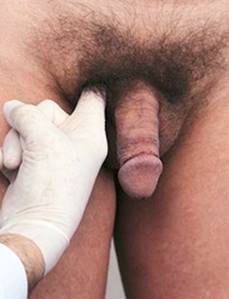
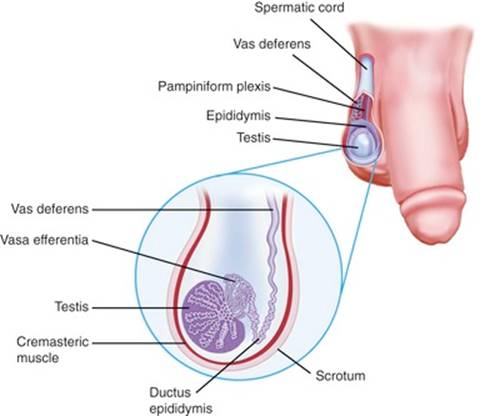
With patient standing, ask him to bear down as if for bowel movement. While he strains, inspect area of inguinal canal and region of fossa ovalis. Ask patient to relax, and insert examining finger into lower part of scrotum and carry upward along vas deferens into inguinal canal, as shown in figure on p. 202. Ask patient to cough. Repeat examination on opposite side. |
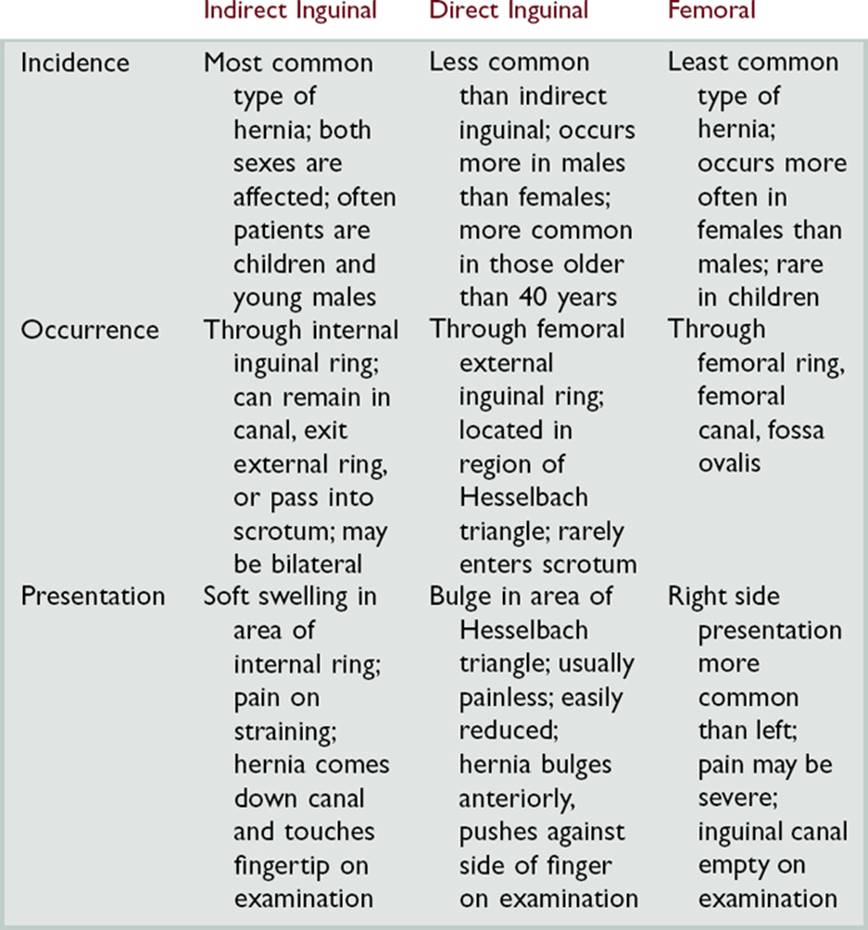
EXPECTED:Presence of oval external ring. UNEXPECTED:Feeling a viscus against examining finger with coughing. If hernia felt, note as indirect (felt within inguinal canal or even into scrotum) or direct (felt medial to external canal). |
|
|
|
|
Palpate testes |
|
|
Use thumb and first two fingers. |
|
|
|
EXPECTED:Smooth and rubbery. Sensitive to gentle compression. |
|
UNEXPECTED:Tenderness or nodules. Total insensitivity to painful stimuli. |
|
|
|
UNEXPECTED:Irregular texture. |
|
|
UNEXPECTED:Irregular size; asymmetry in size, less than 1 cm or greater than 5 cm. |
|
|
UNEXPECTED:Cryptorchidism. |
|
Palpate epididymides |
|
|
EXPECTED:Smooth and discrete, with larger part cephalad. |
|
|
UNEXPECTED:Tenderness. |
|
|
Palpate vas deferens |
|
|
Palpate from testicle to inguinal ring. Repeat with other testicle. |
EXPECTED:Smooth and discrete. |
|
UNEXPECTED:Beaded or lumpy. |
|
|
Palpate for inguinal lymph nodes |
|
|
Ask patient to lie supine, with knee slightly flexed on side of palpation. |
EXPECTED:Nodes unable to be palpated. |
|
UNEXPECTED:Enlarged, tender, red or discolored, fixed, matted, inflamed, or warm nodes and increased vascularity. |
|
|
Elicit cremasteric reflex bilaterally |
|
|
Stroke inner thigh with blunt instrument. Repeat with other thigh. |
|
AIDS TO DIFFERENTIAL DIAGNOSIS
|
ABNORMALITY |
DESCRIPTION |
|
Hernia |
See table on p. 205. |
|
Genital herpes |
Subjective Data:Painful lesions on penis; sexually active; may report burning or pain with urination. |
|
Objective Data:Superficial vesicles—located on glans, penile shaft, or base of penis; often associated with inguinal lymphadenopathy. |
|
|
Condylomata acuminata (genital warts) |
Subjective Data:Soft painless warty-like lesions on penis. Sexually active. |
|
Objective Data:Single or multiple papular lesions; may be pearly, filiform, fungating (ulcerating and necrotic) cauliflower, or plaquelike. |
|
|
Hydrocele |
Subjective Data:Painless enlargement or swelling of the scrotum. |
|
Objective Data:Nontender, smooth, firm mass superior and anterior to the testis. Transilluminates. |
|
|
Varicocele |
Subjective Data:Usually asymptomatic (and found during evaluation for infertility); may report scrotal pain or heaviness |
|
Objective Data:Abnormal tortuosity and dilated veins of pampiniform plexus within spermatic cord; described as “bag of worms.” |
|
|
Epididymitis |
Subjective Data:Painful scrotum, urethral discharge, fever, pyuria, recent sexual activity. |
|
Objective Data:Possible erythema of overlying scrotum, epididymis feels firm and lumpy and may be slightly tender, and vasa deferentia may be beaded. |
|
|
Testicular torsion |
Subjective Data:Acute onset of scrotal pain, often accompanied by nausea and vomiting; absence of systemic symptoms such as fever and myalgia. |
|
Objective Data:Testicle is exquisitely tender; scrotal discoloration often present. |
|
|
Testicular cancer |
Subjective Data:Painless mass in testicle, scrotal enlargement or swelling; sensation of heaviness in the scrotum, dull ache in the lower abdomen, back, or groin. |
|
Objective Data:Irregular, nontender mass fixed on the testis; does not transilluminate. |
|
|
Paraphimosis |
Subjective Data:Retraction of the foreskin during penile examination, cleaning, urethral catheterization, or cystoscopy; penile pain and swelling. |
|
Objective Data:Glans penis congested and enlarged; foreskin edematous; constricting band of tissue directly behind the head of the penis. |
Distinguishing Characteristics of Hernias
Pediatric Variations
EXAMINATION
|
TECHNIQUE |
FINDINGS |
|
Inspect glans penis |
|
|
Retract foreskin. |
EXPECTED:In children, foreskin is fully retractable by age 3 to 4 years. Before that age, forced retraction of foreskin may result in injury. |
|
Palpate scrotum |
|
|
Palpate testes in children to determine whether testes have descended. If any mass other than testicles or spermatic cord is palpated in scrotum, determine whether it is filled with fluid, gas, or solid material. |
EXPECTED:Bilaterally palpable; 1 cm. Considered descended if testis can be pushed into scrotum. UNEXPECTED:If penlight transilluminates, most likely contains fluid (hydrocele). If no light transillumination, most likely a hernia. |
|
Evaluate maturation in adolescence |
|
|
Assess stage of pubertal development |
|
|
In males, assess the stage of genital and pubic hair development. |
EXPECTED:Tanner stages of male pubic hair and external genital development progress in the sequence shown on p. 207. |
|
UNEXPECTED:Failure to mature and premature maturation. |
|
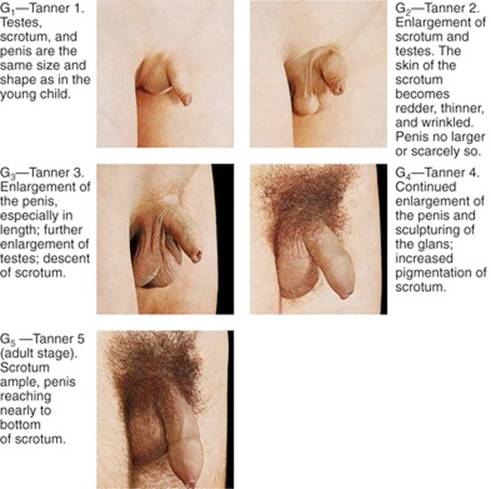
Five stages of penis and testes/scrotum development in males. From Van Wieringen et al, 1971.
SAMPLE DOCUMENTATION
Genitalia.Circumcised. Glans, penile shaft, contents of scrotal sac are intact without lesions or areas of induration. Urethral meatus patent on ventral surface at tip of glans. No discharge evident. Scrotal contents smooth without swelling, masses, or tenderness. Testes size equal. Inguinal areas are smooth; no masses or nodes palpable. Inguinal canals are free of masses, bulges. Cremasteric reflex elicited.
 Characteristics