
APPROACH TO THE PATIENT Headache
Headache is among the most common reasons that pts seek medical attention. Headache can be either primary or secondary (Table 55-1). First step—distinguish serious from benign etiologies. Symptoms that raise suspicion for a serious cause are listed in Table 55-2. Intensity of head pain rarely has diagnostic value; most pts who present to emergency ward with worst headache of their lives have migraine. Headache location can suggest involvement of local structures (temporal pain in giant cell arteritis, facial pain in sinusitis). Ruptured aneurysm (instant onset), cluster headache (peak over 3–5 min), and migraine (onset over minutes to hours) differ in time to peak intensity. Provocation by environmental factors suggests a benign cause.
TABLE 55-1 COMMON CAUSES OF HEADACHE

TABLE 55-2 HEADACHE SYMPTOMS THAT SUGGEST A SERIOUS UNDERLYING DISORDER
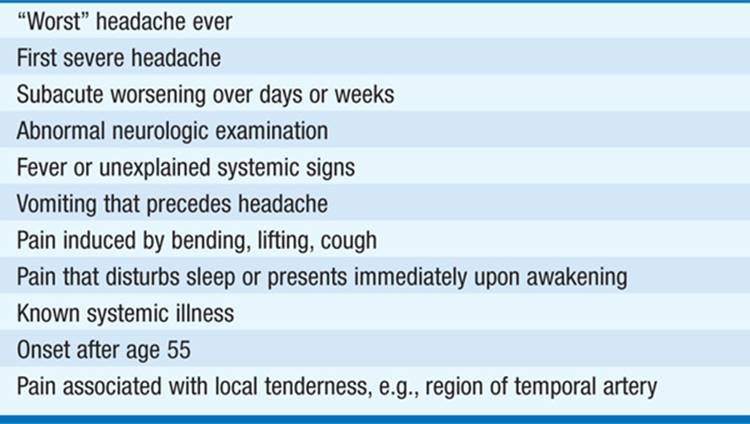
Complete neurologic exam is important in the evaluation of headache. If exam is abnormal or if serious underlying cause is suspected, an imaging study (CT or MRI) is indicated as a first step. Lumbar puncture (LP) is required when meningitis (stiff neck, fever) or subarachnoid hemorrhage (after negative imaging) is a possibility. The psychological state of the pt should also be evaluated since a relationship exists between pain and depression.
MIGRAINE
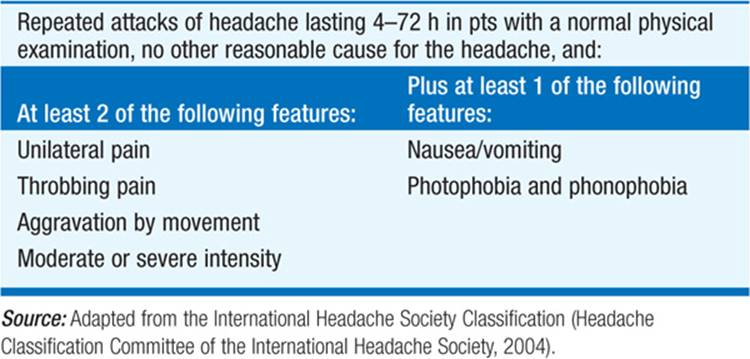
A benign and recurring syndrome of headache associated with other symptoms of neurologic dysfunction in varying admixtures. Second to tension-type as most common cause of headache; afflicts ~15% of women and 6% of men annually. Diagnostic criteria for migraine are listed in Table 55-3. Onset usually in childhood, adolescence, or early adulthood; however, initial attack may occur at any age. Family history often positive. Women may have increased sensitivity to attacks during menstrual cycle. Classic triad: premonitory visual (scotoma or scintillations), sensory, or motor symptoms; unilateral throbbing headache; and nausea and vomiting. Most pts do not have visual aura or other premonitory symptoms and are therefore referred to as having “common migraine.” Photo- and phonophobia common. Vertigo may occur. Focal neurologic disturbances without headache or vomiting (migraine equivalents) may also occur. An attack lasting 4–72 h is typical, as is relief after sleep. Attacks may be triggered by glare, bright lights, sounds, hunger, stress, physical exertion, hormonal fluctuations, lack of sleep, alcohol, or other chemical stimulation.
TABLE 55-3 SIMPLIFIED DIAGNOSTIC CRITERIA FOR MIGRAINE
TREATMENT Migraine
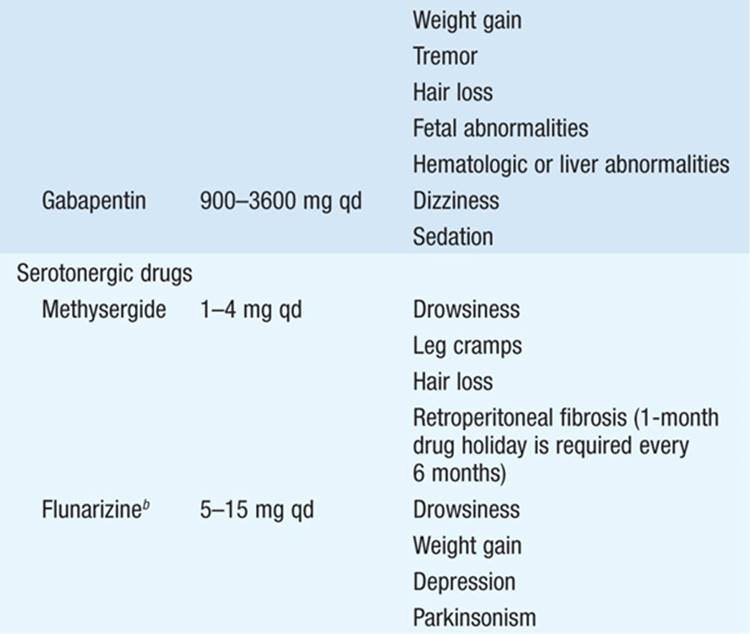
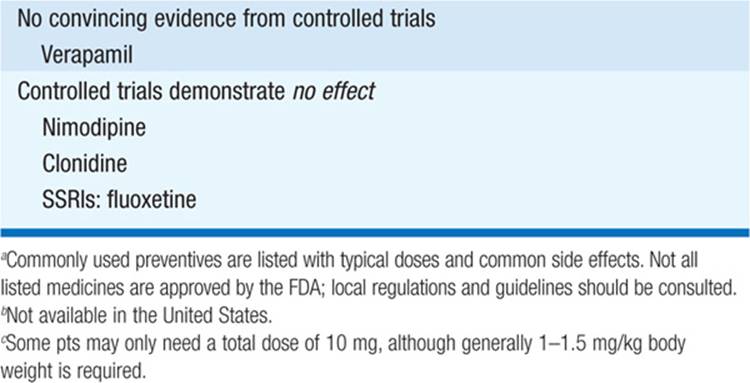
• Three approaches to migraine treatment: nonpharmacologic (such as the avoidance of pt-specific triggers; information for pts is available at www.achenet.org); drug treatment of acute attacks (Tables 55-4and 55-5); and prophylaxis (Table 55-6).
TABLE 55-4 TREATMENT OF ACUTE MIGRAINE

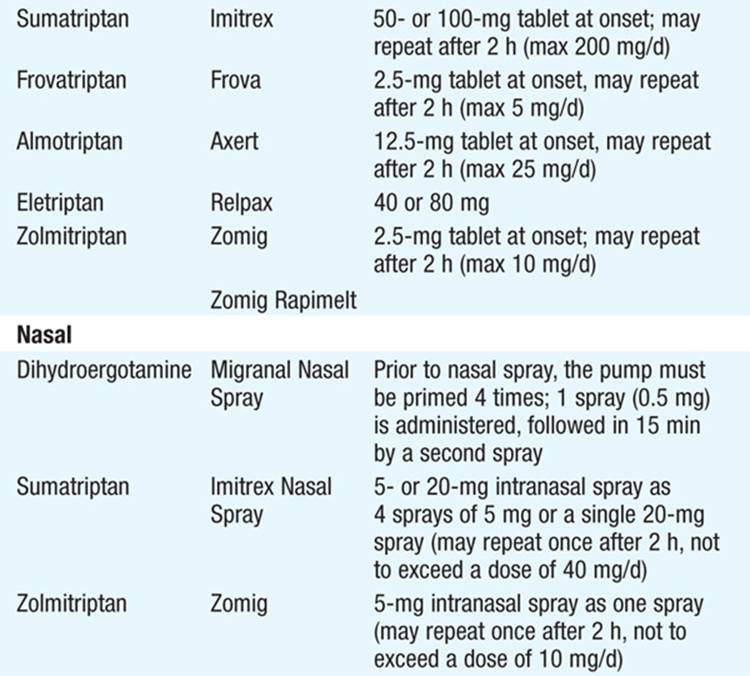

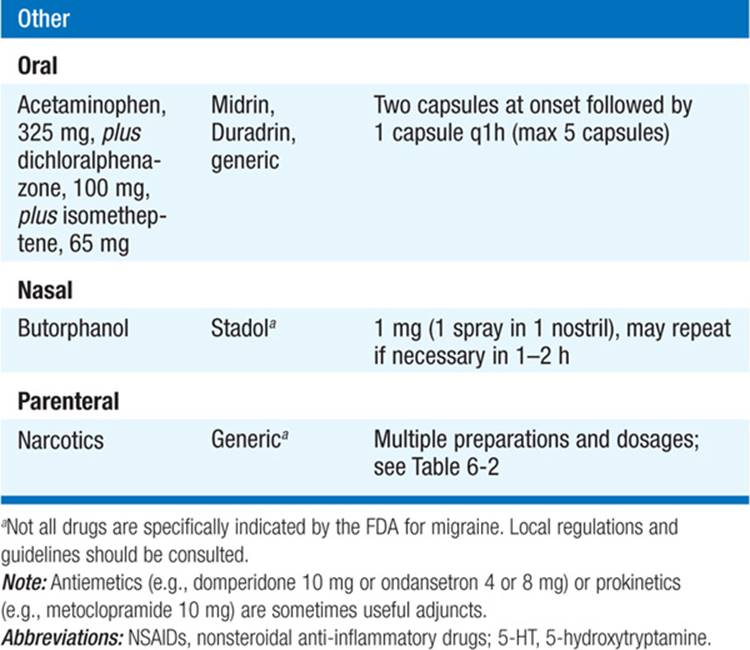
TABLE 55-5 CLINICAL STRATIFICATION OF ACUTE SPECIFIC MIGRAINE TREATMENTS


TABLE 55-6 PREVENTIVE TREATMENTS IN MIGRAINEa

• Drug treatment necessary for most migraine pts, but avoidance or management of environmental triggers is sufficient for some.
• General principles of pharmacologic treatment:
• Response rates vary from 50—70%.
• Initial drug choice is empirical—influenced by age, coexisting illnesses, and side effect profile.
• Efficacy of prophylactic treatment may take several months to assess with each drug.
• When an acute attack requires additional medication 60 min after the first dose, then the initial drug dose should be increased for subsequent attacks.
• Mild to moderate acute migraine attacks often respond to over-the-counter (OTC) NSAIDs when taken early in the attack.
• Triptans are widely used also but many have recurrence of pain after initial relief.
• There is less frequent headache recurrence when using ergots, but more frequent side effects.
• For prophylaxis, tricyclic antidepressants are a good first choice for young people with difficulty falling asleep; verapamil is often a first choice for prophylaxis in the elderly.
Tension-Type Headache
Common in all age groups. Pain is described as bilateral tight, bandlike discomfort. May persist for hours or days; usually builds slowly.
• Pain can be managed generally with simple analgesics such as acetaminophen, aspirin, or NSAIDs.
• Often related to stress; responds to behavioral approaches including relaxation.
• Amitriptyline may be helpful for chronic (>15 days per month) tension-type headache prophylaxis.
Cluster Headache
Rare form of primary headache; population frequency 0.1%. Characterized by episodes of recurrent, deep, unilateral, retroorbital searing pain. Unilateral lacrimation and nasal and conjunctival congestion may be present. Visual complaints, nausea, or vomiting are rare. Unlike migraine, pts with cluster tend to move about during attacks. A core feature is periodicity. Typically, daily bouts of one to two attacks of relatively short-duration unilateral pain for 8–10 weeks a year; usually followed by a pain-free interval that averages a little less than a year. Alcohol provokes attacks in 70%.
• Prophylaxis with verapamil (40–80 mg twice daily to start), lithium (400–800 mg/d), prednisone (60 mg/d for 7 days followed by a taper over 21 days), or ergotamine (1–2 mg suppository 1–2 h before expected attack).
• High-flow oxygen (10–12 L/min for 15–20 min) or sumatriptan (6 mg SC or 20-mg nasal spray) is useful for the acute attack.
• Deep-brain stimulation of the posterior hypothalamic gray matter is successful for refractory cases as is the less-invasive approach of occipital nerve stimulation.
Post-Concussion Headache
Common following motor vehicle collisions, other head trauma; severe injury or loss of consciousness often not present. Symptoms of headache, dizziness, vertigo, impaired memory, poor concentration, irritability; typically remits after several weeks to months. Neurologic examination and neuroimaging studies normal. Not a functional disorder; cause unknown and treatment usually not satisfactory.
Lumbar Puncture Headache
Typical onset within 48 h after LP; follows 10–30% of LPs. Positional: onset when pt sits or stands, relief by lying flat. Most cases remit spontaneously in ≤1 week. Oral or IV caffeine (500 mg IV over 2 hours) successful in 85%; epidural blood patch effective immediately in refractory cases.
Cough Headache
Transient severe head pain with coughing, bending, lifting, sneezing, or stooping; lasts for several minutes; men > women. Usually benign, but posterior fossa mass lesion in some pts; therefore consider brain MRI.
Indomethacin-Responsive Headaches
A diverse set of disorders that respond often exquisitely to indomethacin includes:
• Paroxysmal hemicrania: Frequent unilateral, severe, short-lasting episodes of headache that are often retroorbital and associated with autonomic phenomena such as lacrimation and nasal congestion.
• Hemicrania continua: Moderate and continuous unilateral pain associated with fluctuations of severe pain that may be associated with autonomic features.
• Primary stabbing headache: Stabbing pain confined to the head or rarely the face lasting from 1 to many seconds or minutes.
• Primary cough headache
• Primary exertional headache: Has features similar to cough headache and migraine; usually precipitated by any form of exercise.
FACIAL PAIN
Most common cause of facial pain is dental; triggered by hot, cold, or sweet foods. Exposure to cold repeatedly induces dental pain. Trigeminal neuralgia consists of paroxysmal, electric shock–like episodes of pain in the distribution of trigeminal nerve; occipital neuralgia presents as lancinating occipital pain. These disorders are discussed in Chap. 199.

For a more detailed discussion, see Goadsby PJ, Raskin NH: Headache, Chap. 14, p. 112, in HPIM-18.