
Syncope is a transient, self-limited loss of consciousness and postural tone due to reduced cerebral blood flow. It may occur suddenly, without warning, or may be preceded by presyncopal symptoms such as lightheadedness or faintness, weakness, fatigue, nausea, dimming vision, ringing in ears, or sweating. The syncopal pt appears pale and has a faint, rapid, or irregular pulse. Breathing may be almost imperceptible; transient myoclonic or clonic movements may occur. Recovery of consciousness is prompt if pt is maintained in a horizontal position and cerebral perfusion is restored.
APPROACH TO THE PATIENT Syncope
The cause may be apparent only at the time of the event, leaving few, if any, clues when the pt is seen by the physician. Other disorders must be distinguished from syncope, including seizures, vertebrobasilar ischemia, hypoxemia, and hypoglycemia (see below). First consider serious underlying etiologies; among these are massive internal hemorrhage, myocardial infarction (can be painless), and cardiac arrhythmias. In elderly pts, a sudden faint without obvious cause should raise the question of complete heart block or a tachyarrhythmia. Loss of consciousness in particular situations, such as during venipuncture or micturition, suggests a benign abnormality of vascular tone. The position of the pt at the time of the syncopal episode is important; syncope in the supine position is unlikely to be vasovagal and suggests arrhythmia or seizure. Medications must be considered, including nonprescription drugs or health store supplements, with particular attention to recent changes. Symptoms of impotence, bowel and bladder difficulties, disturbed sweating, or an abnormal neurologic exam suggest a primary neurogenic cause. An algorithmic approach is presented in Fig. 56-1.

FIGURE 56-1 Approach to the pt with syncope.
ETIOLOGY
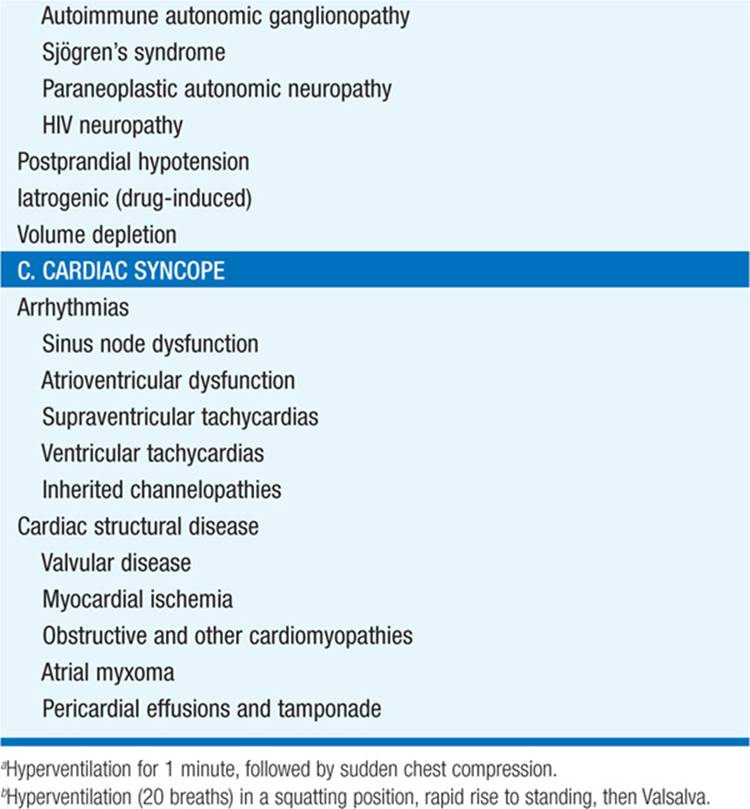
Syncope is usually due to a neurally mediated disorder, orthostatic hypotension, or an underlying cardiac condition (Table 56-1). Not infrequently the cause is multifactorial.
TABLE 56-1 CAUSES OF SYNCOPE
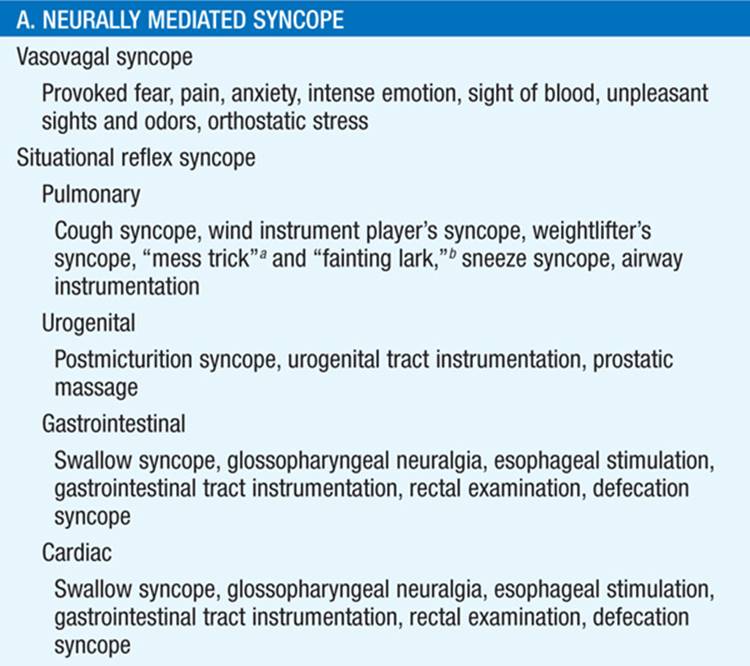

Neurocardiogenic (Vasovagal and Vasodepressor) Syncope
The common faint, experienced by normal persons, accounts for approximately half of all episodes of syncope. It is frequently recurrent and may be provoked by hot or crowded environment, alcohol, fatigue, pain, hunger, prolonged standing, or stressful situations.
Postural (Orthostatic) Hypotension
Sudden rising from a recumbent position or standing quietly are precipitating circumstances. Cause of syncope in 30% of elderly; polypharmacy with antihypertensive or antidepressant drugs often a contributor; physical deconditioning may also play a role. Also occurs with autonomic nervous system disorders, either peripheral (diabetes, nutritional, or amyloid polyneuropathy) or central (multiple system atrophy, Parkinson’s disease). Some cases are idiopathic.
DIFFERENTIAL DIAGNOSIS
Seizures
The differential diagnosis is often between syncope and a generalized seizure. Syncope is more likely if the event was provoked by acute pain or anxiety or occurred immediately after arising from a lying or sitting position; seizures are typically not related to posture. Pts with syncope often describe a stereotyped transition from consciousness to unconsciousness that develops over a few seconds. Seizures occur either very abruptly without a transition or are preceded by premonitory symptoms such as an epigastric rising sensation, perception of odd odors, or racing thoughts. Pallor is seen during syncope; cyanosis is usually seen during a seizure. The duration of unconsciousness is usually very brief (i.e., seconds) in syncope and more prolonged (i.e., >5 min) in a seizure. Injury from falling and incontinence are common in seizure, rare in syncope. Whereas tonic-clonic movements are the hallmark of a generalized seizure, myoclonic and other movements also occur in 90% of syncopal episodes and eyewitnesses will often have a difficult time distinguishing between the two etiologies.
Hypoglycemia
Severe hypoglycemia is usually due to a serious disease. Hunger is a premonitory feature that is not typical in syncope. The glucose level at the time of a spell is diagnostic.
Cataplexy
Abrupt partial or complete loss of muscular tone triggered by strong emotions; occurs in 60–75% of narcolepsy pts. Unlike syncope, consciousness is maintained throughout the attacks. No premonitory symptoms.
Psychiatric Disorders
Apparent loss of consciousness can be present in generalized anxiety, panic disorders, major depression, and somatization disorder. Frequently resembles presyncope, although the symptoms are not accompanied by prodromal symptoms and are not relieved by recumbency. Attacks can often be reproduced by hyperventilation and have associated symptoms of panic attacks such as a feeling of impending doom, air hunger, palpitations, and tingling of the fingers and perioral region. Such pts are rarely injured despite numerous falls. There are no clinically significant hemodynamic changes.
TREATMENT Syncope
Therapy is determined by the underlying cause.
• Pts with neurally mediated syncope should be instructed to avoid situations or stimuli that provoke attacks.
• Drug therapy may be necessary for resistant neurally medicated syncope. β-adrenergic antagonists (metoprolol 25–50 mg twice daily; atenolol 25–50 mg/d; or nadolol 10–20 mg twice daily; all starting doses) are the most widely used agents; serotonin reuptake inhibitors (paroxetine 20–40 mg/d, or sertraline 25–50 mg/d) and bupropion SR (150 mg/d) are also effective.
• Pts with orthostatic hypotension should first be treated with removal of vasoactive medications. Then consider nonpharmacologic (pt education regarding moves from supine to upright, increasing fluids and salt in diet) and finally pharmacologic methods such as the mineralocorticoid fludrocortisone acetate and vasoconstricting agents such as midodrine and pseudoephedrine.
Management of refractory orthostatic hypotension is discussed in Chap. 198.

For a more detailed discussion, see Freeman R: Syncope, Chap. 20, p. 171, in HPIM-18.