
BLADDER CANCER
INCIDENCE AND EPIDEMIOLOGY
Annual incidence in the United States is about 73,510 cases with 14,880 deaths. Median age is 65 years. Smoking accounts for 50% of the risk. Exposure to polycyclic aromatic hydrocarbons increases the risk, especially in slow acetylators. Risk is increased in chimney sweeps, dry cleaners, and those involved in aluminum manufacturing. Chronic cyclophosphamide exposure increases risk ninefold. Schistosoma haematobium infection also increases risk, especially of squamous histology.
ETIOLOGY
Lesions involving chromosome 9q are an early event. Deletions in 17p (p53), 18q (the DCC locus), 13q (RB), 3p, and 5q are characteristic of invasive lesions. Overexpression of epidermal growth factor receptors and HER2/neureceptors is common.
PATHOLOGY
Over 90% of tumors are derived from transitional epithelium; 3% are squamous, 2% are adenocarcinomas, and <1% are neuroendocrine small cell tumors. Field effects are seen that place all sites lined by transitional epithelium at risk, including the renal pelvis, ureter, bladder, and proximal two-thirds of the urethra; 90% of tumors are in the bladder, 8% in the renal pelvis, and 2% in the ureter or urethra. Histologic grade influences survival. Lesion recurrence is influenced by size, number, and growth pattern of the primary tumor.
CLINICAL PRESENTATION
Hematuria is the initial sign in 80–90%; however, cystitis is a more common cause of hematuria (22% of all hematuria) than is bladder cancer (15%). Pts are initially staged and treated by endoscopy. Superficial tumors are removed at endoscopy; muscle invasion requires more extensive surgery.
TREATMENT Bladder Cancer
Management is based on extent of disease: superficial, invasive, or meta-static. Frequency of presentation is 75% superficial, 20% invasive, and 5% metastatic. Superficial lesions are resected at endoscopy. Although complete resection is possible in 80%, 30–80% of cases recur; grade and stage progression occur in 30%. Intravesical instillation of bacille Calmette-Guérin (BCG) reduces the risk of recurrence by 40–45%. Recurrence is monitored every 3 months.
The standard management of muscle-invasive disease is radical cystectomy. 5-year survival is 70% for those without invasion of perivesicular fat or lymph nodes, 50% for those with invasion of fat but not lymph nodes, 35% for those with one node involved, and 10% for those with six or more involved nodes. Pts who cannot withstand radical surgery may have 30–35% 5-year survival with 5000- to 7000-cGy external beam radiation therapy. Bladder sparing may be possible in up to 45% of pts with two cycles of chemotherapy with CMV (methotrexate, 30 mg/m2 days 1 and 8, vinblastine, 4 mg/m2 days 1 and 8, cisplatin, 100 mg/m2 day 2, q21d) followed by 4000-cGy radiation therapy given concurrently with cisplatin.
Metastatic disease is treated with combination chemotherapy. Useful regimens include CMV (see above), M-VAC (methotrexate, 30 mg/m2 days 1, 15, 22; vinblastine, 3 mg/m2 days 2, 15, 22; doxorubicin, 30 mg/m2 day 2; cisplatin, 70 mg/m2 day 2; q28d) or cisplatin (70 mg/m2 day 2) plus gemcitabine (1000 mg/m2 days 1, 8, 15 of a 28-day cycle) or carboplatin plus paclitaxel. About 70% of pts respond to treatment, and 20% have a complete response; 10–15% have long-term disease-free survival.
RENAL CANCER
INCIDENCE AND EPIDEMIOLOGY
Annual incidence in the United States is about 65,000 cases with 13,500 deaths. Cigarette smoking accounts for 20–30% of cases. Risk is increased in acquired renal cystic disease. There are two familial forms: a rare autosomal dominant syndrome and von Hippel–Lindau disease. About 35% of pts with von Hippel–Lindau disease develop renal cancer. Incidence is also increased in those with tuberous sclerosis and polycystic kidney disease.
ETIOLOGY
Most cases are sporadic; however, the most frequent chromosomal abnormality (occurs in 60%) is deletion or rearrangement of 3p21-26. The von Hippel–Lindau gene has been mapped to that region and appears to have ubiquitin ligase activities that influence regulation of speed of transcription and turnover of damaged proteins. It is unclear how lesions in the gene lead to cancer.
PATHOLOGY
Five variants are recognized: clear cell tumors (75%), chromophilic tumors (15%), chromophobic tumors (5%), oncocytic tumors (3%), and collecting duct tumors (2%). Clear cell tumors arise from cells of the proximal convoluted tubules. Chromophilic tumors tend to be bilateral and multifocal and often show trisomy 7 and/or trisomy 17. Chromophobic and eosinophilic tumors less frequently have chromosomal aberrations and follow a more indolent course.
CLINICAL PRESENTATION
The classic triad of hematuria, flank pain, and flank mass is seen in only 10–20% of pts; hematuria (40%), flank pain (40%), palpable mass (33%), and weight loss (33%) are the most common individual symptoms. Paraneoplastic syndromes of erythrocytosis (3%), hypercalcemia (5%), and nonmetastatic hepatic dysfunction (Stauffer’s syndrome) (15%) may also occur. Workup should include IV pyelography, renal ultrasonography, CT of abdomen and pelvis, chest x-ray (CXR), urinalysis, and urine cytology. Stage I is disease restricted to the kidney, stage II is disease contained within Gerota’s fascia, stage III is locally invasive disease involving nodes and/or inferior vena cava, stage IV is invasion of adjacent organs or metastatic sites. Prognosis is related to stage: 66% 5-year survival for I, 64% for II, 42% for III, and 11% for IV.
TREATMENT Renal Cancer
Radical nephrectomy is standard for stage I, II, and most stage III pts. Surgery may also be indicated in the setting of metastatic disease for intractable local symptoms (bleeding, pain). Response rates of 40–48% have been noted with three different single agents, sunitinib (50 mg/d 4 weeks out of 6), sorafenib (400 mg bid), and temsirolimus (25 mg IV weekly). Sunitinib and sorafenib are thought to be antiangiogenic through inhibition of kinases in tumor cells. Temsirolimus is an inhibitor of mTOR. About 10–15% of pts with advanced-stage disease may benefit from interleukin 2 and/or interferon α (IFN-α). Addition of bevacizumab to IFN-α improves the response rate. Some remissions are durable. Chemotherapy is of little or no benefit.
TESTICULAR CANCER
INCIDENCE AND EPIDEMIOLOGY
Annual incidence is about 8590 cases with 360 deaths. Peak age incidence is 20–40. Occurs 4–5 times more frequently in white than black men. Cryptorchid testes are at increased risk. Early orchiopexy may protect against testis cancer. Risk is also increased in testicular feminization syndromes, and Klinefelter syndrome is associated with mediastinal germ cell tumor.
ETIOLOGY
The cause is unknown. Disease is associated with a characteristic cytogenetic defect, isochromosome 12p.
PATHOLOGY
Two main subtypes are noted: seminoma and nonseminoma. Each accounts for ~50% of cases. Seminoma has a more indolent natural history and is highly sensitive to radiation therapy. Four subtypes of nonseminoma are defined: embryonal carcinoma, teratoma, choriocarcinoma, and endodermal sinus (yolk sac) tumor.
CLINICAL PRESENTATION
Painless testicular mass is the classic initial sign. In the presence of pain, differential diagnosis includes epididymitis or orchitis; a brief trial of antibiotics may be undertaken. Staging evaluation includes measurement of serum tumor markers α fetoprotein (AFP) and β-human chorionic gonadotropin (hCG), CXR, and CT scan of abdomen and pelvis. Lymph nodes are staged at resection of the primary tumor through an inguinal approach. Stage I disease is limited to the testis, epididymis, or spermatic cord; stage II involves retroperitoneal nodes; and stage III is disease outside the retroperitoneum. Among seminoma pts, 70% are stage I, 20% are stage II, and 10% are stage III. Among nonseminoma germ cell tumor pts, 33% are found in each stage. hCG may be elevated in either seminoma or nonseminoma, but AFP is elevated only in nonseminoma. 95% of pts are cured if treated appropriately. Primary nonseminoma in the mediastinum is associated with acute leukemia or other hematologic disorders and has a poorer prognosis than testicular primaries (~33%).
TREATMENT Testicular Cancer (Table 79-1)
TABLE 79-1 GERM CELL TUMOR STAGING AND TREATMENT

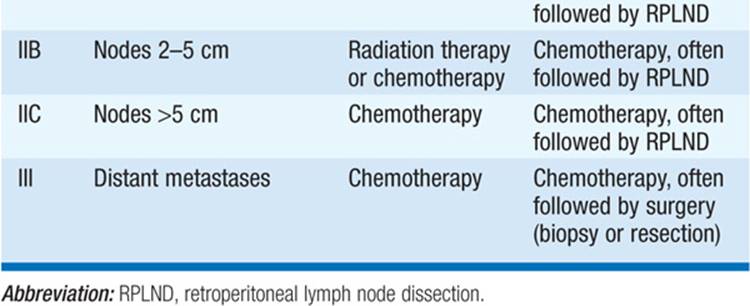
For stages I and II seminoma, inguinal orchiectomy followed by retroperitoneal radiation therapy to 2500–3000 cGy is effective. For stages I and II nonseminoma germ cell tumors, inguinal orchiectomy followed by retroperitoneal lymph node dissection is effective. For pts of either histology with bulky nodes or stage III disease, chemotherapy is given. Cisplatin (20 mg/m2 days 1–5), etoposide (100 mg/m2days 1–5), and bleomycin (30 U days 2, 9, 16) given every 21 days for four cycles is the standard therapy. If tumor markers return to zero, residual masses are resected. Most are necrotic debris or teratomas. Salvage therapy rescues about 25% of those not cured with primary therapy.

For a more detailed discussion, see Scher HI, Motzer RJ: Bladder and Renal Cell Carcinomas, Chap. 94, p. 790; and Motzer RJ, Bosl GJ: Testicular Cancer, Chap. 96, p. 806, in HPIM-18.