
Antibacterial agents are among the most commonly prescribed drugs worldwide and can be lifesaving when used appropriately. However, their indiscriminate use (estimated at ~50% of all antibiotic use) drives up the cost of health care, leads to a plethora of side effects and drug interactions, and fosters the emergence of bacterial resistance, rendering previously valuable drugs useless.
MECHANISMS OF DRUG ACTION
Antibacterial agents act on unique targets not found in mammalian cells. Bactericidal drugs kill bacteria within their spectrum of activity; bacterio-static drugs inhibit bacterial growth. Table 86-1 summarizes the mechanisms of action of commonly used antibacterial drugs.
TABLE 86-1 MECHANISMS OF ACTION OF AND RESISTANCE TO MAJOR CLASSES OF ANTIBACTERIAL AGENTS


• Inhibition of cell-wall synthesis: Drugs that inhibit cell-wall synthesis are almost always bactericidal. The cell wall is broken down by bacterial autolysins (cell wall–remodeling enzymes) during normal growth, and this class of antibacterial agents prevents the synthesis of a repaired cell wall. Examples include β-lactam antibiotics (e.g., penicillins, cephalosporins, carbapenems), glycopeptides (vancomycin, teicoplanin), and lipoglycopeptides (telavancin).
• Inhibition of protein synthesis: Typically, inhibition takes place through interaction with bacterial ribosomes, which differ in composition from mammalian ribosomes. Except for aminoglycosides, these drugs are bacteriostatic. Examples include aminoglycosides (e.g., gentamicin, tobramycin, streptomycin), macrolides (erythromycin, clarithromycin, azithromycin), ketolides (telithromycin), lincosamides (clindamycin), streptogramins [quinupristin/dalfopristin (Synercid)], chloramphenicol, oxazolidinone (linezolid), tetracyclines (tetracycline, doxycycline, minocycline), and glycylcyclines (tigecycline).
• Inhibition of bacterial metabolism: Antimetabolites interfere with bacterial folic acid production, thereby preventing synthesis of thymidine, all purines, and several amino acids. These drugs are generally bacterio-static, although in some cases they may be bactericidal. Examples include sulfonamides and trimethoprim.
• Inhibition of nucleic acid synthesis or activity: Several antibacterial agents have disparate effects on nucleic acids. Examples include fluoroquinolones (ciprofloxacin, levofloxacin, moxifloxacin), rifampin, nitrofurantoin, and metronidazole.
• Alteration of cell-membrane permeability: Agents of this class interact with bacterial membranes and are generally bactericidal. Examples include polymyxins (polymyxin B, colistin) and daptomycin.
MECHANISMS OF ANTIBACTERIAL RESISTANCE
• Bacteria can either be intrinsically resistant to an agent (e.g., obligate anaerobic bacteria are resistant to aminoglycosides) or acquire resistance through mutation of resident genes or acquisition of new genes.
• The major mechanisms of resistance used by bacteria are drug inactivation, alteration or overproduction of the antibacterial target, acquisition of a new gene encoding a drug-insensitive target, decreased permeability to the agent, failure to convert an inactive prodrug to its active derivative, and active efflux of the agent.
• Table 86-1 summarizes specific mechanisms of bacterial resistance to commonly used antibacterial agents.
PHARMACOKINETICS OF ANTIBIOTICS
The pharmacokinetic profile refers to drug concentrations in serum and tissue versus time and reflects the processes of absorption, distribution, metabolism, and elimination.
• Absorption: systemic bioavailability after PO, IM, or IV administration
– The IM and IV routes offer 100% bioavailability.
– Bioavailability after PO administration ranges from 10% (e.g., penicillin G) to nearly 100% (e.g., amoxicillin, clindamycin, metronidazole, fluoroquinolones).
• Distribution: The concentration of an antibiotic must exceed the pathogen’s minimal inhibitory concentration (MIC) at the site of infection to be effective.
• Metabolism and elimination: Antibacterial agents are disposed of by hepatic elimination (metabolism or biliary elimination), renal excretion of the unchanged or metabolized form, or a combination of the two. Understanding the mode of elimination is important in adjusting dosage if elimination is impaired.
PRINCIPLES OF ANTIBACTERIAL CHEMOTHERAPY
• When possible, obtain specimens to identify the etiologic agent (by microscopic examination and culture) before treatment.
• Standard in vitro susceptibility testing assesses only bacteriostasis and is essential to devising a chemotherapeutic regimen. Use local susceptibility patterns to help direct empirical treatment.
• The pharmacokinetic-pharmacodynamic (PK-PD) profile of an antibiotic refers to the quantitative relationships among (1) the time course of antibiotic concentrations in serum and tissue, (2) the MIC, and (3) the microbial response (inhibition of growth or rate of killing). Profiles can be categorized as either concentration or time dependent.
– Concentration-dependent antibiotics (e.g., fluoroquinolones, aminoglycosides): Increasing the ratio of the maximal serum concentration to the MIC (or the ratio of the area under the plasma concentration vs. time curve to the MIC) leads to a more rapid rate of bacterial death. Administration of larger doses (within the confines of toxicity) with longer dosing intervals is the practical application of these relationships.
– Time-dependent antibiotics (e.g., β-lactam antibiotics): The reduction in bacterial density is proportional to the amount of time that drug concentrations exceed the MIC. While the optimal dosing strategy is continuous infusion, more convenient dosing intervals can be used, with maintenance of the serum drug concentration above the MIC for 30–50% of the dosing interval.
• Once etiology and susceptibility are known, the therapeutic regimen should be changed to one that has the narrowest effective spectrum and—all else being equal—is least costly. The status of the host (e.g., pregnancy, immunosuppression, hepatic and renal function, other required medications), the site of infection (e.g., CNS infection or endocarditis), and the adverse reaction profile (including contraindications) need to be considered in choosing an appropriate antibacterial agent.
• Although combination chemotherapy usually is not indicated, it is used occasionally to prevent emergence of resistance (e.g., addition of rifampin for staphylococci), for synergistic or additive activity (e.g., β-lactam/aminoglycoside combinations against enterococci), and for therapy directed against multiple potential pathogens (e.g., intraabdominal or brain abscess). Some combination therapies (e.g., penicillin plus tetracycline against pneumococci) have antagonistic effects; i.e., the combination is worse than either drug alone.
CHOICE OF ANTIBACTERIAL AGENTS
For current and practical information regarding antimicrobial drugs and treatment regimens for specific indications, consult relevant chapters in HPIM-18. In addition, online references such as the Johns Hopkins antibiotic guide (www.Hopkins-abxguide.org) are available. Evidence-based practice guidelines for many infections are available from the Infectious Diseases Society of America (www.idsociety.org).
ADVERSE REACTIONS
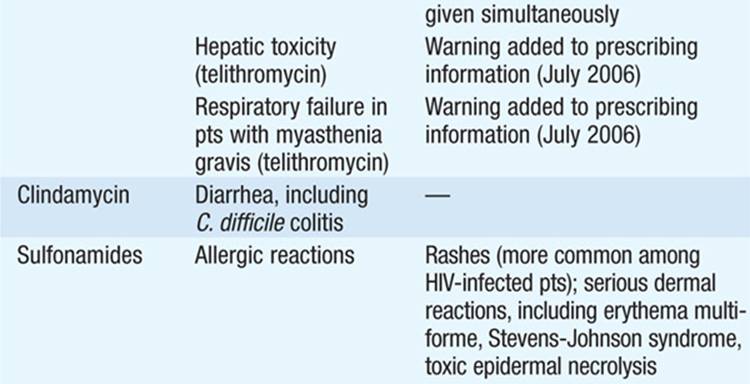
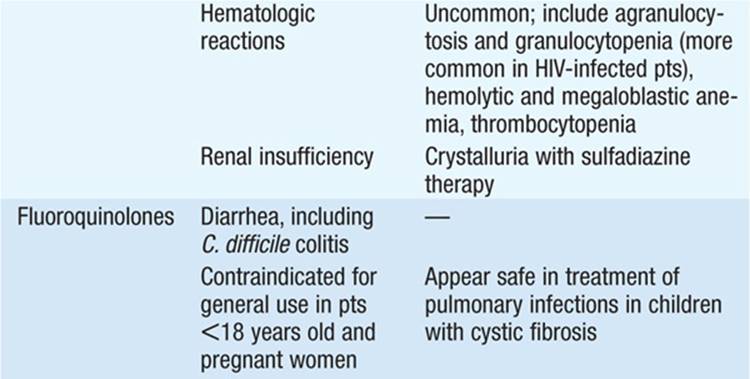
Adverse reactions are classified as either dose-related (e.g., aminoglycoside-induced nephrotoxicity) or unpredictable. Unpredictable reactions are idiosyncratic or allergic. Table 86-2 summarizes the most clinically relevant adverse reactions to common antibacterial drugs.
TABLE 86-2 MOST CLINICALLY RELEVANT ADVERSE REACTIONS TO COMMON ANTIBACTERIAL DRUGS




DRUG INTERACTIONS
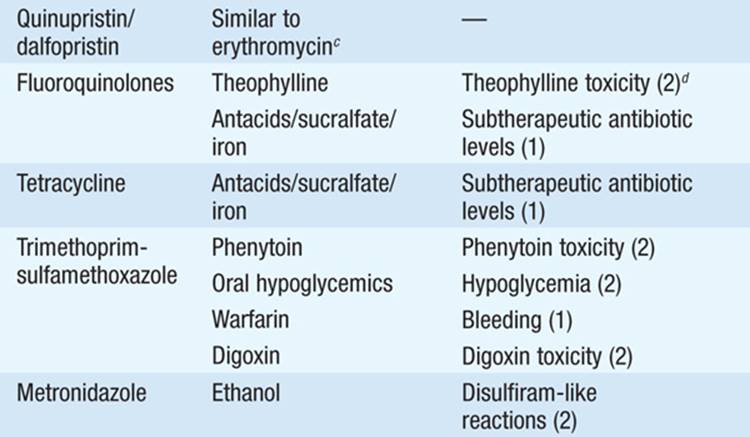
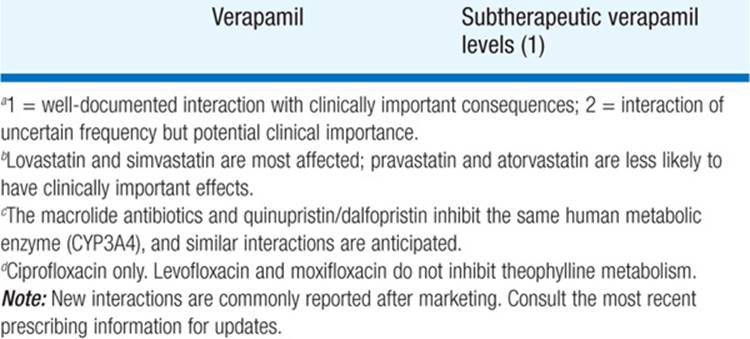
Antimicrobial agents are a common cause of drug–drug interactions, often because of effects on the hepatic P450 system, which is responsible for metabolizing many drugs. Table 86-3 lists the most common and best-documented interactions of antimicrobial agents with other drugs and characterizes the clinical relevance of these interactions. This information is presented only to heighten awareness of potential interactions; to ensure that no drug–drug interactions occur, appropriate sources should be consulted before any antibiotic is prescribed.
TABLE 86-3 INTERACTIONS OF ANTIBACTERIAL AGENTS WITH OTHER DRUGS




For a more detailed discussion, see Archer GL, Polk RE: Treatment and Prophylaxis of Bacterial Infections, Chap. 133, p. 1133, in HPIM-18. For a discussion of antifungal therapy, see Chaps. 115 and 116 in this manual; for antimycobacterial therapy, see Chap. 103; for antiviral therapy, see Chaps. 108 through 114; and for antiparasitic therapy, see Chaps. 117 and 118.