
Peter B. Rice, CSP, CIH, REHS
Occupational safety is the science devoted to the anticipation, recognition, evaluation, and control of workplace safety hazards. The occupational safety professional is concerned with the prevention and control of work-related accidents, injuries, illnesses, and all other harmful incidents. These preventable events may result in property damage, business interruption, and environmental effects that threaten public health and safety, and include product-related injuries and illnesses.
Safety professionals are trained to recognize that all occupational “accidents” can be anticipated from and be attributed to unsafe or unhealthy work conditions, job behaviors or practices. Substandard work conditions and job practices are hazards and are considered the last link in a chain of accident causation.
The safety professional is concerned primarily with empowering managers, supervisors, and employees with information to identify and control occupational hazards. Enabling factors are the underlying deficiencies within the organization’s operations that produce or permit the existence of exposure to a hazard.
The occupational physician—whether employed directly by a company, retained on a consulting basis, or working in a clinic or hospital serving the industrial community—will be called on to work with safety professionals. In very large organizations, the physician and the safety professional may be part of a loss-control or risk-management team, or even may work in the same department. In smaller organizations, the safety professional often will be the point of contact for the company with the consultant occupational physician.
The physician’s interactions with the safety professional generally occur while
• Providing emergency and nonemergency medical services
• Performing medical monitoring of employees potentially exposed to hazards
• Implementing health maintenance programs for employees
• Participating in employee training programs on health hazards
• Serving on management oversight committees reviewing the safety program
• Assisting in accident investigations or reviews
• Interpreting the medical aspects of safety analyses or regulatory standards
PROFESSIONAL QUALIFICATIONS
In the United States, the Occupational Safety and Health Act of 1970 (OSHAct) created the Occupational Safety and Health Administration (OSHA), an administrative agency within the Department of Labor, and made it responsible for the promulgation and enforcement of safety standards applicable to employers. An increasing number of OSHA standards have recognized certified safety professionals, as well as certified industrial hygienists and physicians, as “qualified” and “competent” to evaluate and control regulated hazards.
A safety professional may have a bachelor or master’s degree, but no longer necessarily may be an engineer. It is common to find safety professionals with degrees in management, business administration, the sciences, and even behavioral psychology. Several universities offer baccalaureate, masters, and even doctoral degrees specifically in occupational safety and health or safety management. Some state and community colleges offer associate degrees or technical certification in safety.
The Board of Certified Safety Professionals (BCSP) certifies practitioners in the safety profession. About 12,000 currently hold the CSP and 7500 retain a related occupational safety certification administered by the BCSP. The importance of safety certification continues to grow. In the United States, numerous laws, regulations, and standards cite it. More importantly, many companies include it in position standards, government agencies rely on it, and contracts for safety services require it.
 Certifications & Careers in Safety
Certified Safety Professional (CSP) is the highest professional designation. It is held by the safety professional who has met education and experience standards, has demonstrated by examination the knowledge that applies to professional safety practice, and continues to meet recertification requirements established by the BCSP.
Associate Safety Professional (ASP) is a temporary designation awarded by BCSP. It denotes that an individual has met academic requirements and has passed the safety fundamentals examination—the first of two examinations leading to the CSP.
Graduate Safety Practitioner (GSP) is a designation available to safety degree graduates from degree programs which meet BCSP qualified academic program (QAP) standards. The GSP program is an additional path to the CSP and does not replace other paths.
Construction Health and Safety Technician (CHST) is a certification awarded by the BCSP to individuals who demonstrate competency and work part-time or full-time in health and safety programs in the construction industry.
Occupational Health and Safety Technologist (OHST) is trained to perform worksite assessments to determine risks, potential hazards and controls, evaluate risks and hazard control measures, investigate incidents, maintain and evaluate incident and loss records, and prepare emergency response plans.
Safety Trained Supervisor (STS) certification is intended for managers at all levels, first line supervisors of work groups or organization units or have a safety responsibility for a work group that is part of other work duties. STSs are not safety specialists or safety practitioners. Typical candidates have safety responsibilities that are adjunct, collateral, or ancillary to their job duties. Their main duties are in a craft or trade, in leadership, supervision or management, or in a technical specialty.
Certified Environmental, Safety and Health Trainer (CET) is a certification held by those with experience and expertise in developing and delivering safety, health, and environmental training.
RESPONSIBILITIES OF SAFETY PROFESSIONALS
There are more than 20,000 safety professionals in the United States. Their responsibilities vary widely depending on the size and type of organization, the degree of inherent risks within the workplace, and the level of safety management expertise. In a small service organization, for example, the “safety coordinator” is often a nonprofessional whose responsibilities are limited to ensuring that the organization complies with applicable OSHA regulations. In a medium-sized manufacturing company, the safety practitioner may be a trained professional with a wide range of safety and loss-control responsibilities. In large, complex organizations, a staff of certified professionals from among several different departments usually covers the full scope of safety and loss-control responsibilities. The staff may include safety professionals, industrial hygienists, occupational physicians and nurses, engineers, environmental specialists, ergonomists, risk managers, insurance personnel, security officers, and fire-protection professionals.
The responsibilities of safety professionals may be grouped into six broad functional categories:
1. Safety engineering: the systematic analysis of equipment, tasks, and processes to identify inherent hazards and failure modes, as well as the development of hazard prevention and control measures based on their findings.
2. Safety management: the application of management principles and methods to establish, facilitate, coordinate, and achieve safety goals and objectives.
3. Loss control: the application of safety engineering and safety management methods for the prevention and mitigation of all types of loss-producing events.
4. Safety inspection and auditing: observation and evaluation of worksites, job tasks, and policies and procedures to identify deficiencies or omissions that could contribute to an occupational injury or illness.
5. Regulatory compliance: communication of applicable safety and health regulations to affected personnel and monitoring of response activities to ensure compliance with the regulatory requirements.
6. Education and training: the development, conducting, and/or coordinating of safety training for employees, supervisors, and managers.
Many safety practitioners specialize within one or two of the functional categories and some even concentrate on a subspecialty within a category (eg, construction safety, traffic safety engineering, electrical safety, or hazardous materials training); most, however, perform some duties that fall within each of the broad functions. Some functional specialists and generalists work their entire careers in the same industry and become industry safety specialists. These may include construction safety professionals, electrical safety engineers, systems safety engineers, chemical safety engineers, and railroad safety inspectors.
SAFETY & HEALTH MANAGEMENT SYSTEM
A principal responsibility of a safety professional in any organization is to facilitate and coordinate the development and implementation of an effective safety and health management system. The elements of this system are the related policies, goals, plans, programs, procedures, and standards. Their collective purpose is to systematically guide the organization to (1) prevent work-related injuries and illnesses, (2) comply with applicable health and safety regulations, and (3) minimize injury/illness, regulatory and compliance costs, and violations (Table 38–1).
Table 38–1. Elements of a safety and health management system.
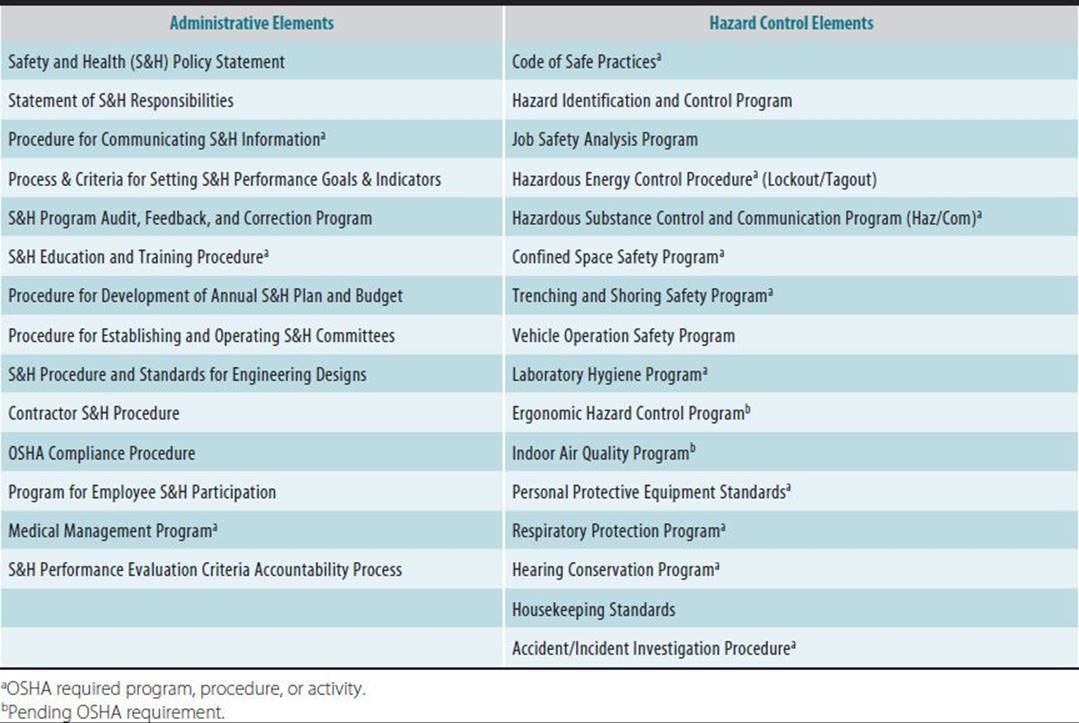
Safety professionals seek to make the occupational safety and health management system a self-regulating process by incorporating performance monitoring, feedback, and correction capabilities. These capabilities can be established either as a separate administrative policy/procedure or as an administrative section in each of the organization’s hazard-control programs and procedures.
The administrative policies and procedures of a safety and health management system are developed to ensure that the system functions properly and consistently. The hazard-control programs and procedures are intended to guide affected personnel in the recognition and control of specified hazards.
Some of the system’s administrative and hazard-control elements may be required by government regulation. The safety professional usually is responsible for ensuring that the safety and health management system includes these required elements.
ELEMENTS OF THE SAFETY SYSTEM
Injury and Illness Prevention (IIP) programs are universal interventions that can substantially reduce the number and severity of workplace injuries and alleviate the associated financial burdens on workplaces. Worker participation and employee compliance is an important element to an effective IIP program. Many states have requirements or voluntary guidelines for workplace IIP programs. Many employers in the United States already manage safety using IIP programs. Most successful injury and illness prevention programs are based on a common set of key elements. These include: management leadership/assignment of responsibility, worker participation and compliance, hazard identification, hazard prevention and control, education and training, and program evaluation and improvement.
Elements of IIP Program
Responsibility—the employer’s written IIP program should provide the name and/or job title of the person(s) with the authority and responsibility for its implementation. Employees should be able to give the name of the individual designated as responsible for the IIP program.
Compliance—a system should be set forth in writing to ensure that employees comply with safe and healthful work practices.
Communication—a system for communicating with employees about safety and health matters—in a form easily understood such as meetings, training programs, posted or written notification—should be part of the employer’s written IIP program. Employees should be encouraged to inform their employer of hazards at the worksite without fear of reprisal.
Hazard assessment—procedures for identifying and evaluating workplace hazards, such as periodic inspections performed by a competent observer, should be provided in the IIP program (Table 38–2).
Table 38–2. Hazard assessment: focuses on the relationship between the worker, the task, the tools, and the work environment.

Accident/exposure investigation—a procedure to investigate workplace incidents that have led to or could lead to injuries or illnesses should be provided in the IIP.
Hazard correction—methods and procedures for correcting all existing workplace hazards, and unsafe or unhealthful work conditions or work practices in a timely manner should be provided in the IIP, and specific abatement methods should also be included.
Training and instruction—an effective program of instructing employees on general safe work practices and hazards specific to each job assignment must be provided in the IIP, and the required training must be given.
Keeping records—there must be adequate written documentation of the steps taken to establish and maintain the employer’s IIP program.
Other important elements of a safety system or IIP program include emergency action planning, fire prevention planning, access to employee exposure and medical records, implementation of a hazard communication program, provisions for personal protective equipment (PPE) to include respiratory protection, and compliance with general requirements for work areas.
Emergency Action Planning
OSHA and often other regulatory agency’s require employers in nearly all cases to prepare and implement an emergency action plan (EAP) for emergency situations. Generally, the EAP development, implementation and management are led by the safety professional.
A. Emergency Planning
Federal, state, and local authorities now require that businesses establish an EAP to include the following:
1. What events might precipitate an evacuation?
2. What other notifications are necessary—medical, fire department, police, others?
3. What medical facilities are likely to be needed?
4. Will electrical and gas services also be shut down?
5. Are there manufacturing processes that should be shut down in emergencies?
6. Who can authorize evacuation?
7. How will the employees be instructed to evacuate?
8. Who will be responsible to see that evacuation is carried out?
9. Where should evacuated employees go?
10. How will it be determined that all employees, contractor personnel, and visitors have been evacuated?
11. Who will do the shutdowns? How? Are they appropriately trained?
B. Chemical Response Teams
Worksites that use large quantities of toxic or hazardous materials often will form specialized teams of employees to contain or control exposures to the employees, the general public, or the environment resulting from accidental discharge. The occupational physician often will be asked to help in the planning and training stages when these teams are formed.
C. Fire Brigades
Industries or operations located at remote sites or with special fire hazards often require the formation of fire-fighting teams. These trained employees are responsible for ensuring swift reaction to the outbreak of fire and for containing the fire until professional help arrives.
D. Emergency Medical Facilities
State regulations now require nearly all places of employment to provide a minimum level of emergency medical capability. Depending on the exposures involved, the safety professional, in concert with the occupational physician, are often able to improve on this minimum requirement significantly.
For an office building with no special hazards, the Red Cross multimedia training certifications for two or three employees, perhaps with cardiopulmonary resuscitation (CPR) training added, very well might be sufficient. However, a hazardous chemical processing plant may require an emergency medical technician (EMT), or an occupational health nurse (OHN) for each shift.
Hazard Communication
In order to ensure chemical safety in the workplace, information about the identities and hazards of the chemicals must be available and understandable to workers. OSHA’s Hazard Communication Standard (HCS) requires the development and dissemination of such information:
• Chemical manufacturers and suppliers are required to evaluate the hazards of the chemicals they produce or import, and prepare labels and safety data sheets to convey the hazard information to their downstream customers.
• All employers with hazardous chemicals in their workplaces must have labels and safety data sheets for their exposed workers, and train them to handle the chemicals safely and appropriately.
Current changes to the Hazard Communication Standard include
• Hazard classification: provides specific criteria for classification of health and physical hazards, as well as classification of mixtures.
• Labels: required by chemical manufacturers and suppliers to provide a harmonized signal word, pictogram, and hazard statement for each hazard class and category. Precautionary statements must also be provided.
• Safety data sheets: now have a specified 16-section format.
Access to Employee Exposure & Medical Records
The safety professional may be responsible for implementation of OSHA’s regulation that mandates access to employee exposure and medical records (29 Code of Regulations, Section 1910.1020). This regulation is often referred to as “Workers Right-to-Know.” It requires that employers provide access to employee exposure and medical records. Employees and their designated representative and OSHA have a right to examine relevant medical exposure records. In general, these records include: Medical records consist of physician and employment questionnaires or histories, laboratory results, medical opinions, diagnoses, treatments, etc. The safety professional will seek direction from or consultation with the occupational physician to obtain these data. The occupational physician should determine that access to these records does not affect existing legal and ethical obligations concerning the maintenance and confidentiality of employee medical information, or any other aspect of the medical-care relationship.
Exposure records consist of safety surveys, industrial hygiene air and exposure monitoring data, and biological monitoring data.
PERSONAL PROTECTIVE EQUIPMENT
One method of providing for employee safety in hazardous conditions is the use of personal protective equipment (PPE). These devices are intended to protect employees in case an accident occurs or to insulate the employee from a hazardous condition (eg, noise, dusts, fumes, etc.) that is part of the normal operation.
The basic problem with personal protective devices is that the individual must understand the need to wear the protection, must wear it properly, and must maintain the device in good working condition. In situations where engineering or administrative controls are not yet effective in eliminating the hazard, protective devices must be issued as a last line of defense to prevent injury to the employee. The occupational health physician may be called on by the safety professional to evaluate an employee’s fitness for wearing the PPE and for the ability to properly use respiratory protection devices. The occupational physician may be consulted about the appropriateness of the device chosen or to assist in educating employees about the necessity for the device.
Any program that provides personal protective equipment to employees must follow the same basic procedures. First, the employer must perform a hazard assessment where hazards are evaluated to ensure that the equipment will be appropriate. Second, the equipment itself must be checked to see that it meets all applicable government standards of manufacture. Employees must be informed of the hazards involved and be trained in how to wear protective equipment and maintain it properly. Supervisors must be trained to ensure that the protection is worn at all times when it is needed. Warnings must be posted to inform everyone of the need for protection.
Inspections & Monitoring
The safety professional, especially in the industrial environment, is responsible for numerous inspections and periodic monitoring. The principal monitoring technique is measurement of airborne chemical contamination levels and physical exposure levels to noise, vibration, and ionizing and nonionizing radiation. While an industrial hygienist usually performs monitoring, the safety professional often is required to perform some routine monitoring. Individual medical monitoring also is required under certain conditions. Again, while monitoring and testing usually are done under the direction of the occupational health physician, the safety professional often is charged with the administrative and record-keeping details of the program.
Physical inspections are the direct responsibility of the safety professional. Federal and state regulations now require periodic inspections of the work environment designed to recognize hazard potentials. Often this type of inspection actually is performed as part of the safety committee’s duties so that various points of view are brought to bear in the attempt to identify accident potentials. However, even when this is the case, the safety professional must review the results and recommendations. Various pieces of equipment also require periodic inspection to ensure that they are in place, fully functional, certified, and suitable for the intended purposes.
Hazard Prevention & Control
Prevent and control hazards
• Regularly and thoroughly maintain equipment.
• Ensure that hazard correction procedures are in place.
• Ensure that everyone knows how to use and maintain PPE.
• Make sure that everyone understands and follows safe work procedures.
• Institute a medical program to prevent workplace hazards and exposures.
Hierarchy of Controls
Controlling exposures to occupational hazards is the fundamental method of protecting workers. Traditionally, a hierarchy of controls has been used as a means of determining how to implement feasible and effective controls (Figure 38–1).
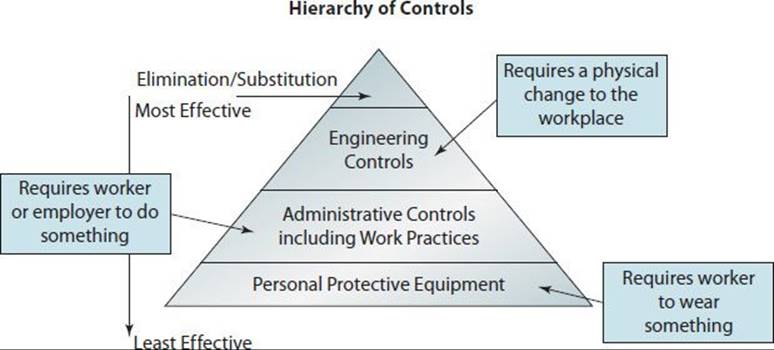
 Figure 38–1. Hierarchy of controls: the employer should first aim to eliminate the hazard altogether.
• Elimination
• Substitution
• Engineering controls
• Administrative controls
• Personal protective equipment
The control methods at the top of the list are potentially more effective and protective than those at the bottom. Following the hierarchy normally leads to the implementation of inherently safer systems, ones where the risk of illness or injury has been substantially reduced (see Chapter 39).
OTHER SAFETY PROGRAM ELEMENTS
Fire Protection
Safety professionals usually are required to take charge of fire-protection activities of the organization as well as employee safety functions. In fact, only organizations with extraordinary casualty exposure will employ a fire-protection engineer.
The primary duty is, of course, to prevent fires. The fire safety program follows much the same pattern as has been outlined for the employee safety program, which was designed to keep injuries from occurring: (1) training, (2) communications, (3) emergency protective equipment, (4) chemical safety, and (5) accident investigation.
The safety professional should be involved in the construction and remodeling of facilities, as well as occupancy plans, in order to create a relatively fire-protected office or plant environment. Once the facility has been constructed, fire-prevention activities usually are limited to monitoring of hazardous areas, fire emergency planning, training, and monitoring of the adequacy of fire-suppression equipment.
Vehicle Fleet Safety
Management usually does not realize the severity of its losses to vehicular accidents unless the company happens to operate an unusually large number of vehicles or is in the transportation industry. The safety professional should gain control of this area of responsibility because it frequently represents one of the major sources of injury within an organization.
The safety professional would begin with documentation to obtain clear-cut authority for a control program through the company’s safety policy and directives. Employee or applicant screening probably is the major loss-control option available to the employer. This is one of the few areas where there is sufficient legal precedent to allow medical and driver-history screening of drivers. Therefore, the safety professional will rely on the occupational health physician to devise an adequate and responsible medical screening program to meet the employer’s needs.
Product Safety & Product Liability
Manufacturers—especially those whose products end up in the hands of the private consumer or in high-technology systems (eg, nuclear reactors, commercial aircraft, or aerospace modules)—are vitally concerned with the safety of their products. It is not uncommon for the organization’s safety professional or an occupational physician to become involved in product safety or product liability reviews.
A product safety review must consider first the intended uses and foreseeable misuses of the product. The aim of the review is to provide the most painstaking analysis—often using the techniques known as systems safety analysis(see below)—to ensure the product’s correct and safe functioning under the most adverse foreseeable use.
The product liability review is performed to determine how to assess or limit (to the extent possible) the legal liability of any unsafe operation of the product that might occur. From this review, the manufacturer—or its product liability insurance carrier—can determine the probable extent to which the manufacturer may be held liable in litigation for product operations or failures that cause personal injury or property damage.
MANAGEMENT APPROACHES TO ACCIDENT PREVENTION
Systems Safety
Systems safety analysis is not a single technique or process but rather a group of analytic techniques wherein operations (such as manufacturing a printed circuit board) or machines (such as punch presses) are viewed as if they were a single system. That system, in turn, should have each of its discrete parts, steps, or functions analyzed for potential hazards. All of this must be limited by practical considerations of operational effectiveness, time availability, and cost-effectiveness.
The traditional approach to safety is called the fly-fix-fly method, wherein an operation is initiated or a machine is designed and put into use. Then, if the operation or machine breaks down, causes an accident, or generally does not perform as expected, it is redesigned, reengineered, or otherwise changed. The operation or machine then is put back into use again until another problem is found with it. However, there are certain systems for which we cannot afford the first accident, such as the core meltdown of a nuclear reactor, an accidental nuclear weapons explosion, the crash of a commercial airliner, the loss of a manned space shuttle, or the release of a toxic gas cloud in an urban area. This is not to say that these catastrophes cannot happen but rather that the manufacturers and operators involved must approach these potentials as if they cannot be allowed to happen.
Employee Operations & Management Reviews
Systems safety analysis was concerned initially only with equipment failures because it grew out of the quality-control discipline. Later, it was realized that the operator is more than just a physical element in the system. The human decisions and actions were in fact a major risk factor and therefore had to be considered as part of the system. Finally, systems safety practitioners began applying the techniques of this discipline to human organizations.
A. Job Safety Analysis
The job safety analysis (JSA) technique was developed during World War II when large numbers of inexperienced workers had to be integrated into the workforce quickly and safely. By systematic observation and detailed analysis, one uncovers the inherent hazards in the work environment, in a task or activity, and recommends control strategies.
This task can be performed by supervisors, who, in turn, gain great understanding and appreciation of the areas under their control. The employees who participate develop a better recognition of the hazards they face. Finally, use of this technique develops an effective teaching tool and documentation on which personnel departments effectively may base their physical hiring requirements for certain jobs. There are other more unique and comprehensive models that include human error rate prediction, management oversight risk tree, and technique and operation review.
Root-Cause Identification & Control
Permanent control of unsafe work conditions and unsafe job practices requires elimination of their underlying support system. Correcting hazards without eliminating their root causes treats only the symptoms of the problem; the hazards eventually will reappear.
Safety professionals identify the enabling or root causal factors of hazards by systematically analyzing the events, conditions, and values that logic, experience, and training lead them to believe could have contributed to the existence of the hazard. The findings then are evaluated to determine where, how, and why the organization’s safety and health management system failed to prevent or control the enabling factors. Permanent control of these factors is achieved by correcting identified inconsistencies, contradictions, and omissions in the organization’s safety and health or operating policies, programs, and procedures.
Accident & Incident Investigation
Accidents are defined as unintended events that result in injury, illness, and/or material loss. Unintended events that have the potential to cause human and/or material harm but which do not only because of chance are called incidents. Many safety professionals prefer to use the term incident to describe both types of events because there is a general misconception that accidents are “freak,” random occurrences that cannot be anticipated. This view can retard an organization’s prevention efforts and lead to the recurrence of loss-producing events. Safety professionals regard accidents/incidents as preventable events that indicate correctable deficiencies in the organization’s safety and loss-control system.
An injury or illness incident occurs when a harmful amount of energy or toxicity is transferred via an unsafe work condition or unsafe job practice to an exposed employee. This transference may occur acutely, as in the case of unprotected contact with a rotating saw blade or with a corrosive chemical, or chronically, from such hazardous exposures as frequent repetitive body motions and long-term inhalation of small amounts of toxic vapors.
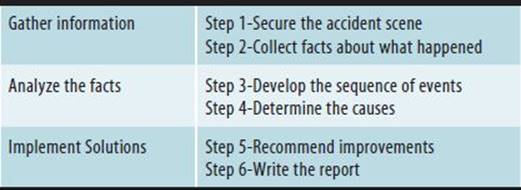
Safety professionals conduct and/or coordinate accident/incident investigations to uncover their proximate and enabling causal factors so that measures can be identified and implemented to prevent a recurrence. The investigation process involves the systematic collection, analysis, documentation, and communication of relevant information (Table 38–3).
Table 38–3. Basic steps for conducting an accident investigation.
Accidents almost never have just one cause but are the result of chains of events and circumstances. Finding the causes of an accident calls for more than simply reviewing the injured employee’s actions at the scene; the physical conditions and all equipment must be scrutinized to determine what could be done to prevent recurrences. Such items as workflow patterns, environmental conditions, and stress levels also must be considered. A primary purpose of accident investigation is to initiate changes or measures to prevent repetitions.
In most routine accidents, it is helpful if the supervisor or manager conducts the accident investigation in order to learn from the experience, although the safety professional will have to instruct the supervisors or managers in how to proceed and should review the results. Safety professionals often develop a written procedure to systematically guide the investigative process. The procedure typically identifies the types of accidents and incidents that are to be investigated and who is to conduct the investigation, when the investigation is to be commenced and ended, where it is to take place, how it is to be conducted, who is to communicate the findings, and the form in which communications will be made. The accident/incident investigation procedure is an important element of any organization’s safety and health management system.
Safety Performance Goals & Indicators
Safety professionals help their organizations develop and administer safety performance goals and indicators. There are several criteria a safety professional may use to evaluate the effectiveness of the safety program and basically two types of goals and indicators, results directed and behavior directed.
Measurement criteria include
• OSHA Log (Form 300)
• Incidence and severity rate
• Medical care cost
• Insurance company “experience rating”
• Observations of safety behavior
• Comparison with peer companies
• Equipment and materials damage cost
• Inspection findings
• Employee questionnaire
Results-directed safety goals and indicators focus on the consequences of desired safety behaviors, whereas behavior-directed safety goals and indicators are concerned with the safety behaviors themselves.
The OSHA incident and severity rates (eg, total recordable incident rate [TRIR] or days away restricted transfer rate [DART] are the principal results-directed safety performance indicators of most organizations. They can be compared against last year’s rate and the industry average to help determine whether current safety performance is acceptable. An annual goal to reduce this rate below the industry average or below last year’s total case rate would be an example of a results-directed goal.
The frequency and quality of employee safety meetings are examples of a behavior-directed performance indicator. The greater the frequency and the better the quality of employee safety meeting, the less likely are job errors and unsafe work practices. A behavior-directed goal would be to have qualified trainers hold structured safety meetings every month.
Safety professionals regularly monitor and analyze the safety performance indicators to help identify any significant behavioral or loss trends.
OSHA COMPLIANCE
Overseeing the organization’s efforts to comply with OSHA regulations is a major responsibility for all safety practitioners. This responsibility is fulfilled by analyzing and interpreting the regulations to determine their applicability to the organization and then communicating the requirements to the affected personnel. Safety practitioners also develop written programs and procedures that are required by the regulations and conduct or arrange mandated training for employees.
If industrial hygiene or medical specialists are employed with the organization, they usually have the lead responsibility for analyzing and interpreting complex health-related regulations. If these specialists are not available in the organization, the safety professional often will consult with an external industrial hygienist or occupational physician.
There are many safety and health regulations that pertain directly to occupational physicians. In the United States, OSHA specifically references medical practitioners in regulations covering such subjects as blood-borne pathogens; physical examinations for asbestos, lead, cadmium, arsenic, and other specified toxic substances; biologic monitoring; audiometric and hearing examinations; respiratory protection; pulmonary function testing; laboratory hygiene; regulated carcinogens; sanitation; and hazard communications (see Chapter 41).
The occupational physician who is well informed about OSHA regulations will be better prepared to provide the diagnostic and treatment methods required by government regulations. The physician also will be able to work with other safety and health professionals to identify deficiencies in the organization’s regulatory compliance efforts that could adversely affect employee health and safety.
LOSS-CONTROL MANAGEMENT
Safety practitioners, like other occupational and safety and health professionals, have the well-being of employees as their primary concern, but unlike the other specialists (at least until recently); some safety professionals have the closely related secondary responsibility of loss-control management. Loss-control management involves planning, organizing, and leading the organization’s efforts to prevent all types of loss-producing events and to control the monetary cost when such an event occurs. A loss-producing event is an incident in which either the value of an organizational asset declines or the cost of preserving it increases.
Losses are measured in monetary terms. Accidents and harmful exposures that cause employee injury or illness, property damage, business disruption, environmental impairment, lost worker productivity, adverse public relations, and labor strife are all loss-producing events; they directly or indirectly cost the organization money.
Employees are the most valuable assets of an organization, so the loss-control responsibilities of safety practitioners are consistent with and supportive of their injury- and illness-prevention interests. Nevertheless, there is a potential for conflict whenever cost considerations may compete with health and safety concerns. This potential for conflict is based on the same kinds of issues that characterize the debate over managed health care: Physicians wish to deliver the best care to their patients without interference and monetary restrictions from the care payers (health insurance companies), whereas the care payers wish to keep the cost of medical care as low as possible.
In the United States, employers pay for the cost of injury care and workers’ compensation through their insurance premiums. They expect, therefore, loss-control managers and health care providers to protect employee health and safety cost-effectively. To achieve this objective, both prevention and case-management efforts are required, with the prevention efforts being the most cost-effective.
CASE MANAGEMENT
Employers want their loss-control representative and the treating physician to ensure that injured employees receive the proper medical care necessary to return them to full health in the shortest period of time for the least amount of money. The following are ways in which safety professionals and occupational physicians can and should collaborate for better case management.
Safety professionals can provide relevant work-history and exposure information to treating physicians as soon as possible after an employee injury and illness is reported. If the safety practitioner fails to provide such information in a timely manner, the physician or an assistant should contact the safety practitioner for input prior to completion of the diagnosis.
Nothing can sour the relationship between an employer and a health care provider more quickly than a controversial medical diagnosis that is (or is perceived to be) based on inaccurate or biased information. Physicians can prevent both the reality and perception of an inaccurate or biased diagnosis by obtaining prior input relative to the injured employee’s work history and exposure. Information obtained by the occupational physician through annual facility visits and discussions with managers will help to preclude misdiagnoses and misperceptions and can obviate the need for case input from safety professionals except in unusual cases.
Safety professionals should provide and medical care providers should seek information on the organization’s modified-duty program and available modified-duty jobs in advance of determination of a treatment protocol for an injured or ill employee. Insurance data indicate that employees with nondisabling injuries who are placed in a job they are able to perform recover sooner than they would have if they were given time off from work. A lack of a monetary incentive to return to work, insufficient physical and mental exercise, and/or the performance of stressful home chores probably account for the slower home healing rates. Safety professionals and occupational physicians can work together on presentations and programs to educate employers about the health and cost benefits of providing modified-duty jobs.
REFERENCES
American Society of Safety Engineers. http://www.asse.org/.
Board of Certified Safety Professionals. http://www.bcsp.org/.
National Institute for Occupational Safety and Health. http://www.cdc.gov/NIOSH/.
US Department of Labor. Occupational Safety and Health Administration. http://www.osha.gov/.
 SELF-ASSESSMENT QUESTIONS
Select the one correct answer for each question.
Question 1: The highest professional designation recognized by the BCSP is
a. Site Safety Coordinator (SSC)
b. Associate Safety Professional (ASP)
c. Certified Safety Professional (CSP)
d. Occupational Safety and Health Technologist
Question 2: The safety and health management system
a. designates the company role in preventive health care
b. guides the organization to prevent work-related injuries and illnesses
c. establishes the insurer’s role in health care
d. circumvents compliance costs
Question 3: Injury and Illness Prevention (IIP) programs
a. reduce the number and severity of workplace injuries
b. alleviate the costs of preventive health care on workers
c. are required by law in all states
d. discourage worker participation and compliance
Question 4: IIP programs should include
a. selection of insurance underwriters
b. bonus awards for loss prevention
c. hazard assessment
d. review of medical records
Question 5: A hazard
a. can cause harm or adverse effects to individuals
b. would be of no interest to the organization
c. is another word for accident
d. is the effect of weather on the workplace
Question 6: Emergency action plan (EAP)
a. is required by OSHA in nearly all cases
b. requires outside consultants
c. centers on the availability of health care facilities
d. ignores prevention planning
Question 7: OSHA’s Hazard Communication Standard (HCS)
a. requires chemical manufacturers to evaluate the hazards of all chemicals
b. requires employers with hazardous chemicals to train workers to handle the chemicals safely and appropriately
c. exempts companies from providing precautionary statements along with labels
d. no longer requires employers to provide safety data sheets
Question 8: OSHA mandates access to employee exposure and medical records
a. without legal and regulatory statute
b. after approval by the employer
c. except physician and employment questionnaires or histories, laboratory results, medical opinions, diagnoses, treatments, etc
d. including industrial hygiene monitoring data
Question 9: Hazard prevention and control
a. excepts equipment maintenance
b. ensures that hazard correction procedures are in place
c. allows employees to decide on which PPE they want to use
d. delegates to employees workplace hazards and exposures
Question 10: Job safety analysis (JSA)
a. entails daily observation and weekly analysis
b. uncovers the inherent hazards in the work environment
c. can be performed only by trained professionals
d. develops an effective teaching tool for consultants