
Michael P. Wilson, PhD, MPH
Megan R. Schwarzman, MD, MPH
THE GLOBAL CHEMICAL INDUSTRY
Over the last 150 years, the chemical industry has played a key role in the global economy. The industry’s contributions to economic growth, employment, and improvements in life expectancy, health, and living conditions in Western-style societies are widely recognized. Chemicals are a basic building block for nearly all industrial and productive activity, and they appear in millions of chemically formulated products, consumer products, and durable goods. Ninety percent of the approximately 100,000 chemicals produced by the chemical industry and used commercially are made using oil, and in the space of just over 50 years, those chemicals have come to constitute the material basis of society.
Not surprisingly, the global chemical industry is enormous and is expected to continue to grow in the future, concomitant with the expansion of the global consumer and industrial economy. In the United States alone, production and importation of industrial chemicals (not including fuels, pesticides, food additives, and pharmaceuticals) is about 74 billion pounds per day, the equivalent—if converted to gallons of water—of over 1 million gasoline tanker trucks, each carrying 8000 gallons. If placed end-to-end, this number of trucks would extend 10,000 miles; in the course of a year, it would circle the earth about 150 times at the equator. On the current trajectory, global chemical production is expected to double every 24 years into the foreseeable future (Figure 44–1). Indexed to 1995, the Organization for Economic Cooperation and Development (OECD) expects non-OECD nations to experience 200% growth in chemical production by 2020 (from US$ 0.5 to 1.5 trillion) compared to 75% growth for OECD countries (US$ 2.0–3.5 trillion). Growth of the chemical industry in the global South will thus outpace its growth in the developed nations of the OECD by a factor of about 2.5.
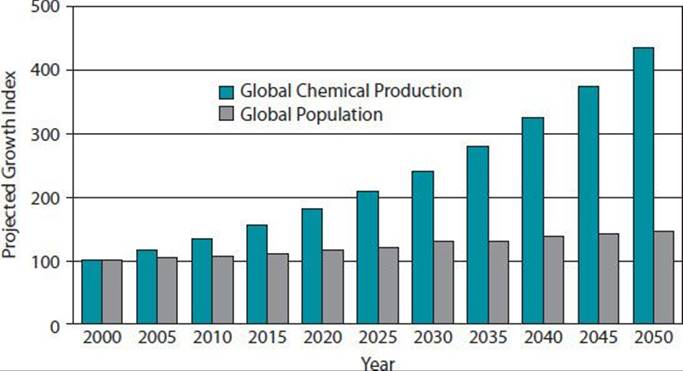
 Figure 44–1. Growth in chemical production outpaces population growth. Global chemical production is expected to grow 3% per year, while global population will grow 0.77% per year. On this trajectory, chemical production will increase 330% by 2050, compared to a 47% increase in population, relative to year 2000.
In both developing and developing nations, many industrial chemicals come in contact with people through exposures that occur in the workplace, in homes, and through air, food, water, and waste streams. Eventually, nearly all industrial chemicals—or their by-products or wastes—enter the earth’s finite ecosystems.
Given the size of the chemical industry, the ubiquitous nature of its products, and its continuing global expansion, it is essential that governments around the world take an active role in developing and adopting comprehensive chemicals policies, with the goal of protecting health and ecosystems for both present and future generations. The adoption of such policies is increasingly important among developing nations. With the recent exception of the European Union (EU), however, the complexity, economic importance, and rapid growth of the industry have made it difficult for governments—including those of OECD member states—to adopt effective chemicals policies. This has had profound implications for public health and the environment worldwide.
HEALTH & ENVIRONMENTAL DAMAGE
The International Labor Organization reports that occupational diseases claim the lives of over 2 million people each year worldwide, or about 86% of the 2.34 million deaths caused by on-the-job accidents and exposures. These disease deaths are the result of exposures to industrial chemicals and pesticides as well as to silica, coal dust, asbestos, and various mineral dusts. These data likely underestimate the true rates, given the weaknesses of occupational disease reporting systems, combined with the difficulty of establishing the cause of many chronic diseases, and the lack of awareness of occupational diseases among health professionals and workers themselves.
The effects of chemical pollution on ecosystems and the “services” they provide society are no less profound, and these effects are not contained within national borders. Although models vary, it is estimated that in the last century, human activities have resulted in between 100 and 1000 times more species extinctions than would have been expected from natural causes. The rate of extinctions is projected to increase tenfold by 2050. The chronic effects of background-level exposures to industrial chemicals and pollutants—in combination with climate change, habitat loss and other stressors—can contribute to species’ reproductive failure, disruption of food webs, population declines the loss of genetic variability, and ultimately, the loss of entire species.
The resulting biodiversity loss undermines the integrity of ecosystems, which in turn is linked inextricably to basic human needs, not only through the inherent value of nature but through the provision of the services that ecosystems deliver. These include, for example, crop pollination, generation of top soil, pest control, waste detoxification, reduction of air pollution and water contamination, the provision of food, fiber and medicines, and mitigation of the effects of floods, droughts and temperature extremes. The many advancements made possible by the chemical industry must be understood in the context of the industry’s effects on human health—in the form of occupational diseases, for example—and on the long-term costs to society, especially in developing nations, of damage resulting from the loss of biodiversity and ecosystem integrity.
Developing nations are the most at risk for both the health effects and long-term ecosystem damage that are likely to occur given the present growth trajectory of the chemical industry. As each year passes, it will become increasingly difficult for these nations to absorb and ameliorate this damage; solutions based on primary prevention are therefore needed now and in coming years. The governments of developing nations will need support in designing and implementing effective, enforceable chemicals policies that are grounded in the principles of primary prevention, precaution, and human rights that have been articulated and accepted in the global community for several decades.
PRIMARY PREVENTION AS A VEHICLE FOR ACHIEVING HUMAN RIGHTS
The vulnerability of workers, communities, and ecosystems in developing nations to the damaging effects of chemical exposures and pollution has been recognized and expressed for decades in the international community, primarily through declarations of the United Nations (UN). These declarations, while not carrying the force of law, nevertheless express an international consensus on the imperative of protecting public health and ecosystems in the context of human rights. They do so both directly and implicitly by calling for primary prevention approaches. As noted below, recent declarations call for upstream, pollution prevention strategies, for example, which seek to avoid the production of toxic substances and hazardous waste at the source, thereby protecting all downstream environmental media and precluding all human exposure pathways. In this way, pollution prevention strategies facilitate environmental justice and equity, in that—by definition—they avoid the otherwise inevitable, disproportionate distribution of toxic substances and hazardous waste into poor and disadvantaged communities and nations.
Pollution prevention differs from end-of-pipe approaches (such as personal protective equipment for workers, or hazardous waste site remediation) which—though important in the short term—ultimately displace health and environmental damage onto the most vulnerable populations, thus perpetuating environmental racism and injustice. End-of-pipe approaches are simply unable to keep pace with the scale of global chemical production and its concomitant health and ecosystem impacts, particularly in the global South. Pollution prevention, therefore, is a primary prevention strategy that is grounded in broadly accepted principles of human rights.
The linkages between primary prevention and human rights find their roots in the founding Universal Declaration of Human Rights, established in 1948, which articulated key elements of occupational and environmental health protection. This includes Article 21, which establishes the right of individuals to work in just and favorable conditions and to form and join trade unions. The United Nations General Assembly of 1966 adopted the International Covenant on Economic, Social and Cultural Rights, which reiterates in Part III, Article 7 rights to “just and favorable conditions of work” and “safe and healthy working conditions.” Article 8 reasserts the “right to everyone to form trade unions” as a vehicle for achieving such conditions, and Article 12 calls for the “right of everyone to the enjoyment of the highest attainable standard of physical and mental health … (including) [t]he improvement of all aspects of environmental and industrial hygiene … (and) [t]he prevention, treatment and control of epidemic, endemic, occupational and other diseases.”
The 1972 United Nations Conference on the Human Environment linked occupational and environmental health with human rights in the Stockholm Declaration, which seeks “[t]o defend and improve the human environment for present and future generations” and that doing so should “ … be pursued together … and in harmony with the established and fundamental goals of peace and worldwide economic and social development.” Twenty-six principles are presented in the Declaration to guide governments and the public toward “sustainable development,” with the goal of establishing a “healthy and productive life in harmony with nature” through efforts that include pollution prevention, environmental equity and justice, and protection of ecosystems and ecological processes.
The 1981 Convention on the Elimination of All Forms of Discrimination against Women makes similar linkages between occupational health and family well-being with regard to chemical exposures and pollution. Part III, Article 11 asserts the right to the protection of health and safety in the workplace, including safeguarding women’s reproductive health, which can be threatened by many workplace chemical exposures. Article 10 calls for the right of access to information necessary to ensure the health and well-being of families. The parties to the Convention wrote that “… a new international order based on equity and justice will contribute significantly towards the promotion of equality between men and women.” The Convention presages the scientific evidence of the subsequent three decades, which demonstrates that exposure to toxic substances in the work-place—and a lack of hazard and exposure information about the those substances—increasingly puts reproductive health and human development at risk.
In 1988, the Adelaide Recommendations on Healthy Public Policy renewed the commitment to primary health care services established in the 1978 Declaration of Alma-Ata, USSR, and it takes the next step in declaring that “environmental management must protect human health from the direct and indirect adverse effects of biological, chemical, and physical factors, and should recognize that women and men are part of a complex ecosystem.” It links primary care with primary prevention and calls for global, regional, and local strategies to advance both.
The 1992 United Nations Conference on Environment and Development in Rio de Janeiro built on these previous declarations and declared that economic development must “… equitably meet developmental and environmental needs of present and future generations.” The Conference responded to the growing body of data that had emerged over the previous 20 years since Stockholm on the effects of multiple stressors on health and ecosystems, including, for example, industrial chemicals, poverty, ozone depletion, disenfranchisement of women, hazardous and solid wastes, vehicle exhaust, global warming, and climate change. The delegates reasserted that protection of health and ecosystems is human right, and that it is linked with economic security. The Rio Declaration calls for the eradication of poverty as a central goal of development and established the Precautionary Principle as a critical element of that process:
The precautionary approach shall be widely applied by States according to their capabilities. Where there are threats of serious or irreversible damage, lack of full scientific certainty shall not be used as a reason for postponing cost-effective measure to prevent environmental degradation.
The 1992 Basel Convention on the Control of Transboundary Movements of Hazardous Wastes and their Disposal, under the aegis of the United Nations Environment Program (UNEP), seeks to prevent harm in developing nations by placing conditions on the export and import of hazardous wastes. The illegal trafficking of hazardous waste across borders is a crime under the Basel Convention. Basel incorporates a primary prevention approach by recognizing the importance of
• Minimizing the generation of hazardous waste at its source
• Disposing of hazardous waste as close as possible to the source of its generation
• Minimizing the international movement of hazardous waste
• Developing low-waste technologies, recycling options, improved housekeeping and better management systems to reduce the generation of wastes
Basel’s regulatory cornerstone is the requirement of Prior Informed Consent for the transboundary shipments of hazardous wastes between contracting parties, which sets forth rules on liability and compensation for damage. Basel has received widespread acceptance, with over 100 signatory nations and the EU; the United States, however, is not a signatory.
In 2006, over 100 governments, together with environmental, labor and health organizations, endorsed the UNEP Strategic Approach to International Chemicals Management (SAICM), which seeks to change the ways in which chemicals are produced and used in order to reduce their harmful effects on health and ecosystems. Like the human rights declarations, SAICM is not legally binding, yet it constitutes a global political consensus “that the environment worldwide continues to suffer from air, water, and land contamination that impairs the health and welfare of millions.” SAICM focuses primarily on developing nations and calls attention to the unique effects of chemical exposures on the health of “children, pregnant women, fertile populations, the elderly, the poor, workers, and other groups and susceptible environments.” SAICM points to the need for action on problems that include
• A lack of capacity for managing chemicals in developing countries and countries with economies in transition
• Dependency on pesticides in developing countries
• Exposure of workers to harmful chemicals
• Concerns about long-term health effects.
ADVANCING PRIMARY PREVENTION THROUGH CHEMICALS POLICY
 The U.S. Toxic Substances Control Act of 1976
The chemicals policy approaches adopted by the United States, EU, and other OECD nations in the 1970s did not achieve the objectives of primary prevention. In large part, they allowed for the unfettered growth of the chemical industry with virtually no regulatory oversight. The dominant model of chemicals policy throughout the developed world, embodied most clearly by the U.S. Toxic Substances Control Act of 1976 (TSCA), represented a step forward at the time, in that prior to the development of these laws in the 1970s, nations throughout the world had no inventory of chemicals in commercial circulation and no vehicle for government to conduct a cursory pre-market evaluation of new chemicals entering the market. However, studies conducted by the National Academy of Sciences (1984), the U.S. General Accounting Office (1994), the Congressional Office of Technology Assessment (1995), the nongovernmental organization Environmental Defense Fund (1997), the U.S. EPA (1998), the U.S. Government Accountability Office (2005), former EPA officials, and researchers have concluded that in the United States, TSCA has fallen short of its objectives and has proved to be an ineffectual vehicle for government, the public or industry to assess the hazards of chemicals in commerce or control those of greatest concern.
In the United States (and in OECD nations that have adopted a similar approach) practitioners refer to three underlying deficiencies, or “gaps,” in the approach embodied in TSCA:
• The data gap. Chemicals producers are not required to investigate or disclose sufficient information on the hazard traits of chemicals. As a result, the public, government, and downstream businesses are unable to know and assessthe hazards of the great majority of chemicals in commerce.
• The safety gap. Even when hazard and exposure information are robust, government is stymied from taking action by TSCA’s high standard of evidence, in which government carries the burden of proving clear cause and effect between a specific chemical and a health or environmental harm. Since 1976, EPA has met its evidentiary burden for less than 5 of the 62,000 chemicals in the original TSCA inventory.
• The technology gap. Lacking a clear regulatory framework that would, for example, make it difficult to produce highly toxic substances, the chemical industry has made only incremental investments in the design and manufacture of safer chemical substances. Ninety-nine percent by weight of the chemicals in use today were in use when TSCA was enacted in 1976.
These three gaps have resulted in a chemicals market in which chemical safety is undervalued relative to chemical function, price, and performance. This has had far-reaching effects. For example, because businesses lack standardized information on toxicity and ecotoxicity, it has been very difficult under TSCA for businesses to identify (and reduce the use of) hazardous chemicals in their supply chains. Similarly, government agencies in the United States and other OECD nations have not had the information they need to systematically identify and prioritize chemical hazards on the market. They have been unable to meet the burden of proof necessary for taking action, even on the most hazardous chemicals. Workers and the public have not had the right kinds of information to advocate for safer chemical products. The lack of chemical information has weakened the deterrent function of product liability and workers’ compensation systems. Lacking regulatory drivers and market signals, the global chemical industry has largely avoided investing in the design of safer chemicals, which would eliminate or reduce health and environmental damage at the source. As a result, toxic chemicals have remained on the market, with producers competing only on the basis of chemical function, price, and performance.
In nations that have chosen to adopt a TSCA-based approach, health and environmental damage from chemical exposures and pollution has continued, checked partially by end-of-pipe strategies that address a portion of chemicals in commerce. In the United States, for example, five Federal statutes that pertain to chemicals apply to only 1134 of the 83,000 chemicals in commercial use, or about 0.14%. As a result, for example, the U.S. EPA reports that leading up to 2033, 294,000 hazardous waste sites will require cleanup in the United States—at a cost of $209 billion—on top of 77,000 existing sites. EPA expects about 600 new sites to appear each month and require cleanup during this same time period.
TSCA-based approaches to chemicals policy have provided a step forward in inventorying chemicals but have largely stymied substantive progress in protecting health and ecosystems. TSCA-based approaches do not lead to primary prevention and would be largely ineffective in producing much-needed health and ecosystem protections in developing nations.
The REACH Regulation of 2006
In contract to the United States, beginning in the early 2000s, the EU began to institute a number of sweeping policies governing chemicals, including those found in products such as electronics, automobiles, and cosmetics. Most notable, perhaps, is Regulation EC 1907/2006 on the registration, evaluation, authorization, and restriction of chemicals (REACH). Though far from perfect, REACH represents a primary prevention strategy that takes important steps in closing the aforementioned gaps in TSCA-based approaches:
• Burden of proof. REACH shifts the burden for providing hazard information and for demonstrating safety from public agencies to chemical producers (addressing data gap problem).
• Transparency. REACH requires communication on chemical hazard and exposure in supply chains between chemical producers and downstream users, including users in developing nations (addressing a data gap problem).
• Precaution. REACH legally implements the precautionary principle for certain persistent, bioaccumulative and toxic substances (addressing a safety gap problem).
• Safer alternatives. REACH requires the use of safer chemicals for certain substances considered to be of very high concern (addressing a safety gap problem).
These changes are beginning to address the longstanding lack of transparency and accountability in the global chemicals market. It is expected that implementation of REACH will begin to motivate chemical producers throughout the world to better understand the hazards of their products and, in some cases, develop safer alternatives.
Among other health and environmental benefits, the European Commission has estimated that REACH will prevent about 4300 occupational cancer cases per year across the EU and will save €50 billion ($60 billion) over a 30-year period in total occupational disease cases avoided.
REACH presents a model for chemicals policy that is more consistent with the principles of primary prevention, when compared to the approach adopted under TSCA. It therefore represents the most concrete policy manifestation that is consistent with the principles articulated in the international human rights declarations. It can serve as a model, which, if leveraged and implemented globally, could provide long-term benefits for public health and ecosystems. This is particularly the case for developing nations, which will experience rapid growth in the chemical industry in coming years.
LEVERAGING REACH
In both its scope and its basis in the precautionary principle, REACH is truly a landmark regulation. It is also the result of a political compromise, which naturally produced a number of limitations:
• Data requirements do not apply to all chemicals in commerce. Chemicals produced or imported in quantities of less than one ton per annum (tpa) per producer are not subject to registration. Only limited data are required for the estimated 17,500 chemicals produced or imported at 1–10 tpa per producer, which constitute up to 60% of chemicals subject to registration.
• There is minimal review and validation of industry data submissions. While the burden of providing hazard and exposure information to the European Chemicals Agency (ECHA) rests with industry, ECHA is responsible for assessing the relevance and accuracy of these data, based on assessments of about 5% of submissions. While outright fraud might be unlikely, industry will likely under-emphasize the potential risks of chemicals, particularly if they are on the market and generating revenue. Using industry-supplied data to prove public and environmental health risks will likely present challenges for ECHA.
• The candidate list for the most toxic chemicals is small. As of June 2013, 144 substances had been nominated for designation as substances of very high concern (SVHC), a category of chemicals that are banned unless companies seek use-specific authorization. As of the same date, the Swedish NGO International Chemical Secretariat had identified 626 substances that meet the criteria for SVHCs.
• There is a loophole for the most toxic chemicals. If companies can demonstrate “adequate control” for specific uses of SVHCs, or if they can show that there are no suitable alternatives and the socioeconomic benefits of continued use outweigh the risks, companies may gain authorization by ECHA to continue selling an SVHC.
• There is a high threshold for reporting the presence of chemicals in products. Registration is only required for chemicals in products if they (1) total more than one tpa per producer, (2) are contained in products in concentration greater than 0.1% by weight, and (3) are intended to be released from the product during normal use. These thresholds are likely to shield many potentially toxic chemicals in products from registration requirements and oversight.
China, India, and Japan are using REACH as a model for new chemicals policies. As other countries move to develop their own chemicals policies, they would benefit from the support of OECD countries in devising strategies that (1) adopt key provisions of REACH, (2) leverage its work products, and (3) take steps to improve its limitations. These actions include, for example, gaining access to chemical data submissions through ECHA and adopting any actions ECHA takes on SVHCs. Developing nations can take steps to prevent sales of SVHCs from shifting into their markets while these substances are being restricted in the EU. In addressing REACH’s limitations, developing nations can draw on the work of nongovernmental organizations and professional associations throughout the world, who have developed strategies to advance comprehensive chemicals policies. We recommend that the underlying objectives in these efforts should be to
Close the data gap. As a condition of market access, require that chemical and product manufacturers generate and disclose information on chemical toxicity, ecotoxicity, exposure potential, expected uses and sales, and other key data, prioritizing chemicals of concern.
Close the safety gap. Strengthen government tools for efficiently identifying, prioritizing, and taking action on chemicals of concern.
Close the technology gap. Support research, development, technical assistance, and education in safer alternatives for chemicals of concern.
Many policy mechanisms could be deployed to meet these objectives. We suggest that the most effective approaches will include elements of the following principles:
• Leverage existing statutes and programs, such as REACH
• Apply well-recognized tools and metrics
• Place the least demands on public agencies
• Shift costs to the regulated industry
• Leverage market forces
• Emphasize primary prevention over mitigation
• Consider impacts across the chemical life cycle, including among workers
• Ensure public access and participation
• Ensure equity and environmental justice
• Encourage continual learning by the regulated industry
• Develop meaningful consequences for noncompliance
• Support technology innovation and diffusion in safer chemicals
• Allow for adaptation as conditions change
CONCLUSION
On the current trajectory, global chemical production is expected to double every 24 years into the foreseeable future. This industrial growth will occur about 2.5 times faster in the developing nations of the global South, compared to the developed nations of the OECD, and it will likely be accompanied by a growing set of health, economic, and environmental problems in these regions. The magnitude of these problems will be determined in large part by the policy decisions developing nations make now and in coming years. To prevent escalating health and ecosystem damage in the global South, developing nations will benefit from support in designing new chemicals policies that link economic development with primary prevention of health and ecosystem damage, in the context of human rights. These objectives have been directly or implicitly articulated in global declarations of the United Nations since 1948. An important recent model that embodies these values in a policy framework and which could support these objectives can be found in the REACH regulation of the EU. Though far from perfect, REACH represents the world’s first multinational chemicals regulation that takes important steps toward embodying a primary prevention approach, and which reflects key elements of many global human rights declarations and accords. REACH differs in fundamental ways from the approach embodied by the U.S. Toxic Substances Control Act of 1976 (TSCA), which has proved to be an ineffectual vehicle for government, the public or industry to assess the hazards of chemicals in commerce or control those of greatest concern. The United States and other OECD nations that have adopted this approach to chemicals policy have suffered from the effects of a chemical data gap, safety gap and technology gap. Developing nations should be supported in leveraging—and where possible, adopting and strengthening—key elements of the REACH regulation, which will provide the means for closing these three gaps. The US public health community, including in occupational and environmental medicine, can play an important role in helping developing nations devise the means to adopt and strengthen the primary prevention strategies embodied in the REACH regulation, which are aligned with the priorities of global human rights declarations and accords.
REFERENCES
Barouki R: Developmental origins of non-communicable disease: implications for research and public health. Environ Health 2012;11:42 [PMID: 22715989].
Crinnion WJ: Maternal levels of xenobiotics that affect fetal development and childhood health. Altern Med Rev 2009;14:212 [PMID: 19803547].
Leith Sly J: Special vulnerability of children to environmental exposures. Rev Environ Health 2012;27:151 [PMID: 23095179].
Mattison DR: Environmental exposures and development. Curr Opin Pediatr 2010;22:208 [PMID: 20216314].
Schwarzman MR: New science for chemicals policy. Science 2009;326:1065 [PMID: 19965413].
Wilson MP: Toward a new U.S. chemicals policy: rebuilding the foundation to advance new science, green chemistry, and environmental health. Environ Health Perspect 2009;117:1202 [PMID: 19672398].
Reports
Center for International Environmental Law. 2013. Stronger Laws for Hazardous Chemicals Spur Innovation. http://ciel.org/Chem/Innovation_Chemical_Feb2013.html.
Denison, R. 2007. High Hopes, Low Marks: A Final Report Card on the HPV Challenge. Washington, D.C.: Environmental Defense Fund. http://www.edf.org/documents/6653_HighHopesLowMarks.pdf.
REACH. 2007. Registration, evaluation, authorisation, and restriction of chemicals. Official Journal of the European Union. http://www.reach-compliance.eu/english/legislation/docs/launchers/launch-2006-1907-EC.html.
EU Commission. 2008. What is REACH? http://ec.europa.eu/environment/chemicals/reach/reach_en.htm.
U.S. EPA. 2003a. Overview: Office of Pollution Prevention and Toxics Programs. Draft Version 2.0. Washington, DC: U.S. Environmental Protection Agency. http://www.chemicalspolicy.org/downloads/TSCA10112-24-03.pdf.
U.S. EPA. 2007. New Report Projects. Number, Cost and Nature of Contaminated Site Cleanups in the U.S. over the Next 30 Years. Washington, DC: U.S. Environmental Protection Agency, Superfund Program. http://epa.gov/superfund/accomp/news/30years.htm.
U.S. EPA. 2004. Cleaning up the Nation’s Waste Sites: Markets and Technology Trends. Washington, DC: U.S. Environmental Protection Agency. pp. vii–x. http://www.clu-in.org/download/market/2004market.pdf.
U.S. GAO. 2005. Chemical Regulation: Options Exist to Improve EPA’s Ability to Assess Health Risks and Manage its Chemicals Review Program (GAO 05-458).
Washington, DC: U.S. Government Accountability Office. http://www.gao.gov/new.items/d05458.pdf.
U.S. GAO. 2007. Chemical Regulation: Comparison of U.S. and Recently Enacted European Union Approaches to Protect against the Risks of Toxic Chemicals (GAO-07-825) Washington, DC: U.S. Government Accountability Office. http://www.gao.gov/new.items/d07825.pdf.
Wilson M, Chia D, Ehlers B. 2006. Green Chemistry in California: A Framework for Leadership in Chemicals Policy and Innovation. Special Report to the California Senate Environmental Quality Committee and the Assembly Committee on Environmental Safety and Toxic Materials. University of California, Office of the President: California Policy Research Center. http://coeh.berkeley.edu/docs/news/06_wilson_policy.pdf.
 SELF-ASSESSMENT QUESTIONS
Select the one correct answer to each question.
Question 1: United Nations declarations
a. articulate important and widely recognized principles for preventing occupational and environmental disease
b. provide a set of laws for protecting health and ecosystems
c. carry the force of law in all countries
d. mandate pollution prevention strategies that avoid the production of toxic substances and hazardous waste at the source
Question 2: REACH
a. represents a primary prevention approach that is useful only in the European Union context
b. mandates the precautionary principle with regard to all substances found to be persistent, bioaccumulative, and toxic
c. shifts the burden for providing hazard information and for ensuring safety from public agencies to chemical producers
d. requires the use of safer substitutes for all substances considered to be of very high concern
Question 3: REACH
a. requires chemical producers to communicate to the public about the hazards of their products
b. can easily be adopted by developing nations
c. eschews the principles of human rights
d. carries the force of law