
Approach
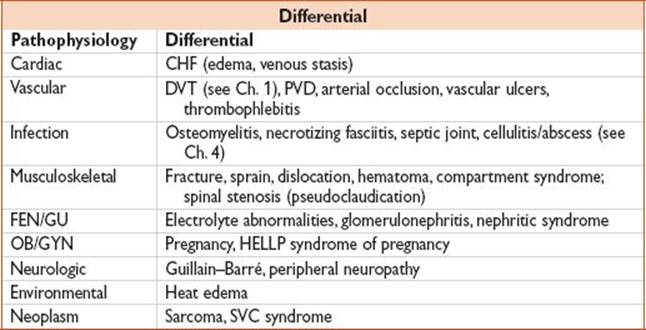
• Careful hx: Anatomic distribution, unilateral vs. bilateral, acute vs. chronic, a/w erythema or dermatologic findings; h/o trauma
• Assess for paresthesia, hyperesthesia, or neuropathy
• Complete neurologic & vascular exam, assess for motor weakness
PERIPHERAL VASCULAR DISEASE
Claudication
History
• Ischemic muscle pain reproducible w/ exertion, improves w/ rest
• Pts often place legs in dependent position to improve flow
• 1–2% have chronic critical limb ischemia: Pain at rest, nonhealing ulcers, dry gangrene
Findings: May have nl exam at rest w/ or w/o ↓ peripheral pulses
Evaluation
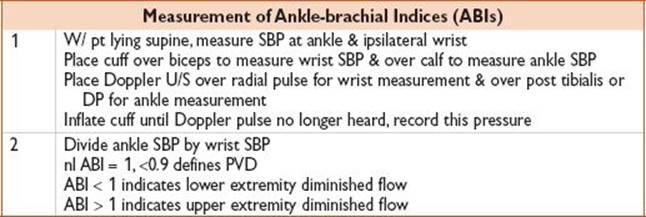
• ABI <0.9 is diagnostic of PVD (sens & spec)
• Careful pulse exam, w/ Doppler if difficult to palpate
• Look for signs of critical ischemia (rest pain, nonhealing ulcers)
Management: If concern for critical ischemia or acute dz, vascular surgery consult
Disposition
• Admit acute dz
• D/c home if chronic w/ vascular surgery f/u, strict return instructions
Acute Extremity Arterial Occlusion
History
• Known PVD +/or RFs (HTN, tobacco, known CAD, AF)
• Abrupt onset of pain w/ distal paresthesias
• Late (concerning findings): Pain, pallor, paresthesia, pulselessness
Findings
• Cold, mottled extremity, ↓ pulse, motor weakness, ± bruit
• Tenderness to palpation out of proportion of exam or ↓ sensation
Evaluation
• Bedside Doppler of all pulses, including unaffected extremities; ABI
• U/S can demonstrate level of occlusion
• CTA or angiography
• ECG for arrhythmia, may need echo to look for embolic source
Treatment
• Immediate vascular surgery consultation for possible embolectomy
• Anticoagulation (discuss w/ vascular): Heparin 18 U/kg/h IV w/o bolus
Disposition
• Transfer to facility w/ vascular surgery capability if none available
Pearl
• Ischemic tissue death starts by 4 h; sooner in pts w/ chronic arterial insufficiency
TRAUMA
Compartment Syndrome
History
• Can occur in any closed fascial space, most commonly in distal lower extremity (calf)
• H/o trauma (esp crush), burns, rhabdomyolysis, tight cast/dressing, hemorrhage (anticoagulants, coagulopathy), postischemic swelling, snakebites, IVDU
Findings
• Pain out of proportion to exam, pain w/ passive stretch of muscles that run through compartment (see the table below), paresthesias, pallor of the extremity, taut or rigid compartment. LATE: Decreased pulse, sensory/motor deficits.
Evaluation
• Measure compartment pressures: nl <8 mmHg; emergent fasciotomy if >30 mmHg
• Stryker instrument: Enter each compartment perpendicular to the skin
• A-line manometer: Attach 18G needle to A-line manometer; check that the compartment pressure being measured is at the same height as the manometer transducer
Treatment
• Immediate orthopedic/surgical consult for fasciotomy
Disposition
• Admit to ortho for serial manometry & neurovascular checks if compartment pressures <30 mmHg but evolving compartment syndrome suspected
Pearls
• nl compartment pressure does not r/o compartment syndrome; clinical Dx
• 6% incidence open tibia fx; 1% in closed tibia fx; 30% w/ arterial injury; 14% w/ venous
