
Approach
• Careful hx: Anatomic distribution, unilateral vs. bilateral, acute vs. chronic, fever, abdominal pain, groin pain, syncope h/o trauma; worse at rest or at night; incontinence?
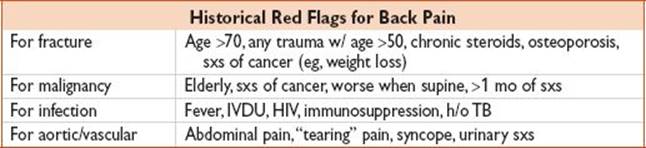
• Physical exam w/ thorough neurologic exam, straight leg raise, pulses, rectal tone, gait
• Always check urine pregnancy test in females of childbearing age
• X-rays not routinely indicated: Use for red flags above, abnl exam, point tenderness
• Most require only analgesia & f/u but always consider life- & limb-threatening conditions
TRAUMA
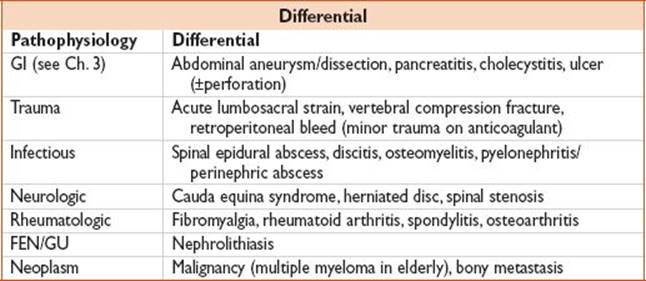
Acute Lumbosacral Strain
History
• Usually h/o precipitating event: Twisting, lifting, new workout. Acute/subacute onset.
• Should have no fever or radicular sxs
Findings: Paravertebral muscle spasm & tenderness, nl neuro exam
Evaluation: No indication for imaging acutely
Treatment
• NSAIDs; if severe, short course opioids or benzodiazepines; early activity (no bed rest)
• Muscle relaxants of no proven value, many side effects (anticholinergic)
Disposition: D/c home w/ PCP f/u, strict return instructions
Pearl: Lumbar strain is the #1 cause of LBP in ED but Dx of exclusion
Vertebral Compression Fracture
History: Acute-onset LBP usually in elderly pts w/ osteopenia, smoking, on steroids
Findings: Focal tender area on spine, usually no neuro findings
Evaluation: Plain film of affected thoracic, lumbar, or sacral spine
Treatment
• Usually stable fractures; analgesia ± brace for comfort
• Consult ortho or spine for >50% compression or multiple fractures
Disposition: Admit for intractable pain, any neuro findings, >50% compression, multiple fractures
Pearl: Look for neoplastic cause if no other RFs or hx, esp in elderly
NEUROLOGIC
Cauda Equina Syndrome
Definition: Large central disk herniation of distal spinal cord – neurosurgical emergency
History
• Severe LBP shooting down 1 or both legs & neuro sxs: Saddle paresthesias, urinary retention w/ overflow incontinence, loss of bowel control or sexual Dysfxn; pts w/ recent trauma or cancer w/ possible mets
Findings: ↓ rectal tone, urinary retention, saddle anesthesia, areflexia, weakness
Evaluation
• MRI is imaging test of choice
• Postvoid residual is the most sens initial finding
Management: Emergent Neurosurgery consult, admit
Lumbar Spinal Stenosis
Definition: Narrowing of lumbar spinal canal from degeneration, facet arthritis, or subluxation
History: 40+ y/o, bilateral low back pain, pseudoclaudication (pain w/ walking), age >40, improves w/ rest & flexion of back (walk hunched over to keep back flexed)
Findings: nl exam, nl SLR, pain w/ back extension
Evaluation: Emergent imaging not needed if nl neuro exam; CT, MRI are diagnostic
Treatment: Pain mgmt w/ NSAIDs; hip flexor & abdominal exercises; surgery if severe
Disposition: Close f/u w/ PCP
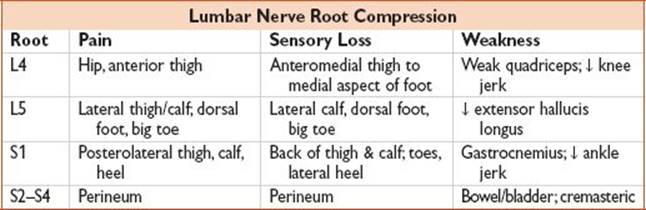
Herniated Disc
History
• 30–40 y/o, h/o waxing/waning back pain shooting down leg (past knee) ± paresthesias
• Exacerbated by leaning forward, coughing, sneezing, & straining (stretches nerve root)
Findings
• See table below (L4–5 is most common)
• SLR test correlates w/ nerve root irritation only if reproduced sxs extend below knee. Ipsilateral is sens, contralateral is spec.
Management:
• Neuro intact: Analgesia, DC home. MRI or CT myelogram if no improvement in 4–6 wk.
• Neuro deficits (or acute traumatic herniation): MRI to eval for cord involvement
Disposition: D/c if no cord findings; o/w need neurosurgery consult
Pearl: Sciatica is lumbar disc herniation impinging on sciatic nerve
INFECTIOUS
Spinal Epidural Abscess
History
• Classic triad of fever, local spine tenderness, extremity neurologic deficit
• High-risk population: IV drug abusers, immunocompromised, recent instrumentation, DM
Findings
• Classic sequence: Back pain → root pain/radiculopathy → motor weakness, sensory changes, bowel/bladder Dysfxn → paralysis
Evaluation: MRI test of choice, ESR elevated in 95–100% cases
Treatment
• Cover Staph, Strep, gram-negative organisms: (Nafcillin 2 g OR oxacillin) AND (ceftriaxone 2 g OR ciprofloxacin) ± vancomycin, antipseudomonal if instrumented
• Neurosurgical consultation; ±steroids; may want biopsy prior to abx
Disposition: Admit usually to spine surgery; operative wash-out
Pearl: Avoid LP to prevent introduction of organisms into CSF unless meningitis suspected
NEOPLASTIC
Bony Metastasis
History: >50 y/o, >1 mo of sxs, weight loss. Commonly breast, lung, kidney, prostate, thyroid.
Findings: Tenderness of lumbar spine to palpation
Evaluation
• Plain film. CT/MRI/bone scan if plain film not definitive.
• MRI & neurosurgery/oncology consultation if cord syndrome or findings
Treatment
• Pain control, Oncology referral
• If cord compressed, administer dexamethasone 10 mg IV or methylprednisolone 30 mg/kg IV, immediate consult
Disposition: Tx per neurosurgery; possible operative decompression
Pearls
• Primary malignancy (esp multiple myeloma) should also be considered, esp in elderly
• Many bony mets missed on original x-rays, review films w/ radiologist specifically