
Background
• Leading cause of traumatic death in pts <25
• 80% mild (GCS 14–15), 10% mod (GCS 9–13), 10% severe (GCS <9) injuries
• CPP = MAP − ICP, poor outcome if CPP <70 mmHg, CPP constant when MAP b/w 50 & 160
• 1° brain injury: Mechanical, irreversible damage caused by mechanical cell damage
• 2° brain injury: Alteration in cerebral blood flow → cerebral ischemia, membrane disruption, cerebral edema, free radical generation
Approach
• Careful hx: Associated sxs (photophobia, vomiting, visual changes, ocular pain), focal neurologic sxs
• Assess for head or neck trauma, medications, substance abuse
• Check finger-stick blood sugar to r/o hypoglycemia as cause for AMS
• Warning signs for neuroimaging: Severe HA, vomiting, worsening over days, aggravated by exertion or Valsalva, neck stiffness, AMS, abnl neuro exam, peri- or retro-orbital pain
Skull Fractures
History
• Direct blow to the head, pt c/o pain
Findings
• Skull depression
• Basilar skull fx: Periorbital ecchymosis (raccoon eyes), retroauricular hematoma (Battle sign), otorrhea & rhinorrhea (CSF leak), 7th nerve palsy, hemotympanum
Evaluation
• Noncontrast head CT. CBC, Chem, coags, T&C, tox screen; plain films not indicated
• CTA to eval for vascular injury if basilar skull fx present
Treatment and Disposition
• Airway management; management guided by underlying brain injury
• Linear skull fx: If not other IC injury may be observed for 6 h & discharged
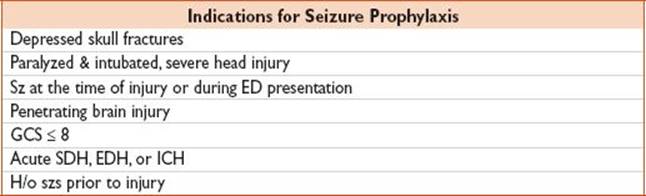
• Depressed skull fx: Admit to NSGY, surgical elevation if depressed skull fx > thickness of skull, update tetanus, consider ppx abx & anticonvulsants
• Basilar skull fx: Admit to NSGY
Pearl
• GCS more indicative of underlying brain injury or hemorrhage
Scalp Laceration
History
• Direct blow to the head, direct bleeding from scalp
Findings
• Often blood has clotted upon ED arrival; has potential for large blood loss
• Blood loss may not be evident in ED, eval for blood loss in field
Evaluation
• Noncontrast head CT if indicated. CBC, Chem, coags, T&C, tox screen if significant blood loss
• Thoroughly evaluate & explore skull for depressions & large lacerations
Treatment
• Hemostasis & irrigation: Wounds often contaminated despite rich blood supply, direct venous drainage into the venous sinuses can cause significant CNS infections
• Staples can be used if galea not involved
• Interrupted or vertical mattress sutures w/ 3–0 nylon or Prolene
• Galea must be repaired w/ absorbable sutures if lacerated; continued bleeding → subgaleal hematoma that often becomes infected
Disposition
• If no other injuries, can d/c. O/w admission & observation.
Pearl
• Abx not indicated for properly managed head wound unless gross contamination


Postconcussive Syndrome
History
• Closed head injury, ± LOC (brief). HA, memory problems, dizziness, etc. may last 6 wk.
Findings
• nl neurologic exam, wide spectrum of mild neuro complaints
Evaluation
• Noncontrast CT shows no bleed but clinically insignificant SAH may have occurred
Treatment
• Symptomatic HA control
Disposition
• D/c w/ careful head injury instructions
• May return to sport only after 2 wk of complete resolution of concussive sxs
Pearls
• Thought to be secondary to stretching of white matter fibers at time of injury
• 2nd head injury more dangerous than 1st
Intracerebral/Intraparenchymal Hemorrhage
History
• Depends on size & location of bleed
Findings
• Pts commonly c/o HA, n/v
Evaluation
• Noncontrast head CT. CBC, Chem, coags, T&C.
Treatment
• Airway management
• Emergent neurosurgical eval although most pts are managed nonoperatively; ICP monitor if significant bleed present
• Mannitol for ↑ ICP, antiseizure medication to all pts
• Reverse coagulopathy emergently w/ Vit K 5–10 mg IV × 1 ± FFP &/or factor conc.
Disposition
• Follow
Pearl
• Frontal lobe hematoma may cause disinhibition & personality changes
Subarachnoid Hemorrhage (SAH)
History
• Pt c/o “worst HA of life”; acute onset & rapid progression, meningismus, vomiting, photophobia; can often pinpoint exact moment of onset
• Spontaneous (ruptured cerebral aneurysm [∼75%], AVM [∼10%]) or traumatic
Findings
• HA, n/v, sz, syncope, acute distress
• Acute AMS is indicative of large bleed, usually requires emergent intervention
Evaluation
• Noncontrast CT scan of head, ancillary studies (CBC, BMP, coags, T&S)
• Head CT 95–99% sens for acute SAH (w/i 6–24 h); perform LP if CT neg
• If concern for ruptured cerebral aneurysm, should also obtain CT angiogram
• Large # RBC in CSF highly suggestive of SAH
• RBCs are hemolyzed in CSF, may not be present in large numbers after 12 h or may not be present at all after 2 wk
• Xanthochromia highly suggestive of bleed b/w 12 h & 2 wk (yellow discoloration due to RBC breakdown)
• Check finger-stick blood sugar to R/O hypoglycemia as cause for AMS
Treatment
• Airway management if comatose or not protecting airway, neurosurgical consultation
• ICP & BP monitoring if bleed is significant; a-line, elevate head of bed to 30°
• SPB b/w 90 & 140 mmHg, HR b/w 50 & 90 bpm, nicardipine or labetalol
• Mannitol for significant bleed
• Nimodipine to decrease vasospasm 60 mg PO q4h × 21 d
• Sz prophylaxis (phenytoin, Keppra)
Disposition
• To neurologic ICU
Pearls
• Outcome directly related to amount of intracranial blood
• 30–50% have “sentinel HA” days to weeks prior to SAH


Subdural Hematoma (SDH)
History
• Often caused by acceleration/deceleration tearing injury of bridging veins
• Can be acute (<48 h), subacute (2 d–3 wk) or chronic (>3 wk)
Findings
• Varied. Range from HA w/ nausea to comatose & flaccid
Evaluation
• Noncontrast head CT shows crescent-shaped mass. Check CBC, Chem, Coags, T&C.
Treatment
• Airway management, emergent neurosurgical eval
• If e/o ↑ ICP or midline shift, mannitol & anticonvulsant
• Reverse coagulopathy emergently w/ Vit K 5–10 mg IV × 1 ± FFP &/or factor conc.
Disposition
• Follow
Pearls
• More common than epidural hematoma
• Comatose & flaccid pts w/ SDH have an extremely poor prognosis, should discuss w/ family
Epidural Hematoma
History
• Brief LOC followed by “lucid interval,” then rapidly progressive deterioration
• Head injury usually in area of temporal bone, causes damage to middle meningeal artery
Findings
• Ipsilateral pupil deviation, occasionally contralateral hemiparesis, n/v, sz, hyperreflexia, + Babinski
Evaluation
• Noncontrast CT often shows lenticular biconcave mass, possible fx of temporal bone
• CBC, Chem, coag panel, T&C
Treatment
• Airway management, emergent neurosurgical consultation
• Mannitol & anticonvulsant
• Reverse coagulopathy emergently w/ Vit K 5–10 mg IV × 1 ± FFP &/or factor conc.
Disposition
• Follow
Pearl
• Bleeding b/w the dura mater & skull
Diffuse Axonal Injury (DAI)
History
• Result of tremendous shearing forces seen in high-speed MVCs
Findings
• Pts present in coma; document best neuro response: May have prognostic value
Evaluation
• Noncontrast CT often nl, must r/o bleed
• CBC, Chem, coag panel, T&C, tox; look for other etiology for coma
• MRI (nonemergent) will show changes & can guide prognosis
Treatment
• Airway management
• Emergent neurosurgical consultation for ICP monitor to avoid 2° injury from edema
• Mannitol & phenytoin
Disposition
• Follow
Pearl
• Prognosis determined by clinical course & difficult to predict