
Definition
• Trauma to hip or pelvis
Approach
Pelvis Anatomy
• Sacrum, coccyx, & R/L innominate bones (ileum, ischium, pubis) fuse at acetabulum
Inspection
• Perineal edema/lacerations/ecchymosis, deformities (length discrepancy, internal/external rotation)
Palpation
• Rectal exam (blood, high-riding prostate, tone), pulses, pelvic stability (limit manipulation if unstable → clot dislodgement), neurologic exam (strength, sensation, DTRs), in females pelvic exam
Radiology
• AP pelvis (can miss sacral fractures/SI joint disruptions → inlet/outlet views), CT scan (superior for acetabular fractures/associated injuries), hip x-ray
Pelvic Fractures
Definition
• Fractures of the pelvis usually caused by significant mechanism (↑ association w/ other injuries)
History
• Blunt trauma, lateral/AP compression, vertical shear (fall)
Physical Findings
• External contusion/abrasion/ecchymosis, caution w/ manual compression/distraction of pelvis (may dislodge clot → hemorrhage), evaluate for open pelvic fx as these have 40–50% mortality, hypotension (42–50% mortality), blood at meatus, perineal trauma, neurologic abnormalities (cauda equina syndrome, plexopathies, radiculopathies)
Evaluation
• FAST, AP pelvis, CT scan, evaluate carefully for intra-abdominal trauma as >15% w/ pelvic fx will have intra-abdominal injury
Treatment
• Unstable: Temporizing measures (wrapped sheet/external binders/external clamps), immediate orthopedic & trauma surgery consult (reduction/external fixation & pelvic packing), IR for hemorrhage control
• Stable: Orthopedic consult
Disposition
• Admit
Pearls
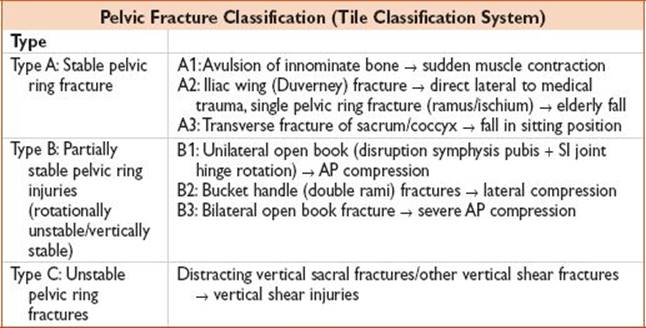
• Type A (inferior pubic rami/avulsion) & type B2 (bucket handle) → most common
• Type B3 (open book) & C (70% have major associated injuries) → most life-threatening
Vascular Pelvic Injuries
Definition
• Injury to vascular structures of pelvis a/w pelvic fractures (most commonly AP trauma or vertical shear)
History
• Blunt trauma, lateral/AP compression, vertical shear (fall)
Physical Findings
• Unstable pelvis, hypotension resistant to resuscitation
Evaluation
• FAST, AP pelvis, CT scan (if stable), pelvic angiography, consider DPA if FAST neg but HD unstable
Treatment
• Stabilization of pelvis, orthopedic & trauma surgery consult (external fixation & pelvic packing to control hemorrhage), IR embolization for continued hypotension (less effective for venous bleed → high collateralization)
Disposition
• Admit
Acetabular Fractures
Definition
• Fractures to the acetabulum (MVC → knee striking dashboard or lateral intrusion), fall in elderly
History
• Blunt trauma, pain w/ movement of hip
Physical Findings
• Pain w/ movement of hip/compression of sole of foot or greater trochanter
Evaluation
• AP pelvis, lateral hip films (± Judet views), CT scan (if plain films unrevealing)
• 3 types (although some fit in multiple categories
• Wall: Anterior, posterior, posterior wall/column, transverse/posterior wall
• Column: Anterior, posterior, both, posterior wall/column, anterior/transverse
• Transverse: Transverse, T, transverse/posterior wall, anterior column/transverse
Treatment
• Orthopedic consult for operative management
Disposition
• Admit
Hip Fractures
Definition
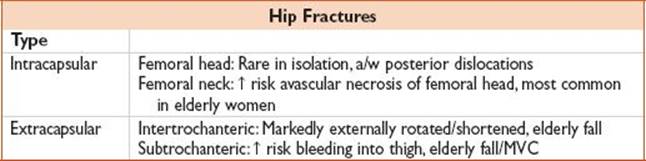
• Fractures of the hip (femoral head/neck/trochanter)
History
• Elderly → fall from standing, young → significant mechanism trauma (MVC)
Physical Findings
• External rotation, shortening of leg
Evaluation
• AP pelvis, lateral hip films, CT (if unable to bear weight + neg plain films)
Treatment
• Orthopedic consult for operative management (femoral neck fractures → ↑ risk avascular necrosis of femoral head, surgical repair in <6 h)
Disposition
• Admit
Pearl
• Hip fracture in elderly → 25% 1-y mortality
Hip Dislocations
Definition
• Dislocation of femoral head from acetabulum (90% posterior)
History
• Elderly fall w/ h/o hip total hip replacement, MVC (knee hitting dashboard, a/w other injuries), athlete running & lands w/ hip flexed/internally rotated & adducted
Physical Findings
• Flexed/adducted/internally rotated hip (posterior)
Evaluation
• AP pelvis, lateral hip films
Treatment
• Orthopedic consult if fracture or prosthetic hip, reduction under conscious sedation (in <6 h, ↑ risk avascular necrosis of femoral head)
Disposition
• Admit if needed