
Definition
• Injuries to the extremities (vascular/bony/soft tissue/nerve)
Approach
History
• Last tetanus (booster if >5 y), hand dominance, time of injury, mechanism (crush/penetrating), neurologic deficit (loss of sensation/motor), environmental exposures (burn/cold), preinjury functional status
Inspection
• Color (discoloration/ecchymosis/perfusion), soft tissue defects (control hemorrhage during primary survey), deformities (angulations/shortening), swelling
Palpation
• Pulses, all joints/bones (tenderness), FB, crepitance, strength, sensation, DTRs, range all joints, joint effusions
Radiology
• Plain films guided by PE
Consults
• Orthopedic &/or vascular for open fractures/amputations/vascular injuries/compartment syndrome, hand surgery for significant hand injuries
Extremity Vascular Injury
Definition
• Injury to the vasculature of the extremities
History
• Blunt trauma (fracture/dislocation → tearing of vessels) or penetrating trauma
Physical Findings
• Obvious vascular compromise → pulseless/pallor/pain/paresthesia/cold, indicators of vascular injury → swelling/pain/↓ cap refill/mottled skin/↓ pulses
Evaluation
• Plain films (blunt trauma), CTA, or angiography (if stable), Ankle/Brachial index or Ankle/Ankle index: Abnl if <0.9
Treatment
• Vascular surgery consult for immediate surgical repair (↓ salvage rate if >6 h)
Disposition
• Admit if needed
Extremity Orthopedic Injuries
Definition
• Bony fractures or joint dislocations of the extremities
History
• Blunt trauma or penetrating
Physical Findings
• Deformities, pain, swelling, crepitance, neurologic deficits, diminished pulses
Evaluation
• Plain films, image joint above & below for significant fracture, CT in certain injuries (tibial plateau)
Treatment
• Open fractures: Immediate orthopedic consult for operative washout/fixation (<6 h), abx (cefazolin 1–2 g)
• Closed UE fractures + intact neuro exam: Splint, outpt f/u (see table)
• Closed LE fractures + intact neuro exam: Splint, outpt f/u if able to use crutches (see table)
• Dislocations: ED reduction, pt f/u
Disposition
• Admit if needed
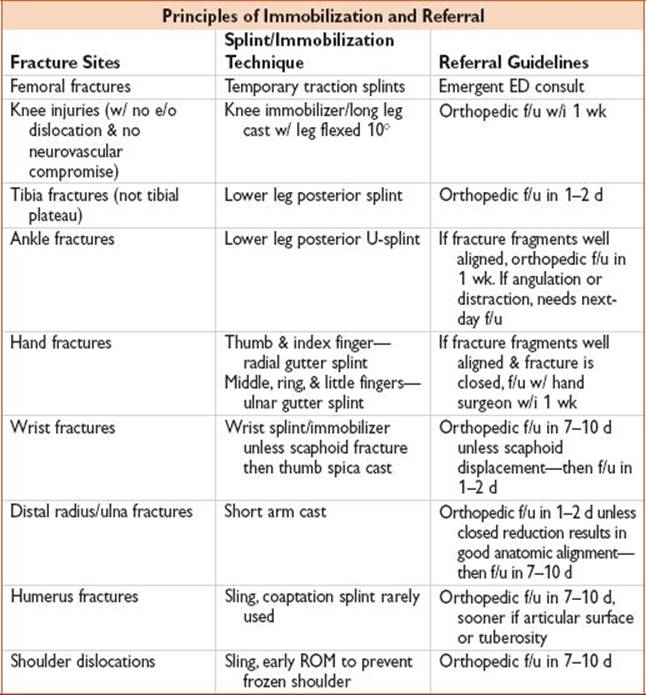
Pearls
• 5th MCP fractures or “Boxer fractures” have a high rate of infection secondary to breaks in skin from opponent’s tooth. Always r/o FB w/ plain radiographs & f/u in 1–2 d in ED or in hand clinic.
• Scaphoid tenderness w/o radiologic e/o fracture requires splinting & orthopedic f/u & repeated x-rays w/i 7 d.
• ED, emergency department; MCP, metacarpal.
Extremity Soft Tissue Injury
Definition
• Injury to the soft tissue of the extremities
History
• Blunt trauma or penetrating (polytrauma, industrial accidents)
Physical Findings
• Soft tissue defects, FBs
Evaluation
• Plain films for FB/underlying fractures, US, CPK (if extensive injury)
Treatment
• Irrigate, explore for FB (↑ risk wound infection → poor cosmetic outcome), plastic surgery consult (extensive injuries), hand consult for palmar injuries as exploration w/ potential for iatrogenic injury, abx (grossly contaminated wounds)
Disposition
• Admit if extensive, e/o rhabdomyolysis/compartment syndrome
Extremity Nerve Injury
Definition
• Injury to the nerves of the extremities (a/w fractures/dislocations/lacerations/vascular ischemia/compartment syndrome)
History
• Blunt trauma or penetrating
Physical Findings
• See table
Evaluation
• Plain films for fracture/dislocation
Treatment
• Reduce fracture/dislocation (↓ pressure on nerve), fasciotomy (compartment syndrome), orthopedic/plastic surgery consult
Disposition
• Admit if needed
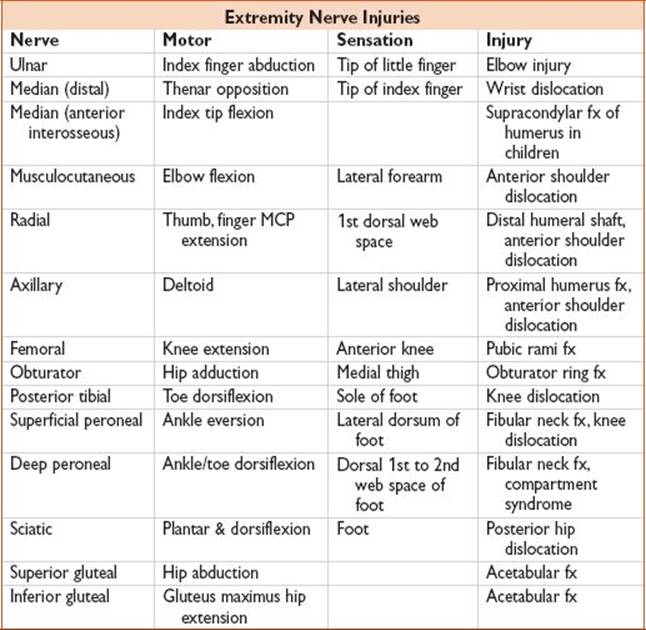
Compartment Syndrome
Definition
• A condition in which perfusion pressures < tissue pressures in closed space (fascial compartments) → ↓ circulation/tissue function (↑ risk injuries: Tibial/forearm fractures, crush injuries, burns, immobilized injuries in tight dressing/cast)
History
• Blunt trauma or penetrating, pain > than expected/worse w/ passive muscle stretching
Physical Findings
• Tenderness, tense swelling, classically: Pain, pallor, paresthesias, paralysis, pulselessness (late finding). Pain w/ passive stretching is early sign but not always reliable.
Evaluation
• Compartment pressures (measure w/ Stryker or 18 G IV + arterial line transducer) >30 mmHg or <20–30 mmHg difference b/w DBP & compartment pressure (if hypotensive necrosis occurs at ↓ pressures), CK
Treatment
• Remove restrictive dressings/casts, elevate extremity, correct BP, surgery consult for fasciotomy (do not delay fasciotomy for surgical availability)
Disposition
• Admit
Crush Syndrome/Rhabdomyolysis
Definition
• Crush injury → release in cellular contents of muscle cells → CK levels >5000 U/L
History
• Crush injury
Physical Findings
• May have minimal external injury, dark brown/orange urine
Evaluation
• CK levels >5000 U/L, ↑ Cr (15–47% a/w ARF), ↑ potassium, UA (+ myoglobin), observe closely for reperfusion syndrome, esp if in field
Treatment
• IV fluids for UOP >1 mL/g/h, traditionally alkalization of urine (sodium bicarbonate, 1 amp/1 L NS → urine pH >7 → prevents tubular precipitation of myoglobin) → no difference than NS in prevention of renal failure, treat hyperkalemia (J Trauma 2004;56:1191)
Disposition
• Admit
Partial/Complete Amputation
Definition
• Amputation of extremity
History
• Blunt or penetrating trauma (polytrauma, industrial accident)
Physical Findings
• Document motor/neurologic/vascular function in remaining limb
Evaluation
• Plain films of stump + amputated fragment, ± angiography (if not going directly to OR)
Treatment
• Limit mobility, hemostasis w/ direct pressure, immediate surgery consult for replantation, abx (cefazolin 1–2 g IV), pack stump w/ sterile NS soaked gauze, wrap amputated part in cold NS soaked gauze/place on ice (do not place in direct contact w/ ice or NS)
Disposition
• Admit
Pearl
• Replantation depends on age, vocation, injury severity