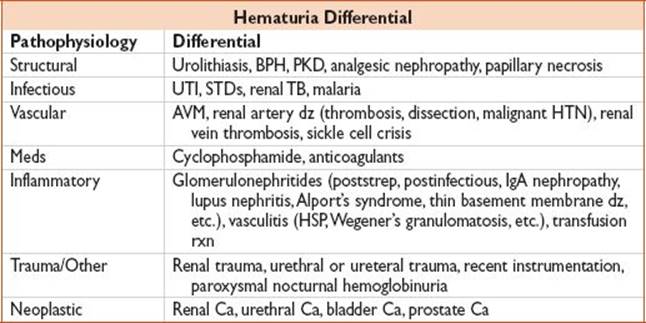
Approach to the Patient
Definition
• Hematuria defined as >5 RBCs/hpf in urine sediment, although variably defined in the literature
• Hematuria must be distinguished from pigmenturia (discoloration of urine). Pigmenturia can be caused endogenously by melanin, porphyrins, bilirubin, myoglobin, or hemoglobin or exogenously by medications (ie, warfarin, rifampin, phenazopyridine, phenytoin, etc.)
History
• Onset (sudden vs. chronic)? Dysuria/urinary frequency/renal colic? During entire or part of urine stream? (hematuria at beginning of urination → urethral; throughout urination → upper urinary tract or proximal bladder; end of urination → bladder neck or prostatic urethra)
• Painless hematuria should raise suspicion for genitourinary malignancy
• ROS (fever, weight loss, night sweats, rash, sore throat, abdominal pain, N/V, recent viral infection or UTI; trauma; excessive exercises; pelvic radiation)
• PMH (kidney stones, HTN, cancer, congenital kidney dz, vascular dz, bleeding diathesis, SCD, hereditary spherocytosis)
• MEDS:
• Drug that cause pigmenturia: Warfarin, rifampin, phenazopyridine, phenytoin, azathioprine, deferoxamine, doxorubicin, riboflavin
• Drugs that cause myoglobinuria: Amphotericin B, barbiturates, cocaine, diazepam, ethanol, heroin, methadone, statins
• Drugs that cause hematuria: NSAIDs, anticoagulations, busulfan, cyclophosphamide, OCPs, quinine, vincristine
• Social (smoking, benzene or aromatic amine exposure)
Physical
• Evaluate for HTN, petechiae, arthritis, rash
• Assess for suprapubic & CVA tenderness; thorough GU exam including prostate exam
• Postvoid residual if concern for urinary retention
Evaluation
Key question: Is this truly hematuria?
• Urine dipstick + blood (can be seen w/ hematuria, hemoglobinuria, myoglobinuria, or other pigmenturias); urine sediment necessary to confirm >5 RBCs/hpf as well as identify protein, RBC casts (suggests glomerulonephritis), & crystalluria (suggests urolithiasis)
• Other urine studies: Urine cytology
• CBC, BUN/Cr, coags (if isolated hematuria—erythrocytes in sediment, but no protein—suggests bleeding diathesis)
• Consider renal U/S, contrast-enhanced CT, CT urography; cystoscopy
Disposition
• Large, gross hematuria may warrant continuous monitoring of HCT & urology eval. If microscopic, can obtain further outpt eval by nephrology or urology.