
Approach to the Patient
Definition & Staging
• AKI is defined as any of the following:
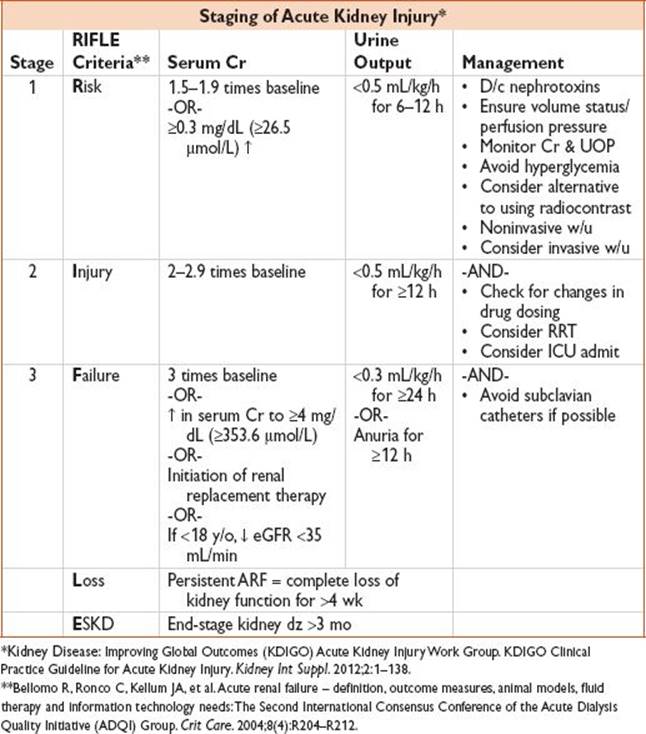
• Increase in serum Cr by ≥0.3 mg/dL (≥26.5 μmol/l) w/i 48 h; or
• Increase in serum Cr by ≥1.5 times baseline, which is known or presumed to have occurred w/i prior 7 d; or
• Urine volume <0.5 mL/kg/h for 6 h
• AKI is staged for severity according to the following criteria:
• AKD is defined as any of the following:
• AKI
• GFR 60 mL/min/1.73 m2 for <3 mo
• Decrease in GFR by ≥35% or increase in serum Cr >50% for <3 mo
• CKD is defined as GFR <60 mL/min/1.73m2 for >3 mo
• CKD is classified by Cause, GFR & Albuminuria (CGA) staging
• Cause: Is based on the presence or absence of systemic dz & location w/i the kidney of observed or presumed pathologic-anatomic finding
• GFR: GFR categories are assigned as follows


• Albuminuria: Based on albumin excretion rate & not practical to calculate in ED, but may be referenced as part of pt’s problem list
• Equations for estimation of GFR:
• Modification of Diet in Renal Disease (MDRD)
• Estimated GFR (mL/min/1.73 m2) = 1.86 × (PlasmaCr)1.54 × (age)0.203
• Multiply by 0.742 for women
• Multiply by 1.21 for African American
• Cockcroft–Gault equation
• Estimated Cr clearance (mL/min) = [(140 – age) × (weight, kg)]/(72 × PlasmaCr)
• Multiply by 0.85 for women
History
• ARF is usually asymptomatic & diagnosed when labs reveal renal abnormalities
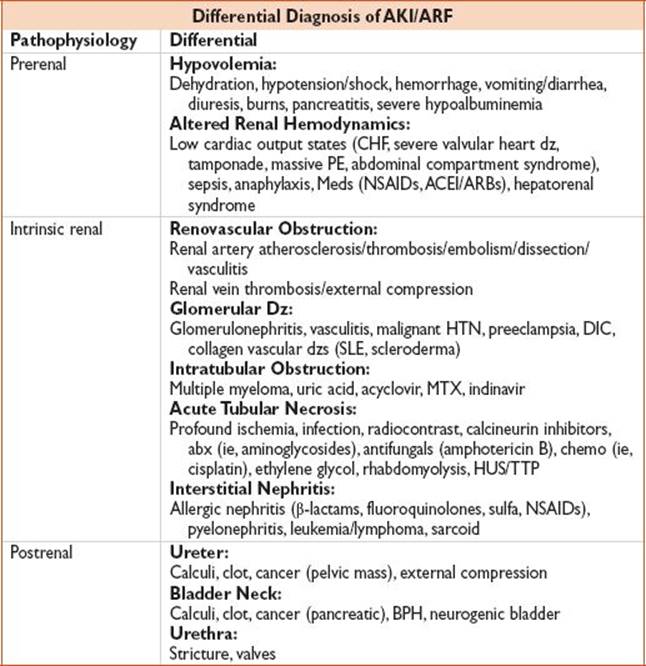
• Sxs may include decreased urine output, weight gain, fluid retention (peripheral edema, anasarca, ascites), fatigue, anorexia, N/V, pruritus, altered sensorium, thirst/orthostasis (prerenal)
• ROS (fever, rash, flank pain, hematuria)
• PMH: Baseline renal impairment, CHF, liver dz, SLE, multiple myeloma
• MEDS (ACEI/ARB, NSAIDs, aminoglycosides, other abx, cisplatin, amphotericin B, diuretics)
Physical
• Assess volume status; myoclonus, pericardial or pl rub, rash, mental status, edema
• Stigmata of CHF, liver dz, collagen vascular dzs
Evaluation
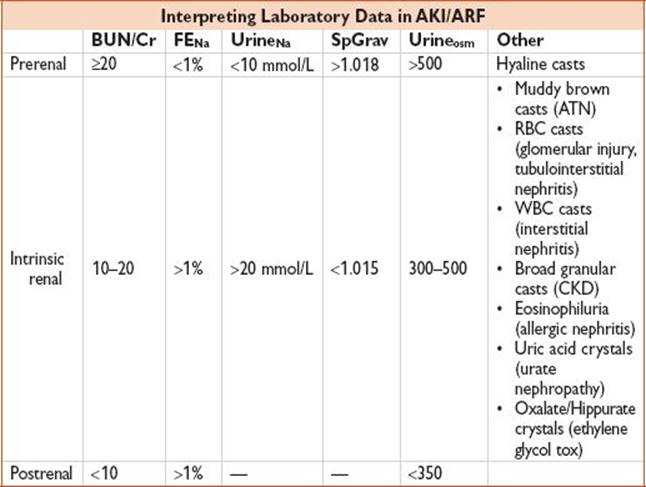
• CBC, Chem 10 (BUN/Cr ratio), serum osmolality; consider VBG w/ STAT potassium
• Urinalysis/sediment, urine lytes (urine Na, urine K, urine Cr, urine osmolality)
• FENa% = (Urine Na × Plasma Cr)/(Plasma Na × Urine Cr) × 100
• Consider LFTs, BNP if indicated
• EKG for cardiac electrical instability from potential electrolyte abx
• Consider point-of-care cardiac, IVC, renal U/S
• Imaging: Renal U/S (r/o obstruction, assess flow); consider CT abdomen if c/f pelvic mass, Doppler U/S of renal vasculature
• Other studies: Renal biopsy
Treatment
• Prerenal: Correct volume status/perfusion pressure (IVFs, pressors, PRBCs if indicated, diuresis/inotropes if cardiorenal)
• Intrinsic: Eliminate nephrotoxins, treat underlying cause, consider glucocorticoids
• Postrenal: Transurethral or suprapubic catheter placement; may require ureteric stents or percutaneous nephrostomy tube placement
• Consider sodium bicarbonate if pH <7.2 or HCO3 <15 mmol/L as bridge to dialysis
Indications for Emergent Dialysis and Renal Replacement Therapy “A, E, I, O, U”
• Acidosis (pH < 7.1)
• Electrolyte imbalance (hyperkalemia, hypocalcemia, hyperphosphatemia)
• Intoxication (lithium, salicylates, ethylene glycol, methanol, among others)
• Overload (volume overload)
• Uremia (pericarditis, encephalopathy, neuropathy, bleeding)
Disposition
• Home: Mild prerenal azotemia may be adequately treated w/ hydration; pts w/ postobstructive ARF can be sent home if obstruction is relieved (ie, w/ bladder catheter) & no significant comorbidities
• Admit: Pts w/ uremia, significant electrolyte abnormalities, volume overload, severe metabolic acidosis, unexplained ARF
Pearl
• Cx: Intravascular volume overload, hyponatremia, hyperkalemia, hyperphosphatemia, hypocalcemia, hypermagnesemia, metabolic acidosis, uremia, anemia, arrhythmias
Guideline: Kidney Disease: Improving Global Outcomes (KDIGO) Acute Kidney Injury Work Group. KDIGO Clinical Practice Guideline for Acute Kidney Injury. Kidney Int Suppl. 2012;2:1–138.