
Approach to the Patient
History
• Onset? Painful? Quality (dark vs. clots vs. bright red)? Quantity (number of pads/h)? Pregnant or postpartum? LMP? Last intercourse? Use of protection? Gravida and parity? Trauma? ROS: Dizziness or lightheadedness? Presyncopal? Other bleeding? Fever? PMH (clotting disorder, hypo- or hyperthyroid, liver dz) MEDS (anticoagulants or antiplatelet tx, contraceptives, hormonal therapy), SOCIAL (domestic violence)
Diagnostics
• CBC, type and screen (Rh), urine hCG; quantitative hCG if pt is pregnant; crossmatch (if heavily bleeding); consider pelvic U/S
Pearls
• Average pad holds 5–15 cc of blood
• Average tampon holds 5 cc of blood
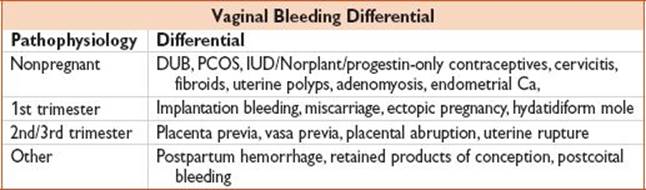
Miscarriage
History
• Vaginal bleeding ± passage of clots or tissue at <20 wk; abdominal pain/cramps
Physical Exam
• Speculum and bimanual inspection to assess for passage of blood/POC and whether os is open or closed. (If copious bleeding, remove POC w/ gentle traction to allow uterus to clamp.)
Evaluation
• Labs: UA, quant hCG, HCT, type and screen (crossmatch if HD unstable). If products expelled, send to pathology.
• Imaging: Pelvic U/S to determine location of pregnancy
Classification of Miscarriage
• Threatened: Os closed, no passage of POC, viable fetus w/ heart tones, mild cramping/bleeding (∼20% will eventually abort)
• Inevitable: Os dilated and effaced; POC not passed; cramps, moderate bleeding
• Complete: POC expelled, cervical os closed; little cramping or bleeding
• Incomplete: Clots and tissue in cervical os w/ os open; severe cramps and bleeding
• Missed: Uterus fails to expel fetus for >2 mo, os closed, no heart tones, pregnancy test negative
Treatment
• ED:
• Supportive management: IVFs, O2, monitoring, position on L side
• Blood products: Transfuse if HD unstable
• Medication therapy:
• Oxytocin: 20 U in 1 L NS for incomplete or inevitable abortion
• Rh immunoglobulin: 300 mcg if Rh-negative
• Consult: Gyn service if HD unstable or if need for D&C anticipated (inevitable, incomplete or missed abortion)
• Home management:
• Hormonal therapy: Methotrexate may be indicated under guidance of OB/Gyn
• Abx: Consider prophylaxis w/ doxycycline or testing for STD if discharging home w/ open os
Disposition
• Home: Stable pts w/ complete or threatened abortion; f/u w/ OB/Gyn w/i 72 h to monitor hCG levels
• Admit: Uncontrolled bleeding or pts requiring immediate D&C
Pearl
• Threatened and missed abortions can only be distinguished by pelvic U/S
Ectopic Pregnancy
History
• Abdominal pain, vaginal bleeding. Most often presenting 6–10 wk after LMP.
• RFs: H/o PID, IUD, fertility tx, recent abortion or prior ectopic
Physical Exam
• Assess for HD stability. Signs of peritonitis if rupture has occurred. Speculum and bimanual exam may reveal pelvic tenderness and/or adnexal mass.
Evaluation
• Labs: Quant hCG, HCT, Rh screen, PT/PTT and type and crossmatch 4 U (if HD unstable)
• Imaging: Pelvic U/S; if HD unstable, FAST exam to assess for free fluid
Treatment
• Supportive: 2 large-bore IVs, IVF resuscitation, monitor
• Transfusion: If HD unstable
• Medications: Rh immunoglobulin 300 mcg if Rh-negative
• Consult: Urgent Gyn eval for consideration of medical (MTX) vs. surgical (laparoscopy/laparotomy) tx options
Placenta Previa and Abruptio Placentae
History
• Placenta previa: Painless, bright red, vaginal bleeding usually after 28 wk (from placental implantation in adjacent to or over os). RFs: Multiple gestation, multiparity, advanced maternal age, previous placenta previa/C-section, maternal smoking or cocaine
• Abruptio placentae: Painful, dark red bleeding (80%); may also present w/ signs/sxs of DIC. RFs: Eclampsia, DM, renal dz, HTN, abdominal trauma
Physical Exam
• Check fundal height, contractions, and uterine tenderness:
• Firm/tender uterus = placental abruption until proven o/w
• AVOID SPECULUM AND VAGINAL EXAM
Evaluation
• Labs: CBC, Chem 7, LFTs, PT/PTT, fibrinogen (r/o DIC), UA, type/crossmatch 2 U
• Imaging: Doppler U/S (fetal heart tones); bedside abdominal U/S to assess placenta and signs of fetal movement, though may not always detect abruption
Treatment
• Supportive: Place on L side, 2 large-bore IVs, IVF resuscitation, monitor pt and fetus
• Transfusion: Blood products ± FFP (HD unstable or signs of DIC)
• Medications: Rh immunoglobulin 300 mcg if Rh-negative, magnesium for fetal neuroprotection if emergent delivery under 32 wk
• Consult: Urgent Gyn eval for possible STAT C-section
Disposition
• Admit: All pts to the OB service even if HD stable for close monitoring
Retained Products of Conception and Postabortion Sepsis
History
• Retained POC: Cramping, heavy bleeding
• Postabortion sepsis: Cramping, bloody or purulent d/c, fever
Physical Exam
• Fever, vaginal bleeding or purulent/bloody d/c, uterine tenderness
Evaluation
• Labs: Quant hCG, type/crossmatch/preop labs
• Imaging: Pelvic U/S
Treatment
• Supportive: Stabilize (see Sepsis chapter), correct coagulopathy/anemia
• Abx: If suspected infection, (Clindamycin 900 mg IV q8h PLUS gentamicin 2 mg/kg IV × 1 then 1.5 mg/kg q8h) OR (cefoxitin 2 g IV q8h PLUS doxycycline 100 mg IV q12h)
• Consult: Gyn service for D&C
Disposition
• Admit: All pts to OB/Gyn for D&C
Postcoital Bleeding
History
• Trauma during intercourse? Vaginal d/c, assess domestic violence or abuse.
• RFs: Cervical abnormalities, STDs, postmenopausal
Physical Exam
• Ongoing bleeding; vaginal lacerations, abrasions
Evaluation
• Labs: Urine hCG, GC/Chlamydia testing; HCT
Treatment
• ED:
• Abx: Treat STI appropriately (see STD section in Renal/GU)
• Consult: Gyn service for laceration requiring extensive repair; social services if concern for domestic violence