
Background
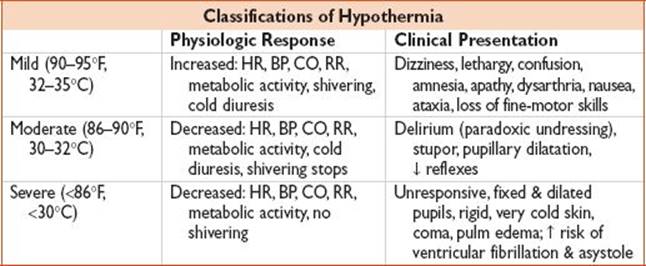
• Multiple classifications of hypothermia, severity, etiology
Approach
• Careful hx: Determine etiology of hypothermia: Environmental exposure vs. medical
• Environmental hypothermia can occur even in the absence of freezing weather (malnourished pt, elderly)
• Many medical etiologies: Hypothyroidism (myxedema coma), hypoglycemia, hypoadrenalism, sepsis, hypothalamic lesion (eg, 2/2 trauma, tumor, stroke), dermatologic conditions that prevent heat conservation (burns, erythrodermas)
• If unresponsive, check BS/give D50, give Naloxone 2 mg
History
• Environmental exposure, drug use, trauma, comorbid illnesses
Findings
• Based on degree of hypothermia (table below)
Evaluation
• Obtain core temp (bladder, rectum, esophagus: All can be inaccurate)
• Cardiac monitor, CBC (Hct ↑ 2% for every 1° ↓ temp), CMP (↑ K bad sign), tox screen, coags, CXR, lipase (cold-induced pancreatitis), CK, UA (rhabdomyolysis), ABG, head CT
• ECG shows Osborn waves (J pt deflection in same direction as QRS), <32°C/90°F
• Interval prolongation (PR, QRS, QT), AF w/ slow ventricular response (common)
Treatment
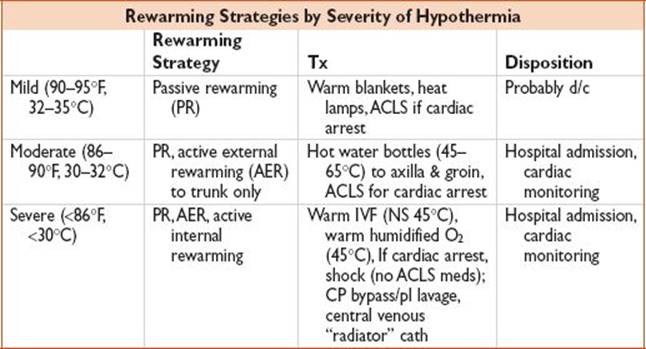
• Rewarm as per table below; intubate as needed, remove wet clothing
• Maintain horizontal position, avoid movement, limit manipulation to essential tasks. However this should not prevent CPR or other critical interventions.
• Monitor ECG, check for pulse q1min; chest compressions may cause ventricular dysrhythmias, perform only if no pulse
• If no cardiac activity, start CPR
• VF or VT: Defibrillate up to 3 times
• Core temp <30°C, cont compressions/rewarming, no ACLS meds/shock until >30°C
• Core temp >30°C, ACLS protocol w/ meds/shock, allow longer time b/w doses
• Cont resuscitation until core temp >32°C/90°F
• Consider hydrocortisone 250 mg IV or levothyroxine 250–500 μg if doesn’t rewarm w/ above
Disposition
• Based on severity of hypothermia (table below)
Pearls
• Hypothermic bradycardia is refractory to atropine since not vagally mediated; no indication for temporary pacing
• Core temp afterdrop: Peripheral vasodilation from rewarming extremities will cause return of cooler peripheral blood to core
• Consider femoral line placement if needed to avoid cardiac stimulation
• Pt not dead until they are warm & dead, aggressively rewarm before stopping efforts
FROSTBITE
History
• Cold exposure, numbness of body part → loss of sensation
Findings
• Distal body part most commonly affected (fingers, nose, toes, ears)
• Caused by both immediate cell death from cold & delayed injury from inflammatory response
• Skin initially white, waxy, insensate → erythematous, edematous, painful 48–72 h after rewarming → bleb formation, devitalized tissue demarcation over weeks
Evaluation
• Check core temp to look for systemic hypothermia
• Superficial: Areas of pallor & edema, local anesthesia, potentially clear blisters, erythema, no tissue loss
• Deep: Hemorrhagic blisters, eschar, if severe extends to muscle/bone, mummification
Treatment
• Handle tissue gently, keep extremity elevated, sterile/nonadherent dressing
• Rapid rewarming of frozen extr in gentle warm water bath (40–42°C), ROM exercise in bath, avoid water temp falling outside of range; 30 min if superficial/60 min if deep
• Consider intra-arterial tPA in severe cases
• Topical aloe vera q6h
• Aspirate & débride clear blisters, only aspirate (do not débride) hemorrhagic blisters to avoid desiccation, infection of deeper tissues
• Tetanus prophylaxis, consider ppx abx
• Early surgical intervention not indicated other than escharotomy for circumferential limb lesions (very uncommon)
Disposition
• Refer to burn service; consider admission for 24–48 h to observe for progression
Pearls
• Long-term cx: Cold insensitivity, paresthesias, nail loss, joint stiffness
• Avoid refreezing, if unable to maintain warmth to affected part (ie, prehospital) do not rewarm