
RHEUMATOLOGY
AMYLOIDOSIS
The deposition of misfolded and insoluble fibrous proteins in normal organs and tissues.
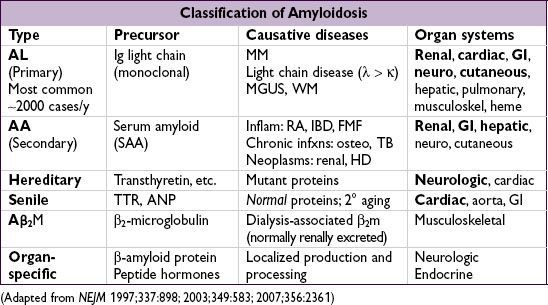

Diagnostic studies
• If suspect AL → ✓ SIEP & UIEP (↑ Se vs. SPEP & UPEP) & free light chains, ± BM bx
• If suspect renal involvement ✓ U/A (proteinuria)
• If suspect cardiac involvement: ✓ ECG (↓ voltage, conduction abnl), echo (biventricular thickening with “granular sparkling” appearance; ↑ wall w/o ↑ volt 75% Se, 95% Sp), MRI
• Biopsy (abdominal SC fat pad, rectal or affected tissue) → apple-green birefringence on Congo red stain; fat pad bx Se 60–85%, Sp 90–100%
• Genetic testing for hereditary forms
Treatment
• AL: ? high-dose melphalan → auto HSCT if limited organ dysfxn (NEJM 2007;357:1083); o/w low-dose melphalan + dexamethasone; novel agents (eg, bortezomib, lenalidomide, thalidomide) being evaluated (J Hematol Oncol 2011;4:47)
• AA: Rx underlying disease; colchicine for FMF esp. to prevent progressive renal disease (NEJM 2007;356:23); eprodisate promising for renal disease (NEJM 2007;356:2349)
• For hereditary amyloidoses in which amyloid precursor protein is produced by the
liver (eg, TTR), liver transplantation may prevent further deposition
• Cardiac involv.: diuretics; avoid dig & CCB; avoid vasodilators; ? ICD for 1° prevention
• Heart, kidney and liver Tx may be considered in those w/ advanced disease
Prognosis
• AL amyloid: median survival ~12–18 mo; if cardiac involvement, median survival ~6 mo
• AA amyloid: median survival ~11 y (NEJM 2007;356:2361)