HEMATOLOGY-ONCOLOGY
LUNG CANCER

(NEJM 2008;359:1367; JCO 2012;30:863; J Thorac Oncol 2012;7:924; Nature 2011;489:519; Cell 2012;150:1107)
Epidemiology and risk factors
• Most common cause of cancer-related death for both men and women in the U.S.
• Cigarette smoking: 85% of lung cancers occur in smokers; risk ∝ total pack-yrs, ↓ risk after quitting/reducing, but not to baseline (Int J Cancer 2012;131:1210) squamous & small cell almost exclusively in smokers adenocarcinoma most common type in nonsmokers bronchioalveolar carcinoma associated with women, nonsmokers, EGFR mutations
• Asbestos: when combined with smoking, synergistic ↑ in risk of lung cancer
• Radon: risk to general population unclear
Clinical manifestations
• ~10% are asx at presentation and are detected incidentally by imaging
• Endobronchial growth of 1° tumor: cough, hemoptysis, dyspnea, wheezing, post– obstructive pneumonia; more common with squamous or small cell (central location)
• Regional spread
pleural effusion, pericardial effusion, hoarseness (recurrent laryngeal nerve palsy), dysphagia (esophageal compression), stridor (tracheal obstruction)
Pancoast’s syndrome: apical tumor → brachial plexus involvement (C8, T1, T2) → Horner’s syndrome, shoulder pain, rib destruction, atrophy of hand muscles
SVC syndrome (NEJM 2007;356:1862): central tumor → SVC compression → face or arm swelling (>80%), venous distention of neck & chest wall (~60%), dyspnea/cough (~50%), HA (~10%); Rx = steroids & diuretics, RT ± chemo after tissue dx, SVC stent for severe sx, fibrinolytic + anticoag if thrombus
• Extrathoracic metastases: brain, bone, liver, adrenal
• Paraneoplastic syndromes
Endocrine:
ACTH (SCLC) → Cushing’s syndrome; ADH (SCLC) → SIADH
PTH-rP (squamous cell) → hypercalcemia
Skeletal: digital clubbing (non–small cell), hypertrophic pulmonary osteoarthropathy (adenocarcinoma) = symmetric polyarthritis and proliferative periostitis of long bones
Neurologic (SCLC): Eaton-Lambert, peripheral neuropathy, cerebellar degeneration, limbic encephalitis
Cutaneous: acanthosis nigricans, dermatomyositis
Hematologic: hypercoagulable state (adenocarcinoma), DIC, marantic endocarditis
Screening (JAMA 2011;306:1865; NEJM 2011;365:395)
• No benefit to CXR or sputum cytology, even in high-risk Pts
• Low-dose chest CT in >30 pack-y smokers age 55–74 y → 20% ↓ in lung cancer–related mortality vs. CXR; number needed to screen = 320; high false  rate
rate
Diagnostic and staging evaluation (NCCN Guidelines v.3.2012)
• Initial imaging: chest CT (include liver and adrenal glands) w/ contrast if possible
• Tissue
bronchoscopy (for central lesions) or CT-guided needle bx (for peripheral lesions or accessible sites of suspected metastasis)
mediastinoscopy (lymph node bx), VATS (eval. of pleura peripheral lesions), thoracentesis (cell block for cytology) or sputum cytology (for central lesions)
• Staging
Intrathoracic: mediastinoscopy (± preceded by U/S-guided transesoph. or transbronch. needle aspiration; JAMA 2010;304:2245) or VATS; thoracentesis if pleural effusion
Extrathoracic: PET-CT more Se than CT alone for detecting mediastinal and distant mets as well as bone mets (NEJM 2009;361:32); brain MRI for all Pts (except IA)
• Genetic testing for EGFR mutations and ALK rearrang. for stage IV nonsquam NSCLC
• PFTs w/ quantitative V/Q if planned treatment includes surgical resection; need to have 30% of normal, predicted lung fxn after resection
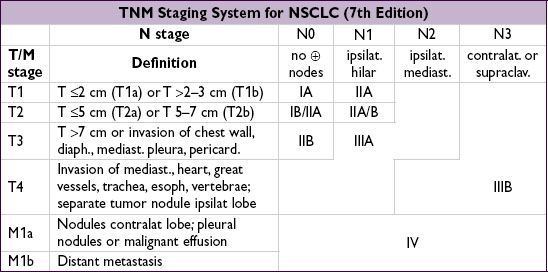
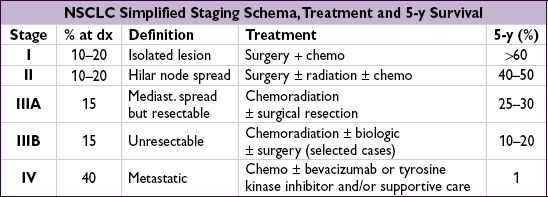
NSCLC treatment (NCCN Guidelines v.3.2012)
• Stages I & II: surgical resection + adjuvant chemo (surgery alone for stage IA) (NEJM 2004;350:351 & 2005;352:2589)
• Stage III: chemoradiation is main treatment modality
IIIA viewed as potentially resectable (Lancet 2009;374:379) and IIIB as unresectable neoadjuvant chemoradiation may convert unresectable → resectable
• Stage IV: chemotherapy ↑ survival vs. best supportive care
backbone of therapy is platinum-based doublet; cisplatin/pemetrexed better for adenocarcinoma; cisplatin/gemcitabine better for squamous (JCO 2008;26:3543)
bevacizumab (anti-VEGF mAb) + chemo ↑ median survival by 2 mo; ↑ risk of bleeding, ∴ do not use if untreated or hemorrhagic brain mets (JCO 2009;27:5255) or squamous cell (hemoptysis) (NEJM2006;355:2542)
if EGFR mutation (a/w improved prognosis): EGFR tyrosine kinase inhibitor (TKI, eg, erlotinib) first-line Rx (Lancet 2008;372:1809; NEJM 2010;362:2380 & 2011;364:947)
if ALK rearrangement: ALK TKI (eg, crizotinib) first-line Rx (Lancet Oncol 2011;12:1004)
TKI toxicities: rash & diarrhea (common); lung & liver injury (rare but potentially serious) palliative radiation used to control local sx caused by tumor or metastasis solitary brain metastasis: surgical resection + brain radiation may ↑ survival
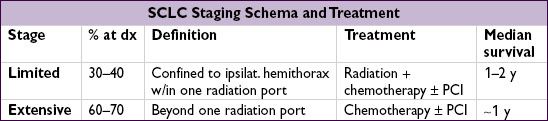
SCLC treatment (NCCN Guidelines v.2.2013)
• SCLC usually disseminated at presentation, but can be very responsive to chemoradiation
• Chemotherapy (platinum + etoposide) is primary treatment modality
• Thoracic radiation added to chemotherapy improves survival in limited stage disease
• Prophylactic cranial irradiation (PCI) improves survival for limited stage disease in complete remission (NEJM 1999;341:476)