HEMATOLOGY-ONCOLOGY
HEMATOPOIETIC STEM CELL TRANSPLANTATION (HSCT)
Transplantation of donor pluripotent cells that can reconstitute all recipient blood lineages
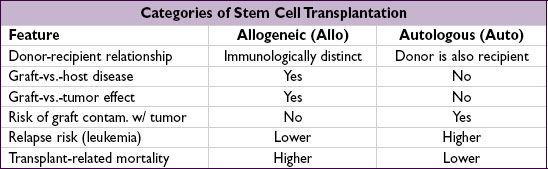
• Types of Allo HSCT: based on donor/recipient matching of major HLA antigens on Chr. 6 (4 principal genes for serotyping: HLA-A, -B, -C, & -DR; each w/ 2 alleles ∴ 8 major Ag)
Matched related (sibling matched at 8/8 major Ag): lowest risk of GVHD; preferred donor
Mismatched related (eg, 1/8 Ag mismatch) or haploidentical (mismatch at 4/8 Ag): easiest to find, but ↑ risk of GVHD, rejection; ∴ need additional immunosuppression
Matched unrelated: ↑ risk of GVHD; ∴ matching of 10 HLA alleles (DQ also) to ↓ risk; chance of match correlates w/ ethnicity
Umbilical cord blood: HSC processed at birth & stored; ↓ risk of GVHD; tolerate mismatch but much slower immune reconstitution (Blood 2010;116:4693)
• Graft-vs.-host disease (GVHD): undesirable side effect of allo HSCT allogeneic T cells view host cells as foreign; ↑ incid. w/ mismatch or unrelated donors
• Graft-vs.-tumor (GVT) effect: desired in allo-SCT; graft T cells attack host tumor cells
Indications (NEJM 2006;354:1813; BMT 2010;45:1259)
• Malignant disease:
Auto HSCT allows higher ablative chemo doses and then rescues the hematopoietic system (used mostly for lymphoma, multiple myeloma, testicular cancer)
Allo HSCT produces graft-versus-tumor (GVT) effect, in addition to hematopoietic rescue (used for AML, ALL, CML, CLL, MDS, lymphoma)
• Nonmalignant disease: allo HSCT replaces abnl lymphohematopoietic system w/ one from nl donor (eg, immunodef., aplastic anemia, hemoglobinopathies, ? autoimmune dis.)
Transplantation procedure
• Preparative regimen: chemotherapy and/or immunosuppression prior to transplantation
myeloablative (traditional): chemotherapy and/or total body irradiation. Goal is eradication of underlying disease for which transplant is being performed.
reduced intensity conditioning (RIC or “mini”): lower dose conditioning → ↓ toxicity to allow Pts w/ comorbidities or ↑ age to tolerate HSCT. Goal to proceed w/ transplant when in disease remission. Depends mostly on GVT; ↓ mortality w/ RIC, but ↑ relapse.
• Sources of stem cells:
bone marrow (BM): original source of HSCT, now less commonly used than PBSC
peripheral blood stem cells (PBSC): easier collection, most commonly used source
BM vs. PBSC  survival; BM ↓ chronic GVHD, PBSC ↓ graft failure (NEJM 2012;367:1487)
umbilical cord blood (UCB): less stringent HLA-matching requirements, but fewer cells available from single donor (∴ 2 donors combined in adults); slower engraftment
haploidentical: most available; newer regimens starting to make safer/more common
• Engraftment: absolute neutrophil count (ANC) recovers to 500/µL w/in ~2 wk w/ PBSC, ~3 wk w/ BM, ~4 wk w/ UCB. G-CSF accelerates recovery by 3–5 d in all scenarios.
Engraftment syndrome: fever, rash, noncardiogenic pulm edema, abnl LFTs, AKI, wt gain. Dx of exclusion: r/o infection, GVHD; Rx w/ IV steroids.
Complications
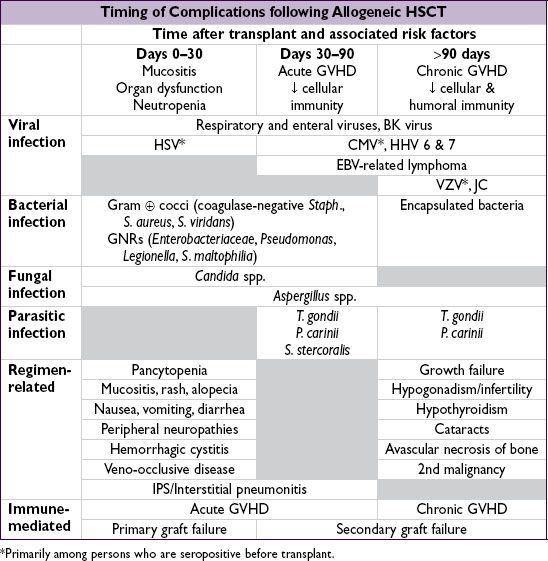
• Either direct chemoradiotoxicities associated with preparative regimen or consequences of interaction between donor and recipient immune systems
• Sinusoidal obstruction syndrome (SOS): incidence ~10%, mortality ~30%
Previously known as veno-occlusive disease (VOD)
Mechanism: direct cytotoxic injury to hepatic venules → in situ thrombosis
Symptoms: tender hepatomegaly, ascites, jaundice, fluid retention with severe disease → liver failure, encephalopathy, hepatorenal syndrome
Diagnosis: ↑ ALT/AST, ↑ bilirubin; ↑ PT with severe disease; Doppler U/S may show reversal of portal vein flow; ↑ hepatic wedge pressure; abnl liver bx
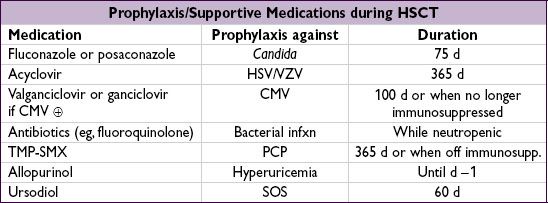
Treatment: supportive; prophylaxis with ursodiol; defibrotide
• Idiopathic pneumonia syndrome (IPS): up to 70% mortality (Curr Opin Oncol 2008;20:227)
Mech: alveolar injury due to direct toxicity → fever, hypoxia, diffuse pulmonary infiltrates
Diffuse alveolar hemorrhage (DAH): subset of IPS
Diagnosis: bronchoscopy to exclude infection; ↑ bloody lavage fluid seen with DAH
Treatment: high-dose corticosteroids, etanercept (Blood 2008;112:3073)
• Acute GVHD (usually within 6 mo of transplant; Lancet 2009;373:1550)
Clinical grades I–IV based on scores for skin (severity of maculopapular rash), liver (bilirubin level) and GI (volume of diarrhea); bx supports diagnosis
Prevention: immunosuppression (MTX + CsA or tacrolimus) or T-cell depletion of graft
Treatment: grade I → none; grades II–IV → associated with ↓ survival and ∴ treated with immunosuppressants (corticosteroids, CsA, tacrolimus, rapamycin, MMF)
• Chronic GVHD (developing or persisting beyond 3 mo posttransplant)
Clinical: malar rash, sicca syndrome, arthritis, obliterative bronchiolitis, bile duct degeneration, cholestasis and many others. More common w/ PBSC than BM.
Treatment: immunosuppressants; rituximab; photopheresis
• Graft failure
Primary = persistent neutropenia without evidence of engraftment
Secondary = delayed pancytopenia after initial engraftment; either immune mediated via immunocompetent host cells (graft rejection) or non–immune mediated (eg, CMV)
• Infectious complications
due to regimen-induced pancytopenia and immunosuppression
auto HSCT recipients: no immunosuppression ∴ at ↑ risk only pre-/postengraftment
both primary infections and reactivation events occur (eg, CMV, HSV, VZV)