
INFECTIOUS DISEASES
TICK-BORNE DISEASES
LYME DISEASE
Microbiology
• Infection with spirochete Borrelia burgdorferi (consider coinfection w/ Ehrlichia, Babesia)
• Transmitted by ticks (Ixodes, deer tick); infxn usually requires tick attached >36–48h
Epidemiology
• Most common vector-borne illness in U.S.; peak incidence in summer (May–Aug)
• Majority of cases in MN, WI, New England, northern mid-Atlantic, northern CA
• Humans contact ticks usually in fields with low brush near wooded areas
Diagnostic studies
• Often a clinical dx esp. in early disease; dx w/o EM requires confirmation testing (per IDSA)
• Serology (in right clinical setting): screen w/ ELISA, but false  from other spirochetal disease, SLE, RA, EBV, HIV, etc.; false
  due to early abx or w/in 6 wk of infxn.
Confirm ELISA results w/ Western blot (↑ Sp)
• ✓ CSF if suspected neuro disease: intrathecal Ab if (IgGCSF/IgGserum)/(albCSF/albserum) >1
Treatment (NEJM 2006;354:2794)
• Prophylaxis (best prevention is tick avoidance): protective clothing, tick ✓ q24h, DEET
Chemoprophylaxis w/ doxycycline 200 mg PO × 1 only if all of the following:
1. Ixodes scapularis tick attached ≥36 h
2. Local Lyme carriage in ticks ≥20% (peak season in New England, mid-Atl, MN, WI)
3. Abx can be given w/in ≤72 h
4. No contraindication to doxy (eg, preg, allergy, age <8 y)
If all the above met, NNT still 40–150 to prevent 1 case of Lyme (NEJM 2001;345:79)
Regardless of Ppx, monitor for fever, flu-like sx, rash (erythema migrans) × 30 d
• Antibiotics: if clin. manifestations and serology (? and h/o tick bite if nonendemic area)
local or early dissem. w/o neuro or cardiac involvement: doxycycline 100 mg PO bid × 2 wk (range: 10–21 d); alternative (eg, pregnancy, doxy allergy): amox 500 mg PO tid or cefuroxime 500 mg PO bid × 14–21 d neuro (other than isolated CN VII palsy), cardiac, chronic arthritis: CTX 2 g IV qd × 2–4 wk; alt (eg, severe b-lactam allergy): doxy 100–200 mg PO bid × 2–4 wk.
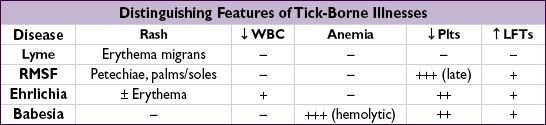
• Consider coinfection if severe/refractory sx, persistent fever, cytopenias
ROCKY MOUNTAIN SPOTTED FEVER (RMSF)
Microbiology & epidemiology
• Infection with Rickettsia rickettsii (Gram obligate intracellular bacterium)
• Transmitted by Dermacentor variabilis, D. andersoni (dog tick); peak in spring/early summer
• Occurs in mid-Atl, SE, Midwest, New Engl, NW, Canada, Mexico, Central & S. America
• Consider other rickettsial spp.: R. akari (Rickettsial pox), R. conorii (Mediterranean spotted fever), R. africae (African tick bite fever), R. felis (Flea rickettsiosis)
Clinical manifestations (typically w/in 1 wk of tick exposure)
• Nonspecific: fever, HA, DMS, myalgias, N/V, occasionally abdominal pain
• Rash (2–5 d after onset) = centripetal: starts on ankles and wrists → trunk, palms & soles; progresses from macular to maculopapular to petechial
• Severe cases → vasculitis, hypoperfusion/shock, end-organ damage; more likely in elderly
• Up to 75% mortality if untreated, 5–10% even w/ Rx (esp. if delayed) (NEJM 2005;353:551)
Diagnosis
• Usually a clinical dx; requires early clinical suspicion given risks of delayed Rx
• Acute illness dx by skin bx for rickettsiae (Se ~70%); 7–10 d after sx onset, serology
Treatment
• Doxycycline 100 mg PO bid (give empirically if clinical suspicion)
EHRLICHIOSIS/ANAPLASMOSIS
Microbiology
• Gram obligate intracellular bacterium; human monocytic ehrlichiosis (E. chaffeensis, HME); human granulocytic anaplasmosis (A. phagocytophilum, HGA)
• Transmission: HME by Amblyomma americanum, Dermacentor variabilis; HGA by Ixodes
Epidemiology
• HGA cases typically in RI, MN, CT, NY, MD; HME in SE, south central and mid-Atlantic
• Peak incidence spring and early summer; can be transmitted by blood transfusion
Clinical manifestations (typically w/in 3 wk of tick exposure)
• Asx or nonspecific: fever, myalgias, malaise, HA, cough, dyspnea; onset often acute
• Laboratory: leukopenia, thrombocytopenia, ↑ aminotransferases, LDH, Af, renal insuff
• More severe disease can occur with bacterial superinfection in HGA
Diagnosis
• Acute: intraleukocytic morulae on peripheral blood smear (rare); PCR; later: serology
Treatment
• Start Rx based on clinical suspicion; definitive dx requires PCR (may not detect all spp.)
• Doxycycline 100 mg PO bid (often × 10 d); should defervesce in ≤48 h, else reconsider dx
BABESIOSIS
Microbiology & epidemiology
• Infxn w/ parasite Babesia microti (U.S.), transmitted by Ixodes ticks; also a/w transfusion
• Europe & U.S. (more commonly MN, WI, coastal areas & islands of MA, NY, NJ, RI, CT)
• Peak incidence June–August (MMWR 2012;61:505)
Clinical manifestations (typically 1–4 wk after tick exposure; <9 wk if transfusion)
• Range from asx to fevers, sweats, myalgias, & HA to severe hemolytic anemia, hemoglobinuria, & death (degree of parasitemia correlates roughly with severity)
• Risk factors for severe disease: asplenia, ↓ cellular immunity, TNF inhib, ↑ age, pregnancy
Diagnosis (NEJM 2012;366:2397)
• Clinical syndrome + blood smear w/ intraerythrocytic parasites
• Repeat smears (q12–24h) if sx persist despite negative initial smear
• PCR serum if smear and high clinical suspicion, serum IgG can help but some false
Treatment (NEJM 2002;343:1454)
• Atovaquone & azithro for mild/mod illness; clinda & quinine if severe (more toxic)
• Duration depends on host; immunosupp Pts often need longer Rx
• Exchange transfusion if parasitemia >10%, severe hemolysis or SIRS
TULAREMIA
Microbiology
• Infxn w/ Francisella tularensis via contact w/ animal tissue, aerosol, tick/insect bite
Clinical manifestations (typically w/in 2–10 d of exposure)
• Acute onset of fever, HA, nausea; ulcer w/ black eschar at site of entry; LAN; PNA
Diagnosis & treatment
• Hazardous and difficult to Cx, alert lab. Serology by wk 2. PCR by research lab.
• Streptomycin or gentamicin × 7–14 d; empiric Rx may be needed given challenges in dx