ENDOCRINOLOGY
THYROID DISORDERS

Figure 7-1 Approach to thyroid disorders

HYPOTHYROIDISM
Etiologies
• Primary (>90% of cases of hypothyroidism; ↓ free T4, ↑ TSH)
Goitrous: Hashimoto’s thyroiditis, after hyperthyroid phase of thyroiditis, iodine defic, Li, amiodarone
Nongoitrous: surgical destruction, s/p radioactive iodine or XRT, amiodarone
• Central (↓ free T4, low/nl or slightly high TSH): hypothalamic or pituitary failure (TSH levels ↓ or “normal,” can be slightly ↑ although functionally inactive due to abnormal glycosylation)
Hashimoto’s thyroiditis
• Autoimmune destruction with patchy lymphocytic infiltration
• Associated with other autoimmune disease and may be part of PGA syndrome type II
•  antithyroid peroxidase (anti-TPO) and antithyroglobulin (anti-Tg) Abs in >90%
Clinical manifestations (Annals 2009;151:ITC61)
• Early: weakness, fatigue, arthralgias, myalgias, headache, depression, cold intolerance, weight gain, constipation, menorrhagia, dry skin, coarse brittle hair, brittle nails, carpal tunnel syndrome, delayed DTRs (“hung up” reflexes), diastolic HTN, hyperlipidemia
• Late: slow speech, hoarseness, loss of outer third of eyebrows, myxedema (nonpitting skin thickening due to↑ glycosaminoglycans), periorbital puffiness, bradycardia, pleural, pericardial, & peritoneal effusions, atherosclerosis
• Myxedema crisis: hypothermia, hypotension, hypoventilation, Δ MS (including coma) hyponatremia, hypoglycemia; often precipitated by infection or major cardiopulmonary or neurologic illness (Med Clin North Am 2012;96:385)
Diagnostic studies
• ↓ FT4; ↑ TSH in primary hypothyroidism; antithyroid Ab in Hashimoto’s thyroiditis
• May see hyponatremia, hypoglycemia, anemia, ↑ LDL, ↓ HDL and ↑ CK
• Screening recommended for pregnant women
Treatment of overt hypothyroidism
• Levothyroxine (1.5–1.7 µg/kg/d), re ✓ TSH q5–6wk and titrate until euthyroid;
sx can take mos to resolve; lower starting dose (0.3–0.5 µg/kg/d) if at risk for ischemic heart disease or elderly; advise Pt to keep same formulation of levothyroxine
↑ dose typically needed if: pregnancy (~30% ↑ by wk 8), initiation of estrogen replacement, on meds that accelerate T4 catabolism (eg, phenytoin, phenobarbital), poor GI absorption (concomitant Fe or Ca suppl, PPI, sucralfate, cholestyramine, celiac disease, IBD)
• Myxedema coma: load 5–8 µg/kg T4 IV, then 50–100 µg IV qd; b/c peripheral conversion impaired, may also give 5–10 µg T3 IV q8h if unstable w/ bradycardia and/or hypothermia (T3 more arrhythmogenic); must give empiric adrenal replace- ment therapy first as ↓ adrenal reserves in myxedema coma
Subclinical hypothyroidism (Lancet 2012;379:1142)
• Mild ↑ TSH and normal free T4 with only subtle or no sx
• If TSH <7 or  anti-TPO Ab, ~1⁄2 euthyroid after 2 y (JCEM 2012;97:1962) if ↑ titers of antithyroid Abs, progression to overt hypothyroidism is ~4%/y
• Rx controversial: follow expectantly or treat to improve mild sx or dyslipidemia most initiate Rx if TSH >10 mU/L, goiter, pregnancy or infertility if TSH 5–10 mU/L Rx if ≤60 y (usually don’t Rx if ≥60 b/c ↑ risk CV complications)
HYPERTHYROIDISM
Etiologies (Lancet 2012;379:1155)
• Graves’ disease (60–80% of thyrotoxicosis)
• Thyroiditis: thyrotoxic phase of subacute (granulomatous) or painless (lymphocytic)
• Toxic adenomas (single or multinodular goiter)
• TSH-secreting pituitary tumor or pituitary resistance to thyroid hormone (↑ TSH, ↑ free T4)
• Misc: amiodarone, iodine-induced, thyrotoxicosis factitia, struma ovarii (3% of ovarian dermoid tumors and teratomas), hCG-secreting tumors (eg, choriocarcinoma), large deposits of metastatic follicular thyroid cancer
Clinical manifestations of hyperthyroidism
• Restlessness, sweating, tremor, moist warm skin, fine hair, tachycardia, AF, weight loss, ↑ frequency of stools, menstrual irregularities, hyperreflexia, osteoporosis, stare and lid lag (due sympathetic overactivity)
• Apathetic thyrotoxicosis: seen in elderly who can present with lethargy as only sx
• Thyroid storm (extremely rare): delirium, fever, tachycardia, systolic hypertension but wide pulse pressure and ↓ MAP, GI symptoms; 20–50% mortality
Laboratory testing
• ↑ FT4 and FT3; ↓ TSH (except in TSH-secreting tumors)
• RAIU scan is very useful study to differentiate causes (see table on page 7-3); cannot do if recent IV contrast or amio load b/c iodine blocks uptake so ✓ autoantibodies instead
• Rarely need to ✓ for autoantibodies except in pregnancy (to assess risk of fetal Graves’)
• May see hypercalciuria ± hypercalcemia, ↑ AΦ, anemia
Graves’ disease (NEJM 2008;358:2594)
•  :
: ratio is 5–10:1, most Pts between 40–60 y at dx
• thyroid antibodies: TSI or TBII ( in 80%), anti-TPO, antithyroglobulin; ANA
• Clinical manifestations in addition to those of hyperthyroidism (see above):
goiter: diffuse, nontender, w/ thyroid bruit
ophthalmopathy (NEJM 2009;360:994): Seen in 50%; up to 90% if formally tested. Periorbital edema, lid retraction, proptosis, conjunctivitis, diplopia (EOM infiltration); associated w/ smoking. Stare and lid lag seen in any type of hyperthyroidism.
pretibial myxedema (3%): infiltrative dermopathy
Thyroiditis (NEJM 2003;348:2646; Med Clin North Am 2012;96:223)
• Acute: bacterial infection (very rare in U.S. except postsurgical)
• Subacute: transient thyrotoxicosis → transient hypothyroidism → normal thyroid fxn
painful (viral, granulomatous or de Quervain’s): fever, ↑ ESR; Rx = NSAIDs, ASA, steroids
silent (postpartum, autoimmune including Hashimoto’s, or lymphocytic): painless, TPO Abs; if postpartum, can recur with subsequent pregnancies
other: amiodarone, palpation thyroiditis, after radiation
Treatment
• β-blockers: control tachycardia (propranolol also ↓ T4 → T3 conversion)
• Graves’ disease: either antithyroid drugs or radioactive iodine (NEJM 2005;352:905)
methimazole: 70% chance of recurrence after 1 y; side effects include pruritus, rash, arthralgia, fever, N/V and agranulocytosis in 0.5%. PTU: 2nd line (risk of hepatocellular necrosis; TID dosing; slower effect). For both, need to ✓ LFTs, WBC, TSH at baseline and in follow-up.
radioactive iodine (RAI) (NEJM 2011;364:542): typically done as outPt; preRx selected Pts w/ CV disease or elderly w/ antithyroid drugs to prevent ↑ thyrotoxicosis, stop 3 d before to allow RAI uptake; >75% of treated Pts become hypothyroid
surgery: less commonly chosen for Graves’, usually for Pts w/ obstructive goiter or ophthalmopathy
• Toxic adenoma or toxic multinodular goiter: RAI or surgery (methimazole preRx for surgery, in selected patients before RAI)
• Thyroid storm: β-blocker, PTU or methimazole, iopanoic acid or iodide (for Wolff-Chaikoff effect) >1 h after PTU, ± steroids (↓ T4 → T3)
• Ophthalmopathy: can worsen after RAI, prevented by prophylactic Rx w/ prednisone in high-risk Pts; can be Rx’d w/ radiation and/or surgical decompression of orbits
Subclinical hyperthyroidism (Lancet 2012;379:1142)
• Mild ↓ TSH and normal free T4 with only subtle or no sx
• ~15% → overt hyperthyroidism in 2 y; ↑ risk of AF, CHD (Archives 2012;172:799), osteoporosis
• Rx controversial: consider if TSH <0.1 mU/L and ↑ risk for CV disease or osteopenic
NONTHYROIDAL ILLNESS (SICK EUTHYROID SYNDROME)
• TFT abnormalities in Pts w/ severe nonthyroidal illness (∴ in acute illness, ✓ TFTs only if ↑ concern for thyroid disease); may have acquired transient central hypothyroidism
• If thyroid dysfxn suspected in critically ill Pt, TSH alone not reliable; must measure total T4, FT4, & T3 (J Endocrinol 2010;205:1)
• Mild illness: ↓ T4 → T3 conversion, ↑ rT3 ⇒ ↓ T3; in severe illness: ↓ TBG & albumin, ↑↑ rT3 ⇒ ↓↓ T3, ↑ degradation of T4, central ↓ TSH ⇒ ↓↓ T3, ↓↓T4, ↓FT4, ↓TSH
• Recovery phase: ↑ TSH followed by recovery of T4 and then T3
• Replacement thyroxine not helpful or recommended for critically ill Pts w/ ↓ T3 and T4 unless other s/s of hypothyroidism
AMIODARONE AND THYROID DISEASE
6 mg iodine per 200 mg tablet; risk of thyroid dysfunction lower with lower doses
✓ TSH prior to therapy, at 4-mo intervals on amio, and for 1 y after if amio d/c’d
Hypothyroidism (occurs in ~10%; more common in iodine-replete areas)
• Pathophysiology
(1) Wolff-Chaikoff effect: iodine load ↓ I– uptake, organification and release of T4 & T3
(2) inhibits T4 → T3 conversion direct/immune-mediated thyroid destruction
• Normal individuals: ↓ T4; then escape Wolff-Chaikoff effect and have ↑ T4, ↓ T3, ↑ TSH; then TSH normalizes (after 1–3 mo)
• Susceptible individuals (eg, subclinical Hashimoto’s, ∴ ✓ anti-TPO) do not escape effects
• Treatment: thyroxine to normalize TSH; may need larger than usual dose
Hyperthyroidism (3% of Pts on amio; ∼10–20% of Pts in iodine-deficient areas)
• Type 1 = underlying multinodular goiter or autonomous thyroid tissue
Jod-Basedow effect: iodine load → ↑ synthesis of T4 and T3 in autonomous tissue
• Type 2 = destructive thyroiditis
↑ release of preformed T4 & T3 → hyperthyroidism → hypothyroidism → recovery
• Doppler U/S: type 1 w/ ↑ thyroid blood flow; type 2 w/ ↓ flow
• Treatment: not absolutely necessary to d/c amio b/c amio ↓ T4 → T3 conversion methimazole for type 1; steroids for type 2 often difficult to distinguish so Rx for both typically initiated ( JCEM2001;86:3) consider thyroidectomy in severely ill patient
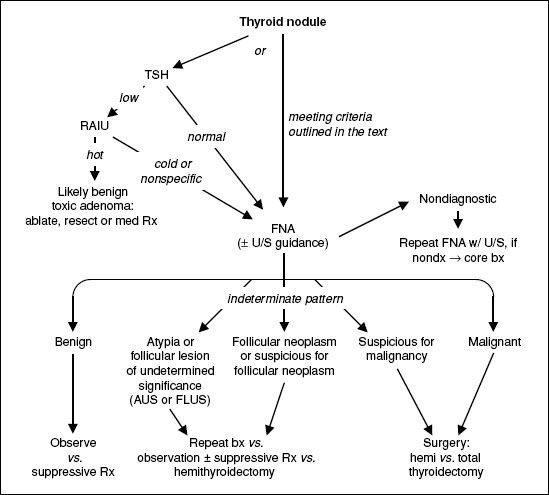
THYROID NODULES
• Prevalence 5–10% (50–60% if screen with U/S), ~5% malignant
• Features associated w/ ↑ risk of malignancy: age <20 or >70 y, , h/o neck XRT, hard and immobile mass, cold nodule on RAIU, large size, worrisome U/S findings (hypoechoic, solid, irregular borders, microcalcifications, central blood flow), cervical LAN
• Features associated w/ benign dx: FHx of autoimmune thyroid disease or goiter, presence of hypothyroidism or hyperthyroidism, nodule tenderness
• Screening U/S recommended for those with FHx of MEN2 or medullary thyroid cancer, personal h/o neck XRT, palpable nodules or multinodular goiter
• Any evidence of tracheal deviation or compression → ✓ PFTs & refer to surgery
• FNA for nodules >10 mm (>8 mm if irregular borders), microcalcifications or central vasculature; FNA any nodules in Pts with h/o neck XRT or FHx of MEN2 or MTC
• Indeterminate pattern in 15–30% of FNA; gene expression pattern has Se 92% & Sp 52% for malignancy (NEJM 2012;367:705)
• Suppressive Rx w/ high doses of levothyroxine less successful in iodine-sufficient regions
• After complete surgical resection of thyroid cancer, RAI is administered (in Pts w/ low-risk thyroid cancer, this practice is controversial) (Lancet 2013;381:1046 & 1058)
Figure 7-2 Approach to thyroid nodules (Thyroid 2009;19:1167; Am J Clin Pathol 2009;132:658)