ENDOCRINOLOGY
PITUITARY DISORDERS
HYPOPITUITARY SYNDROMES
Panhypopituitarism
• Etiologies
Primary: surgery, radiation, tumors (primary or metastatic), infection, infiltration (sarcoid, hemochromatosis), autoimmune, ischemia (including Sheehan’s syndrome caused by pituitary infarction intrapartum), carotid aneurysms, cavernous sinus thrombosis, trauma
Secondary (hypothalamic dysfunction or stalk interruption): tumors (including craniopharyngioma), infection, infiltration, radiation, surgery, trauma
• Clinical manifestations
Hormonal: acute → weakness, easy fatigability, hypotension, polyuria and polydipsia; chronic → bradycardia, sexual dysfxn, loss of axillary & pubic hair, wt loss, amenorrhea
Mass effect: headache, visual field Δs, cranial nerve palsies, galactorrhea
Apoplexy (pituitary hemorrhage or infarction, usually w/ underlying pituitary adenoma): sudden headache, N/V, visual field Δs, cranial nerve palsies, meningismus, Δ MS, hypoglycemia, hypotension
• Diagnostic studies
Hormonal studies
chronic: ↓ target gland hormone + ↓ or normal trophic pituitary hormone acute: target gland hormonal studies may be normal partial hypopituitarism is more common than panhypopituitarism
Pituitary MRI
• Treatment
Replace deficient target gland hormones
Most important deficiencies to recognize and treat in inPts are adrenal insufficiency and hypothyroidism; if both present, treat with glucocorticoids first, then replace thyroid hormone so as not to precipitate adrenal crisis
↓ ACTH
• Adrenal insufficiency similar to 1° (see “Adrenal Disorders”) except:
no salt cravings or hypokalemia (b/c aldo preserved)
no hyperpigmentation (b/c ACTH/MSH is not ↑)
↓ TSH
• Central hypothyroidism similar to 1° (see “Thyroid Disorders”) except absence of goiter
• Dx with free T4 in addition to TSH, as TSH may be low or inappropriately normal
↓ PRL
• Inability to lactate
↓ GH
• ↑ chronic risk for osteoporosis, fatigue, weight gain
• Dx with failure to ↑ GH w/ appropriate stimulus (eg, insulin tolerance test, glucagon stimulation)
• GH replacement in adults controversial (Annals 2003;35:419)
↓ FSH & LH
• Clinical manifestations: ↓ libido, impotence, oligomenorrhea or amenorrhea, infertility
• Physical exam: ↓ testicular size; loss of axillary, pubic and body hair
• Dx with: ↓ a.m. testosterone or estradiol (also assess SHBG, esp. in obese) and ↓ or normal FSH/LH (all levels ↓ in acute illness, ∴ do not measure in hospitalized Pts)
• Treatment: testosterone or estrogen replacement vs. correction of the underlying cause
↓ ADH (hypothalamic or stalk disease): diabetes insipidus
• Typically from mass lesion extrinsic to sella; pituitary tumor doesn’t typically present w/ DI
• Clinical manifestations: severe polyuria, mild hypernatremia (severe if ↓ access to H2O)
• Diagnostic studies: see “Sodium and Water Homeostasis”
HYPERPITUITARY SYNDROMES
Pituitary tumors
• Pathophysiology: adenoma → excess of trophic hormone (if tumor fxnal, but 30–40% not) and potentially deficiencies in other trophic hormones due to compression; cosecretion of PRL and growth hormone in 10% of prolactinomas
• Clinical manifestations: syndromes due to oversecretion of hormones (see below)
± mass effect: headache, visual Ds, diplopia, cranial neuropathies
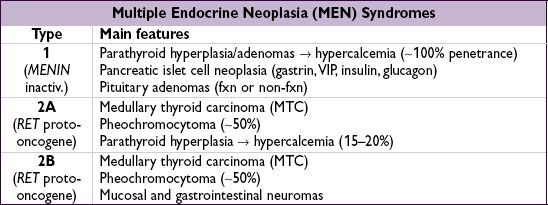
• Workup: MRI, hormone levels, ± visual field testing, consider MEN1 (see below)
if <10 mm, mass effect, no hormonal effects, can f/up q3–6mo
Hyperprolactinemia (NEJM 2010;362:1219)
• Etiology
prolactinoma (50% of pituitary adenomas)
stalk compression due to nonprolactinoma → ↓ inhibitory dopamine → ↑ PRL (mild)
• Physiology: PRL induces lactation and inhibits GnRH → ↓ FSH & LH
• Clinical manifestations: amenorrhea, galactorrhea, infertility, ↓ libido, impotence
• Diagnostic studies: ↑ PRL (✓ fasting levels), but elevated in many situations, ∴ r/o pregnancy or exogenous estrogens, hypothyroidism, dopamine agonists (psych meds, antiemetics), renal failure (↓ clearance), cirrhosis, stress, ↑ carb diet. MRI to evaluate for tumor; visual field testing if MRI shows compression of optic chiasm.
• Treatment
If asx (no HA, galactorrhea, hypogonadal sx) & microadenoma (<10 mm), follow w/ MRI
If sx or macroadenoma (≥10 mm) options include:
medical with dopamine agonist such as cabergoline (70–100% success rate) or bromocriptine (not as well tol); side effects include N/V, orthostasis, nasal congestion, tricuspid valve regurgitation (✓ echo before & q1–2y during Rx) (JCEM 2010:95:1025)
surgical: transsphenoidal surgery (main indications: failed or cannot tolerate medical Rx, GH cosecretion or neurologic sx not improving); 10–20% recurrence rate
radiation: if medical or surgical therapy have failed or are not tolerated
Acromegaly (↑ GH; 10% of adenomas; NEJM 2006;355:2558)
• Physiology: stimulates secretion of insulin-like growth factor 1 (IGF-1)
• Clinical manifestations: ↑ soft tissue, arthralgias, jaw enlargement, headache, carpal tunnel syndrome, macroglossia, hoarseness, sleep apnea, amenorrhea, impotence, diabetes mellitus, acanthosis/skin tags, ↑ sweating, HTN/CMP, colonic polyps
• Diagnostic studies: no utility in checking random GH levels because of pulsatile secretion
≠ IGF-1 (somatomedin C); ± ↑ PRL; OGTT → GH not suppressed to <1 (<0.3 if newer assay) ng/mL; pituitary MRI to evaluate for tumor
• Treatment: surgery, octreotide (long- and short-acting preparations), dopamine agonists (if PRL co-secretion), pegvisomant (GH receptor antagonist), radiation
• Prognosis: w/o Rx 2–3× ↑ mortality, risk of pituitary insufficiency, colon cancer
Cushing’s disease (↑ ACTH): 10–15% of adenomas; see “Adrenal Disorders”
Central hyperthyroidism (↑ TSH, ↑ ɑ-subunit): extremely rare; see “Thyroid Disorders”
↑ FSH & LH: usually non-fxn, presents as hypopituitarism b/c of compression effects