ENDOCRINOLOGY
LIPID DISORDERS
Measurements
• Lipoproteins = lipids (cholesteryl esters & triglycerides) + phospholipids + proteins
include: chylomicrons, VLDL, IDL, LDL, HDL, Lp(a)
• Measure after 12-h fast; LDL is calculated = TC – HDL – (TG/5) (if TG >400, order
direct LDL measurement as calc. LDL inaccurate). Lipid levels stable up to 24 h
after ACS and other acute illnesses, then ↓ and may take 6 wk to return to nl.
• Metabolic syndrome (≥3 of following): waist ≥40” ( ) or ≥35” (
 ); TG ≥150; HDL <40 mg/dL () or <50 mg/dL (); BP ≥130/85 mmHg; fasting glc ≥100 mg/dL (Circ 2009;120:1640)
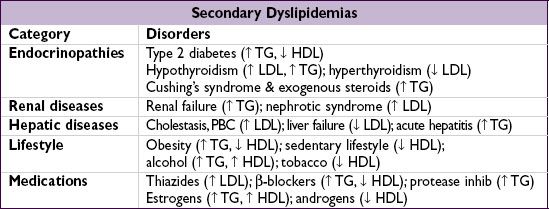
Primary dyslipidemias
• Familial hypercholesterolemia (FH, 1:500): defective LDL receptor; ↑↑ chol, nl TG; ↑ CAD
• Familial defective apoB100 (FDB, 1:1000): similar to FH
• Familial combined hyperlipidemia (FCH, 1:200): polygenic; ↑ chol, ↑ TG, ↓ HDL; ↑ CAD
• Familial dysbetalipoproteinemia (FDBL, 1:10,000): apoE ε2/ε2 + DM, obesity, renal disease, etc.;↑ chol and TG; tuberoeruptive and palmar striated xanthomas; ↑ CAD
• Familial hypertriglyceridemia (FHTG, 1:500): ↑ TG, ± ↑ chol, ↓ HDL, pancreatitis
Physical exam findings
• Tendon xanthomas: seen on Achilles, elbows and hands; imply LDL >300 mg/dL
• Eruptive xanthomas: pimple-like lesions on extensor surfaces; imply TG >1000 mg/dL
• Xanthelasma: yellowish streaks on eyelids seen in various dyslipidemias
• Corneal arcus: common in older adults, imply hyperlipidemia in young Pts
Treatment
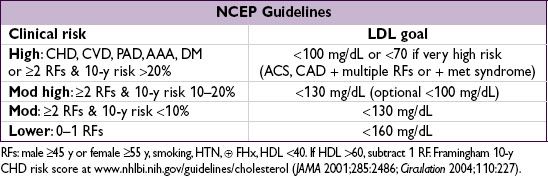
• Every 1 mmol (39 mg/dL) ↓ LDL → 22% ↓ major vascular events (CV death, MI, stroke, revasc) in individuals w/ & w/o CAD (Lancet 2010;376:1670); in healthy individuals w/ LDL <130 mg/dL & hs-CRP >2, rosuvastatin → 47% ↓ CVD/MI/stroke (NEJM 2008;359:2195)
• Fewer clinical data, but TG <400 and HDL >40 are additional reasonable targets