
RHEUMATOLOGY
ARTHRITIS-OVERVIEW
Approach to patient with joint pain
• Articular vs. periarticular (bursitis, tendinitis) pain: typically active ROM more painful in periarticular process than passive ROM
• Inflammatory vs. noninflammatory pain: features of inflammatory pain include swelling, warmth or redness in specific joint, persistence over days to weeks, prolonged morning stiffness (>30 min), improvement of pain/stiffness w/ motion/exercise
• Physical exam (see table): localize complaint and identify objective signs of inflammation
• The physical exam is only 50–70% sensitive for detecting inflammatory arthritis

aMay initially present as arthralgia w/o signs of overt arthritis. bRange of motion (ROM) of joint or joint associated with bursa or tendon.
Approach to arthritis
Figure 8-1 Approach to arthritis

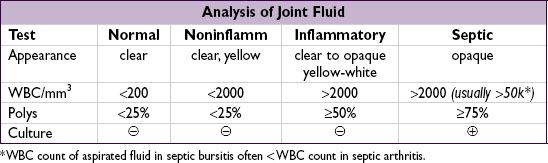
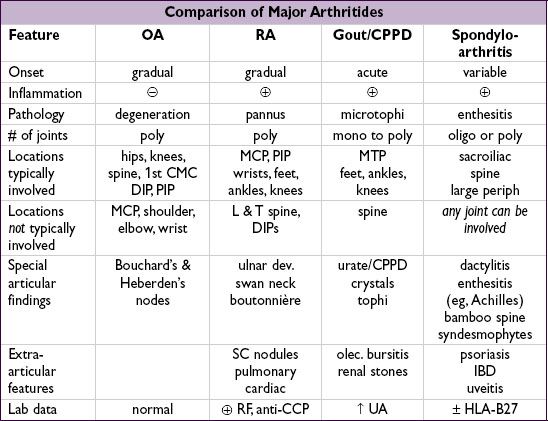
Radiologic features
• OA
plain films: osteophyes, asym joint space narrowing (JSN), subchondral sclerosis/cysts MRI may show early disease not seen on plain films; U/S  MRI for structural damage
• RA
plain films: early=periarticular osteopenia; late=erosions, symmetric JSN MRI & U/S able to detect early and subclinical disease; MRI U/S for erosions
• Gout
plain films: early=nonspec swelling; late=tophus, joint erosions w/ overhanging edges U/S > MRI for detection of microtophi (double contour sign); MRI U/S for erosions
• Spondyloarthritis (sacroiliac joint)
plain films: pseudo-widening of joint space (early), sclerosis, erosions, ankylosis MRI most sensitive for early Δ in SIJ; U/S MRI for early detection of peripheral enthesitis
INFLAMMATORY MARKER & AUTOANTIBODY TESTING
Inflammatory markers (Mod Rheumatol 2009;19:469)
• ESR: indirect measure of inflammation (↑ RBC aggregation due to acute-phase proteins); slow to rise; ↑ w/ age, pregnancy, anemia, obesity
• CRP: direct measure of inflammation (protein produced by liver, part of innate immune system); typically rises and falls before the ESR w/ treatment/resolution of process
Autoantibody testing
• ANA: screening test for Ab directed against extractable nuclear antigens (ENAs) found in autoimmune conditions, most useful in testing for connective tissue diseases
• ENAs: proteins precipitated from spleen extracts; targets are generally of nuclear origin
• Order ANA only when clinical suspicion for disease b/c nonspecific: 1:40 (low  , 25–30% of healthy people); 1:80 (low , 10–15% of healthy people); ≥1:160 (, 5% of healthy). May be in Pts prior to clin manifest (NEJM 2003;349:1526; Arthritis Res Ther 2011;13:1).
• Does not correlate well w/ disease activity, ∴ no clinical value in serial testing
• dsDNA and ENA antibodies (Ro/La/Smith/RNP) are highly specific for various CTD and can be used to further w/u ANA in setting of clinical suspicion
• RF and anti-CCP can be seen in CTD but are not specific