
I. Grant McQuaker1 & Ian M. Franklin2
1BMT Unit, Beatson West of Scotland Cancer Centre, Glasgow, Scotland, UK
2Irish Blood Transfusion Service, National Blood Centre, Dublin, Republic of Ireland
Introduction
Although the treatment of haematological malignancies has improved significantly in the past 30 years, many patients have diseases that remain incurable with conventional therapeutic approaches. Bone marrow cells are exquisitely sensitive to chemotherapy and radiotherapy, and the recognition that radiation could kill bone marrow function permanently while other organs recovered or were largely unaffected suggested that bone marrow transplantation (BMT) might be feasible [1]. Initially the pretransplant chemoradiotherapy conditioning of the patient was thought to provide ‘space’ for the incoming cells to engraft, as well as killing any residual cancer cells. The transplant itself was perceived only as a haemopoietic ‘rescue’. Subsequently, it was recognized that the person's own (autologous) bone marrow cells could be used for the same purpose. However, it became apparent that allogeneic transplants (between different individuals) produce an immune mediated graft-versus-leukaemia (GVL) effect, because patients with chronic graft-versus-host disease (GVHD) had improved disease-free survival [2]. Allogeneic BMT is therefore a combination of the chemotherapy and/or radiotherapy with an immune mediated effect against the leukaemia or other malignancy. Later, it was shown that some patients with chronic myeloid leukaemia, who had relapsed after an allogeneic HSCT, could return to full molecular remission after infusions of immune competent lymphocytes from the original donor [3]. This provided more direct proof of a GVL effect. Allogeneic BMT is now seen as more of an immunotherapy, in which the transplant itself is a major component in keeping the disease under control. This is why allogeneic BMT has a much lower recurrence rate, but also a higher incidence of posttransplant infections and immune-associated complications than an autologous transplant. Reduced intensity conditioning (RIC) transplants have been developed to harness the immunological benefits of allogeneic transplants, while avoiding much of the toxicity [4]. The RIC is insufficient to eradicate bone marrow cells but immune tolerance is induced to ensure engraftment of the incoming donor transplant. Although these RIC transplants are sometimes known as ‘mini-transplants’, they are still arduous procedures requiring great commitment from the patient.
Principles of haemopoietic stem cell transplants (HSCT)
The original bone marrow derived transplants are now more likely to be performed using peripheral blood stem cells (PBSCs) or even cord blood. The term haemopoietic stem cell is now more appropriate. HSCT is used:
· to enable intensification of chemotherapy and radiotherapy so that toxicity to the bone marrow is no longer an important factor in determining outcome and/or
· to ensure complete engraftment of the donor marrow through immunosuppression of the host (patient), thus permitting tolerance to develop;
· to promote a GVL (or other tumour) effect.
Sources of stem cells
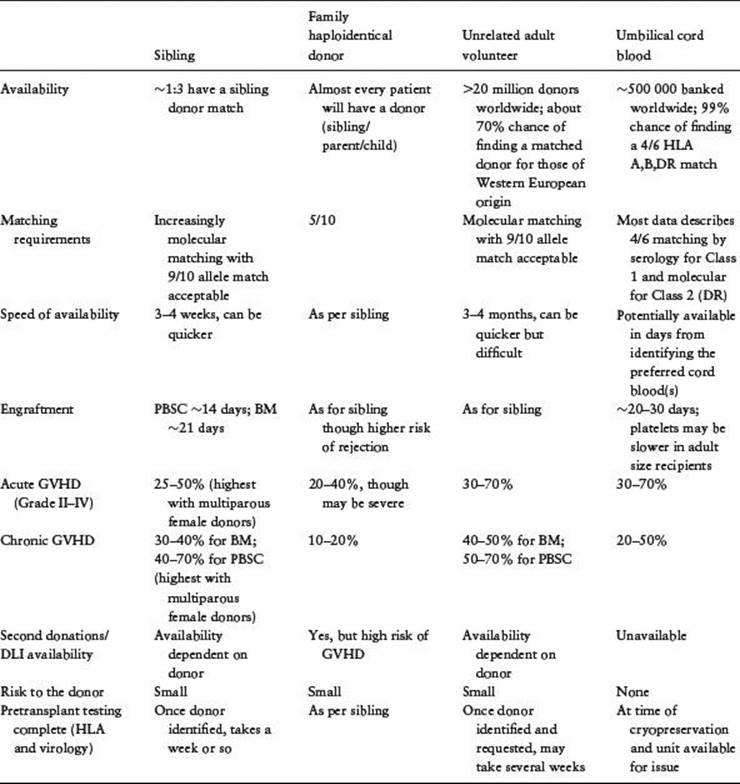
· Allogeneic stem cells. These come from another individual, traditionally a matched sibling. There is an increasing use of alternative donors, mainly unrelated adults from donor registries but also cord blood derived cells [5] (see Table 41.1). There is currently increasing interest in using haploidentical family donors. Unrelated transplants use volunteer donors from national and international registries. The toxicity and results of these procedures is improving steadily. HLA compatibility testing using molecular typing and sequencing of patient and recipient genes has resulted in much improved transplant outcomes. The use of umbilical cord blood, from unrelated donor cord blood banks, is increasing worldwide. It is still, in the main, for individuals with low body weight (<50 kg) because of the small number of stem cells in a cord sample. Using two cord donations may lead to more rapid engraftment and much reduced failed engraftment (10%). Additionally, a double cord transplant is associated with a reduced relapse rate and means that cord blood transplants for adults are now a realistic option [6]. The advantage of cord blood is that it is obtained from an immune naive source, so that HLA and other mismatches are tolerated with less GVHD than would be expected if an adult donor were used.
· Syngeneic cells. These come from an identical twin and have similar attributes to autologous stem cells.
· Autologous. These come from the patient.
Table 41.1 Comparison of sources of stem cells.
The donor
Donors must always be treated with respect and not as a means to an end. In particular, the patient must not be used as a conduit to transmit information to a potential sibling donor. Ideally, a physician separate from the transplant team should take responsibility for donor care. Both the Human Tissues Authority (HTA) and the Joint Accreditation Committee of EBMT and the International Society for Cytotherapy (ISC)-Europe (JACIE) have recommendations regarding donor care, and where the donor is a child an independent assessor is essential. Doctors involved in advising donors, whether family or unrelated, must be aware of current guidance and legislation in this area [7].
Often, especially if the donor is a sibling, there is only one available. However, if there is a choice of donor a range of factors must be considered before selecting the best donor, including the degree of HLA matching between the donor and recipient, the gender and age of the donor, CMV status and blood group. Young male donors are preferred. Multiparous female donors can increase the risk of GVHD, and usually have a lower body weight [8].
Collecting haemopoietic stem cells
Bone marrow cells may be obtained either directly by aspiration or from the peripheral blood (peripheral blood stem cells, PBSCs). Bone marrow harvesting involves bone marrow aspiration from both posterior iliac crests (under general anaesthesia). A minimum of 2 × 10⁸/kg nucleated cells provides reliable engraftment posttransplant. PBSC mobilization is increasingly used instead of marrow harvesting, although some donors may be unfit for one method or the other or express a preference, which should be respected. In healthy donors this is achieved using the growth factor G-CSF, in patients undergoing autologous procedures, following chemotherapy and growth factor. It is likely that PBSC allografts produce more chronic, but not acute, GVHD than bone marrow transplants in siblings. This may be associated with less relapse in patients at high risk of recurrent disease – advanced-phase CML, for example – and so will still be favoured [9]. Comparative data in unrelated donor transplants also suggest that the use of PBSC is associated with more chronic GVHD but no difference in long-term survival [10].
Indications for haemopoietic stem cell transplants
Stem cell therapy is generally used when conventional dose treatment has failed or is expected to have a high likelihood of failure. The failure of primary therapy when a disease recurs is a clear endpoint. A perception that failure is likely is more subjective, although some objective evidence may be present. Examples would be chromosome abnormalities known to be associated with poor outcomes, such as the Philadelphia chromosome or 4,11 translocations in acute lymphoblastic leukaemia (ALL), and chromosome 7 deletions in acute myeloid leukaemia (AML). A slow initial response to treatment may suggest that relapse will be likely, as might a high tumour load (bulky disease or a high leucocyte count). Prognostic scoring systems are now available for a number of conditions and can be used to select patients who may benefit from transplantation.
The indications for HSCT have changed over time and will continue to do so [11]. Current indications for HSCT in 2012 are shown in Table 41.2.
Table 41.2 Classification of indications for blood and marrow transplants.
|
Degree of consensus |
Allogeneic HSCT |
Autologous HSCT |
|
Very high level of agreement |
Poor risk AML CR1 |
Multiple myeloma first response |
|
AML other than CR1 |
Relapsed Hodgkin disease |
|
|
Adults <35 years with ALL CR1 |
Relapsed aggressive non-Hodgkin lymphoma (NHL) |
|
|
ALL other than CR1 |
||
|
CML CP1 if poorly responsive to TKI |
||
|
CML other than CP1 |
||
|
Poor risk myelodysplasia |
||
|
Very severe aplastic anaemia in children and young adults |
||
|
Some variation in practice between BMT units/nations |
Multiple myeloma |
AML CR1 |
|
Chronic lymphocytic leukaemia |
AML other than CR1 |
|
|
Low grade NHL |
||
|
Little consensus as to evidence in support of indications. Clinical trials highly appropriate in these indications |
Hodgkin's disease |
CML other than CP1 |
|
Myelodysplasia |
||
|
Chronic lymphocytic leukaemia |
||
|
All transplant procedures are arduous, even though mortality has fallen over the past years. In addition, the use of allogeneic donors causes major problems with immune reconstitution such that few patients over 60 years would be considered for such transplants. With improved tissue matching, the difference between sibling and unrelated transplants is less apparent. Reduced intensity conditioned transplants have increased these age thresholds. For autografting some groups have extended the limit to 75 years and the authors have experience of up to 69 years. Fitness of the patient and the likelihood of benefit are the most important considerations. |
||
Complications of transplantation
Patients who are being considered for any form of HSCT must be given full information about the procedure prior to giving consent. Although results are improving, all HSCT procedures carry major risks of mortality, morbidity and long-term complications. Some of these risks will be lifelong. Careful assessment of potential transplant candidates is mandatory [12].
Regimen-related toxicity
This refers to the immediate toxic effects of the radiotherapy or chemotherapy used for the transplant. Even the reduced intensity conditioning (RIC) protocols are sufficient to cause toxicity. Organs at risk of damage include the gut, with severe mucositis a major problem. Less commonly, liver, heart, lungs and kidneys may suffer transient or even permanent damage. Careful pretransplant assessment of each patient is essential. Damage to these tissues by the conditioning may be more likely to elicit an immune response from the donor cells, adding to the toxicity of the procedure. The use of RIC transplants does reduce this toxicity and enables some patients to receive transplants who might be unfit for full chemotherapy and radiotherapy conditioning. In addition, there are now validated pretransplant comorbidity scoring systems, which can estimate the risk transplant related mortality for individual patients and aid in decision making [13].
Rejection
Rejection is an immune-mediated event in which the pretransplant conditioning and immunosuppression are insufficient to prevent residual recipient immune cells eradicating donor cells. It only occurs in allogeneic transplants, although graft failure due to inadequate numbers of stem cells in the transplant and/or pre-existing damage to the marrow microenvironment can occur in autografts. HLA incompatibility between the patient and donor, and prior sensitization of the patient to HLA or other marrow cell antigens are risk factors for rejection. HLA sensitization should be prevented by using leucocyte-reduced blood components from presentation onwards [14].
GVHD
GVHD is caused by immune-competent T-lymphocytes in the donor recognizing recipient antigens in the patient as foreign, a process that begins with tissue damage caused by the conditioning therapy [15]. This is followed by antigen recognition, clonal T-cell expansion and then cytokine release, which increases and perpetuates the response. Despite prophylactic immunosuppression, more than half of patients receiving allogeneic transplants will develop acute GVHD in the first 100 days posttransplant. Acute GVHD is characterized by involvement of the skin, liver and gut.
· Skin: from an erythematous sunburn-like rash to a blistering, exfoliative erythroderma.
· Liver: typically the bile ducts are attacked and an obstructive jaundice-type picture develops. Milder forms may lead to elevated transaminases and cause considerable difficulties with diagnosis.
· Gastrointestinal tract: classically profuse watery diarrhoea develops, bloody in the most severe cases. Upper gastrointestinal upset is not uncommon, with nausea and sickness.
Relapse
Despite the intensive preparation for transplant a significant proportion of patients will suffer recurrent disease posttransplant. Patients at special risk are those not in remission at the time of transplant or patients with more advanced disease, i.e. has already relapsed once after chemotherapy. An absence of a GVL effect, as in autologous HSCT, or when no GVHD is seen, also increase relapse risk [2].
Infectious complications
The immune system of the transplant recipient must be suppressed to allow the graft to be accepted and antitumour therapy such as total body irradiation (TBI) ensures that the patient has minimal immune function at the time of the transplant. Even the RIC transplants have this risk, because they utilize intensive immunosuppression in order to ensure that the transplant is not rejected. The agents used (fludarabine and anti-T cell or panlymphoid monoclonal antibodies) induce prolonged and profound immune deficiency. Haemopoietic recovery takes at least 2–3 weeks, but recovery of neutrophils is only part of the reconstitution of the immune system that must occur for full recovery. BMT-related immune problems may be divided conveniently into three phases as follows. Immune deficiency is compounded at any point after BMT by the presence of active GVHD.
Immediate post-BMT phase
This phase is characterized by neutropenia as well as lymphopenia and hypogammaglobulinaemia. During this period the patient is managed with:
· protective isolation; filtered air to reduce fungal contamination is especially important;
· prophylactic antifungal, antiviral and antibacterial therapy is routine;
· pre-emptive use of therapeutic antimicrobials; broad-spectrum antibacterial agents at the first sign of fever, followed by antifungal treatment in the absence of prompt resolution;
· intravenous immunoglobulin may be used in some patient groups; and
· prophylactic neutrophil infusions are not used routinely; trials are needed urgently but are very difficult to design and deliver.
Early postengraftment period
The patient will now have some marrow function and, if GVHD is absent or controlled, may be able to leave hospital. Although patients having autologous transplants rarely have major problems after this time, vigilance is necessary. Allogeneic HSCT recipients remain at risk of:
· bacterial infections related to central lines;
· fungal infection;
· cytomegalovirus (CMV). Most units will monitor for emerging CMV using a polymerase chain reaction (PCR)-based test, and treat positive results before there is evidence of disease. Such pre-emptive strategies are very effective and CMV is becoming a much less important cause of mortality after allogeneic SCT [16]. Such monitoring is also applied to other viruses such as adenovirus and EBV, which are becoming more important considerations as current SCT techniques produce more profound pre- and posttransplant immunosuppression;
· other viruses, especially respiratory virus and other herpes viruses such as herpes zoster (HZV);
· toxoplasmosis and pneumocystis.
Later problems
Patients who have active GVHD requiring immunosuppressive therapy will continue to have impaired immunity to pathogens, and most patients who have received unrelated donor transplants will have detectable abnormalities of the immune system. However, by three years posttransplant almost all patients not taking immunosuppressive drugs will have virtually normal immunity.
· (Re-)vaccination has a role to play but those patients still on immunosuppression will not respond optimally.
· Continued prophylaxis and vigilance are required.
· Hyposplenic cover. Patients who have had allogeneic transplants are hyposplenic and must receive vaccine against organisms such as Pneumococcus, Meningococcus and Haemophilus influenzae B (HIB), as well as receiving lifelong chemoprophylaxis, e.g. with amoxicillin.
Late effects
It might be thought that having endured a life-threatening primary disease followed by the immediate risks of HSCT outlined above, that survivors might be entitled to a respite from further problems. Unfortunately, a litany of potential problems can and do occur, including the following:
· cataracts (total body irradiation only);
· endocrine problems such as:
· hypothyroidism;
· growth retardation in children (especially TBI +/− steroids);
· infertility;
· sexual dysfunction;
· second malignancies, which remains a risk even 20 years after the transplant;
· transfusion-transmitted viruses, e.g. hepatitis C;
· iron overload and liver dysfunction from red cell transfusions.
These problems mean that HSCT recipients require lifelong follow-up at a centre familiar with the range of late complications and with a sufficiently large practice to ensure that emerging problems are identified promptly. There are published recommendations for the follow-up of these patients [17].
BMT outcome
A discussion of the results of BMT for the wide range of indications now accepted is beyond the scope of this chapter. Current results from the International Bone Marrow Transplant Registry (IBMTR) are available on their web site and should be referred to so that only the most up to date information is used. Historically matched sibling donor transplantation is favoured over matched unrelated donor transplantation, which is favoured over transplantation with significant mismatches (cord and haploidentical transplants). However, there is no doubt that the differences in outcome are becoming less marked.
CML
Historically, CML has been one of the major and most widely accepted indications for allogeneic HSCT and excellent results were achieved, especially in young patients transplanted early after diagnosis. Since the advent of tyrosine kinase inhibitors (TKI), such as Imatinib, disease control is excellent in the majority of patients and so HSCT is no longer considered to be standard first-line treatment if a good response to TKI is achieved. Patients with more advanced stage CML or those who fail to respond or lose a response to TKI are considered for allogeneic SCT.
Acute leukaemia
For acute leukaemia, the precise details of each case are needed before a recommendation can be made. These include chromosome analysis and phenotype. For example, very few patients with Philadelphia chromosome-positive ALL will be cured without an allogeneic transplant.
Results for all patient groups at 3 years for leukaemia-free survival (LFS) in acute leukaemia in adults are on the order of:
· 50–60% in first complete remission (CR1): relapse risk 25%;
· 35–40% for second or subsequent complete remission: relapse risk 46%;
· 20–25% for patients transplanted not in remission: relapse risk 68%.
Registry data are of great importance but cannot replace the careful assessment of individual patients in the light of their specific prognostic factors. These may serve to improve or worsen the risks for a particular case, e.g. coexistent disease, toxic effects of prior chemotherapy, previous invasive fungal infection. Also, registries report only mature data, usually with a minimum of 3 years follow-up. The value of more recent developments requires the scrutiny of primary research publications and reports to specialist meetings.
Post-BMT chimerism and molecular monitoring
It has been possible to monitor leukaemic clones using sensitive molecular techniques for nearly 20 years now. More recently, molecular techniques have been applied to routine monitoring of donor and recipient chimerism posttransplant. RIC transplants often exhibit a period of mixed chimerism early posttransplant, when the presence of both residual host and donor haemopoiesis is detectable. Capillary electrophoresis detection systems allow accurate quantitation of the relative contributions of host and donor to haemopoiesis, by detecting short tandem repeats (STR). Mixed chimerism is believed to be associated with a higher risk of graft rejection or relapse and optimal graft versus leukaemia responses are dependent upon full donor chimerism [18]. Donor lymphocyte infusions (DLI) of graded numbers of T-lymphocytes can be used to switch patients from mixed to full donor chimerism.
By using DLI early in relapse of CML after allogeneic HSCT and giving a specific dose of cells, it is possible to separate GVL from a GVHD response, although the particular subset of T cells that will generate GVL without the risk of GVHD has not been identified. DLI has been tried in numerous diseases with varying success.
Cytotoxic T-cell therapy
It has been known for some time that DLI targeted against Epstein–Barr virus (EBV) can be used to treat lymphoproliferative disorder (LPD) in children who have received an unrelated donor HSCT. In these cases intensive immunosuppression is given to ensure that the graft was not rejected and this led to increased reactivation of EBV, which triggered the LPD. By isolating T cells and exposing them to EBV in vitro it is possible to generate clonal cytotoxic T cells that recognize EBV antigens and kill the LPD cells. In the main this treatment has been highly effective in both the prophylactic and therapeutic management of EBV LPD [19].
Although it is possible to generate sufficient antitumour effect to induce remissions in LPD, the one disease that has been treated effectively with immunotherapy is a virus-associated malignancy. In the past few years more progress has been made in developing strategies for using cytotoxic T cells against viruses in the HSCT setting, particularly CMV, than for antitumour indications. Viruses possess foreign antigens not possessed by the human patient and the relative lack of progress in antitumour immunotherapy, beyond basic DLI approaches, suggests that identifying and exploiting tumour antigens remains elusive (see also Chapter 43).
Regulatory aspects of haemopoietic stem cell transplantation
An awareness of current regulations regarding HSCT is essential for medical, nursing and scientific staff responsible for the various parts of the service.
In the European Union (EU), competent authorities regulate tissue banks, which includes processing and storage of HSC. In the UK, for example, the Human Tissue Authority (HTA) is the competent authority to ensure that the EU Directive on Tissues and Cells is implemented, and has legal powers. A professional organization, JACIE, inspects and sets standards for the clinical and laboratory HSCT process. Although not having legal force, JACIE compliance is seen as essential to an active HSCT programme.
Conclusion
At present there are still no clearly developed indications or proven strategies for cellular immunotherapy other than for generating GVL against CML using DLI and for the prevention and treatment of EBV LPD. The exploitation of increasing knowledge of the immune system has not been easy. The most likely application appears to be in a more refined approach to the use of DLI posttransplant and the application of RIC transplants to more nonmalignant diseases where immune modulation may have a role.
Meanwhile, what is the long-term future for HSCT generally? These transplants can save life in many patients with incurable leukaemia and lymphomas. Patients who survive the first three years are likely to enjoy long-term survival, although life expectancy does not return to normal. RIC transplants extend the benefits to more patients who might have been unfit to undergo the rigours of a myeloablative procedure. Whether the use of RIC transplants in a wider range of malignant diseases is effective will become apparent in the next few years. Autologous transplants seem set to decline further in importance as improved chemotherapy, immunotherapy (Rituximab) and improved allogeneic HSCT reduces the number of patients for which they are applicable. Additional approaches are still needed to deal with those patients whose primary disease is poorly responsive to current chemoradiotherapy.
Key points
1. The increasing use of cord blood transplants generally, and particularly for adult/larger patients >50 kg.
2. The declining role for autologous transplants due to improvements in conventional treatment (for myeloma and lymphoma) or a greater emphasis on allogeneic stem cell transplantation (for adult acute leukaemia).
3. The importance of treating donors of stem cells as individuals and not as a means to an end.
4. The stem cell transplantation field is becoming increasingly regulated in Europe by both professional and statutory bodies.
5. That although reduced intensity/nonmyeloablative transplants have less immediate toxicity than conventional radiation therapy based transplants, they remain arduous procedures with many short- and medium-term complications.
6. That randomized controlled clinical trials remain the best way to produce definitive data as to the relative merits of treatments in blood and lymphoid malignancies.
References
1. Thomas ED, Lochte Jr HL, Lu WC & Ferrebee JW. Intravenous infusion of bone marrow in patients receiving radiation and chemotherapy. N Engl J Med 1957; 257: 491–496.
2. Weiden PL, Sullivan KM, Flournoy M, Storb R & Thomas ED. Antileukemic effect of chronic graft versus-host disease: contribution to improved survival after allogeneic bone marrow transplantation. N Engl J Med 1981; 304: 1592–1633.
3. Kolb HJ, Mittermuller J, Clemm C et al. Donor leucocyte transfusions for treatment of recurrent chronic myelogenous leukaemia in marrow transplant patients. Blood 1990; 76: 2462–2465.
4. Giralt S, Estey E, Albitar M et al. Engraftment of allogeneic hematopoietic progenitor cells with purine analog-containing chemotherapy: harnessing graft versus leukemia without myeloablative therapy. Blood 1997; 89: 4531–4536.
5. Gratwohl A, Baldomero H, Frauendorfer K et al. Results of the EBMT activity survey 2005 on haematopoietic stem cell transplantation: focus on increasing use of unrelated donors. Bone Marrow Transplantation 2007; 39: 71–87.
6. Brunstein CG, Gutman JA, Weisdorf DJ et al. Allogeneic hematopoietic cell transplantation for hematologic malignancy: relative risks and benefits of double umbilical cord blood. Blood 2010; 116: 4693– 4699.
7. Sacchi N, Costeas P, Hartwell L et al. Haematopoietic stem cell donor registries: World Bone Marrow Donor Association recommendations for evaluation of donor health. Bone Marrow Transplantation 2008; 42: 1–6.
8. Gharton G. Risk assessment in haematopoietic stem cell transplantation: impact of donor-recipient sex combination in allogeneic transplantation. Best Pract Res Clin Haematol 2007; 20: 219–229.
9. Schmitz N, Eapen M, Horowitz MM et al. Long-term outcome of patients given transplants of mobilized blood or bone marrow: a report from the International Bone Marrow Transplant Registry and the European Group for Blood and Marrow Transplantation Blood 2006; 108: 4288–4290.
10. Eapen M, Logan BR, Confer DL et al. Peripheral blood grafts from unrelated donors are associated with increased acute and chronic graft versus-host disease without improved survival. Biol Blood Marrow Transplantation 2007; 13: 1461–1468.
11. Ljungman P, Bregni M, Brune M et al. Allogeneic and autologous transplantation for haematological disease, solid tumours and immune disorders: current practice in Europe 2009. Bone Marrow Transplantation 2010; 45: 219–234.
12. Deeg HJ & Sandmaier B. Who is fit for allogeneic transplantation? Blood 2010; 116: 4762–4770.
13. Sorror ML, Maris MB, Storb R et al. Hematopoietic cell transplantation (HCT) – specific comorbidity index: a new tool for risk assessment before allogeneic HCT. Blood 2005; 106: 2912–2919.
14. Mattson J, Ringden O & Storb R. Graft failure after allogeneic haematopoietic cell transplantation. Biol Blood Marrow Transplantation 2008; 14: 165–170.
15. Goker H, Haznedaroglu IC, Chao NJ. Acute graft-vs-host disease: Pathobiology and management. Exp Hematol 2001; 29: 259–77.
16. Ljungman P, Reusser P, de la Camara R et al. Management of CMV infections: recommendations from the infectious diseases working party of the EBMT. Bone Marrow Transplantation 2004; 33: 1075–1081.
17. Majhail NJ, Rizzo DJ, Lee SJ et al. Recommended screening and preventative practices for long-term survivors after haematopoietic cell transplantation. Biol Blood Marrow Transplantation 2012; 18: 348–371.
18. Liesveld JL & Rothberg PG. Mixed chimerism in SCT: conflict or peaceful coexistence? Bone Marrow Transplantation 2008; 42: 297–310.
19. Comoli P, Basso S, Zecca M et al. Preemptive therapy of EBV-related lymphoproliferative disease after pediatric haploidentical stem cell transplantation. Am J Transplantation 2007; 7: 1648–1655.
Further reading
Ballen KK et al. Selection of optimal alternative graft source: mismatched unrelated, umbilical cord blood, or haploidentical transplant. Blood 2012; 119: 1972–1980.
Barker JN, Byam C & Scaradavou A. How I treat the selection and acquisition of unrelated cord blood grafts. Blood 2011, 117; 2332–2339.
British Society of Blood and Marrow Transplantation (BSBMT) site: http://bsbmt.org/.
Centre for International Blood and Marrow Transplant Research (CIBMTR) site: http://www.cibmtr.org.
European Group for Blood and Marrow Transplantation (EBMT) site. http://www.ebmt.org/.
Slavin S. Immunotherapy of cancer with alloreactive lymphocytes. Lancet Oncology 2001; 2: 491–498.
Socie G et al. Long-term survival and late deaths after allogeneic bone marrow transplantation. N Engl J Med 1999; 341: 14–21.
Storek J et al. Immunity of patients surviving 20 to 30 years after allogeneic or syngeneic bone marrow transplantation. Blood 2001; 98: 3505–3512.
Thomas, ED. Does BMT confer a normal life span? N Engl J Med 1999; 341: 50–51.