
Rachael Hough
University College London Hospital's NHS Foundation Trust, London, UK
Introduction
Over the last five decades, transplantation of haemopoietic stem cells (HSCs) from related or unrelated donors has provided curative therapy for thousands of patients with a wide range of malignant, metabolic and immunological disorders [1]. HSCs have conventionally been harvested from the donor's bone marrow or granulocyte colony-stimulating factor (GCSF) mobilized peripheral blood, with minimal risks to the donor.
The impetus to explore alternative HSC sources arose because a suitably HLA-matched donor could not be identified for a substantial proportion of patients and the time to acquisition of donor cells was too long for those requiring an urgent transplant.
The optimal HSC donor for any patient is an HLA-identical sibling. However, the chance of any brother or sister being ‘matched’ is 1 in 4 and, as a result, a sibling allograft is an option for only around 30% of patients. Over recent years, there has been a considerable effort and success in expanding international volunteer donor registry panels, with over 14 million donors currently registered. However, the likelihood of identifying a ‘suitably matched’ unrelated donor is dependent on the ethnicity of the recipient; whilst Caucasians may have at least a 50% chance of finding a donor, the likelihood falls to around 10% for certain ethnic or mixed race groups who are poorly represented on the registry panels.
In addition, the time taken from commencing an unrelated donor search to the delivery of HSCs to the patient is an average of 4 months [2]. For patients who are clinically unstable and require an urgent transplant, this can be too long and patients may succumb to their disease or toxicity of further chemotherapy in the interim.
Over the last decade, the use of more stringent molecular HLA typing methods has optimized donor selection and improved transplant survival outcomes [3]. However, it has also further prolonged the search process and reduced the likelihood of finding any HLA-matched volunteer donor.
The first umbilical cord blood transplant (UCBT) was performed in 1988 in a boy with Fanconi anaemia, using cells collected from his sibling's umbilical cord blood [4]. This successful transplant was proof of the principle that umbilical cord blood (UCB) could be harvested, cryopreserved and thawed and still contain sufficient viable stem cells to successfully repopulate the recipient's bone marrow and immune system. Further successful related donor UCBTs followed quickly and led to the establishment of public UCB banks, the first of which was the New York Cord Blood Bank in 1993. These banks have rapidly expanded internationally since, with a current worldwide repository in excess of 600 000 units, which have facilitated over 20 000 UCBT so far.
Umbilical cord blood banking
Cryopreserved UCB may be safely stored for many years without significant deleterious effect on the viability of stem cells, in either public or private cord banks.
The large public banks store UCB that has been altruistically donated for transplantation into unrelated recipients. Some countries also have national, publicly funded banks for directed donations, usually collected for siblings with known life-threatening disease. More recently, siblings have been specifically conceived using preimplantation genetic diagnosis to select HLA-matched and disease-unaffected embryos for implantation, from whom UCB can be harvested after delivery and used for transplantation of an existing sick child [5]. The practice of storing UCB, collected by either altruistic or directed donations, is now well established and has already saved many thousands of lives.
An increasing number of private UCB banks are becoming available and offer cryopreservation of UCB for the specific use of the donating family as an ‘insurance policy’ and source of stem cells for either:
· the conventional indications for an HSC transplant;
· the future use in the treatment of other diseases (regenerative medicine).
At the present time, the utility of private cord banking is unclear. The chances of using a privately stored unit for transplantation have been estimated to be between 1 in 1400 and 1 in 20 000 [6]. The issue is further complicated by the possibility of contamination of autologous cord blood by disease, which subsequently presents in childhood, such as acute leukaemia. There is considerable current scientific exploration into the potential of cord blood as a source of nonhaemopoietic cells that could be utilized in the treatment of many different diseases, in particular degenerative diseases. Should this potential be realized, the utility of storing autologous cord blood for subsequent use may become clearer.
Quality assurance for the collection (including maternal consent), processing and storage of UCB is now provided by inspection against international standards (Netcord-FACT standards).
Table 42.1 lists the key elements involved in the recruitment of expectant women who may wish to altruistically donate their baby's UCB to public banks. As the potential role of UCB becomes more widely appreciated, an increasing number of women actively seek the opportunity to donate. For others, literature or verbal information may be provided at booking clinics or antenatal classes. A history is taken from mothers-to-be who are interested in donation, focusing on ethnicity and the risks of transmissible infection or genetic disease. The consent process ensures that the future mother is aware that her child's UCB may be used at any time for transplantation in an unknown recipient, the need for testing for transmissible infectious or genetic diseases and the potential for discard or use in research if the unit collected does not meet key criteria for clinical grade banking (Table 42.1).
Table 42.1 Donor recruitment, selection and consent.
|
Donor recruitment · Need consent to collect before delivery (EU Directive) · Prenatal information to mothers · leaflets, posters, videos · Antenatal/parents classes · Brief medical history for obvious exclusions
· Informed written consent for use for CBT± R+D · Medical, lifestyle, ethnic and travel history · Maternal samples
· Telephone at 12 weeks · Postnatal health of mother and baby · Medical, genetic and family history · Haemoglobinopathy screening results · UK Congenital Malformation Register checked when unit is issued
· Collection and storage of CB for transplantation into unrelated individuals worldwide · Possible risks and benefits to mother and/or infant, including medical and ethical concerns · Maintenance of linkage for the purpose of notifying infant family of communicable or genetic diseases · Examination of the mother's and infant's relevant medical notes and dialogue with relevant clinical professionals · Permission for microbiological testing, including for HIV, and for the donor to be counselled in the event of results relevant to their health · Storage of samples for future testing · Storage of personal information · Right of the mother to refuse without prejudice · Research and development use if the donation is unsuitable for clinical use |
|
NB. UK NHSBT Cord Bank Procedure. |
Table 42.2 lists the mandatory tests of both mother and UCB, performed at the time of banking and subsequently prior to issue. There is an increasing tendency for collection centres to appoint and train a team of UCB harvesters who collect the placenta from the delivery room following placental delivery. This obviates the need for midwives to be involved in UCB collection, which might otherwise distract them from nursing the new mother and baby.
Table 42.2 Testing.
|
At processing/cryopreservation Maternal · HIV (Ab + PCR), HCV (Ab + PCR), HBV, (HBsAg + anti HBcore), HTLV 1 + 2 Ab, TPHA, CMV IgG, ±Malaria Ab
· HIV Ab, HCV Ab, HBsAg, TPHA, HTLV Ab · ABO/Rh · Bacteriology · HLA-A, -B, -DR (DNA typing) · FBC pre- and postprocess · CD34/viability · nRCC (manual)
· HLA type · HBV PCR
· Confirmatory HLA typing (high resolution) · Additional microbiology · Anti-HBc · HIV, HBV & HCV PCR · CMV IgG + CMV PCR · Others as necessary · Blood film examination · Bleedline · STR analysis · CFU assay · CD34 count + viability
|
The exact timing of collection is currently controversial. Some centres harvest UCB whilst the placenta is still in utero. Although this approach optimizes the volume and stem cell yield from the collection, it potentially distracts from the birthing process and may present a risk to both mother and newborn. In fact, some midwives and obstetricians advocate delaying the clamping of the umbilical cord even after placental delivery. This recommendation is based on the observation that delayed cord clamping leads to a higher ferritin in the newborn child, which may impact favourably on their subsequent development [7]. Unfortunately, delaying cord clamping will have a significant impact on the volume and number of stem cells present in each UCB unit, which may considerably limit the usefulness of many collected. This controversial issue is currently being debated by neonatologists and obstetricians internationally.
Clinical outcomes of UCBT
Malignant disease
The efficacy of allogeneic HSC transplantation in haematological malignant diseases is achieved by the cytoreductive impact of the conditioning chemotherapy and/or radiotherapy and a later immune-mediated clearance of any residual malignant cells, called the graft-versus-malignancy (GVM) or graft-versus-leukaemia (GVL) effect.
Early experience of UCBT in malignant disease used single unit transplants from related and, subsequently, unrelated donors in children. Table 42.3 summarizes these outcome data compared to other stem cell sources. The key observations, established over time, are that UCBTs are associated with equivalent survival and relapse rates (demonstrating a preserved GVM effect) compared to bone marrow or peripheral blood stem cell transplants. Interestingly, the incidence and severity of acute and chronic graft-versus-host disease (GVHD) is less than observed with conventional HSC sources, which allows for a more permissive ‘matching system’ between the recipient and donor. In general, unrelated donors are only used if they are matched at 9 or 10 out of 10 HLA alleles, whilst unrelated donor UCB units can be used if matched at 4 or more out of 6 alleles (with less stringent matching at class I antigens).
Table 42.3 Summary of studies comparing CBT with HSC sources in paediatric patients.

The key limitation of using UCB as an alternative stem cell source is that the time to and probability of ‘engraftment’ or recovery of the neutrophil and platelet counts are both inferior when compared to bone marrow or peripheral blood stem cell transplants. The time to neutrophil recovery is around one week longer than using bone marrow, leading to a prolonged risk of early transplant mortality, predominantly due to infection.
One of the key determinants of engraftment, transplant-related mortality and survival is the cell dose (as measure by the total nucleated cell count or CD34+ cell count) infused into the recipient [10]. Outcome improves with increasing cell dose, with an apparent pre-thaw threshold of around 2–3 × 10⁷ TNC/kg or 2 × 10⁵CD34+/kg, below which toxicity is prohibitively high. Engraftment, transplant-related mortality and survival also improve with closer HLA matching, although the deleterious impact of each mismatch can be overcome to some extent by a higher cell dose [11].
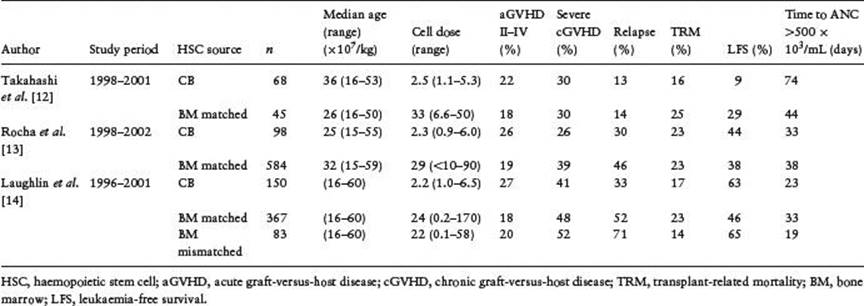
Initial outcome data in adults showed a high risk of graft failure and transplant-related mortality, with UCBT tending to be restricted to patients with advanced stage disease who were heavily pretreated. However, with modified conditioning regimens (including reduced intensity regimens) and an increasing awareness of the key factors in optimizing graft selection, adult UCBT outcomes have improved considerably (Table 42.4) and are now also considered to be standard of care, when a conventional donor is unavailable.
Table 42.4 Summary of studies comparing CBT with other unrelated HSC sources in adult patients.
Metabolic disorders
The metabolic disorders are a range of diseases that result from enzyme deficiencies or transport protein defects, which lead to accumulation of toxic substrates in critical organs, leading to progressive, and often, fatal organ failure. Allogeneic HSCT has been shown to arrest disease progression in selected disorders. The mechanism of benefit is unclear, but may be due to production of continuous and sufficient enzyme by graft-derived cells and a concomitant reduction of central nervous system inflammation.
The largest experience of HSCT in a metabolic disorder is in Hurler's syndrome, an autosomal recessive deficiency of α-L-iduronidase. The key factors considered in HSC choice in this disorder are:
· the need for rapid transplant before neurological damage occurs;
· the lack of necessity for GVM (thus GVHD is less tolerable than in the context of malignancy).
UCB has the advantage of being rapidly available for transplant and, in a small series of 20 patients published to date, has a high rate of survival (85% EFS) with an incidence of grade II–IV acute GVHD of 28% – outcomes at least equivalent to that previously reported for other stem cell sources [15]. Whilst further data are clearly required, UCB appears to be an attractive stem cell choice for some metabolic disorders.
Primary immunodeficiencies
The primary immunodeficiency syndromes are a rare group of inherited disorders in which there is a single or combined deficiency in key elements of the innate and/or adaptive immune systems. Early death due to infection may be prevented by enzyme therapy in some children and gene therapy offers the promise of disease amelioration for others in the future. However, for many, replacement of the immune system by allogeneic HSCT provides the only curative therapeutic strategy at present.
The outcome of allogeneic HSCT has improved considerably over recent years with improvements in supportive care, better prevention of GVHD and the use of reduced intensity conditioning regimens. The critical determinant of a successful transplant is for the procedure to be performed prior to the onset of significant infections or comorbidities, which may lead to death within the first year of life in some disorders such as severe combined immune deficiency syndrome (SCID). Whilst the donor of choice for such children is a sibling with overall survival rates of 70–100%, the likelihood of having an HLA-matched sibling who is unaffected by the same inherited disease is only around 10% [1].
UCB is an attractive stem cell source for children with primary immunodeficiencies, given the rapid availability and low risk of GVHD. Four small series have been published to date showing survival rates of 71–88% [1]. However, the slower engraftment rates compared to conventional transplants may increase the risk of peritransplant infections. Currently an UCBT is considered to be an acceptable alternative when no sibling or unrelated donor is available [16].
Advantages and disadvantages of UCB
The wealth of experience of UCBT to date has demonstrated a number of advantages and disadvantages compared to other stem cell sources, which are summarized in Table 42.5. The reduced stringency required in ‘HLA matching’ between recipient and donor, due to a lower incidence of GVHD following UCBT, allows patients access to a life-saving allogeneic HSCT, when previously they would not have had a ‘suitable’ donor. This access is increased further by targeting collection centres in areas where the population has a broader ethic mix, which allows specific harvesting of units from a racially diverse HLA background, currently underrepresented on international volunteer donor panels. UCB can be collected with no risk to either the donor or mother. Once stored, UCB units are available immediately, thus allowing rapid access when a transplant is urgently indicated and also easy rearrangement of the transplant date when necessary. Adult volunteer donors may also become unwell or be unavailable for donation when required; there is no such ‘donor attrition’ with UCB. There is also a very low risk of transmission of infectious agents with transplantation of HSCs collected from a newborn baby.
Table 42.5 Advantages and disadvantages of different stem cell sources (from Warwick & Brubaker [17]).

The principal limitation of UCB is that it is a ‘one-off’ collection of a finite number of HSCs. Futher stem cells cannot be harvested in the event of graft failure and donor lymphocytes cannot be given as immunotherapy in the management of relapse, serious infection or mixed chimerism. The stem cell dose is a crucial determinant of outcome and a single UCB will generally have insufficient HSCs to transplant a larger adolescent or adult patient safely. The other potential disadvantage of UCB is that the stem cells may harbour transmissible genetic disease, not yet apparent in the baby from whom it came.
Future developments
The focus of recent and ongoing research efforts has been on improving engraftment and shortening the duration of cytopenia posttransplant, with the aim of reducing early mortality and improving survival (Table 42.6).
Table 42.6 Stategies to overcome the limitations of lower cell dose.
|
Mechanism |
Approach |
|
Increase cell dose infused |
Double unit transplant |
|
Coinfusion of CD34 selected haploidentical cells |
|
|
Ex vivo expansion |
|
|
Improved homing |
Direct intro-osseous infusion |
|
Allow host haemopoiesis to abrogate duration of neutropenia |
Reduced intensity conditioning |
The most successful so far has been the coinfusion of two unrelated UCB units in larger children, adolescents and adults. Initial concerns that this could lead to graft failure due to an immunological reaction between the two units or to prohibitive GVHD have not been substantiated. This work, pioneered by researchers in Minneapolis, have shown that the duration of neutropenia is acceptable and the likelihood of engraftment increased, even in large adult patients [18]. Although there is an increase in GVHD compared to a single unit transplant, the impact of this on survival appears to be offset by a reduced incidence of relapse. This strategy has led to safe and efficacious UCBT in adults, with a consequent rapid increase in the number of these transplants performed internationally. Interestingly, although both infused units contribute to initial haemopoiesis, ultimately one unit will predominate and will usually eradicate the ‘losing’ unit by around 3 months posttransplant.
Another significant development has been the use of reduced intensity conditioning regimens. It has been shown that UCB will engraft even in this setting and importantly the duration of neutropenia is considerably reduced to around 12 days, due to a temporary contribution of haemopoiesis from nonablated recipient stem cells [19]. Again, the engrafting unit will subsequently eradicate host cells that have effectively ‘bridged’ the neutropenic phase. This approach has made it possible for older patients or those with significant comorbidities to safely proceed to transplant.
Other approaches, including the coinfusion of CD34-selected haploidentical stem cells [20], ex vivo expansion [21] and direct intraosseous injection of UCB [22], are also showing promising results in ongoing international clinical trials.
Conclusions
Allogeneic HSCT provides a life-saving treatment option for patients with many malignant and genetic diseases. Over the last 30 years, UCB has emerged as a safe and effective alternative stem cell source for patients lacking an HLA-matched sibling or unrelated donor, available within the required time-frame. Previously considered a waste product, UCB is abundantly and rapidly available, without risk to the donor or mother. UCB also has a lower incidence of GVHD and transmissible infection. The limitations of finite cell dose and slower engraftment are being overcome by novel approaches, thus expanding access to transplantation to older, larger recipients and those with comorbidities.
Key points
1. Over the last 30 years, UCB, previously a biological waste product of pregnancy, has been shown to be an effective and safe alternative source of HSCs for transplantation in patients with life-threatening diseases who otherwise would not have a suitable related or unrelated donor.
2. The lower stringency required for recipient and donor matching and the targeted collection of ethnic minority and mixed race UCB units has extended access to transplantation considerably, particularly for those of racial backgrounds poorly represented on volunteer donor panels.
3. UCB collection presents no risk to the mother or baby and provides a rapidly available HSC source when urgently required, with no risk of donor attrition.
4. The incidence and severity of acute and chronic GVHD is lower, following an UCBT compared to BMT, despite greater HLA disparity. Transplant-related mortality, relapse rate and overall survival are at least comparable with BM.
5. A limited cell dose, resulting in a slower and reduced probability of engraftment, remains the biggest obstacle to the wider use of UCBT.
6. Double unit UCBT has been shown to be safe and efficacious in larger adolescents and adults, in whom a single unit transplant would result in an unacceptably high risk of graft failure and early mortality.
7. Other strategies, such as ex vivo expansion, intraosseous injection and coinfusion of haploidentical CD34-selected stem cells all show promise and may yet expand the utility of UCBT further.
References
1. Hough R, Cooper N & Veys P. Allogeneic haemopoietic stem cell transplantation in children: what alternative donor should we choose when no matched sibling is available? Br J Haematol 2009, December; 147(5): 593–613. Epub 25 August 2009.
2. Barker JN, Krepski TP, DeFor TE, Davies SM, Wagner JE & Weisdorf DJ. Searching for unrelated donor hematopoietic stem cells: availability and speed of umbilical cord blood versus bone marrow. Biology of blood and marrow transplantation. J Am Soc for Blood and Marrow Transplantation 2002; 8(5): 257–260. PubMed PMID: 12064362.
3. Eapen M, Klein JP, Sanz GF, Spellman S, Ruggeri A, Anasetti C et al. Effect of donor-recipient HLA matching at HLA A, B, C, and DRB1 on outcomes after umbilical-cord blood transplantation for leukaemia and myelodysplastic syndrome: a retrospective analysis. Lancet Oncol 2011, December; 12(13): 1214–1221. PubMed PMID: 21982422, Pubmed Central PMCID: 3245836.
4. Gluckman E, Broxmeyer HA, Auerbach AD, Friedman HS, Douglas GW, Devergie A et al. Hematopoietic reconstitution in a patient with Fanconi's anemia by means of umbilical-cord blood from an HLA-identical sibling. N Engl J Med 1989, 26 October; 321(17): 1174–1178. PubMed PMID: 2571931.
5. Samuel GN, Strong KA, Kerridge I, Jordens CF, Ankeny RA & Shaw PJ. Establishing the role of pre-implantation genetic diagnosis with human leucocyte antigen typing: what place do ‘saviour siblings’ have in paediatric transplantation? Archiv Disease in Childhood 2009, April; 94(4): 317–320. PubMed PMID: 18684746.
6. Fisk NM, Roberts IA, Markwald R & Mironov V. Can routine commercial cord blood banking be scientifically and ethically justified? PLoS Med 2005, February; 2(2): e44. PubMed PMID: 15737000, Pubmed Central PMCID: 549592.
7. Mercer JS & Erickson-Owens DA. Rethinking placental transfusion and cord clamping issues. J Perinatal and Neonatal Nursing 2012, July; 26(3): 202–217. PubMed PMID: 22843002.
8. Rocha V, Wagner Jr JE, Sobocinski KA et al. Eurocord and International Bone Marrow Transplant Registry Working Committee on Alternative Donor and Stem Cell Sources. Graft-versus-host disease in children who have received a cord-blood or bone marrow transplant from an HLA-identical sibling. N Engl J Med 2000, June; 342(25): 1846–1854.
9. Rocha V, Cornish J, Sievers E et al. Comparison of outcomes of unrelated bone marrow and umbilical cord blood transplants in children with acute leukemia. Blood 2001; 97: 2962–2971.
10. Wagner JE, Barker JN, DeFor TE, Baker KS, Blazar BR, Eide C et al. Transplantation of unrelated donor umbilical cord blood in 102 patients with malignant and nonmalignant diseases: influence of CD34 cell dose and HLA disparity on treatment-related mortality and survival. Blood 2002, 1 September; 100(5): 1611–1618. PubMed PMID: 12176879.
11. Eapen M, Rubinstein P, Zhang MJ, Stevens C, Kurtzberg J, Scaradavou A et al. Outcomes of transplantation of unrelated donor umbilical cord blood and bone marrow in children with acute leukaemia: a comparison study. Lancet 2007, 9 June; 369(9577): 1947–1954. PubMed PMID: 17560447.
12. Takahashi S, Iseki T, Ooi J et al. Single-institute comparative analysis of unrelated bone marrow transplantation and cord blood transplantation for adult patients with hematologic malignancies. Blood 2004; 104: 3873–3820.
13. Rocha V, Labopin M, Sanz G et al. Acute Leukemia Working Party of European Blood and Marrow Transplant Group; Eurocord-Netcord Registry. Transplants of umbilical cord blood or bone marrow from unrelated donors in adults with acute leukemia. N Engl J Med 2004; 351: 2276–2285.
14. Laughlin MJ, Eapen M, Rubinstein P et al. Outcomes after transplantation of cord blood or bone marrow from unrelated donors in adults with leukemia. N Engl J Med 2004; 351: 2265–2275.
15. Staba SL, Escolar ML, Poe M, Kim Y, Martin PL, Szabolcs P et al. Cord-blood transplants from unrelated donors in patients with Hurler's syndrome. N Engl J Med 2004, 6 May; 350(19): 1960–1969. PubMed PMID: 15128896.
16. Shaw BE, Veys P, Pagliuca A, Addada J, Cook G, Craddock CF et al. Recommendations for a standard UK approach to incorporating umbilical cord blood into clinical transplantation practice: conditioning protocols and donor selection algorithms. Bone Marrow Transplantation 2009, July; 44(1): 7–12. Epub 12 January 2009.
17. Warwick RM & Brubaker SA (eds). Tissue and Cell Clinical Use. Oxford: Blackwell Publishing; 2012.
18. Barker JN, Weisdorf DJ, DeFor TE, Blazar BR, McGlave PB, Miller JS et al. Transplantation of 2 partially HLA-matched umbilical cord blood units to enhance engraftment in adults with hematologic malignancy. Blood 2005, 1 February; 105(3): 1343–1347. PubMed PMID: 15466923.
19. Barker JN, Weisdorf DJ, DeFor TE, Blazar BR, Miller JS & Wagner JE. Rapid and complete donor chimerism in adult recipients of unrelated donor umbilical cord blood transplantation after reduced-intensity conditioning. Blood 2003, 1 September; 102(5): 1915–1919. PubMed PMID: 12738676.
20. Fernandez MN, Regidor C, Cabrera R, Garcia-Marco JA, Fores R, Sanjuan I et al. Unrelated umbilical cord blood transplants in adults: early recovery of neutrophils by supportive co-transplantation of a low number of highly purified peripheral blood CD34+ cells from an HLA-haploidentical donor. Expl Hematol 2003, June; 31(6): 535–544. PubMed PMID: 12829030.
21. de Lima M, McMannis J, Gee A, Komanduri K, Couriel D, Andersson BS et al. Transplantation of ex vivo expanded cord blood cells using the copper chelator tetraethylenepentamine: a phase I/II clinical trial. Bone Marrow Transplantation 2008, May; 41(9): 771–778. PubMed PMID: 18209724.
22. Frassoni F, Gualandi F, Podesta M, Raiola AM, Ibatici A, Piaggio G et al. Direct intrabone transplant of unrelated cord-blood cells in acute leukaemia: a phase I/II study. Lancet Oncol 2008, September; 9(9): 831–839. PubMed PMID: 18693069.
Further reading
Boelens JJ. Trends in haematopoietic cell transplantation for inborn errors of metabolism. J Inherit Metab Dis 2006; 29: 413–420.
Brunstein CG, Barker KS & Wagner JE. Umbilical cord blood transplantation for myeloid malignancies. Curr Opin Hematol 2007; 14: 162–169.
Brunstein CG, Setubal DC & Wagner JE. Expanding the role of umbilical cord blood transplantation. Br J Haematol 2007; 137: 20–35.
Gluckman E & Rocha V. Donor selection for unrelated cord blood transplants. Curr Opin Immunol 2006; 18: 565–570.
Locatelli F, Rocha V, Reed W et al. Related umbilical cord blood transplantation in patients with thalassemia and sickle cell disease. Blood 2003; 101: 2137–2143.
Martin PL, Carter SL, Kernan NA et al. Results of the Cord Blood Transplantation Study (COBLT): outcomes of unrelated donor umbilical cord blood transplantation in pediatric patients with lysosomal and peroxisomal storage diseases. Biol Blood Marrow Transplantation 2006; 12: 184–194.