
Deborah L. Haller, PhD and Edward V. Nunes, MD
CHAPTER OUTLINE
■ HISTORY OF PSYCHOTHERAPY FOR SUBSTANCE USE DISORDERS
■ DEVELOPMENT OF PSYCHOTHERAPIES FOR SUBSTANCE USE DISORDERS: THE TECHNOLOGY MODEL
■ COMMON ELEMENTS OF EFFECTIVE PSYCHOTHERAPIES
■ OVERVIEW OF EVIDENCE-BASED PSYCHOTHERAPIES FOR SUBSTANCE USE DISORDERS
■ THE ROLE OF SIGNIFICANT OTHERS IN SUBSTANCE ABUSE TREATMENT
■ COMBINING INDIVIDUAL PSYCHOTHERAPY WITH OTHER MODALITIES: GROUP THERAPY AND MEDICATIONS
■ DIFFERENTIAL THERAPEUTICS: HOW TO MATCH PATIENTS WITH THERAPIES
■ TECHNOLOGY TRANSFER: HOW TO EFFECTIVELY TRAIN CLINICIANS TO DELIVER EVIDENCE-BASED PSYCHOTHERAPIES
This chapter provides an introduction to individual for substance use disorders, including overviews of the following: (a) the history of psychotherapy for the addictions, (b) the contemporary technology model for the development of psychotherapies and the associated criteria for describing and specifying a psychotherapy method and establishing its effectiveness, (c) common elements shared by effective psychotherapies for substance use disorders, and (d) a section briefly comparing and contrasting the main current individual psychotherapy methods that have evidence supporting their effectiveness. The chapter concludes with sections on (e) treatments that involve significant others, (f) interventions that combine individual treatment with group therapy and pharmacotherapy, (g) differential therapeutics or how to match patients with treatments, and (h) procedures for training clinicians in evidence-based psychotherapies ways to maintain clinician skills over time. It is hoped that the chapter will provide a foundation that will enable readers to critically evaluate the various therapies currently available for treating substance use disorders, in terms of their supporting evidence; for selecting the most appropriate psychotherapeutic approach for a given patient; and for understanding what is necessary to deliver these treatments effectively.
HISTORY OF PSYCHOTHERAPY FOR SUBSTANCE USE DISORDERS
The first theory-based individual psychotherapy, namely, psychoanalysis, was founded in the late 19th century by Viennese psychiatrist Sigmund Freud. Psychoanalysis is based on the premise that mental life is both conscious and unconscious and that early life experiences have a powerful psychological influence on the individual throughout the life span. The goal of psychoanalysis is to increase awareness and understanding of unconscious patterns of thought and feeling and, by making them conscious, to correct the overt problems they are driving. However, clinical experience has shown that psychoanalysis is not particularly helpful for treating the addictions. One likely explanation is that psychoanalysis does not focus on overt symptoms (including drug use). Unfortunately, failure to address active substance abuse only allows the disease to progress. In contrast, therapies with demonstrated effectiveness directly address substance abuse and related symptoms and behaviors as well as provide coping strategies of one form or another. Another limitation of psychoanalysis as a treatment for the addictions is its tendency to arouse anxiety and other painful affects. High anxiety states among individuals with poor coping skills can provoke drug use and trigger relapse. Finally, psychoanalysis provides minimal emotional support as the analyst is expected to maintain therapeutic “neutrality.” This too stands in contrast to the relatively supportive and directive stance that characterizes most contemporary, evidence-based psychotherapies targeting addictive disorders (1). Unfortunately, when the preeminent treatment for mental diseases in the early 20th century proved incapable of helping most individuals with substance use disorders, they were left without options for professional treatment.
In the absence of any effective therapies for addiction, Alcoholics Anonymous (AA) emerged in 1935 (2). Founded by two alcoholics (Dr. Bob and Bill W.), AA borrowed the principle of spiritual values in daily living from the Oxford Group, a non–alcohol-based fellowship (3), and the concept of alcoholism as an illness of mind, emotions, and body from the first private “drying out hospital” in New York City (Towns Hospital) where Bill W. had began his own recovery (4). AA offered the Twelve Steps (2), which, in many ways, resemble a treatment plan (i.e., need for problem recognition, commitment to abstinence and change, focus on changing “character defects”). The 12-step “program” focuses on drinking as the identified problem behavior and abstinence as the goal. It provides a structured pathway, including a variety of concrete coping skills, thus anticipating many of the features of contemporary, evidence-based psychotherapies. Although AA is a group-based approach, “sponsorship” (5) bears a resemblance to substance abuse counseling that includes adoption of a nonjudgmental stance, encouragement, education, advice on how to sustain sobriety, and support for socialization within the context of a “long-term relationship.” In the 1950s and 1960s, a number of related self-help approaches for addressing substance dependence emerged. An Addicts Anonymous meeting was held at the US public health hospital in Lexington, Kentucky, in 1947, 12 years after the first AA meeting. Early New York–based Narcotics Anonymous (NA) groups were plagued by organizational problems, fear of police infiltration, slow growth in membership, and relapse among prominent members, leading them to disband in the mid-1960s and early 1970s; today’s version of NA can be traced to Los Angeles in the 1950s (6).
Residential treatment programs began to emerge in the mid-20th century. The classic “Minnesota Model” of substance abuse treatment, which first appeared in 1949, was based on a simple 5-point recovery plan: (i) behave responsibly, (ii) attend lectures on the 12 steps, (iii) talk with other patients, (iv) make your bed, and (v) stay sober; conspicuously, absent from the original model was any sort of counseling or therapy (7).
In 1958, the first therapeutic community (TC) (Synanon) was established. TCs seek to rehabilitate addicts through long-term stays in residential programs that employ a hierarchical model with treatment stages corresponding to gradually increasing levels of personal and social responsibility. (See Chapter 61 and its sidebars for more about TC based treatment.) In this self-help approach, the community is the primary agent of change (8). Over the past several decades, residential treatment models have been modified to include counseling and therapy; however, prior to that time, psychosocial treatment for substance abuse consisted almost exclusively of self-help. Thus, even when treatment was being delivered within the confines of a drug treatment facility, professional treatment was almost nonexistent.
Provisions for “substance abuse counseling” were written into legislation to fund community mental health centers, antipoverty programs, and criminal justice diversion beginning in the 1960’s, around the same time insurance began. Concurrently, insurance companies began paying for substance abuse treatment. Together, these factors resulted in a dramatic increase in the number of addicted patients who accessed treatment (9). However, while treatment (including substance abuse counseling) was readily available, the interventions were poorly defined and delivered mostly by counselors whose primary credential was their own recovery. Furthermore, as treatment outcomes were not assessed, there was no way to determine the extent to which the approaches that were being used were effective. During this same era, evidence-based psychotherapies began to emerge in response to increased scientific knowledge. Unfortunately, these research-informed interventions were not available to clinicians. The field of behavioral pharmacology first recognized that alcohol and drugs serve as “reinforcers,” ushering in the conceptualization of addictions according to classical learning theory. The discovery of the brain reward system and its role in the addictions established a biologic basis for addictive phenomena (10). Psychotherapeutic and behavioral approaches to addictions subsequently have drawn heavily from classical learning theory, cognitive psychology, and social learning theory.
In the 1980s, changes in the political climate (“Just Say No” antidrug campaign), along with decreased funding for stand-alone drug treatment (28-day programs), brought the substance abuse and mental health closer together such that scientific information began to be shared. Addiction researchers became increasingly interested in adapting and testing psychotherapies originally developed to treat psychiatric problems such as depression and anxiety for use with patients with addictive disorders (1,9). Thus, cognitive– behavioral therapy (CBT), originally developed for depression (11), was a forerunner of a broad family of therapies for the addictions including cognitive–behavioral relapse prevention (12,13), coping skills therapies (14), and the community reinforcement approach (CRA) (15). Contingency management (CM) techniques for treating addictions (16) grew out of applications of classical behavioral theory and principles of reinforcement. Motivational interviewing (MI) evolved, in part, from social psychological theories of interpersonal influence and social learning (17,18).
Finally, contemporary therapies for the addictions owe their roots, in part, to the development of interest in the evidence-based practice (EBP) of medicine. During the 1970s, a series of studies showed that only 10% to 25% of health care decisions were being made on the basis of findings from high-quality research studies, with the remainder made on the basis of clinical judgment (19). Results of randomized clinical trials (RCTs) were asserted as the “gold standard” for knowledge; in contrast, clinical judgment was seen as less valid, unless backed by data from scientific studies. The principles of EBP apply to psychological, as well as medical, treatments. Adhering to EBP principles thus requires the use of psychotherapies that have been well specified (the ingredients or techniques of the treatment are clearly defined, measurable, and replicable) and proven to be effective in controlled studies with well-defined populations (20). During the 1970s and 1980s, consensus emerged as to the steps needed to specify a psychotherapy (i.e., development of a treatment manual, describing the treatment in detail; prescribing methods for training and supervising therapists; specifying methods for monitoring and assuring accurate delivery of the treatment) and to test its effectiveness in an RCT. These principles began to be applied to the development of psychotherapies for the addictions. Early landmark studies in this evolution include those of Woody et al. (21,22) focusing on psychotherapy on treatment of methadone maintenance patients; Project MATCH (23,24), which contrasted motivational enhancement therapy (MET) (25), cognitive–behavioral coping skills therapy (26), and twelve-step facilitation (TSF) for treatment of alcohol dependence (27); and the National Institute on Drug Abuse (NIDA) Collaborative Cocaine Study (28), which randomized cocaine-dependent patients to either supportive–expressive (SE) psychotherapy or cognitive therapy (CT) (delivered by professional psychotherapists) or manual-guided drug counseling (delivered by experienced substance abuse counselors). We now further describe the principles for development of effective psychotherapies as they have been applied to the addictions, broadly referred to as the “technology model.”
DEVELOPMENT OF PSYCHOTHERAPIES FOR SUBSTANCE USE DISORDERS: THE TECHNOLOGY MODEL
For the past several decades, researchers, clinicians, and trainers have worked together with the federal government to develop and improve substance abuse treatment at the patient, program, and system levels. The process consists of (a) developing new (or adapting existing) interventions for substance-abusing populations, (b) specifying a process for determining the efficacy of interventions, (c) creating a network of treatment programs in which promising interventions may be tested, (d) disseminating positive research findings in user-friendly format, (e) training substance abuse clinicians to deliver interventions with fidelity, and (f) providing technical assistance to clinicians and programs to facilitate adoption of these interventions in a timely manner. A series of events have facilitated these efforts (29). During the 1980s, methodologic standards for pharmacologic research became more rigorous; not surprisingly, the expectation for similar scientific rigor was applied to behavioral research. Adoption of the “technology model” (30,31) was a critical step in improving how psychotherapy research is conducted as it systematized the methods by which interventions were being evaluated, thus increasing internal validity, generalizability, and replicability. In the 1990s, several landmark psychotherapy studies employing these rigorous methods emerged (32,33). However, it soon became clear that the technology model was too restrictive to promote the development of novel therapies, as it required that interventions be (close to) fully developed prior to efficacy testing. A revised model thus was needed, which would encompass the tasks of intervention development and refinement prior to efficacy testing (29).
To remedy this situation and provide the financial support needed for early-stage treatment development, NIDA issued a program announcement entitled “Development of Theoretically-Based Psychosocial Therapies for Drug Dependence” in 1992 (34), thus officially launching the “Behavioral Therapies Development Program” (35). Its objectives included development, pilot testing, and standardization of both novel and adapted behavioral interventions for substance abuse. Other objectives included identifying effective therapies for subpopulations that had been overlooked in prior research (e.g., those for substance abusers with co-occurring disorders), analyzing the effective “components” of interventions; determining mechanisms of action, and demonstrating that treatments developed in research settings with highly selected patients and expert therapists would “transfer” to real-world drug treatment programs. The program lays out the elements of this “stage model” as summarized in Table 57-1. Briefly, the behavioral therapy development process (36,37) is divided into three discrete stages, analogous to the familiar Phases I, II, and III of medications development research.
TABLE 57-1 STAGE MODEL FOR THE DEVELOPMENT OF BEHAVIORAL THERAPIES
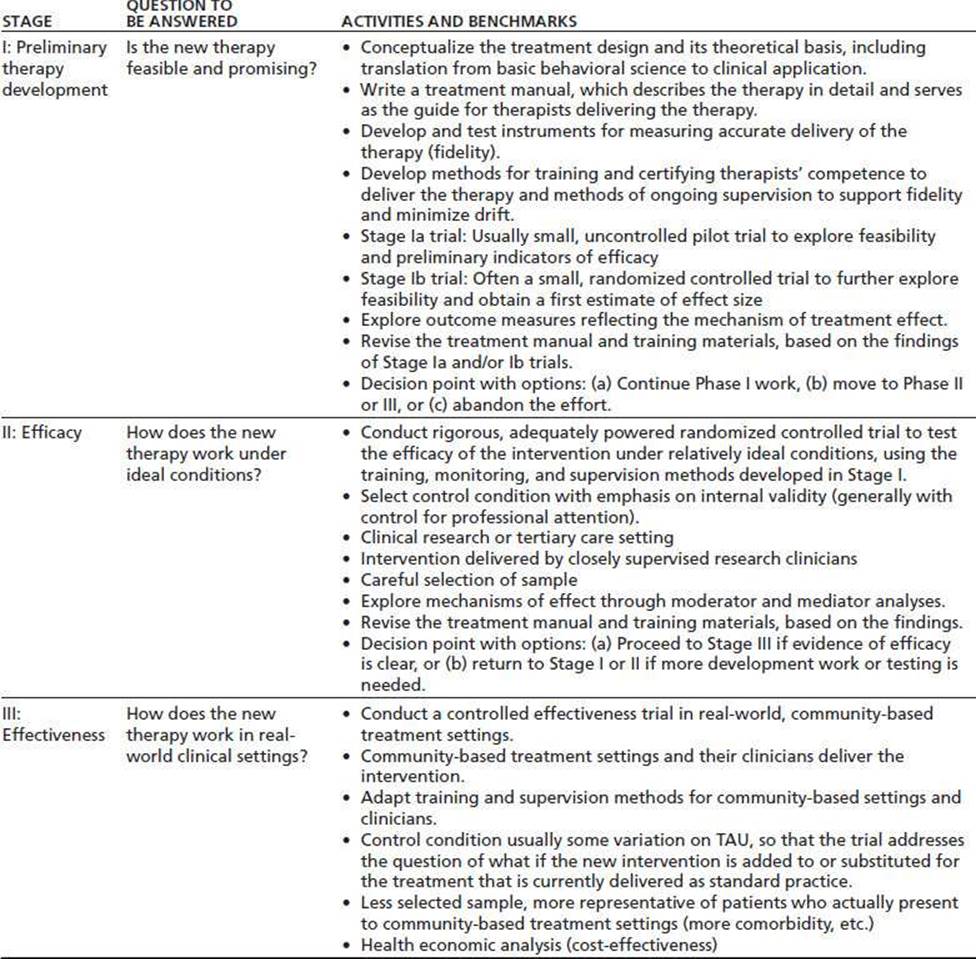
Adapted from National Institute on Drug Abuse. Behavioral & Integrative Treatment Development Program. 2013; NIDA Pub Number: PA-13-077.
Stage I: Stage I includes all of the preparatory tasks that need to be completed before efficacy testing begins. During Stage I, psychotherapy researchers plan the treatment and draft a treatment manual that will be used to train clinicians to deliver the intervention. In Stage I, the intervention is piloted, usually in small uncontrolled or controlled pilot trials, and revised according to this initial clinical experience. During Stage I, the treatment development team establishes protocols for training and certifying therapists as competent to deliver the intervention; they also develop fidelity rating scales designed to assess the extent to which the psychotherapists are adhering to the treatment protocol and delivering the therapy exactly as envisioned. The treatment manual, training materials and procedures, and methods for measuring fidelity and for supervising the ongoing delivery of the therapy represent the essential basic elements for an empirically based therapy, ensuring that the treatment can be reliably replicated. Stage I also provides a potential stopping point for those interventions that lack sufficient “promise.” This is important because efficacy trials are costly and should be avoided if they have little chance of yielding positive effects. Key questions at the end of Stage I include the following: (a) Is the treatment tolerable and feasible? (i.e., are the patients favorably inclined toward the therapy and willing to participate?), (b) is the therapy replicable? (i.e., is it possible to train clinicians to deliver the therapy as envisioned and to reliably measure its delivery?), and (c) does the therapy show promise of effectiveness, based on clinical outcomes from preliminary and pilot studies? Negative answers to one or more of these questions might prompt the therapy development team to rethink the treatment or abandon it altogether. The NIDA program announcement provided a mechanism for funding Stage I work, which was particularly important to the field since this type of preliminary pilot work had not usually been fundable through traditional R01 grant mechanisms. As a result of this initiative, a large cohort of Stage I projects was funded, several of which have developed into therapies that have proven effective, advancing through Stage II and III trials.
Stage II: Stage II represents formal efficacy testing of psychotherapies showing promise during Stage I pilot testing. Also during Stage II, “mechanisms of action” (i.e., therapeutic processes that contribute to treatment outcomes) are identified by examining moderators and mediators suggested by theory underlying the therapy. As efficacy research, Stage II studies generally address the question of whether the therapy is beneficial when delivered under ideal circumstances. Thus, Stage II trials typically take place at one or several clinical sites that are generally university-based research centers where the therapy is delivered by relatively expert therapists, under the close supervision of the developers of the therapy. The patient samples typically are carefully selected to represent the sample targeted by the intervention, and the sample size is sufficient to detect the sorts of small- to medium-range effect sizes that can be expected from behavioral interventions (usually at least 100 study participants but often more). Stage II designs typically are randomized, controlled trials that involve a control, which is carefully specified, and often controlled for attention—that is, the control condition is delivered by therapists with similar expertise, under similarly careful supervision. Stage II again represents a decision point where a therapy development effort might be advanced, rethought and reworked, or abandoned if not showing sufficient promise. An intervention that produces a statistically and clinically significant beneficial effect would be considered appropriate to advance to Stage III testing. Stage II studies may also provide indicators of where a therapy should be modified to improve its efficacy before moving to Stage III, perhaps prompting more Stage I or II work.
Stage III: The goal of Stage III research is to evaluate the generalizability and ease of implementation of treatments that have been shown to be effective in several Stage II trials. The key question addressed in Stage III is: How does the therapy work when delivered in real-world, community-based treatment programs (CTPs) and settings when delivered by community-based clinicians? This addresses the ultimate public health impact of the new intervention. Like Stage II studies, Stage III studies typically are randomized controlled trials; however, eligibility criteria are more open for both patients and therapists. In community-based treatment, a therapy needs to be effective for the types of patients that present for treatment, including those who have more medical, psychiatric, and substance abuse comorbidity than would be ideal for a Stage II clinical trial. Stage III research also needs to evaluate how the therapy will work in the hands of the range of therapists that work in community settings, including those who may have less or more varied backgrounds, training, or expertise than do the research therapists working in Stage II clinical trials. Furthermore, the designs of Stage III trials need to select control groups that will address the practical utility of the therapy. Hence, control groups in Stage III trials typically represent some form of treatment as usual (TAU). In this way, the design answers questions of practical utility to program managers and payors such as…“How much benefit will the new therapy yield when added to the treatment we currently are delivering at our treatment program?” or …“when substituted for the treatment we currently are delivering at our treatment program?” (38). In addition, Stage III research often includes an economic or cost-effectiveness analysis, again yielding important information for program directors and payors who must make business decisions about whether or not to implement a new treatment. Stage III studies typically are multisite trials, in order to gain data on effectiveness from a representative sample of the treatment programs (39). Sample sizes typically are large, in order to account for potentially smaller sample sizes that result from the greater variation in patients, clinicians, and settings and to be able to understand how these sources of variation may impact the effectiveness of the intervention (moderator and mediator analyses). To summarize, Stage III studies provide evidence of effectiveness of new therapies in less controlled environments and with a wide range of patients and therapists. If the therapy produces positive results under these conditions, program managers and clinicians can be more confident that a particular treatment is worthy of being considered for implementation, so long as costs and training/ supervision requirements are not too high.
Several other federal initiatives have had a major impact on the substance abuse treatment development and dissemination process. In 1999, NIDA established the Clinical Trials Network (CTN). Originally comprised of 6 academic nodes and their associated CTPs, there currently are 13 nodes. The primary goal of the CTN is to increase the number and variety of evidence-based treatments available to substance abuse clinicians. To accomplish this, large-scale treatment effectiveness trials are conducted within CTPs throughout the country, under the direction of the academic nodes. Since its inception, the CTN has completed 28 multisite studies, with 7 others active. A number of these studies have focused on behavioral interventions, including those testing the effectiveness of MI (40,41), CM (42,43), Brief Strategic Family Therapy (44), and Seeking Safety (45) among other psychotherapies.
Once a therapy has been determined to be effective, the next step is dissemination throughout the larger drug treatment community. Unfortunately, the “lag” time between the determination of a treatment’s effectiveness and its implementation in clinical programs is approximately 17 years (46). Accelerated dissemination of research findings from studies conducted by the CTN and other researchers is a NIDA priority and the primary mission of the NIDA/ Substance Abuse and Mental Health Service (SAMHSA) “blending initiative,” (47) which has two components— that is, “blending products” and “blending conferences.” Examples of blending products, designed to facilitate implementation of evidence-based interventions, may be found at http://www.drugabuse.gov/blending-initiative (47). In addition, training manuals are available at no cost from NIDA and National Institute on Alcohol Abuse and Alcoholism (NIAAA) through their Web sites or in print from the National Clearinghouse on Alcohol and Drug Abuse Information. Complimenting these efforts, the mission of SAMHSA’s Addiction Technology Transfer Centers (ATTCs) is to accelerate change in the substance abuse treatment delivery system by “translating, disseminating and promoting the adoption and implementation of effective and culturally sensitive clinical practices” (48). To facilitate technology transfer, the ATTCs train clinicians to deliver evidence-based psychotherapies with fidelity. Methods include live and remote (computer-based) trainings and technical assistance, including for “systems change support.”
COMMON ELEMENTS OF EFFECTIVE PSYCHOTHERAPIES
Examination of the range of psychotherapies that have been developed for addictive disorders suggests a set of common elements that are useful to understanding the psychotherapeutic approach to treating addictive disorders (1). These common elements include (a) focusing directly on substance abuse, (b) enhancing motivation to change, (c) building coping skills, (d) changing reinforcement contingencies, (e) managing painful affects, (f) improving interpersonal functioning, and (g) fostering a treatment alliance. While different treatments may approach each of these elements somewhat differently, the weight of the evidence suggests these represent essential dimensions of effective treatments for addictive disorders.
Focusing Directly on Substance Abuse
While this may seem obvious, it will be recalled that psychoanalysis likely fell short in terms of its efficacy for addictive disorders because of a lack of predominant focus on the presenting behavioral symptom, namely, substance abuse and its concomitants. In contrast, all of the effective behavioral and psychotherapeutic approaches for addiction maintain a focus on controlling and ameliorating substance abuse. Even when the immediate focus of a session may be outside of substance abuse, the underlying agenda is always the substance problem. For example, in MI, the therapist may “roll with resistance” and change the subject to something else (e.g., job functioning, family relationships), but the agenda is to increase the patient’s awareness and understanding of how substance abuse may be affecting his/her functioning in those areas and to help him/her circle back to a direct focus on the substance problem. Likewise, in cognitive–behavioral relapse prevention or the CRA, a session might be focused on managing painful affects or conflict in relationships, but the reason is that these represent stresses that are likely to engender substance use. Thus, addressing substance abuse and its consequences is a critical aspect of successful drug treatment, regardless of the approach that is selected.
Enhancing Motivation to Reduce/Stop Substance Use and Adhere to a Treatment Plan
Addiction is fundamentally a disorder of motivation. Addictive substances interact with the brain reward system and function as positive reinforcers, creating a natural drive to partake. Clinically, this manifests as cravings and repetitive use. Conversely, patients present to treatment because of the adverse consequences of substance abuse, which create the wish to cut down or quit. These opposing desires to both use and quit create a state of ambivalence, which is typical of addicted patients seeking treatment and which manifests as efforts to reduce substance use, punctuated by cravings, lapses and relapses, and/or fluctuating engagement with treatment. For example, patients may miss treatment sessions, fail to carry follow through with parts of the treatment plan (e.g., homework), or avoid discussing substance use during sessions. They also may express the wish to cut down or control their substance use without stopping altogether; i.e., they may seek to continue to enjoy the positive effects of substances, while minimizing the adverse consequences. Any psychotherapeutic or behavioral approach to treating an addiction must address these variations. MI provides a tactical and strategic persuasion method for talking with patients in order to enhance their internal motivation to quit substance use. MI can be viewed as a fundamental skill, which clinicians can implement any time motivation for treatment wavers. (For a more detailed look at MI, see Chapter 55 in this section.) Other approaches, such as individual drug counseling (IDC) or medical management (MM), provide direct advice from the therapist to quit, which can be powerful when coming from someone who is respected as an expert. CM strategies, where concrete rewards or punishments are established contingent upon substance use (or treatment participation, etc.), can enhance external motivation in the absence of internal motivation to change. Cognitive–behavioral approaches, such as relapse prevention or CRA, seek to render more salient the adverse consequences of substance use on the one hand and alternative sources of satisfaction and reward on the other, which, in turn, should have an impact on patients’ decisions to use versus abstain. Thus, while MI is considered the preeminent intervention for enhancing internal motivation and “readiness” to change drug use behavior, other drug abuse therapies also have the capacity to evoke change, albeit by different methods and means.
Coping Skills to Avoid Substance Use and Change Lifestyle
Whether patients are struggling to achieve initial abstinence, avoid relapse, or effect other lifestyle changes that will improve their prospects for a long-term recovery, they generally need to be taught skills and strategies to achieve these ends. AA and other 12-step groups can be viewed as conveying such a set of skills (e.g., practicing acceptance, maintaining focus on abstinence, avoiding “people, places, and things” associated with use, wariness of strong emotions, taking “a day at a time”). Cognitive–behavioral approaches focus specifically on skills building, providing practice, both in role-plays within sessions and through homework assignments between sessions. Similarly, the CRA focuses on building social, recreational, and occupational skills, again through practice and homework.
Changing Reinforcement Contingencies
Addictive substances function as reinforcers, becoming increasingly salient and predominant as an addiction progresses. As a patient’s behavior increasingly falls under the control of the substance, more time is spent seeking out and using the substance while normal or healthy sources of reinforcement are displaced, such as family, friends, recreation, work, and even food and sex. Thus, an effort to reconnect a patient with his or her former sources of healthy reinforcement may help to combat the reinforcement value of substances, resulting in reductions in drug use. When an addicted patient achieves abstinence, this often leaves a gap, since important areas (i.e., family, friends, work, and recreation) often have been forsaken during extended periods of drug use. In order to reduce the likelihood of relapse, such patients need to literally rebuild their lives by reestablishing their networks of family and friends. To this end, MI focuses on what a patient values in life and how substance abuse conflicts with those values; for instance, if family relationships are important but the substance abuser has become alienated from his/her significant others, this discrepancy could be a focus of MI. The CRA specifically emphasizes engagement in healthy social and recreational activities and relationships and teaches skills (e.g., conflict resolution) to foster growth in those areas. CM provides concrete monetary rewards for avoiding substance use, often in conjunction with CRA. Rewards likewise can be given for engaging in prosocial behaviors, such as socializing and other forms of drug-free recreation.
Managing Painful Effects
Stress is a risk factor for the development and progression of substance abuse; furthermore, dysphoric affects can contribute to relapse. To avoid such negative occurrences, addicted patients need to learn to recognize, label, and tolerate painful affects as part of the recovery process. A number of evidence-based approaches address painful affects. SE therapy focuses on helping patients to feel comfortable recognizing and expressing their feelings and understanding the relationship between their emotions, substance use, and problematic relationships. MI stresses the fostering of empathy; patients are encouraged to experience and share their feelings, which are reflected back by the clinician so that the patient feels understood. Cognitive– behavioral approaches, such as relapse prevention, the CRA, or dialectical behavior therapy (49), teach explicit skills for tolerating and managing strong affects similar to those conveyed by CBTs developed to treat depression or anxiety disorders. AA and systematized 12-step approaches like IDC also recognize and label the role of strong affect in substance abuse and relapse, encourage sharing and discussion of feelings at meetings, and provide coping skills (e.g., the concepts of acceptance and serenity) to help deal with emotions.
Improving Interpersonal Functioning and Social Support
Addicted patients have often damaged or lost contact with positive social networks (e.g., divorce, alienation from family and friends, loss of connection to social groups and activities), with any remaining relationships revolving around others who also are unstable in recovery or actively using (e.g., “drug buddies”). The absence of positive social support is highly problematic since this has been shown to foster recovery from addiction and help protect against relapse. To enhance interpersonal functioning and improve support, the CRA places an emphasis on social skills building by helping patients rebuild and reengage in their social networks. Further, when CRA is combined with CM, patients are encouraged to spend the monetary rewards they earn by engaging in a social activity with family or friends (50). The functional analysis component of cognitive–behavioral approaches often identifies social settings that promote substance use, thus affording the clinician an opportunity to teach skills to avoid those particular situations and substitute healthy ones instead. MI seeks to help patients become more aware of the relationships they have damaged/lost but would like to reestablish and to foster self-efficacy to reengage. Approaches like network therapy that involve the family in a supportive way provide an in vivo opportunity for relationship repair work to begin. It is well known that, for some individuals, attendance at 12-step meetings (and sponsored events) can become an important part of their social life; individual treatments that employ the 12-step approach (e.g., TSF, IDC) likewise have the building of a strong support network as one of their primary objectives.
Fostering the Treatment Alliance
Treatment alliance refers to the collaborative relationship that develops between the patient and therapist. It is measured from both the patient’s and therapist’s perspectives using questionnaires such as the Helping Alliance Questionnaire–II (HAq-II) (51). Alliance is composed of three components— that is, shared goals, tasks, and emotional bonds (52)—and accounts for as much as 15% of the variance in treatment outcomes (53). A common mediator of effectiveness of treatments across a wide range of therapies and disorders (54), treatment alliance affects treatment retention, completion, and outcomes among substance-abusing patients (55). While all psychotherapies acknowledge the importance of a good therapeutic relationship, some focus more intently on this element, namely, those that are more emotionally based (i.e., SE therapy and MI). Nevertheless, across addiction therapies, it is necessary for the therapist to monitor the extent to which the patient is engaged in the therapy and to address therapeutic lapses in a nonjudgmental fashion. While breaches in alliance generally are seen as a patient problem, it is notable from study findings that low therapist alliance scores (on the HAq-II) are associated with poorer patient outcomes, even when patient alliance scores are high (56). In this study, both patient and therapist alliance scores remained high during the relationship-building phase of treatment and only began to diverge at the point in treatment where patients were confronted about the need to make changes in their drug-taking behavior. This suggests that substance abuse clinicians may become disillusioned and frustrated when their patients fail to progress as planned, even when patients are feeling generally positive about the treatment, perhaps contributing further to bad outcomes.
OVERVIEW OF EVIDENCE-BASED PSYCHOTHERAPIES FOR SUBSTANCE USE DISORDERS
This section will provide an overview of individual treatments for substance dependence that have evidence of efficacy or effectiveness from large-scale controlled trials. Most of these approaches are covered in detail in other chapters in the “Behavioral Interventions” section of this volume. Treatment manuals and training materials are available from SAMHSA (http://mentalhealth.samhsa.gov/cmhs/CommunitySupport/toolkits/community). The purpose of the review is to provide a brief synopsis of each intervention and its supporting evidence so that the reader may compare and contrast the approaches and consider how the menu of available therapies might be worked into individual treatment plans or organized treatment programs.
Motivational Interviewing and Motivational Enhancement Therapy
MI is a way of approaching and talking to patients that is designed to increase their commitment to reducing or stopping substance use and taking the steps necessary to do so (17,18). MI can be viewed as an essential therapeutic skill, to be employed during the initial contact and evaluation of a patient and redeployed periodically whenever a patient’s motivation wavers during treatment. MI can be used either as a stand-alone intervention or as a prelude to another treatment such as CBT. MI is founded on guiding principles, called the “spirit” of MI, namely, collaboration, evocation, and respect for the autonomy of the patient. The most recent formulation of MI also includes acceptance of the patient for who he or she is and empathy as an essential stance of the therapist (18). Collaboration means that the clinician avoids taking on the role of an authority figure (e.g., teacher, expert) but rather creates a sense of partnership with the patient. Evocation means that the clinician makes an effort, partly through the concerted use of open questions, reflections, and reflective listening, to get the patient talking about his or her life and what he or she values. By expressing genuine curiosity and openness to the patient’s experience and values, the clinician builds and communicates empathy. Respect for autonomy means that the clinician makes it clear that the patient is making the decisions about whether and how to change; additionally, the clinician supports the patient’s self-efficacy to change. MI is not simply an empathic, exploratory interview, however. It also is strategic in the sense that the therapist is seeking to guide the patient toward change. In this sense, a therapist practicing MI is like a good salesman, who keeps the client talking and thinking while moving the client toward a decision to buy.
MI also prescribes a group of interviewing skills, which include open questions, reflections, affirmations, summarizations, and avoidance of statements that run counter to MI principles (e.g., confrontation, argumentation, or unsolicited advice). Simple reflections are statements made by the therapist that reflect back to patient what the therapist has been hearing as a way for the therapist to check with the patient that he or she has understood what has been said; reflections convey genuine interest and curiosity, thus building empathy. Complex reflections go beyond simply reflecting, by also expressing some level of inference— that is, by probing for things the patient may not have said directly and thus gently moving the patient toward change. Another tactical strategy, “developing discrepancy,” consists of trying to help the patient become more aware of any divergence between the things he or she values and how substance abuse interferes with attaining these things. Reliable measures of MI therapist behaviors have been developed—for example, motivational interviewing training instrument or MITI (57,58), which can be used to rate the skill of clinicians and provide feedback to them as part of supervision. Clearly, MI has the fundamental features of therapy technology, namely, treatment manuals (the Miller and Rollnick texts and other training materials), as well as a reliable method for measuring performance and for training and supervising clinicians.
MI therapists also are trained to recognize, elicit, and respond to “change talk.” Change talk consists of statements by the patient that reflect one or more of desire, ability, reasons, need, and commitment (DARN-C) to change their substance using behavior. An instrument to measure DARN-C statements by patients has been developed and can be used to help train clinicians to recognize change talk. In particular, commitment talk (e.g., “I have set my quit date for tomorrow”) has been shown to be a strong predictor of good outcome among substance-dependent patients (59). Hence, an important tactic is for the therapist to recognize and reinforce change talk whenever it occurs. While MI represents a style of interviewing that may take the interview in a variety of directions depending on what the patient brings to the session, MET is a manual-guided approach that is more structured and includes giving patients feedback on their substance use behaviors and other structured activities aimed at enhancing motivation.
Motivational interviewing approaches (both MI and MET) have been shown to be effective in multiple randomized trials for a wide range of substance problems and related health behaviors (17,60). The evidence is stronger for nicotine and alcohol use disorders though less consistent for drug use disorders (29,41). The mixed results found for some populations suggest what may seem self-evident, namely, that a single or limited set of MI or MET sessions may be insufficient to effect much change, particularly among more severely addicted or disorganized patients. This suggests the strategy of combining MI or MET within a larger treatment plan, including other evidence-based approaches. For more on enhancing motivation to change, see Chapter 55.
Brief Advice
Any encounter between a clinician and a patient represents an opportunity for therapeutic effect. While not a formal or elaborate psychotherapy method, brief advice from a clinician, such as a physician, has been shown to be beneficial in influencing patients to reduce substance use (61,62) and thus is important to include in this overview of individual psychotherapeutic interventions. In a busy clinical setting, with limited time for encounters with patients, brief advice has obvious advantages. In some respects, brief advice seems a polar opposite to MI. MI instructs clinicians to avoid the role of expert or authority figure, to forego giving direct advice, and to take a more collaborative and exploratory approach. However, clinicians (particularly physicians) command respect in our society. Thus, simple advice from a physician is likely to be salient, and the evidence suggests it can be beneficial in reducing substance use. Brief advice also can be reconciled with, and understood within, the context of the theory of MI. MI does not necessarily proscribe advice giving; rather, it recommends that advice giving needs to be done in the context of an empathic relationship. One concrete strategy of MI is to ask for a patient’s permission before giving advice—for example “Would it be OK with you if I let you know what I’m thinking about your drinking?” This maintains the collaborative nature of the interaction and respects the patient’s autonomy, by giving the patient the opportunity to refuse. This strategy (i.e., asking permission) easily can be incorporated into the brief advice paradigm as a way of encouraging autonomy and advancing the therapeutic relationship.
Supportive–Expressive Therapy
As previously noted, in the early years of psychotherapy development, psychoanalytic therapy was attempted with addicted patients with limited success. Going forward, treatment development went in a more behavioral direction, with few dynamically oriented interventions for substance abuse being systematized—that is, with treatment manuals, methods of training, and measuring therapist performance. One exception was supportive–expressive therapy. SE psychotherapy (63) is a time-limited therapy that was adapted for use with both cocaine- and heroin-dependent patients. It represents an effort to apply psychoanalytic and psycho-dynamic principles in a systematic way to the problem of addiction. One way in which SE differs from other psycho-dynamic approaches for substance abuse is that there is no focus on an “ addictive personality.” Rather, drug use and efforts to quit are viewed in relation to the patient’s interpersonal and intrapsychic world. The patterns that are identified are viewed either as triggers for relapse or as linked to avoidance of appropriate actions needed to achieve sobriety, rather than as direct causes of addiction. As with other psychodynamic approaches, emphasis is placed on development and maintenance of the therapeutic alliance. SE has two main components. The first employs supportive techniques to assist patients in feeling comfortable discussing their feelings and life experiences while addressing the role that drugs have paid with regard to problematic feelings and behaviors. In this phase, the therapist focuses on developing a helping relationship with the patient and on identifying and bolstering the patient’s strengths and areas of competence. The second component involves the use of expressive techniques to help the patient understand and work through relationship issues. To achieve this goal, the therapist employs unreflective listening, evaluative understanding, and responding to identify the problematic relationship themes. SE helps patients explore the meanings they attach to their drug dependence and address their relationship problems more directly, thus allowing them to develop better solutions to life problems than drug use.
The SE treatment model for drug abuse is based on Luborsky’s standard SE model (63); however, a more detailed treatment manual is available, which includes adaptations specifically for cocaine users (64). These adaptations were made when SE was employed in the Collaborative Cocaine Study, the results of which are described below.
Clinical trials testing the effectiveness of SE among substance-dependent patients have generated mixed results, with some evidence of efficacy. In the NIDA Collaborative Cocaine Treatment Study (28), patients received group therapy (i.e., group drug counseling); three of four study groups also got individual psychotherapy—that is, SE therapy, IDC, or CT. SE (plus group therapy) was associated with reduced cocaine use, but was not superior to the control group, which received group therapy only. Furthermore, IDC produced significantly greater abstinence from cocaine than either SE therapy or CT (28). Among methadone-maintained opioid-dependent patients, those with high psychopathology who received 6 months of SE therapy or CBT in addition to traditional drug counseling achieved better outcomes than did those receiving drug counseling only, although drug counseling was beneficial for those with lower levels of psychopathology (21). A second study found that clients in three methadone clinics who received SE required lower doses of methadone than did those receiving standard drug counseling; not only did they maintain their gains after 6 months of treatment, they also continued to improve compared to those receiving drug counseling only, who began to lose ground (22). In summary, there is at least some evidence that SE may be helpful for treating patients with greater psychopathology, particularly when combined with other interventions.
Cognitive–Behavioral Approaches: Relapse Prevention and Coping Skills Therapies
Cognitive–behavioral relapse prevention and related approaches are based on the premise that the development and continuation of substance use is a learning process (12–14). Accordingly, the therapy is founded on a “functional analysis” where the sequences of thoughts, feelings, behaviors, and circumstances that lead to substance use for a given patient are reviewed and understood. The therapist then introduces coping skills to promote the unlearning of these maladaptive patterns and to substitute more adaptive patterns that will oppose and prevent substance abuse. This is structured, time-limited (usually 8 to 12 weeks in duration), goal-oriented treatment, which can be flexibly adapted for a variety of individual obstacles, skill deficits, settings, and formats. Specific foci of CBTs include recognizing triggers that lead to substance use (e.g., places, persons, or particular emotions), avoiding high-risk situations, and coping with cravings. Skills that are taught and rehearsed include drug refusal skills (literally, how to respond when someone asks the patient to use substances), decisional delay (putting off a decision to use for a brief period—e.g., 20 minutes during which time the desire often goes away), and talking oneself through cravings. Patients also are taught to recognize, tolerate, and counteract painful feelings (e.g., sadness or worry), much along the lines of skills conveyed in CBTs for depression or anxiety disorders. In addition to role-plays during sessions, patients typically are given homework and instructed to practice particular skills in real life between sessions.
Cognitive–behavioral relapse prevention and related approaches, such as coping skills therapies, have extensive evidence from clinical trials supporting efficacy among nicotine-, alcohol- (65), and cocaine-dependent patients (66). One interesting feature of cognitive–behavioral approaches is that the outcome data often show a “sleeper effect,” namely, that the beneficial effect on substance use augments over time, after the treatment has been completed; that is, at long-term follow-ups, the treated group often continues to evidence further reductions in substance use, while control group does not (66,67). This suggests that ongoing practice of skills established during treatment continues to produce benefits, even after treatment ends. Chapter 66 explores relapse prevention and further discussion of cognitive– behavioral approaches to addiction treatment.
Community Reinforcement Approach
The CRA is a cognitive–behavioral approach that has much in common with relapse prevention and other related approaches previously described (15). It differs in that it places greater emphasis on examining the reinforcers in a patient’s life and helps the patient to reengage and reconnect with healthy sources of reinforcement (e.g., family, friends, work, and recreation). The theory is that this will interfere with and replace drug-seeking behaviors, which are under the control of reinforcement of the drugs or alcohol. CRA involves teaching patients to conduct a functional analysis so that they can better understand their drug use and problem solve ways to decrease the probability of substance use going forward. Other key skills include self-management planning and drug refusal skills, much like in other CBT approaches. Another component of CRA involves encouraging patients to engage in healthy sources of reinforcement to include vocational and recreational activities, as well as positive relationships. CRA often has been combined with CM in which voucher-based rewards are used to enhance abstinence (50). These two approaches seem synergistic, as the vouchers provide concrete rewards within the therapy, while the CRA attempts to foster rewards within the patient’s life outside of therapy.
Contingency Management
CM seeks to directly harness the principles of reinforcement and behavior modification by making concrete rewards or punishments contingent upon some key target behavior (68). The target behavior usually has been abstinence from substances as confirmed by urine testing, but other targets (e.g., attendance at therapeutic activities) also can be reinforced. The basic principle is that contingent rewards or punishments will help reduce the likelihood of substance use and help patients achieve and sustain abstinence. The key principles of this approach, derived from theory of learning and behavior modification, include the following: (a) The target behavior needs to be well defined and measurable; and (b) the reinforcement should be well defined, delivered as immediately as possible upon production of the target behavior, and be as salient (or valuable) to the patient as possible. CM has been applied effectively for drugs such as cocaine, heroin, and cannabis where use over the last several days can be readily detected in urine (43,69–71). Alcohol can be detected in blood, urine, or breath but washes out of the system quickly. Thus, while CM with rewards contingent on negative breath testing has some evidence of efficacy (72), false negatives are more likely, defeating the requirement for accurate detection of use. In addition to toxicology results, treatment plan adherence (e.g., attendance at groups) is readily verifiable and also has been tested in clinical trials (73); this represents a more natural application of CM when adapted to community-based practice (74). Similar examples of incentives for program participation can be seen in the business world, as with frequent flyer miles in the airline industry.
When employing CM based on results of urine testing, direct observation of urine collection is ideal in order to avoid patients adulterating or substituting specimens. However, while direct observation typically has been employed in efficacy trials, this can be a barrier in community-based treatment where bathrooms often are too small to accommodate both patient and observer, where same-sex staff may be unavailable to conduct observation, and/or where clinic staff may be too embarrassed to observe patients urinating. To overcome these obstacles, many urine collection systems now incorporate tests for detecting falsification based on temperature or concentration. Another caveat when using results from urine testing to determine whether or not to reinforce a patient who is on a CM protocol is that many point-of-care drug tests are unable to reliably detect some commonly abused drugs such as synthetic opioids like oxycodone. Special tests need to be added to the protocol for patients with a history of abusing these substances in order to avoid false-negative results and inadvertent reinforcement in the face of ongoing use.
Contingent reinforcement can consist of rewards such as vouchers that are exchangeable for actual dollar amounts contingent on negative urines (75,76) or access to a workplace where wages can be earned (77) or punishments to include loss of methadone take-home privileges or threat of arrest and incarceration—an incentive often inherent in drug courts and other alternative sentencing programs. Principles of learning suggest that positive reinforcement tends to produce behaviors that are more durable and generalizable beyond the immediate context. Hence, many of the most successful CM treatments have worked with rewards, often on an escalating schedule, where the magnitude of the reward increases with each consecutive negative urine; this procedure is intended to shape prolonged periods of abstinence on the theory that sustained abstinence is the most valuable clinical outcome.
Principles of learning also suggest that the impact of a reinforcer will be proportional to its magnitude; thus, it is not surprising that larger monetary rewards produce more abstinence (78). This has led to one of the key barriers to widespread implementation of CM, namely, the problem of how to finance the rewards. Typical reinforcement schedules in clinical trials have allowed patients to earn around $1,000 for 3 months of sustained abstinence. In response to this problem, Petry et al. developed a lower-cost voucher regimen that involves rewarding patients not with set monetary vouchers but rather with opportunities to engage in a sort of lottery where what is earned are draws from a “fish bowl”; only some draws yield prizes, most of small magnitude, with a few of larger magnitude, whereas other draws simply yield praise (“good job”). This “fish bowl” model has shown strong evidence of both efficacy and effectiveness in community-based treatment settings (43,79).
Among psychotherapeutic and behavioral treatments for the addictions, CM has shown the most consistent and strongest evidence of efficacy compared to control conditions, at least during treatment (70). Response tends to be bimodal, however; some patients (usually around 50% of the sample) rapidly achieve and sustain abstinence, whereas the remainder produce little or no abstinence and earn few or no vouchers at all. This raises one immediate question for future research, which is how to better understand which patients will respond to incentives and how to better help those who fail to respond. Another limitation of CM is that its impact tends to wear off, at least partially, when the treatment ends and contingencies are no longer in force meaning that some (but not all) successful patients will relapse. CM often has been combined with other treatment methods. As previously noted, CRA, with its emphasis on fostering reinforcers in a patient’s environment, most commonly has been combined with CM. This approach (CRA + CM), originally pioneered by Higgins (50), has proven to be one of the most effective and consistently replicated treatments for drug dependence. Chapter 58 by Higgins et al. presents a broader explication of the CRA + CM approach. Certainly, more research is needed on combining CM with other therapies. One trial that randomized cocaine-dependent patients to CM, cognitive–behavioral relapse prevention (CBT-RP), the combination (CM + CBT-RP), or a control condition found that while CM produced high levels of immediate abstinence, abstinence at long-term post-treatment follow-up was most likely among those who received CBT-RP alone (67). Clearly, more research is needed to understand how to sustain the gains achieved by short-term CM regimens and how to combine CM with other treatments to produce good long-term outcomes.
Individual Drug Counseling
Although drug counseling was readily accessible to substance abusers entering treatment in the 1970s, it was a “black box” whose active ingredients were unknown and whose efficacy was unclear. In an effort to learn more about “what good counselors do,” Woody et al. (21,28,80) studied them, both in outpatient drug-free and methadone maintenance clinics. This early work contributed to the development of IDC, one of the first science-based treatments for addiction. The IDC manual was developed for use in the Collaborative Cocaine Study and is readily available to the public as part of the “Therapy Manuals for Drug Addiction” series (81). The first section of the manual is devoted to discussing the contribution of the 12-step approach to the IDC model. An overview of IDC, including a comparison to other approaches to treating addiction, is provided. The IDC approach includes assessing the patient’s status prior to initiating treatment; recommendations include using the addiction severity index (82), along with biomarkers to ascertain abstinence. The role of the counselor, including developing alliance and proscribed behaviors (i.e., those that should not occur during treatment), is described. The manual then details the phases of treatment, which include (a) treatment initiation (targeting denial and ambivalence); (b) early abstinence (which focuses on advice for avoiding relapse such as “people, places, and things”), cravings, dealing with high-risk situations (all reminiscent of cognitive–behavioral approaches), and 12-step meeting attendance; (c) maintaining abstinence by addressing the potential for relapse, dealing with relationships while in recovery, living a drug-free lifestyle, encouraging spirituality, and dealing with character defects; (d) advanced recovery; (e) dealing with specific problems, including relapse; (f) counselor characteristics and training; and (g) counselor supervision. The IDC intervention incorporates the essential elements of the 12-step approach, while also addressing the important issue of intervention fidelity, thus allowing IDC to be compared with other evidence-based interventions for substance abuse.
The efficacy of IDC was demonstrated in the NIDA-funded Collaborative Cocaine Treatment Study (28) in which patients treated by drug abuse counselors who were trained and supervised according to the IDC manual produced superior rates of cocaine abstinence at follow-up compared to those who were treated with either CT or SE therapy administered by professional therapists; all patients also received group therapy. The results were surprising as IDC had been designated the control condition, with the hypothesis that the CT and SE interventions would be superior. The results show that high-quality drug counseling delivered by trained clinicians, 12-step meeting attendance, and a commitment to abstinence can make for a highly effective therapy.
Twelve-Step Facilitation
TSF therapy (83) is characterized as a guided approach to “facilitating” early recovery and is intended to give clinicians a tool to help their patients engage productively in AA or other 12-step groups. Clinical trials testing TSF have come the closest of any research studies to testing the effectiveness of 12-step participation itself. TSF is an individual treatment that, by design, is brief (12 to 15 sessions) and structured. Like IDC, it is based on the principles of the 12-step program. The therapy focuses on two general goals, acceptance of the need for abstinence and surrender, which includes a willingness to engage in the 12-step fellowship as a means to achieving sobriety. These principles include acknowledging that addiction is incurable and that willpower is insufficient to achieve and sustain abstinence. In this model, it is considered necessary to surrender to the “group conscience.” The act of surrender also involves acknowledging that 12-step programs have helped millions of people to achieve and sustain sobriety and that an addict’s best changes at recovery come through following the 12-step path. Hope for recovery comes through recognition of loss of control and by having faith in a “higher power” (such as God or even the 12-step group). In this way, recovery is seen as a process of spiritual renewal. TSF counselors assess patients’ substance use, advocate for abstinence, explain basic 12-step concepts, and actively support and facilitate involvement in AA/NA. Counselors also discuss 12-step reading and share resources with their patients. The TSF manual incorporates material originally developed for Project MATCH, a clinical trial focusing on patient–treatment matching and funded by NIAAA. Project MATCH included two independent (but parallel) study arms, with patients recruited from both outpatient and aftercare programs and randomly assigned to TSF, CBT, or MET. When the data from Project MATCH were analyzed, only 1 of 16 of the hypothesized patient–treatment matches was confirmed, basically debunking the idea that patient characteristics should be used to assign patients to alcohol treatments. Patients in all three treatments evidenced substantial improvements in their drinking behavior (rom baseline) on the two primary outcome measures—percentage of days abstinent and number if drinks consumed on drinking days, with improvements maintained across the 3-year follow-up period (24). In contrast, a significant group difference was found for another outcome variable, total abstinence. Specifically, patients who received TSF were significantly more likely to be abstinent at all follow-up points compared to those receiving CBT or MET; the magnitude of this difference was substantial, about 10 percentage points, and was evident across the entire 3-year follow-up period. Thus, the intervention that focuses more on abstinence (TSF) was more likely to produce abstinence in this landmark study.
Medical Management
Manual-guided MM interventions originally were developed to provide clinicians who were treating patients in pharmacotherapy trials with a standard, well-specified set of goals and talking points to cover during clinic visits. In a sense, this represented an effort to systematize what good prescribing physicians do during medication visits, analogous to the effort in IDC to define what good drug counselors do. Typically, clinicians are asked to systematically address symptoms, side effects, and medication adherence and to troubleshoot any problems in an empathic, supportive, nonjudgmental manner. In the setting of clinical trials for the addictions, MM interventions have been employed that generally focus on assessing substance use, assessing medication adherence, monitoring for any side effects, troubleshooting problems with abstinence or adherence, and, in some cases, recommending 12-step participation. In clinical trials examining combinations of medications with psychotherapies, MM interventions have sometimes been used as control conditions. For example, an intervention called compliance enhancement therapy (K. Carroll and S. O’Malley, unpublished treatment manual, 1996) was used as the control condition in clinical trials, which showed that more elaborate behavioral interventions (e.g., CM; significant other involvement) improved adherence with naltrexone treatment for opioid dependence (84,85). In another landmark study, the NIAAA-funded COMBINE (86), participants were randomly assigned to an enhanced behavioral therapy including aspects of MI and CT or a medication management control called BRENDA (87) and also randomized to placebo, naltrexone, or acamprosate. While the expectation was that the enhanced behavioral therapy would improve the outcome of medication treatment, there was no main effect for therapy type; if anything, the best drinking outcomes were observed among patients who received MM plus naltrexone. Patients who seek to enter a medication trial probably are more favorably inclined to medication and may be less interested in psychotherapy. However, the results of this trial also could be interpreted as showing that the most essential elements of successful addiction treatment are a commitment to abstinence and treatment adherence. See Chapter 66 on integrating pharmacologic and behavioral treatment for more detail on MM.
THE ROLE OF SIGNIFICANT OTHERS IN SUBSTANCE ABUSE TREATMENT
Several individual therapies for addictive disorders involve family and significant others in the treatment. Exceptions include 12-step approaches, which expect members to “make amends” to family and friends who have been wronged, offer opportunities for significant others to attend “open” meetings” with the substance abuser, and provide family support services through the 12-step family programs (e.g., Al-Anon). The CRA urges patients to reengage with significant others as part of the effort to restore healthy sources of reinforcement. This approach also provides for more direct involvement of family members, for example, by having them monitor medication ingestion. In their early work on CRA (88), outlined the strategy for disulfiram monitoring in which the patient, significant other, and therapist all agree that the patient will take his/her medication in the presence of another every day, at a scheduled time. The significant other then thanks the patient for his/her adherence. If the patient refuses to take the medication, the significant other simply informs the therapist, and the matter is taken up at the next visit. Thus, the treatment remains focused on the addicted patient, but the significant other plays a concrete role designed to enhance the patient’s chances for success.
Network Therapy
In the 1990s, Galanter (89) developed network therapy in an effort to harness the therapeutic potential of concerned significant others. In network therapy, the therapist employs tools of MI and cognitive–behavioral relapse prevention, but the unique aspect is that one or more significant others is directly involved in the treatment, also attending the therapy sessions. Still, the focus remains on the addicted patient. In contrast to family systems therapies, where there is a sophisticated effort to diagnose and repair dysfunctional family systems, network therapy has more concrete goals. The significant others mainly are asked to support the patient’s treatment, for example, by understanding the treatment and its goals, helping with homework assignments (e.g., practicing relapse preventions skills), delivering social reinforcers contingent on abstinence or treatment adherence (e.g., a gift, meal, night out), and/or monitoring medication taking. During treatment sessions, the therapist seeks to support the integrity of the network by keeping patient and significant others motivated, by improving communication, and by diffusing any tension that may arise. Such tension is common and can function as a stressor that promotes relapse. Network therapy has been tested and found to be effective as an adjunct to buprenorphine treatment for opioid dependence (90); aspects of network therapy also have shown promise in promoting adherence to naltrexone treatment for opioid dependence (83,91). (For more information about network therapy, see Chapter 60 in this volume).
Community Reinforcement and Family Training Model
In contrast to network therapy, where the family is involved in the treatment in a purely supportive role, the CRAFT model trains the family to be the instrument of therapeutic change. Specifically, CRAFT teaches significant others how to get their treatment-refusing loved ones to engage in treatment (92,93). Unlike in planned “interventions,” where stakeholders (generally with assistance from a substance abuse clinician) confront the addicted person with the goal being to convince him/her to go immediately to treatment, the CRAFT model steers away from confrontation. Instead, family and friends are taught to identify contexts in which substance abuse occurs, to make use of positive reinforcers, and to let the addicted person suffer the consequences of drug use without enabling them. Studies have suggested that 7 of 10 significant others using CRAFT can induce patients who are in denial to submit to treatment (94), while also improving their own emotional functioning, even if the addicted individual does not enter treatment.
Family Therapies
In family therapies, the patient is the family unit. While an individual’s addiction may be the identified source of dysfunction, there is an expectation that all family members will need to make changes to effect, support, and sustain positive changes in functioning within the unit as a whole. Several family therapies for treating families that are dealing with addiction have been tested and shown to have evidence of efficacy in RCTs (93,95–99), although they have not been widely adopted in clinical practice. Barriers to implementation of family interventions include the fact that these treatments often require a relatively high level of training and sophistication on the part of therapists, lengthy therapy sessions, and cooperation on the part of family members who often are reticent to participate (100). Whether family therapy can realistically be a part a routine part of community-based drug treatment is an open question. A recent large-scale effectiveness trial, conducted by the NIDA-funded CTN, failed to find a beneficial effect of family therapy when delivered by community-based therapists who were new to the method, although carefully trained and supervised during the study (44). This study highlights potential difficulties associated with transporting family systems therapy into broad clinical use although, given other positive trials, more research on how to implement this treatment would seem called for. Liepman et al., in this volume (Chapter 63), discusses family interventions in addiction, treatment, and recovery.
COMBINING INDIVIDUAL PSYCHOTHERAPY WITH OTHER MODALITIES: GROUP THERAPY AND MEDICATIONS
Group Therapy
It is very common for substance abusers who are receiving individual treatment also to be engaged in other interventions. The predominant treatment modality in most CTPs is group therapy, even though there is limited evidence from clinical trials as to its effectiveness. One reason for the popularity of group therapy is its cost-effectiveness; group therapy is far less expensive than is individual therapy, as multiple patients can be treated simultaneously by a single therapist. In the Collaborative Cocaine Treatment Study (28), all patients received GDC as the background treatment; those who also received IDC had better outcomes compared to those receiving GDC only. Thus, individual treatment provides additional therapeutic benefits beyond those conveyed by group treatment alone, although the capacity of most programs to provide this additional service seems doubtful. Similarly, a recently completed NIDA-funded CTN study demonstrated the efficacy, among stimulant-dependent patients, of a TSF intervention that consisted of a combination of group and individual formats (101). In some instances, combining group therapy and individual therapy can produce enhanced outcomes and therefore should be considered; unfortunately, it still is unclear which combinations of individual and group treatments are most effect and for which drug use disorders. Chapter 56 further explores the research and clinical basis for the use of group therapies in the treatment of substance use disorders.
Individual Therapy and Medications for Addictive Disorders
Several effective medications are available for treating substance use disorders, particularly alcoholism (e.g., disulfiram, naltrexone) and opioid dependence (methadone, buprenorphine, naltrexone). Yet, these medications remain underutilized. Individual treatment sessions are a natural setting in which the potential benefits of medications could be discussed, encouraged, and supported; however, nonphysicians may not be knowledgeable or comfortable enough to have this conversation with their patients. In addition, many drug treatment programs have limited medication options available to them (e.g., only methadone only for opioid dependence) and may be resistant to adding others, especially when additional staff training and expense are involved. Another limitation is that many “unique” combinations of individual treatments and medications simply have not been tested, despite each treatment having shown evidence of efficacy as a stand-alone intervention. That said, several of the psychotherapies that have been reviewed in this chapter have been tested in combination with certain medications (e.g., SE therapy with methadone (21,22), network therapy with buprenorphine (90), and combined behavioral intervention in combination with naltrexone or acamprosate (86).
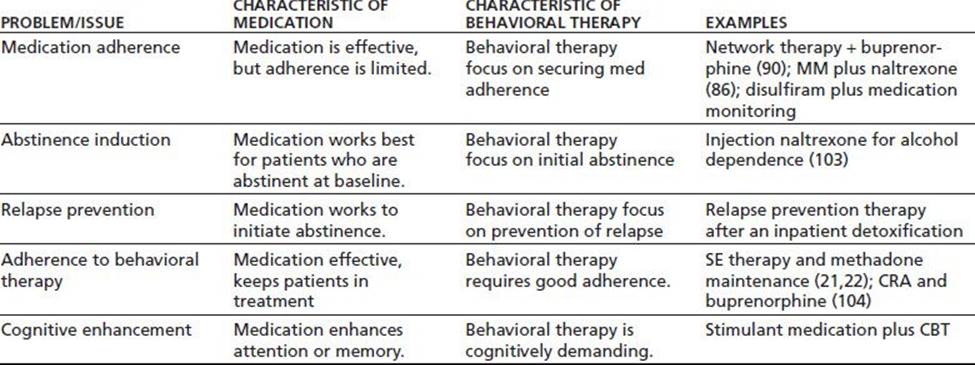
Carroll et al. (102) reviewed a number of potential synergistic combinations between psychotherapy and medication treatments, which may be considered during treatment planning. This provides a roadmap of potential hypotheses to test in clinical trials, but also can be used as a framework when tailoring treatment for a patient where pharmacotherapy is planned. These potential combinations and their rationales are summarized in Table 57-2. As can be seen in Table 57-2, there are a number of possible logical combinations, some of which already have been tested in clinical trials; other promising combinations also are suggested. While adherence to treatment is a general problem in the treatment of substance dependence, adherence to medications is a particular problem. Even agonist treatments like methadone or buprenorphine, which are inherently reinforcing, are accompanied by substantial dropout rates. However, MI could be employed to decrease ambivalence about medication taking. CM could identify medication ingestion as the target behavior and provide rewards contingent on ingestion. Following the CRA approach, family members could be enlisted in helping to monitor ingestion to improve compliance. Relapse after discontinuation of medications is common, and several therapies, including cognitive–behavioral relapse prevention therapy and TSF, focus specifically on this problem. Cognitive enhancement is a relatively unexplored area, but neuropsychological deficits are common among substance-dependent patients (105) and have been shown to predict dropout from cognitive–behavioral relapse prevention (106). Thus, medications to improve attention and reduce impulsivity, such as those used to treat attention deficit disorder, might be considered in conjunction with CBT-RP or even potentially some of the medications used to improve memory in Alzheimer disease. Further discussion of convergent and complimentary strategies for combining medication and behavioral treatments can be found in Chapter 67. Considerable work needs to be done in this area. Further, the only medications addressed in this chapter are those designed specifically to address addiction problems. Additionally, medications for psychiatric disorders like depression and anxiety must be considered as possible adjuncts to individual psychotherapy since unstable mood states and co-occurring mental disorders also can destabilize patients and contribute to substance use and relapse.
TABLE 57-2 RATIONALES FOR COMBINING MEDICATIONS WITH BEHAVIORAL THERAPIES
DIFFERENTIAL THERAPEUTICS: HOW TO MATCH PATIENTS WITH THERAPIES
As in much of mental health therapeutics, choosing the best treatment for a given substance-dependent patient remains more art than science in many instances. Most of the research studies testing individual treatments for addictive disorders test efficacy or effectiveness against a control condition. Moderator analyses, examining patient characteristics that predict good response to a specific treatment, are usually exploratory. One exception was Project MATCH, which specifically sought to generate information on matching of alcohol-dependent patients to one of three individual treatments (MET, cognitive–behavioral relapse prevention, or TSF) based on a broad panel of baseline characteristics. As previously noted, only one of the prespecified matching hypotheses was supported by the data, although several secondary matching factors were identified. For example, MET was found to be particularly effective, compared to the other treatments, for angry patients. Angry patients may be irritated by being told what to do as in more directive therapies and, conversely, may be more responsive to the collaborative, person-centered approach of MET. In contrast, TSF was found to be particularly effective for patients whose social networks included other substance abusers, which makes sense, given that 12-step participation encourages access to a substance-free social network.
In the absence of strong indicators for matching patients to specific substance abuse treatments, a sensible approach is to make a best guess as to where to start and then be prepared to switch interventions if the initial effort fails. For example, should an MET approach fail, one might consider switching to a more directive approach, such as TSF. Unfortunately, clinicians (and treatment programs) tend to offer just one or only a few predominant treatment methods in a “one-size-fits-all” approach. They may ascribe strongly to a particular theoretical orientation, have had limited training in other approaches, and/or lack confidence in their ability to deliver alternative therapies beyond those with which they are most familiar. Many clinicians have not been formally schooled in the evidence-based approaches described in this chapter; accordingly, they may be at a loss as to what to do next when their “go to” intervention fails to produce the desired results. In any case, many patients will fail to respond to the initial treatment to which they are assigned and thus will require recalibration. Therefore, clinicians must be prepared to deliver alternative interventions themselves or else refer their patients to other therapists who have larger repertoires. Future research should examine “adaptive approaches” that regularly measure progress and provide opportunities for patients to switch treatments who are not doing well. For this to occur, treatment programs must regularly assess for change among their clientele and must foster expertise among their clinicians in a wider range of approaches, so that patients will have more treatment options available to them should these be needed.
TECHNOLOGY TRANSFER: HOW TO EFFECTIVELY TRAIN CLINICIANS TO DELIVER EVIDENCE-BASED PSYCHOTHERAPIES
This chapter concludes with a discussion of the challenges inherent in training the clinician workforce in the delivery of evidence-based treatments. As the preceding review suggests, a number of different individual psychotherapy and behavioral therapy approaches for the addictions have been developed, which have proven effective in clinical trials. Yet, these treatments are not widely used in the community-based treatment system (107).
Technology transfer refers to the process of taking a new technology, evidence-based psychotherapy in our case, and getting it into widespread use in the community. People and systems resist new technologies; clinicians are no different. A fundamental precept of technology transfer is that clinicians need encouragement, feedback, and supervision in order to learn and successfully use new psychotherapeutic skills. Clinical trials among physicians have repeatedly shown that traditional methods of introducing new treatments (journal articles, lectures, and didactic symposia or workshops) may increase knowledge but do not get physicians to actually practice the new methods. Rather, what is effective in promoting use of new treatments are training methods that include feedback and supervision (108,109). This is the reason, for example, that pharmaceutical companies invest heavily in sales forces of well-educated representatives, who visit physicians and engage in “academic detailing”—that is, teaching physicians about their new medical product while also getting physicians to talk about their caseloads, try out the new treatment, and obtain feedback. The representative serves as a champion and coach for the new treatment.
Unfortunately, in the substance abuse treatment field, most training takes the form of conferences and workshops. This stands in stark contrast to the clinical trials of psychotherapies, where clinicians are trained on a treatment manual and receive regular measurement of their performance along with supervision sessions to help them hone and maintain their skills. Studies of methods for training community-based clinicians in MI have tended to confirm the lack of effectiveness of didactic workshops alone (110–112); when skill at MI interviewing was measured at followup points after workshop training, some improvement in knowledge can be documented but little improvement in actual skill. However, in these training trials, clinicians who received ongoing feedback and supervision after the workshop did evidence increases in skill over time.
These findings suggest that efforts to disseminate new psychotherapies and other treatments for substance dependence into the treatment community should shift focus from didactic exercises to clinical supervision. During initial training (e.g., psychology or social work graduate school and internship or physicians’ clinical clerkships and residency training), clinicians usually meet regularly with supervisors to go over cases and may even interview patients with supervisors present. Audio- and videotaping are common. However, this type of supervision often ceases once a clinician graduates and gets a job in a treatment program. Programs and their clinicians are under increasing pressure to see more patients and generate corresponding revenue; putting time aside for supervision sacrifices time that could be spent seeing patients. However, given the likely effect of supervision on quality of care, this probably is an investment worth making. Thus, treatment programs should be encouraged to set aside time for clinical supervision intended to introduce, build, and maintain new clinical skills. A related problem is how to provide enough expert supervisors to clinical programs and how to fund staff training and ongoing supervision efforts. Most psychotherapies have a small cadre of “experts” and certainly do not have anything like the large pharmaceutical companies that are able to fund, train, and deploy extensive sales forces. The NIH Institutes and SAMSHA have recognized this problem over the last several decades and have begun funding research on dissemination, as well as dissemination efforts themselves. Mandates from government and third-party payors for delivery of evidence-based treatment also have created incentives for programs to adopt new treatment approaches. The therapies reviewed in this chapter have the potential to improve the public health by improving the quality of care for addicted patients across the treatment system. However, in order for this impact to be realized, widespread adoption of these treatments will be needed, along with research to develop innovative methods of dissemination for promising treatments.
DEDICATION
This chapter is dedicated to the memory of the late Dr. Bruce Rounsaville, our friend, colleague, and previous author of this chapter. Bruce’s contributions to the field of psychotherapy research are extensive, dating back more than 30 years. He is best known for his work in developing and validating behavioral treatments for substance use disorders and for the “stage model” of psychotherapy development, which is described in this chapter. Dr. Rounsaville was Director of the Psychotherapy Development Research Center and the Clinical Scientist Training Program at Yale University, where he served for many years as a Professor in the Department of Psychiatry. We all are indebted to him for his groundbreaking work.
REFERENCES
1.Rounsaville BJ, Carroll KM, Back SE. Behavioral Interventions: Individual Psychotherapy. In: Ries RK, Fiellin DA, Miller SC, Saitz R, eds. Principles of addiction medicine, 4th ed. New York: Lippincott Williams & Wilkins, 2009.
2.Alcoholics Anonymous. http://www.aa.org.Accessed February 24, 2013.
3.Pittman B. AA, the way it began. Seattle, WA: Glen Abbey Books, 1988.
4.Hartigan F. Bill W: a biography of alcoholics anonymous Cofounder Bill Wilson, 1st ed. New York: St. Martin’s Press, 2000:50–53.
5.Alcoholics Anonymous. Questions and Answers on Sponsorship. http://www.aa.org/pdf/products/p-15_Q&AonSpon.pdf. Accessed February 24, 2013.
6.White W, Budnick C, Pickard B. Narcotics Anonymous: its history and culture. Counselor 2011;12(2):22–27.
7.Hazelden. The Minnesota Model. http://www.hazelden.org/web/public/minnesotamodel.page. Accessed February 24, 2013.
8.National Institute on Drug Abuse. Therapeutic community. New York: National Institute on Drug Abuse, 2002; NIH Pub Number: 02–4877.
9.White W. Slaying the dragon: the history of addiction treatment and recovery in America. Bloomington, IL: Chestnut Health Systems, 1998.
10.Volkow ND, Li TK. Drug addiction: the neurobiology of behavior gone awry. In: Ries RK, Fiellin DA, Miller SC, Saitz R, eds. Principles of addiction medicine, 4th ed. Philadelphia, PA: Lippincott Williams & Wilkins, 2009.
11.Beck AT. The evolution of the cognitive model of depression and its neurobiological correlates. Am J Psychiatry 2008;165(8):969–977.
12.Carroll KM, Rounsaville BJ, Keller DS. Relapse prevention strategies for the treatment of cocaine abuse. Am J Drug Alcohol Abuse 1991;17(3):249–265.
13.Larimer ME, Palmer RS, Marlatt GA. Relapse prevention: an overview of Marlatt’s cognitive-behavioral model. Alcohol Res Health 1999;23(2):151–160.
14.Longabaugh R, Morgenstern J. Cognitive-behavioral coping-skills therapy for alcohol dependence. current status and future directions. Alcohol Res Health 1999;23(2):78–85.
15.Smith JE, Meyers RJ, Miller WR. The community reinforcement approach to the treatment of substance use disorders. Am J Addict 2001;10(Suppl):51–59.
16.Stitzer M, Petry N. Contingency management for treatment of substance abuse. Annu Rev Clin Psychol 2006;2:411–434.
17.Miller WR, Rollnick S, Conforti K. Motivational interviewing: preparing people for change, 2nd ed. New York: Guilford Publications, Inc., 2002.
18.Miller WR, Rollnick S. Motivational interviewing: helping people change (applications of motivational interviewing), 3rd ed. New York: Guilford Publications, Inc., 2013.
19.Cochrane AL. Effectiveness and efficiency: random reflections on health services. London, UK: Royal Society of Medicine Press Ltd., 1972:1999.
20.Chambless DL, Hollon SD. Defining empirically supported therapies. J Consul Clin Psychol 1998;66(1):7–18.
21.Woody GE, Luborsky L, McLellan AT, et al. Psychotherapy for opiate addicts: does it help? Arch Gen Psychiatry 1983;40:639–645.
22.Woody GE, McLellan AT, Luborsky L, et al. Sociopathy and psychotherapy outcome. Arch Gen Psychiatry 1985;42(11):1081–1086.
23.Project MATCH Research Group. Matching alcoholism treatments to client heterogeneity: project MATCH post treatment drinking outcomes. J Stud Alcohol Drugs 1997;58(1):7–29.
24.Project MATCH Research Group. Matching alcoholism treatments to client heterogeneity: project MATCH three-year drinking outcomes. Alcohol Clin Exp Res 1998;22(6):1300–1311.
25.Miller WR, Zweben A, DiClemente CC, et al. Motivational enhancement therapy manual: a clinical research guide for therapists treating individuals with alcohol abuse and dependence. Rockville, MD: National Institute on Alcohol Abuse and Alcoholism, 1994.
26.Kadden R, Carroll KM, Donovan D, et al. Cognitive-behavioral coping skills therapy manual: a clinical research guide for therapists treating individuals with alcohol abuse and dependence. Rockville, MD: National Institute on Alcohol Abuse and Alcoholism, 1992.
27.Nowinski J, Baker S, Carroll KM. Twelve-step facilitation therapy manual: a clinical research guide for therapists treating individuals with alcohol abuse and dependence. Rockville, MD: National Institute on Alcohol Abuse and Alcoholism, 1992.
28.Crits-Christoph P, Siqueland L, Blaine J, et al. Psychosocial treatments for cocaine dependence: National Institute on Drug Abuse Collaborative Cocaine Treatment Study. Arch Gen Psychiatry1999;56(6):493–502.
29.Carroll KM, Onken LS. Behavioral therapies for drug abuse. Am J Psychiatry 2005;162:1452–1460.
30.Waskow IE. Specification of the technique variable in the NIMH Treatment of Depression Collaborative Research Program. In: Williams JBW, Spitzer RL, eds. Psychotherapy research: where are we and where should we go? New York: Guilford, 1984:150–159.
31.Docherty JP. Implications of the technological model of psychotherapy. In: Williams JBW, Spitzer RL, eds. Psychotherapy research: where are we and where should we go? New York: Guilford, 1984:139–149.
32.Kang SY, Kleinman PH, Woody GE, et al. Outcomes for cocaine abusers after once-a-week psychosocial therapy. Am J Psychiatry 1991;148:630–635.
33.Kleber HD, Gawin FH. Cocaine abuse: a review of current and experimental treatments. In: Grabowski J, ed. Cocaine: pharmacology, effects and treatment of abuse. Rockville, MD: National Institute on Drug Abuse, 1984:111–129.
34.National Institutes of Health. Development of theoretically-based psychosocial therapies for drug dependence. New York: National Institutes of Health, 1992;21(34): PA-92-110.
35.National Institute on Drug Abuse. NIDA NOTES. 1995;10(2). http://archives.drugabuse.gov/NIDA_Notes/NN95index.html
36.Rounsaville BJ, Carroll KM, Onken LS. A stage model of behavioral therapies development: getting started and moving on from Stage I. Clin Psychol Sci Prac 2001;8(2):133–142.
37.National Institute on Drug Abuse. Behavioral & Integrative Treatment Development Program. 2013; NIDA Pub Number: PA-13-077.
38.Nunes EV, Ball S, Booth R, et al. Multisite effectiveness trials of treatments for substance abuse and co-occurring problems: have we chosen the best designs? J Subst Abuse Treat2010;38(Suppl 1): S97–S112.
39.Feaster DJ, Mikulich-Gilbertson S, Brincks AM. Modeling site effects in the design and analysis of multi-site trials. Am J Drug Alcohol Abuse 2011;37(5):383–391.
40.Carroll KM, Ball SA, Nich C, et al. Motivational interviewing to improve treatment engagement and outcome in individuals seeking treatment for substance abuse: a multisite effectiveness study. National Institute on Drug Abuse Clinical Trials Network. Drug Alcohol Depend 2006;81(3):301–312.
41.Ball SA, Martino S, Nich C, et al. Site matters: Multisite randomized trial of motivational enhancement therapy in community drug abuse clinics. National Institute on Drug Abuse Clinical Trials Network.J Consult Clin Psychol 2007;75(4):556–567.
42.Petry NM, Peirce JM, Stitzer ML, et al. Effect of prize-based incentives on outcomes in stimulant abusers in outpatient psychosocial treatment programs: a national drug abuse treatment clinical trials network study. Arch Gen Psychiatry 2005;62(10): 1148–1156.
43.Peirce JM, Petry NM, Stitzer ML, et al. Effects of lower-cost incentives on stimulant abstinence in methadone maintenance treatment: a National Drug Abuse Treatment Clinical Trials Network study. Arch Gen Psychiatry 2006;63(2):201–208.
44.Robbins MS, Feaster DJ, Horigian VE, et al. Brief strategic family therapy versus treatment as usual: results of a multisite randomized trial for substance using adolescents. J Consult Clin Psychol2011;79(6):713–727.
45.Hien DA, Jiang H, Campbell AN, et al. Do treatment improvements in PTSD severity affect substance use outcomes? A secondary analysis from a randomized clinical trial in NIDA’s Clinical Trials Network. Am J Psychiatry 2010;167(1):95–101.
46.Morris ZS, Wooding S, Grant J. The answer is 17 years, what is the question: understanding lag times in translational research. J R Soc Med 2011;104:510–520.
47.National Institute of Drug Abuse, Substance Abuse and Mental Health Services Administration. NIDA/SAMHSA Blending Initiative. http://www.drugabuse.gov/blending-initiative. Updated June 2012. Accessed February 24, 2013.
48.Addiction Technology Transfer Center Network. http://www.attcnetwork.org/index.asp. Accessed February 24, 2013.
49.Linehan MM, McDavid JD, Brown MZ, et al. Olanzapine plus dialectical behavior therapy for women with high irritability who meet criteria for borderline personality disorder: a double-blind, placebo-controlled pilot study. J Clin Psychiatry 2008;69(6):999–1005.
50.Higgins ST, Sigmon SC, Wong CJ, et al. Community reinforcement therapy for cocaine-dependent outpatients. Arch Gen Psychiatry 2003;60(10):1043–1052.
51.Luborsky L, Barber JP, Siqueland L, et al. The Revised Helping Alliance Questionnaire (HAq-II): psychometric properties.J Psychother Pract Res 1996;5(3):260–271.
52.Bordin, ES. The generalizability of the psychoanalytic concept of the working alliance. Psychol Psychother 1979;16:252–260.
53.Horvath AO. The alliance in context: accomplishments, challenges, and future directions. Psychotherapy (Chic) 2006;43:258–263.
54.Meier PS, Barrowclough C, Donmall MC. The role of therapeutic alliance in the treatment of substance misuse: a critical review of the literature. Addiction 2005;100(3):304–316.
55.Carroll KM, Nich C, Rounsaville BJ. Contribution of the therapeutic alliance to outcome in active versus control psychotherapies. J Consult Clin Psychol 1997;65:510–514.
56.Bethea A, Acosta MC, Haller DL. Patient versus therapist alliance: whose perception matters? J Subst Abuse Treat 2008;35:174–183.
57.Moyers TB, Martin T, Manuel JK, et al. Assessing competence in the use of motivational interviewing. J Subst Abuse Treat 2005;28(1):19–26.
58.Moyers TB, Martin T, Manual JK, et al. Revised global scales: Motivational Interviewing Treatment Integrity 3.1.1 (MITI 3.1.1). Albuquerque, NM: University of New Mexico Center on Alcoholism, Substance Abuse and Addictions, 2010.
59.Amrhein PC, Miller WR, Yahne CE, et al. Client commitment language during motivational interviewing predicts drug use outcomes. J Consult Clin Psychol 2003;71:862–878.
60.Hettema J, Steele J, Miller WR. Motivational interviewing. Ann Rev Clin Psychol 2005;1:91–111.
61.Bien TH, Miller WR, Tonigan JS. Brief interventions for alcohol problems: a review. Addiction 1993;88:315–335.
62.Wilk AI, Jensen NM, Havighurst TC. Meta-analysis of randomized controlled trials addressing brief interventions in heavy alcohol drinkers. J Gen Intern Med 1997;12:274–283.
63.Luborsky L. Principles of psychoanalytic psychotherapy: a manual for supportive-expressive (SE) treatment. New York, NY: Basic Books, 1984.
64.Mark D, Luborsky L. A manual for the use of supportive-expressive psychotherapy in the treatment of cocaine abuse. Philadelphia, PA: University of Pennsylvania, 1992.
65.O’Malley SS, Jaffe AJ, Chang G, et al. Naltrexone and coping skills therapy for alcohol dependence: a controlled study. Arch Gen Psychiatry 1992;49(11):881–887.
66.Carroll KM, Rounsaville BJ, Nich C, et al. One-year follow-up of psychotherapy and pharmacotherapy for cocaine dependence. Delayed emergence of psychotherapy effects. Arch Gen Psychiatry1994;51(12):989–997.
67.Rawson RA, Huber A, McCann M, et al. A comparison of contingency management and cognitive-behavioral approaches during methadone maintenance treatment for cocaine dependence. Arch Gen Psychiatry 2002;59(9):817–824.
68.Kellogg SH, Stitzer ML, Petry NM, et al. Contingency management: foundations and principles. http://www.nattc.org/pami/PDF/Contingency_Mgt_F_P.pdf. Accessed February 24, 2013.
69.Higgins ST, Wong CJ, Badger GJ, et al. Contingent reinforcement increases cocaine abstinence during outpatient treatment and 1 year of follow-up. J Consult Clin Psychol 2000;68:64–72.
70.Lussier JP, Heil SH, Mongeon JA, et al. A meta-analysis of voucher-based reinforcement therapy for substance use disorders. Addiction 2006;101(2):192–203.
71.Prendergast M, Podus D, Finney J, et al. Contingency management for treatment of substance use disorders: a meta-analysis. Addiction 2006;101(11):1546–1560.
72.Petry NM, Martin B, Cooney JL, et al. Give them prizes, and they will come: contingency management for treatment of alcohol dependence. J Consult Clin Psychol 2000;68(2):250–257.
73.Carpenter KM, Smith JL, Aharonovich E, et al. Developing therapies for depression in drug dependence: results of a stage 1 therapy study. Am J Drug Alcohol Abuse 2008;34(5):642–652.
74.Kellogg SH, Burns M, Coleman P, et al. Something of value: the introduction of contingency management interventions into the New York City Health and Hospital Addiction Treatment Service. J Subst Abuse Treat 2005;28(1):57–65.
75.Petry NM. A comprehensive guide for the application of contingency management procedures in standard clinic settings. Drug Alcohol Depend 2000;58:9–25.
76.Silverman K, Higgins ST, Brooner RK, et al. Sustained cocaine abstinence in methadone maintenance patients through voucher-based reinforcement therapy. Arch Gen Psychiatry1996;53(5):409–415.
77.Silverman K, Svikis D, Wong CJ, et al. A reinforcement-based therapeutic workplace for the treatment of drug abuse: three-year abstinence outcomes. Exp Clin Psychopharmacol2002;10(3):228–240.
78.Higgins ST, Heil SH, Dantona R, et al. Effects of varying the monetary value of voucher-based incentives on abstinence achieved during and following treatment among cocaine-dependent outpatients. Addiction 2007;102(2):271–281.
79.Petry NM. Contingency management treatments. Br J Psychiatry 2006;189:97–98.
80.Woody GE, McLellan AT, Luborsky L, et al. Psychotherapy in community methadone programs: a validation study. Am J Psychiatry 1995;152(9):1302–1308.
81.Mercer DE, Woody GE. Therapy manuals for drug abuse: manual 3. Bethesda, MD: National Institute on Drug Abuse, 1999.
82.McLellan AT, Luborsky L, O’Brien CP, et al. An improved diagnostic instrument for substance abuse patients: the Addiction Severity Index. J Nerv Ment Dis 1980;168:26–33.
83.Nowinski W, Baker S, Carroll KM. Twelve-Step facilitation therapy manual: a clinical research guide for therapists treating individuals with alcohol abuse and dependence. Project MATCH Monograph Series Vol 1. Bethesda, MD: National Institute on Alcohol Abuse and Alcoholism, 1992.
84.Carroll KM, Ball SA, Nich C, et al. Targeting behavioral therapies to enhance naltrexone treatment of opioid dependence: efficacy of contingency management and significant other involvement. Arch Gen Psychiatry 2001;58(8):755–761.
85.Nunes EV, Rothenberg JL, Sullivan MA, Carpenter KM, Kleber HD. Behavioral therapy to augment oral naltrexone for opioid dependence: a ceiling on effectiveness? Am J Drug Alcohol Abuse.2006;32(4):503–517.
86.Anton RF, O’Malley SS, Ciraulo DA, et al. Combined pharmacotherapies and behavioral interventions for alcohol dependence: the COMBINE study: a randomized controlled trial. JAMA2006;295(17):2003–2017.
87.Volpicelli JR, Pettinati HM, McLellan AT, et al. Combining medication and psychosocial treatments for addictions: the BRENDA approach. New York: The Guilford Press, 2001.
88.Hunt GM, Azrin NH. A community-reinforcement approach to alcoholism. Behav Res Ther 1973;11(1):91–104.
89.Galanter M. Network therapy for addiction: a model for office practice. Am J Psychiatry 1993;150(1):28–36.
90.Galanter M, Dermatis H, Glickman L, et al. Network therapy: decreased secondary opioid use during buprenorphine maintenance. J Subst Abuse Treat 2004;26(4):313–318.
91.Brooks AC, Comer SD, Sullivan MA, et al. Long-acting injectable versus oral naltrexone maintenance therapy with psychosocial intervention for heroin dependence: a quasi-experiment. J Clin Psychiatry2010;71(10):1371–1378.
92.Meyers RJ, Miller WR, Hill DE, Tonigan JS. Community reinforcement and family training (CRAFT): engaging unmotivated drug users in treatment. J Subst Abuse 1998;10(3):291–308.
93.O’Farrell TJ, Clements K. Review of outcome research on marital and family therapy in treatment for alcoholism. J Marital Fam Ther 2012;38(1):122–144.
94.Center on Alcoholism, Substance Abuse, and Addiction. Community reinforcement and family training (CRAFT): a unilateral family intervention for unmotivated alcohol/drug users in treatment. http://casaa.unm.edu/craft.html. Updated July 19, 2012. Accessed February 28, 2013.
95.Henggeler SW, Sheidow AJ. Empirically supported family-based treatments for conduct disorder and delinquency in adolescents. J Marital Fam Ther 2012;38(1):30–58.
96.Santisteban DA, Coatsworth JD, Perez-Vidal A, et al. Efficacy of brief strategic family therapy in modifying Hispanic adolescent behavior problems and substance use. J Fam Psychol2003;17(1):121–133.
97.Santisteban DA, Suarez-Morales L, et al. Brief strategic family therapy: lessons learned in efficacy research and challenges to blending research and practice. Fam Process2006;45(2):259–271.
98.Hogue A, Liddle HA. Family-based treatment for adolescent substance abuse: controlled trials and new horizons in services research. J Fam Ther 2009;31(2):126–154.
99.Henderson CE, Dakof GA, Greenbaum PE, et al. Effectiveness of multidimensional family therapy with higher severity substance-abusing adolescents: report from two randomized controlled trials. J Consult Clin Psychol 2010;78(6):885–897.
100.Smith JE, Meyers RJ. Motivating substance abusers to enter treatment: working with family members. New York, NY: Guilford, 2004.
101.Donovan DM, Daley DC, Brigham GS, et al. Stimulant abuser groups to engage in 12-step: a multisite trial in the National Institute on Drug Abuse Clinical Trials Network. J Subst Abuse Treat2013;44(1):103–114.
102.Carroll KM, Kosten TR, Rounsaville BJ. Choosing a behavioral therapy platform for pharmacotherapy of substance users. Drug Alcohol Depend 2004;75(2):123–134.
103.Garbutt JC, Kranzler HR, O’Malley SS, et al. Efficacy and tolerability of long-acting injectable naltrexone for alcohol dependence: a randomized controlled trial. JAMA 2005;293:1617–1625.
104.Bickel WK, Amass L, Higgins ST, et al. Effects of adding behavioral treatment to opioid detoxification with buprenorphine. J Consult Clin Psychol 1997;65(5):803–810.
105.Bates ME, Bowden SC, Barry D. Neurocognitive impairment associated with alcohol use disorders: implications for treatment. Exp Clin Psychopharmacol 2002;10:193–212.
106.Aharonovich E, Nunes E, Hasin D. Cognitive impairment, retention and abstinence among cocaine abusers in cognitive-behavioral treatment. Drug Alcohol Depend 2003;71:207–211.
107.Institute of Medicine of the National Academies. Statement on quality of care: National Roundtable on Health Care Quality—the urgent need to improve health care quality. Washington, DC: National Academy Press, 1998.
108.Grol R. Improving the quality of medical care: building bridges among professional pride, payer profit, and patient satisfaction. JAMA 2001;286:2578–2258.
109.Grol R, Grimshaw J. From best evidence to best practice: effective implementation of change in patients’ care. Lancet 2003;362:1225–1230.
110.Miller WR, Mount KA. A small study of training in motivational interviewing: does one workshop change clinician and client behavior? Behav Cogn Psychother 2001;29:457–471.
111.Moyers TB, Manual JK, Wilson PG, et al. A randomized trial investigating training in motivational interviewing for behavioral health providers. Behav Cogn Psychother 2008;36:149–162.
112.Smith JL, Carpenter KM, Amrhein PC, et al. Training substance abuse clinicians in motivational interviewing using live supervision via teleconferencing. J Consult Clin Psychol2012;80(3):450–464.