
Definition
• A biphasic subtype of sarcomatoid carcinoma with mixed carcinomatous and sarcomatous components
Clinical features
Epidemiology
• Extremely rare
Presentation
• Similar to other subtypes of sarcomatoid carcinoma
Prognosis and treatment
• Similar to other subtypes of sarcomatoid carcinoma
Pathology
Histology
• The carcinomatous component usually contains conventional non–small-cell lung carcinoma (most commonly squamous cell carcinoma, followed by adenocarcinoma, and then large-cell carcinoma); sometimes a high-grade fetal adenocarcinoma can be present with no blastematous stroma
• The sarcomatous component is mostly poorly differentiated spindle cell sarcoma with areas of malignant cartilage, bone, and skeletal muscle formation; rhabdomyosarcoma is the most common, followed by osteosarcoma or chondrosarcoma or a combination of both
• When tumor metastasizes, it may contain only a carcinomatous or sarcomatous component
Immunopathology/special stains
• The carcinomatous component is positive for keratin immunostains
• The sarcomatous component is negative for keratin; other markers are positive according to type of differentiation:
• Rhabdomyosarcoma: immunoreactive with desmin, myogenin, and MyoD1
• Chondrosarcoma: immunoreactive with S100
• Osteosarcoma: osteocalcin stains the osteoid matrix
Main differential diagnoses
• Sarcoma with entrapped benign bronchial epithelium
• Other biphasic tumors:
• Synovial sarcoma: TLE-1 positive, cytogenetic study with t(X;18) translocation is diagnostic
• Biphasic malignant mesothelioma:
– Cytokeratins do not help: mesothelial cells are also immunoreactive with keratins AE1/AE3, CAM5.2, and CK7
– The tumor cells (at least the epithelioid component) are positive for mesothelial markers (WT-1, calretinin, D2-40, and CK5/6) and negative or only focally reactive for epithelial markers MOC-31, BG8, and BerEP4
• Pulmonary blastoma
– Usually in younger patients
– Both epithelioid and stromal components are primitive with “embryonic” appearance
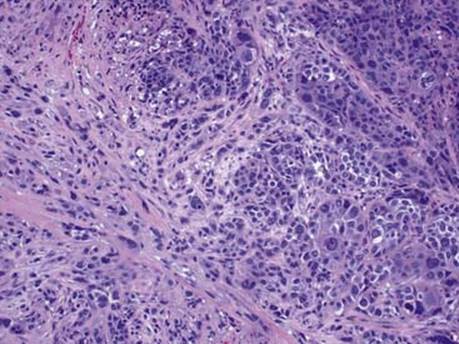
Fig 1 Carcinosarcoma. Carcinosarcoma is composed of mixed malignant epithelial (upper right) and stromal (lower left) components.

Fig 2 Carcinosarcoma. Keratin CAM5.2 is focally and weakly positive in the squamous cell carcinoma component (center) as compared with the residual alveolar lining cells, which are seen as a linear pattern of staining.

Fig 3 Carcinosarcoma. The carcinomatous component contains keratinizing squamous cell carcinoma seen in both A and B; the sarcomatous component contains malignant spindle cells arranged in fascicles in A and a whorling pattern with myxoid stroma in B.

Fig 4 Carcinosarcoma. A and B, Keratin AE1/ AE3 immunostain is only positive in the carcinomatous component and is negative in the sarcomatous component; note that the entrapped bronchial epithelium is also immunoreactive.