
Definition
• A rare biphasic subtype of sarcomatoid carcinoma with a mixture of primitive epithelial and mesenchymal components
Clinical features
Epidemiology
• Mean age: fourth decade, which is younger than other subtypes of sarcomatoid carcinoma
• Males and females are equally affected (other subtypes of sarcomatoid carcinoma have 4:1 ratio)
Presentation
• Similar to other subtypes of sarcomatoid carcinoma
Prognosis and treatment
• Similar to other subtypes of sarcomatoid carcinoma with an aggressive clinical course
Pathology
Histology
• The malignant epithelial component resembles well-differentiated fetal adenocarcinoma with primitive tubular glands that mimic fetal bronchioles
• The primitive epithelial component is surrounded by primitive cellular stroma, which resembles blastema of Wilms tumor or fetal lung at 10 to 16 weeks’ gestational age (pseudoglandular stage)
• The tubular cells are tall, columnar, nonciliated, and glycogen-rich with clear cytoplasm or cytoplasmic vacuoles (may have an endometrioid appearance)
• Squamous morules may be present
• Stroma may contain areas of adult-type spindle cell sarcoma arranged in a fascicular or storiform pattern; focal differentiated sarcomatous areas with rhabdomyosarcoma, osteosarcoma, or chondrosarcoma may also be present
Immunopathology/special stains
• The glycogen in cytoplasmic vacuoles can be demonstrated by PAS stain
• Epithelial component is strongly keratin and TTF-1 positive
• Stromal component is negative for both keratin and TTF-1
Main differential diagnoses
• Carcinosarcoma
• Older patients
• The epithelial component shows specific subtype of malignancy, such as squamous cell carcinoma, adenocarcinoma, or large-cell carcinoma
• The stromal component is sarcomatoid, usually atypical spindle cells
• Pleuropulmonary blastoma
• A tumor of infancy and early childhood
• Cystic or solid or mixed tumors
• Primitive stroma is the only malignant component; the epithelium is reactive; may also have entrapped benign mesothelial elements

Fig 1 Pulmonary blastoma with primitive epithelial component viewed in low power (A) and high power (B), which mimics fetal lung (C).
(Courtesy of Dr. Paolo Gattuso, Rush Medical University, Chicago, Ill; and Dr. Thomas V. Colby, Mayo Clinic, Scottsdale, Ariz.)

Fig 2 Pulmonary blastoma with immature stroma (A), which mimics blastema of Wilms tumor (B).
(Courtesy of Dr. Paolo Gattuso, Rush Medical University, Chicago, Ill; and Dr. Thomas V. Colby, Mayo Clinic, Scottsdale, Ariz.)

Fig 3 Pulmonary blastoma: primitive epithelial component surrounded by primitive stroma with condensation of cellular stroma. Low (A) and high (B and C) powers; note tall, columnar epithelial cells with clear cytoplasmic vacuoles and abnormal mitoses and atypia of stromal cells. D, Developing lung for comparison.
(Courtesy of Dr. Paolo Gattuso, Rush Medical University, Chicago, Ill; and Dr. Thomas V. Colby, Mayo Clinic, Scottsdale, Ariz.)

Fig 4 Pulmonary blastoma: tall, columnar cells with clear cytoplasm and squamous morule resembling endometrioid adenocarcinoma. Low (A) and high (B) powers. C, Some areas have more intracytoplasmic glycogen.
(Courtesy of Dr. Paolo Gattuso, Rush Medical University, Chicago, Ill; and Dr. Thomas V. Colby, Mayo Clinic, Scottsdale, Ariz.)
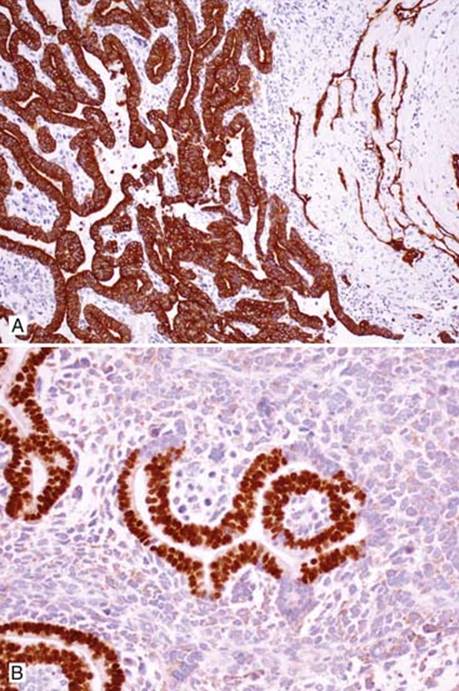
Fig 5 Immunohistochemical stain shows tumor to be positive for keratin AE1/AE3 (A) (note normal compressed lung on the right) and TTF-1 (B).
(Courtesy of Dr. Paolo Gattuso, Rush Medical University, Chicago, Ill; and Dr. Thomas V. Colby, Mayo Clinic, Scottsdale, Ariz.)