
Definition
• Pulmonary artery pressure >20 mm Hg secondary to lung disease (most commonly chronic obstructive pulmonary disease [COPD] or interstitial lung disease)
Clinical features
Epidemiology
• Most common form of pulmonary hypertension
• Related to underlying lung disease
Presentation
• Symptoms often similar to underlying lung disease
Prognosis and treatment
• Prognosis and treatment depend on underlying lung disease
Pathology
Histology
• Medial hypertrophy and intimal fibrosis of arteries and muscularization of pulmonary arterioles
• In idiopathic pulmonary fibrosis (IPF) the arterial changes are usually moderate to severe, whereas in COPD they are usually mild
• In patients with IPF, the architecturally preserved areas of lung may demonstrate venous and venular fibrosis, as well as increased capillaries, arteriolar muscularization, and mild arterial changes
• Plexiform lesions are absent
Main differential diagnoses
• Idiopathic pulmonary arterial hypertension: usually has plexiform lesions and does not have significant interstitial fibrosis
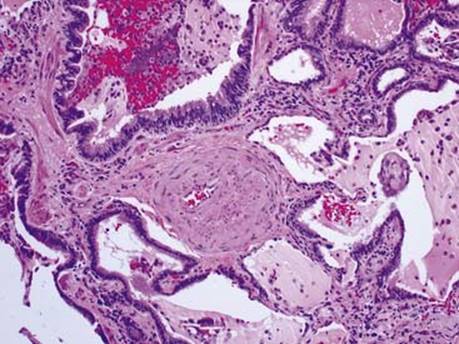
Fig 1 Pulmonary hypertension associated with lung diseases or hypoxemia. In this patient with IPF, there is asymmetric thickening of arterial wall leading to significant luminal narrowing.
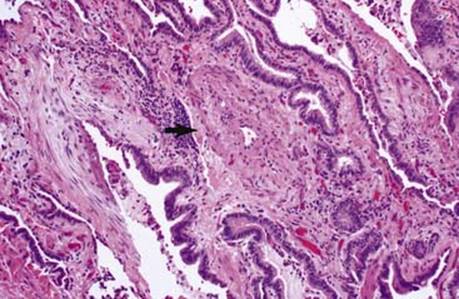
Fig 2 Pulmonary hypertension associated with lung diseases or hypoxemia. Arteries with severe fibrosis (arrow) may be difficult to identify in a background of fibrosis.
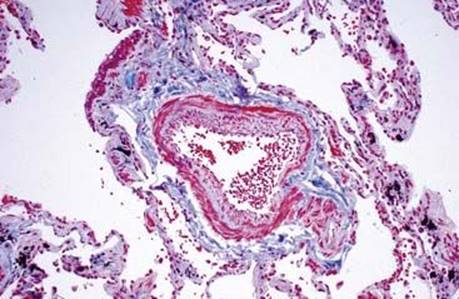
Fig 3 Pulmonary hypertension associated with lung diseases or hypoxemia. Mild fibrosis in vascular wall is more common in emphysema (trichrome stain).
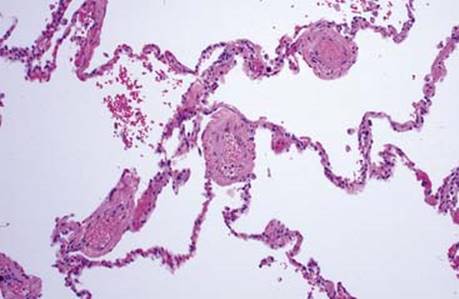
Fig 4 Pulmonary hypertension associated with lung diseases or hypoxemia. Muscularization of distal (alveolar septal) arterioles in emphysema.