
Definition
• An infection caused by the fungal organism Blastomyces dermatitidis
Clinical features
Epidemiology
• Geographically similar to histoplasmosis in the United States. Endemic in the Mississippi River and Ohio River basins and around the Great Lakes
• Also has been reported in parts of Canada, India, Africa, and Central and South America
Presentation
• Much more common in immunocompromised patients than in healthy individuals
• Can present as first time infection or can develop symptoms months to years after an episode of acute pulmonary blastomycosis
• Diverse clinical presentations: flu-like symptoms that resolve within days, an acute illness resembling bacterial pneumonia, a chronic illness that mimics tuberculosis or lung cancer, or a severe progressive process manifesting as acute respiratory distress syndrome (ARDS)
• Infection mostly involves the lung; some cases with extrapulmonary involvement of bone, skin, or other organs
• Lung imaging and clinical symptoms raise the differential diagnosis of carcinoma
Prognosis and treatment
• Antifungal treatment with oral itraconazole or ketoconazole. Amphotericin B is reserved for critically ill, immunocompromised patients
• Cure rates are high in immunocompetent patients
• Mortality rates are much higher in immunocompromised patients (especially AIDS patients) and in patients presenting with ARDS
Pathology
Histology
• Characteristic suppurative necrotizing granulomas with central microabscess and multinucleated giant cells (granulomatous and suppurative inflammation)
• Organisms usually identified in areas of necrosis and microabscess or within multinucleated giant cells
• Round to oval yeasts (8-15 μm) with thick, refractile double-contoured walls and broad-based budding are characteristic; central nuclei can sometimes be appreciated on H&E sections
• In cases of disseminated infection, large aggregates of organisms (yeast lakes) can form with minimal associated inflammation
• On limited biopsy, organisms may not be seen, which may raise the differential diagnosis of other infections that cause mixed inflammation, such as nocardiosis
Immunopathology/special stains
• On GMS stain multiple yeasts are easily identified
• PAS stain highlights the nuclei
Main differential diagnoses
• Histoplasmosis
• Cryptococcosis
• Coccidioidomycosis

Fig 1 Blastomycosis. Blastomycosis elicits both multinucleated giant cells and neutrophilic reaction. Low power (A) and high power (B) with intracytoplasmic fungal yeast.

Fig 2 Blastomycosis. Refractile yeasts with double-contoured walls can be identified within necrosis (A), microabscess (B and C), and multinucleated giant cells (D-F); note central nuclei in some of the H&E sections.
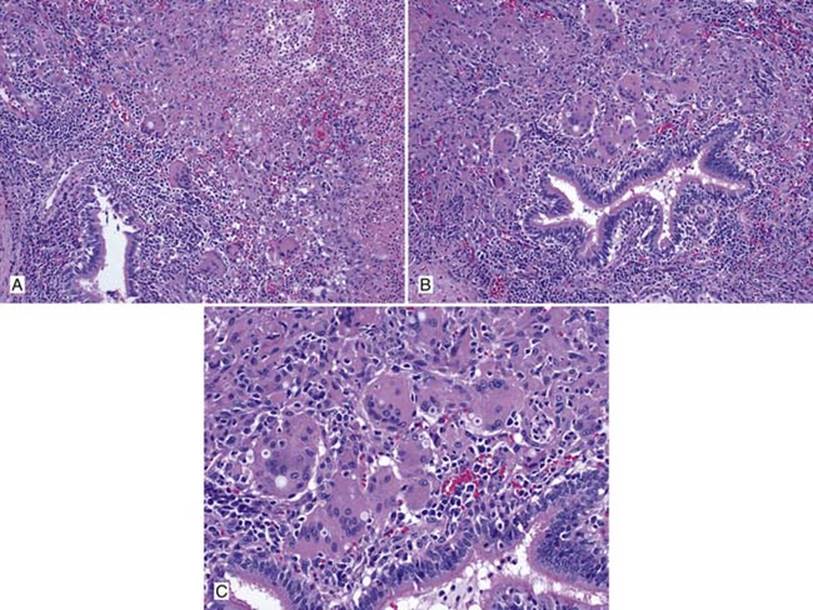
Fig 3 Blastomycosis. Blastomycosis involving bronchioles (A, B and C) with neutrophilic infiltrates and granuloma formation.
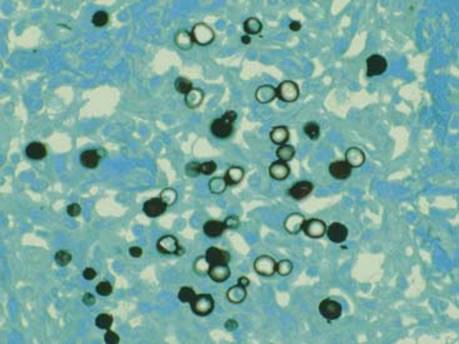
Fig 4 Blastomycosis. GMS stain highlights the contour of Blastomyces yeasts and broad-based budding.
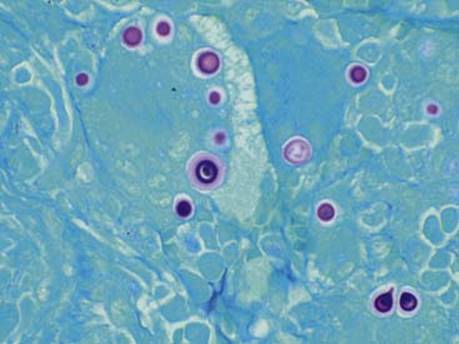
Fig 5 Blastomycosis. PAS stain shows the nuclear detail of Blastomyces yeasts.