
C.O.L.D. is an acronym you can use to help you remember the prevention techniques for cold illnesses.
Cover your extremities, i.e., head, hands (mittens work better than gloves) and feet.
Overexertion will cause you to sweat, which will make your clothes wet, which will make you colder.
Layering: layers of loose fitting, lightweight clothing is a really good way to insulate your body. Wool and silk for inner layers are better than cotton.
Dry: keep as dry as you can.
Cold-water immersion does not lead to immediate hypothermia. In fact, there are four phases of cold water immersion.
1. Cold shock Response
This is the most common cause of drowning in cold water. It can cause a number of life threatening conditions:
a. Gasp Reflex: when cold water is first entered it causes an automatic gasp reflex. This reflex usually lasts about a minute, but if the head is under water at the time, it will lead to drowning.
b. Hyperventilation: panic can cause hyperventilation which can lead to fainting which can lead to drowning.
c. Cardiac Arrest: vasoconstriction (narrowing of the arteries) means the heart must work harder.
2. Cold Incapacitation
Prolonged vasoconstriction will cause the extremities to ‘shut down’ which means the limbs will not be able to help keep the body afloat. This happens after about 10 minutes in the water.
3. Hypothermia
Hypothermia will set in after about 30 minutes in ice water for most adults; Environmentally Induced – Cold and/or Water Induced – Hypothermia.
4. Circum-rescue Collapse
When a patient knows they are being rescued, their mental state relaxes. Blood pressure drops, muscles fail and it may even cause cardiac arrest. It can happen just before, during or just after rescue.
Treatment for Cold-Water Immersion
Only enter water to rescue if no other option.
Extract from water slowly.
Use in-water rescue breathing if needed.
Treat critical systems as needed, e.g., CPR, hypothermia.
Start with 5 rescue breaths, and then continue as normal; Must Read - Immediate First Aid - Critical First Aid – Airway – Rescue Breathing.
If patient is breathing but unconscious, put on his/her side.
Prevention of Cold Water Immersion
Enter cold water slowly keeping the head above the water.
Wear a PFD. They are designed to help keep the head above water, and they also provide warmth.
Wear clothing to provide insulation.
If in the water:
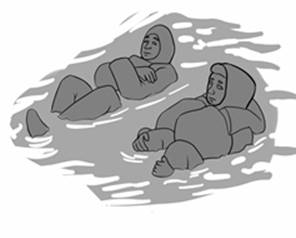
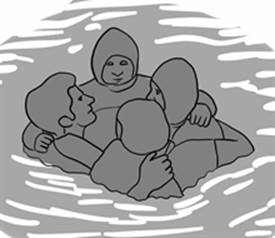
Adopt HELP (Heat Escape Lessening Position) (left picture) or Huddle position (right picture) if in a group placing children in the middle.
Consider swimming to safety. The average person wearing a PFD can swim about 800m in 10C water before failure.
Control hyperventilation with controlled breathing.
Tighten drawstrings.
There are 3 basic classifications of drowning: asymptomatic, symptomatic and respiratory or cardiopulmonary arrest.
Symptoms of Asymptomatic Drowning
The patient has been rescued from the water.
Alert.
No respiratory distress.
With or without coughing.
Treatment for Asymptomatic Drowning
Monitor for respiratory symptoms.
If respiratory symptoms develop seek advanced medical care ASAP.
Protect against and assess for hypothermia Diagnoses and Treatments - Environmentally Induced – Cold and/or Water Induced – Hypothermia.
Patients that do not worsen after 15 minutes are not likely to diminish but should still be monitored.
Symptoms of Symptomatic Drowning
Patient requires resuscitation or shows signs of distress.
Treatment for Symptomatic Drowning
Seek advanced medical care.
Symptoms of and Treatment for Respiratory or Cardiopulmonary Arrest
Must Read - Immediate First Aid - Critical First Aid.
If patient is still in the water, only use rescue breathing.
Abandon a stalled vehicle in a flood area.
Always wear a PDF in open water.
Be prepared for flash flood during heavy rainfall and adopt high ground.
Do not attempt a water crossing when water is above the knees.
Do not try to swim beyond personal capacity.
Learn to swim and teach children to swim.
Never swim under the influence of drugs and/or alcohol.
Swim across rip tides.
Take a surf lifesaver course.
Use flotation devices.
Watch children closely near water.
Wear a helmet during water sports, e.g., kayaking.
Frostbite is the freezing of the water in the cells. The most commonly affected areas are the earlobes, nose, fingers and toes.
Frostnip is a very mild form of frostbite. Frostnip does not do any permanent damage to the skin.
Exposure to the cold is the main cause, but things such as constriction, e.g., tight boots, dehydration, exhaustion, prior cold injuries and vasoconstrictors such as coffee or nicotine are also contributing factors.
There are 3 levels of severity: superficial, partial and severe.
Superficial Frostbite Symptoms:
Cold and uncomfortable.
Perfusion normal; Must Read - Immediate First Aid - Critical First Aid - Circulation – Perfusion.
Pink or pale complexion.
Partial Thickness Frostbite Symptoms:
Reduced Perfusion.
Numbness.
Pale and soft.
Treatment for Frostnip, Superficial and Partial Frostbite
Note: thawing tissue and refreezing it will create more damage. Unless a stable environment is more than 24 hours away, it is best to wait.
Do not drink alcohol or smoke.
Do not massage or rub affected area.
Elevate extremity.
General re-warming of whole body.
Loosen constrictive clothing.
Maintain food and water intake.
Re-warm the affected body part with heat packs, skin to skin (do not rub or massage), warm water etc.
When re-warming, be careful not to burn the patient as he/she may not feel it.
Pharmaceuticals:
Analgesics before re-warming.
Symptoms of Full Thickness Frostbite
Numbness.
Pale and hard body part.
Possible ice crystals.
Perfusion absent.
Note: if the skin turns black it has died from a loss of circulation and is known as gangrene. Amputation is usually necessary; Diagnoses and Treatments – Musculoskeletal System – Amputations.
Treatment for Full Thickness Frostbite
Immersion of frozen area into 37 °C (98 °F) to 39 °C (102 °F) water.
Dry dressings. Separate digits when bandaging.
Pharmaceuticals:
Analgesics before re-warming.
NSAIDs for circulation.
Avoid alcohol and tobacco.
Avoid handling cold liquids and metals, especially fuel.
Avoid wind, especially in high-altitudes.
Do not over wash as it will wash away natural protective oils.
Keep covered and warm.
Keep well rested.
Maintain hydration and nutrition.
Minimize cold exposure.
Hypothermia occurs when the cold overwhelms the body’s ability to produce and retain heat and usually occurs when exposed to the cold.
Hypothermia can be mild or severe and it progresses through very definite symptoms, i.e., the patient will have mild hypothermia and, if untreated, it will progress into severe hypothermia.
Symptoms of Mild Hypothermia:
Body temperature between 35.5 °C (96 °F) to 32 °C (90 °F).
Difficulty speaking.
Intense shivering.
Irritable.
Lethargic.
Loss of fine motor coordination.
Sluggish thinking.
Violent shivering.
Withdrawn.
Symptoms of Severe Hypothermia:
Body temperature below 32 °C (90 °F).
Blue, puffy skin.
Coma.
Decreased vital signs (pulse, respiratory, B/P).
Jerky movements.
Muscular rigidity, i.e., no more shivering.
Respiratory and cardiac failure.
The treatment whether mild or severe is basically the same. The earlier you treat it the better.
Cover the top of the head.
Do not rub or massage extremities (in case of frostbite).
Heat packs on armpits, chest, groin and neck.
Insulate from below and above, starting from the ground up.
Increase heat production, i.e., exercise.
Note: only exercise after sufficient food and fluid has been administrated and when mental status has improved.
Remove causes, e.g., block the wind, remove wet layers.
Warm, non-alcoholic and non-caffeinated liquid (only if patient is capable).
Immersion heating (e.g., a warm bath), only if in a controlled environment; the possibility of after-chill may make it worse.
Re-warming a patient with skin-to-skin contact inside of a sleeping bag (or similar) is a survival technique but may cause the body-temperatures of all involved to drop.
Acclimatize to cold weather.
Avoid alcohol and other recreational substance use.
Dress appropriately.
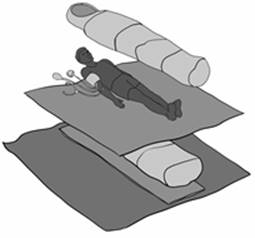
Hypothermia packaging is useful when you need to transport the patient, and even if you do not it is a great way to keep the patient warm.
Ensure the patient is dry.
Keep patient horizontal.
Stabilize any injuries, including covering any open wounds.
Sandwich the patient between layers of insulation and waterproof layers.
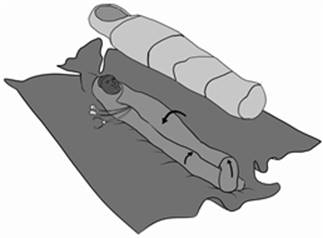
Suggested Hypothermia Packaging:
The face should be partially covered, but allow for breathing, monitoring etc.
Place a large plastic sheet on the ground.
Next place an insulated sleeping pad.
On the pad place a sleeping bag (or blankets or whatever you have).
The patient goes on top of this, along with heating bottles, IV’s etc.
Fold tops and bottom over the patient, then fold the corners over.
Fold the sides over, keeping wrinkles to a minimum.
Strap in place.
When a break in the skin is continuously exposed to salt water, salt water sores may appear.
They may also appear where clothing can be tight, e.g., wrists, ankles.
If in a survival-at-sea situation, prevent sores by not dampening yourself too much with salt water and change positions frequently.
Scabs.
Pus.
Do not open or squeeze sores.
Flush with fresh water.
Keep dry.
Pharmaceuticals:
Antiseptic.
Trench foot (immersion foot), occurs when the skin is immersed in water (or similar) for an extended period of time. A minor form of this is like when you have been in a pool and your hands get wrinkled. A more serious case may be in a survival situation and you have been unable to take off wet shoes for an extended period of time.
Red skin that becomes pale and extremely edematous (filled with fluid).
Initial Symptoms:
Decreased perfusion; Must Read - Immediate First Aid - Critical First Aid - Circulation – Perfusion.
Leg cramps.
Numbness.
Pain.
Paresthesia (tingling).
After 2 to 7 days:
Blisters.
Edema (swelling from fluid).
Ulceration.
After 7 days:
Stabbing pain.
Avoid use of affected part; if use is unavoidable, at least wear dry, loose fitting shoes and socks.
Do not apply creams or ointments.
Elevate the extremity.
Keep area dry, warm and open to air.
Pat dry (do not rub).
Keep feet dry and change to a dry pair of socks at least once a day.
Maintain body core temperature.
Remain active.
Remove your shoes when going to bed at night.
Periodically remove your shoes and socks and rub your feet for 5 to 10 minutes.
There are many things that can wrong when diving, but it is an activity that is usually (and should only be) done under the guidance of a trained professional who should know what to do.
All potential SCUBA divers should seek the advice of a medical practitioner to ensure they are able to participate in the activity, as some conditions are not suitable, e.g., epilepsy, pregnancy, severe asthma, various lung disorders.
Note: some of these conditions may, occur when flying, due to pressure change.
Do not SCUBA dive if:
Flying within 12 hours after last dive.
Flying within 24 hours if making multiple dives for repeated days or dives that require decompression stops.
Alternobaric vertigo usually occurs with ascent and is due to divers’ ears not equalizing pressure at the same rate.
It can happen to anyone but is more common in those with a history of eustachian tube dysfunction or middle ear infections; Diagnoses and Treatments – Head – Ears – Ear Infections – Otitis Media.
Symptoms of Alternobaric Vertigo
The telltale symptom is a feeling of vertigo (perception of motion, usually spinning). Other symptoms include:
Ear pain.
Feeling of fullness in only one ear.
Muffled hearing in one ear.
Nausea.
Spinning sensation.
Sounds in one ear, e.g., hissing, ringing.
Treatment for Alternobaric Vertigo
Symptoms usually resolve quickly (usually within minutes). Symptoms that persist for longer than a few hours or are frequently re-occurring may be a sign of something more serious.
If affected during ascent:
Stop ascending.
Descend a meter or so and stabilize until sensation passes.
Do the same if experienced on descent, but ascend a meter or so.
If patient still has vertigo on surfacing:
Lie down with head elevated 30 degrees.
Discontinue diving until cleared by a professional.
Prevention of Alternobaric Vertigo
Ascend and descend slowly.
Do not dive if sick or congested or have been so recently.
Do not dive if unusual difficulty clearing ears on descent is experienced.
Equalize your ears early and often on descent.
Arterial gas embolism is when air bubbles enter the circulatory system due to ruptured alveoli. It usually occurs immediately after resurfacing and is deadly.
Symptoms of Arterial Gas Embolism
Sudden loss of consciousness upon resurfacing is the major symptom and should be considered arterial gas embolism until proven otherwise. Other symptoms include:
Air bubbles in the retinal vessels of the eye.
Bloody froth from mouth or nose.
Blurred vision.
Chest pain.
Convulsions.
Disorientation.
Dizziness.
Paralysis or weakness.
Personality change.
Respiratory arrest.
Skin Marbling.
Treatment for Arterial Gas Embolism
Treat critical systems and other complications as needed, e.g., CPR, hypothermia.
Recompression chamber ASAP.
Hydrate carefully.
Lie the patient down in a horizontal, neutral position.
Oxygen.
If traveling in an un-pressurized aircraft, fly as low as possible; maximum of 300m (980ft) above sea level.
Carbon monoxide or oil may be present in the scuba tank.
Symptoms of Contaminated Breathing Gas
Carbon monoxide:
Dizziness whilst diving.
Headache.
Mental dullness.
Lethargy.
Nausea.
Oil contamination:
Cough.
Shortness of breath.
Oily taste.
Treatment for Contaminated Breathing Gas
PROP; Must Read - Immediate First Aid - Critical First Aid - Breathing – PROP.
Decompression sickness (DCS, divers’ disease, the bends, caisson disease) is the formation of bubbles in the body and can affect almost any area of the body, e.g., brain, heart, joints, skin.
It usually occurs when a diver resurfaces too fast, and the risk is directly related to the depth of the dive, i.e., the deeper a diver goes, the higher the risk.
Symptoms of Decompression Sickness
Symptoms will occur within 48 hours, but more likely within 6.
Abdominal pain.
Back pain.
Chest pain.
Extremity heaviness, weakness or parenthesis.
Fatigue.
Joint pain and tenderness, especially in shoulders and elbows.
Sphincter weakness.
Staggers may be present:
Deafness.
Ringing in the ears.
Spinning sensation.
Vomiting.
The Chokes is rare but serious:
Burning pain in chest, especially on inhalation.
Cough.
Cyanosis (blue lips and skin).
Respiratory problems.
Treatment for Decompression Sickness
Treat critical systems and other complications as needed, e.g., CPR, hypothermia.
Recompression chamber ASAP.
Lie the patient down in a horizontal, neutral position.
Oxygen.
If traveling in an un-pressurized aircraft, fly as low as possible; maximum of 300 m (980 ft.) above sea level.
Note: DCS not only affects scuba divers, it can also occur in high-altitude (flying and aerospace).
Inner ear barotrauma most commonly occurs when a diver attempts to forcefully equalize his/her ears, which can result in deafness or vestibular disorders (parts of the inner ear and brain that help control balance and eye movements).
Symptoms of Inner Ear Barotrauma
Symptoms may develop immediately or after hours.
Hearing loss.
Feeling of fullness in the ear.
Tinnitus (ringing in the ears).
Vertigo (perception of motion, usually spinning).
Vomiting.
Treatment for Inner Ear Barotrauma
Rest with head elevated approximately 30 degrees.
Seek advanced medical care.
Mask squeeze occurs when the air space in a divers mask is not equalized during descent. It is easily prevented by exhaling periodically into the mask from the nose when descending and anytime suction is felt on the face. Exhaling into the mask after each time you do ear equalization is good practice.
Mask squeeze is not usually dangerous, although severe mask squeeze can be.
Blood in white of eyes.
Raccoon-like bruises over/around cheeks and eyes.
Mask squeeze is self-resolving. The color will probably fade to green or yellow before disappearing.
Pharmaceuticals:
Antibiotic drops (cortisporin) in severe cases to prevent infection.
Nitrogen narcosis is when a diver gets intoxicated by the nitrogen inside the compressed air tank. Severe cases can lead to death.
Most divers experience symptoms of nitrogen narcosis at depths greater than 30 m (100 ft.), but it can occur in as little as 10m depth. For this reason, it is not recommended to use compressed air deeper than 35 m (120 ft.).
Symptoms progressively worsen with depth.
Decreased co-ordination.
Euphoria.
Giddiness.
Light-headedness.
Severe symptoms:
Hallucination (sight and sound).
Increasingly poor judgment.
Overconfidence.
Slowed reflexes.
Unconsciousness.
Treatment for Nitrogen Narcosis
Ascend and stay in shallower water until symptoms resolve.
If symptoms do not resolve, there is another cause for the symptoms.
Hot tub folliculitis (pseudomonas folliculitis) is a skin infection that can occur after being in heated recreational water sources or from wearing a wet suit that has not been washed and dried properly after the previous use.
Symptoms of Hot Tub Folliculitis
Small, red, itchy or tender bumps usually within 48 hours of exposure and usually in areas covered by the bathing suit/wet suit.
Earache.
Headache.
Mild fever.
Nausea.
Sore throat.
Vomiting.
Treatment for Hot Tub Folliculitis
Pharmaceuticals:
Antihistamine.
Drying lotions, e.g., calamine.
Pulmonary barotrauma (pulmonary over-pressurization syndrome) is a lung injury caused by the expansion of gas in the lungs during ascent in scuba divers and during descent in free diving.
It is not related to depth, dive time or nitrogen absorption, hence, all divers are susceptible. It is fatal.
It can be caused by holding the breath underwater, pre-existing lung conditions and/or rapid ascent.
Symptoms of Pulmonary Barotrauma
Chest pain several hours after diving.
Crepitus (grating feeling or sound).
Hoarse voice.
Severe Symptoms
Bloody sputum.
Decreased respiratory.
Fainting.
Pneumothorax.
Treatment for Pulmonary Barotrauma
Oxygen.
Prepare for and treat pneumothorax if needed; Diagnoses and Treatments – Musculoskeletal System – Pneumothorax.
Sinus squeeze (barosinusitis) is when pressure inside a sinus cavity causes pain. It commonly occurs if a diver has nasal congestion due to the inability to equalize sinus pressure.
Pain in and over the affected sinus is the main symptom.
Possible bloody nose.
Avoid diving until recovered.
Warm compress to the face.
Monitor for development of sinusitis and treat if needed; Diagnoses and Treatments – Head – Nose – Sinusitis.
Pharmaceuticals:
Decongestant.
Corticosteroid.
Tooth squeeze (barodontalgia) mostly occurs during ascent. It is when gas/air gets trapped in either a cavity or filling, which causes pressure resulting in pain.
Bleeding around gums.
Broken tooth.
Tooth pain after diving.
Note: pain in the face and upper teeth is probably sinus squeeze; Diagnoses and Treatments – Environmentally Induced – Cold and/or Water Induced – Diving Induced – Sinus Squeeze.
Pain will dissipate after time.
Discontinue diving until recovered.
Treat symptoms.