
Musculoskeletal Injuries in General
There are 2 types of musculoskeletal injuries: stable and unstable. Whether an injury is stable or unstable will determine the basic treatment. Injury symptoms will define whether it is unstable or stable.
Symptoms of Stable and Unstable Musculoskeletal Injuries
The following symptoms may occur in both stable and unstable musculoskeletal injuries:
Bruising/discoloration.
Pain.
Pop/snap.
Swelling.
Tenderness.
Symptoms of Unstable Musculoskeletal Injuries
The following symptoms will occur only in unstable musculoskeletal injuries:
Angulations/deformity.
Crepitus.
Feeling of instability.
Impaired CSM; Diagnoses and Treatments - Musculoskeletal System - Musculoskeletal Injuries in General – Impaired CSM.
Reduced ability to bear weight.
RICES; Diagnoses and Treatments - Musculoskeletal System - Musculoskeletal Injuries in General – RICES.
Treatment for Unstable Injuries
If there is severe deformity or loss of CSM then the body part must be repositioned back towards its correct anatomical position unless a significant increase in pain or physical resistance is met; Diagnoses and Treatments - Musculoskeletal System - Dislocations – Reduction.
In all other cases, the body part can be splinted in position; Diagnoses and Treatments - Musculoskeletal System – Immobilization – Splints.
RICES is an acronym for a common treatment of musculoskeletal injuries.
Rest: do your best to cease using the limb.
Ice: apply a cold compress (or similar) 4 times a day for approximately 20 minutes during the first 48 hours of the injury occurring.
Compression: apply a compression bandage after each cold therapy. Lightly pad the area then wrap it starting below the joint and working your way up beyond it. The wrap should be as tight as possible without causing discomfort or impaired CSM; Diagnoses and Treatments - Musculoskeletal System - Musculoskeletal Injuries in General – Impaired CSM.
Elevation: elevate the affected limb above the heart.
Stabilization: depending on the seriousness of the injury, a splint or cast may be needed.
If the injury is unstable then a splint/cast is definitely necessary. The joint should be immobilized; Diagnoses and Treatments - Musculoskeletal System – Immobilization.
CSM stands for circulation, sensation and movement. Testing for impaired CSM can help to diagnose problems as well as ensure correct treatment is being given.
Circulation:
Color, temperature and capillary refill:
Color: is the skin discolored?
Temperature: is the skin warm or cold?
Capillary Refill; Must Read - Immediate First Aid - Critical First Aid - Circulation - Perfusion
Sensation:
Have the patient close his/her eyes, then move a part of his/her body. Can the patient tell you which part you are moving?
Lightly tap with dull and sharp sensations. e.g., a safety pin. Can the patient tell the difference?
Can the patient move the part of the body you are testing?
Immobilizing a body part means to prevent it from moving or bearing weight. This will stabilize the body part and allow it to rest.
Any injury that requires immobilization should be referred to advanced medical care when possible.
Immobilize the joints above and below the fracture, e.g., if it is the forearm, the elbow and the wrist are included in the splint.
For joint injuries, immobilize the bone above and below.
Immobilize joints in a position for normal function:
Ankles: 90 degree angle to the leg.
Elbows: 90 degree angle to the upper arm.
Fingers: slightly flexed, as if holding an apple.
Legs: basically straight with a slight bend in the knee.
Wrists: straight or extended slightly upward.
Collars stabilize and support the neck and prevent further injury by limiting head movement. A collar can be improvised from a fanny pack, rolled towels, foam mat etc.; Must Read - Secondary Exam - Physical Exam - Spine Stabilization.
These are things such as crutches, walking sticks, wheelchairs etc. Things like crutches and walking sticks can be easily improvised using any pole type item.
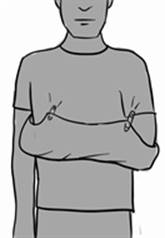
Slings are used to immobilize an arm injury, including a wrist or shoulder. They are often used together with a cast or splint on the arm.
Triangular Bandage Sling and Swath
A triangular bandage can be improvised from many different materials, but having one or two of them in your first aid kit will save some trouble. Also, a triangular bandage can be used in a variety of ways, e.g., to stop bleeding, tying something.
Drape the triangular bandage under one arm and over the opposite shoulder.
Tie the two ends of the cloth behind the neck.
Pin the remaining elbow corner up onto the body of the sling.
Use another bandage or similar to secure the arm to the chest.
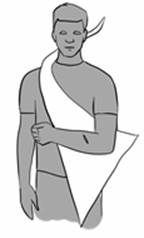
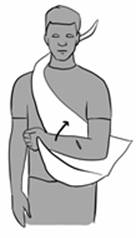

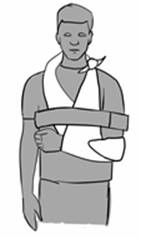
If wearing a long shirt, pin it to the chest.
If wearing a short-sleeved shirt, fold the bottom up over the injured arm and secure in place.
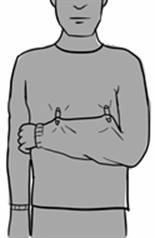
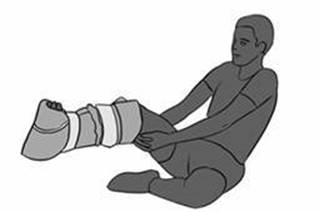
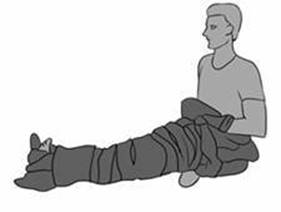
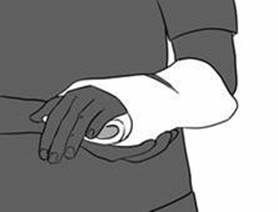
Splints are commonly improvised until a cast can be fitted. In the case of small fractures, splints may be the only thing used. Even in more serious injuries a splint can be used if a cast is not possible, and, as long as proper care is taken, the injury will heal just as well.
Commercial field splints are readily available (SAM Splints), but they can also be improvised with a great number of readily available materials e.g.:
Ø Body parts, e.g., adjacent digit (finger or toe), arm to chest, the patient’s other leg.
Ø Sticks or straight, stiff materials from equipment.
Ø Pliable materials, e.g., strips of cloth, parachute cord.
General Splinting Tips:
When constructing a splint, remember the following:
Adjustable (and adjust when needed).
Light weight.
Monitor CSM before and after splinting; Diagnoses and Treatments - Musculoskeletal System - Musculoskeletal Injuries in General - Circulation, Sensation and Movement.
Pad well.
Sandwich the limb.
Example splint pictures from left to right: ankle, leg, wrist.
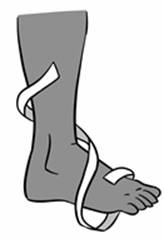
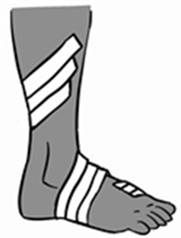
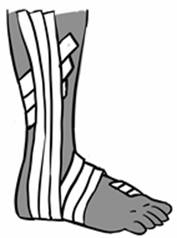
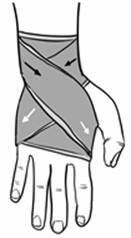
Taping is good for immobilizing whilst healing as well as preventing injuries, e.g., during sporting activities.
If taping around a whole body part (circumferential wrapping), e.g., for anchors, ensure swelling does not impair CSM, i.e., it is best to tape after swelling has gone down; Diagnoses and Treatments - Musculoskeletal System - Musculoskeletal Injuries in General - Circulation, Sensation and Movement.
General Taping Tips:
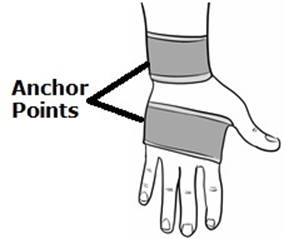
Anchor points are those to which tape can stick.
Avoid leaving gaps as they can lead to blisters.
Duct tape can be used in emergencies, but it does not ventilate.
Ensure your skin is dry.
Follow the contour of the skin.
Keep your limb in a neutral position.
Overlap a half-width on each strip.
A dislocation occurs when a bone is pulled out of the joint and is often a reoccurring injury. It can be caused either by a direct injury or an indirect injury:
Direct injuries: caused by forces generated from outside the body, e.g., getting hit or crashing into a blunt object.
Indirect injuries: caused by a force from within the body, e.g., injury from an abnormal twisting motion.
Bruising.
Pain and/or numbness.
Swelling.
Visibly abnormal.
Unusable.
The dislocation may correct itself. This is called subluxation and is treated with RICES; Diagnoses and Treatments - Musculoskeletal System - Musculoskeletal Injuries in General – RICES.
Dislocations that do not correct themselves require reduction and then stabilization; Diagnoses and Treatments - Musculoskeletal System – Immobilization.
Reductions are safe to use on dislocations caused by an indirect force if the dislocation is of the shoulder, patella or digits.
Everything else should be splinted in position unless there is no advanced medical care available in the foreseeable future.
Perform a reduction as soon as possible. Discontinue if pain significantly increases or physical resistance is encountered.
Use RICES after any successful reduction; Diagnoses and Treatments - Musculoskeletal System - Musculoskeletal Injuries in General – RICES.
Any reduction that doesn’t work after 3 attempts should be referred to advanced medical care.
Pharmaceuticals:
Anti-inflammatory.
Muscle Relaxers: cyclobenzaprine (flexeril).
Traction is a procedure in which you pull the dislocated bone away from the joint in order to give the bone room to slip back into place.
Hold the affected joint in a steady fashion.
Slowly pull the bone away from the joint.
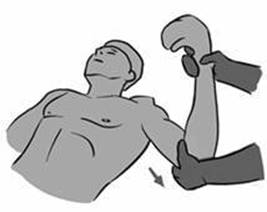
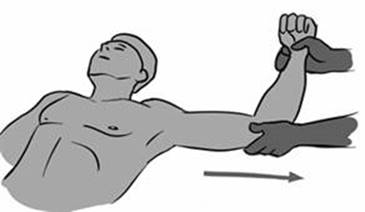
There are two ways in which a dislocated shoulder can be reduced.
Whichever one you choose, and whether or not the reduction is successful, sling and swathe the arm so the elbow is alongside the body; Diagnoses and Treatments – Musculoskeletal Injuries - Immobilization – Slings.
Pain and swelling are extremely likely.
Lay the patient on his/her back.
Sit next to the dislocated shoulder.
Apply traction to the shoulder.
Whilst keeping the elbow at a 90 degree angle, gradually rotate the arm until it is in a baseball-throwing position.
If successful, it will ‘pop’ back into place.
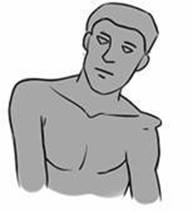
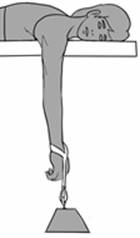
Lay the patient facedown with the affected arm hanging unsupported.
Weigh the persons hand with 3 to 5 kg until the shoulder is reduced.
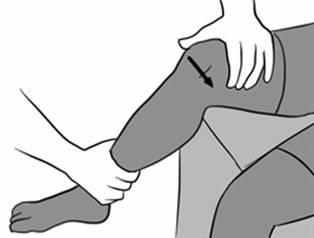
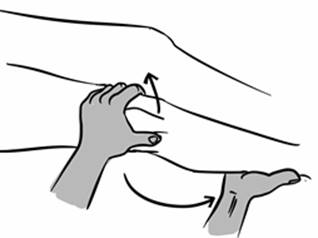
Gently straighten the patient’s knee.
If the patella does not spontaneously reduce, gently guide it into position (see pictures).
Splint the knee at about 10 degrees of flexion.
Stabilize the patella, e.g., tape, brace etc.
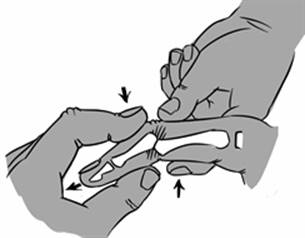
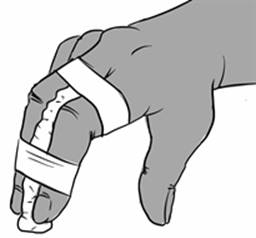
This includes fingers, thumbs and toes.
Hold the finger/toe still nearer the hand/foot.
Pull out and traction into place.
Splint in its correct anatomical position.
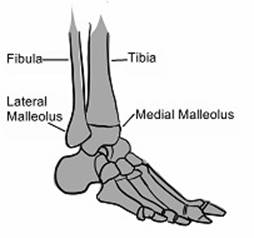
An ankle dislocation usually comes with a fracture of one or both malleoli, i.e., the bony part on each side of the ankle.
With the patient’s knee bent, grasp the heel and apply traction.
Align the foot with the tibia.
The patient keeps his/her elbow slightly flexed.
Apply counter traction to hold the upper arm in place, e.g., a second rescuer.
Apply traction of the lower arm out and down.
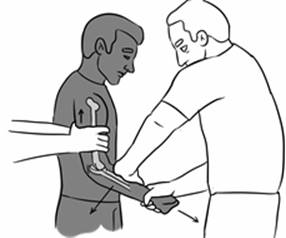
Apply counter traction to hold the arm in place.
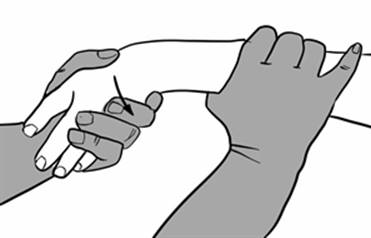
Grasp the fractured hand as if giving a handshake.
Pull out with significant force.
A downward movement may be needed.

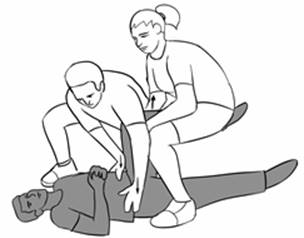
Place the patient on a flat, hard surface.
One rescuer stabilizes the pelvis by pushing down at/near the waist.
Bend the patient’s knee.
Pull up and on the leg and, if possible, out on the thigh.
A fracture occurs when a bone is broken, most commonly due to trauma. All fractures are unstable injuries. Once immobilized, most fractures will take 6 to 8 weeks to heal (rejoin). Large-bone and complicated injuries may take longer.
For the purpose of this book, there are two main types of fractures:
A closed fracture is when there is a break in the bone, but the skin is intact.
An open fracture is when the skin is broken.
A closed fracture can become an open fracture if not treated well.
Deep cut in the area of the injury (open fracture).
Grinding sensation.
Inability to use the bone, i.e., patient cannot put any weight on it.
Motion of the bone where there is no joint.
Severe pain, more so than a sprain; Diagnoses and Treatments - Musculoskeletal System - Sprains and Strains – Sprains.
Swelling and bruising, more so than a sprain.
In the case of your hand, a ‘fifth knuckle’.
Cut away clothing.
If it is an open fracture, gently irrigate and dress.
Check CSM; Diagnoses and Treatments - Musculoskeletal System - Musculoskeletal Injuries in General - Circulation, Sensation and Movement.
If CSM is compromised, reduction is needed; Diagnoses and Treatments - Musculoskeletal System - Dislocations – Reduction.
If CSM is okay, splint in place and seek advanced medical care.
If there is no advanced medical care and the bone is deformed, reduction is needed in order for the bone to heal properly.
Notes:
Reducing a fracture will be more painful and riskier than reducing a dislocation.
Damage to nerves and blood vessels may occur.
Fractured ribs usually occur along the side of the chest. Pushing on the sternum will produce pain at the site of the fracture.
Pain in the chest after blunt chest trauma.
Pain when breathing.
Treat flail chest if applicable (below), otherwise:
Do not tape the ribs.
Encourage deep breathing at least 10 times per hour.
Position of comfort.
Monitor and treat for pneumothorax (punctured lung) if needed; Diagnoses and Treatments - Musculoskeletal System – Pneumothorax.
Transport injured side down.
Flail chest occurs when a part of the rib cage breaks away from the chest wall, i.e., when three or more ribs are broken in two or more places, due to blunt trauma.
Extreme chest pain.
Impaired breathing.
Visual sign of the chest wall moving in and out when breathing.
Pad heavily, e.g., rolled up clothing (use hand pressure to keep it on).
Roll patient onto flail side, if possible.
Monitor for Pneumothorax; Diagnoses and Treatments – Musculoskeletal System – Pneumothorax.
Seek advanced medical treatment.
A fractured pelvis is extremely painful and can result in major blood loss.
Symptoms of a Fractured Pelvis
Bruising and pain around the pelvis.
Impaired CSM; Diagnoses and Treatments - Musculoskeletal System - Musculoskeletal Injuries in General - Circulation, Sensation and Movement.
Treatment for a Fractured Pelvis
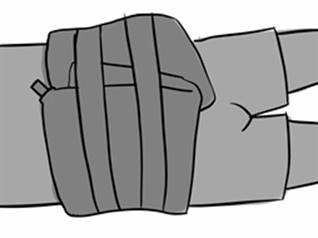
A pelvic sling can be improvised with such things as clothes, a sleeping bag, sleeping mat, tent etc.
The aim is to achieve circumferential binding.
Remove any object that may cause discomfort, e.g., belt, pocket items.
Slide the sling under the bony part of the hips and cross it over the front of the pelvis.
Apply so the pressure is focused over the greater trochanters of the femur (the part of the femur connecting to the hip bone).
Tighten enough for stabilization and comfort.
Sprains and strains are common sporting injuries.
A sprain is when a ligament (the fibrous tissue that connects one bone to another) is excessively stretched due to the forcing of a joint beyond its normal range of motion.
A twisted ankle is a common type of sprain.
Bruising.
Pain.
Swelling.
Most sprains will heal over time. Severe knee sprains may require surgery to heal completely.
RICES; Diagnoses and Treatments - Musculoskeletal System - Musculoskeletal Injuries in General – RICES.
Immobilize if unstable; Diagnoses and Treatments - Musculoskeletal System – Immobilization.
Pharmaceuticals:
Anti-inflammatory.
Strains are when the muscle or its tendon (tissue that connects the muscle to connect to bone) is partially torn. Back muscles are most commonly strained.
Daily morning stretches and using correct lifting techniques will help prevent strains.
Correct lifting techniques:
Don’t lift things whilst unbalanced.
Don’t reach for an object, i.e., hold it as close to your body as possible whilst lifting.
Don’t twist while lifting.
Lift with your legs and a straight back.
If carrying a pack, keep the weight of it on your hips as opposed to your shoulders.
Mild massage.
Pharmaceuticals:
Anti-inflammatory.
Muscle relaxer.
Alternative/Natural Remedies:
Clove oil compress.
Ginger and raw honey tea.
Salicin poultice.
Amputation is a last resort procedure to remove all or part of an extremity in an effort to save a life in the case of severe injuries.
When to amputate:
Cancerous tumors.
Extensive injury from trauma or burns.
Gangrene.
Serious infection that does not get better with antibiotics.
Severe frostbite.
Where to amputate:
At areas of reddened (infection) or blackened (gangrene) skin.
Where the bone has been crushed beyond repair.
Where the extremity is no longer sensitive to touch.
Where the extremity loses normal temperature.
Where the extremity loses pulse.
Note: the closer to the body that the amputation is performed, the more dangerous it is.
Amputation procedure:
Sedate the patient.
Use antiseptics on the damaged area.
Consider a tourniquet to prevent massive blood loss; Must Read - Immediate First Aid - Critical First Aid - Severe Bleeding – Tourniquet.
Amputate the limb and preserve enough living tissue to cover the exposed end of the bone.
Remove debris and bits of shattered bone.
Tie off any bleeding blood vessels.
Shorten and smooth the bone.
Stitch remaining muscle to the bone lining, if possible.
Before closing completely, place a drain.
Adequately close the wound with sutures or staples.
Change dressings regularly.
Back pain is a common occurrence and usually feels like an ache, tension or stiffness in your back. It can be caused from a variety of things, e.g., bad posture, incorrect lifting, punched nerve, unusual moment (bending or twisting) etc. Sometimes it occurs for no apparent reason, e.g., you just wake up with a bad back. People with excess weight (including pregnancy) are more at risk.
Back pain is not generally caused by a serious condition and in most cases it gets better within 12 weeks. It can usually be successfully treated by taking painkillers and keeping mobile.
Back pain will usually go away within 12 weeks.
Hot or cold compresses.
Unless incapacitated, continue with daily activities; excessive inactivity will make it worse.
Pharmaceuticals:
Muscle relaxers.
Alternative/Natural Remedies for a Back Ache:
Yoga
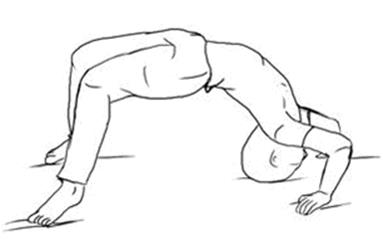
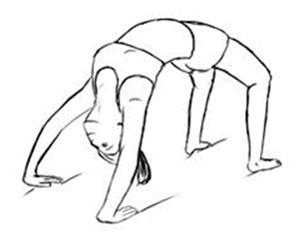
The bridge can be helpful with any type of back pain (as well as having a multitude of other benefits), but it’s particularly good for lower back pain, which is the most common type of back pain. It is also great for prevention.
Bridge
If you are on hard ground, use something to provide padding on your head, e.g., a folded towel.
Lie on your back with your arms parallel to your body. Bend your knees so your feet are flat on the floor. Keeping your head, neck, arms and shoulders on the floor, push with your legs and arch your back to lift your stomach to the sky.
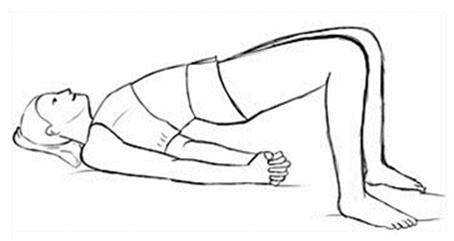
Next, place your hands flat on either side of your head.
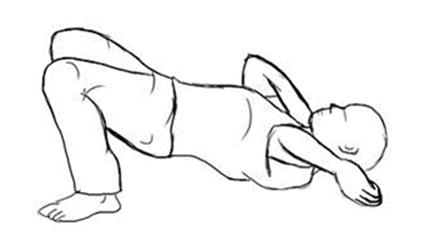
Place your feet on the ground and use them to push yourself into an arched back position.
Finally, push up on your hands to raise your head off the floor.
Yoga has an incredible number of health benefits. It is amazing for prevention. To learn more about yoga visit SurviveTravel.com/Yoga.
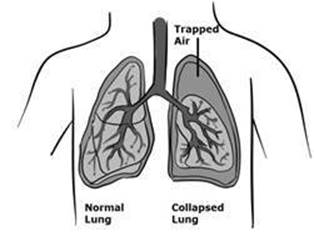
Pneumothorax is when a lung is punctured and becomes decompressed, usually from a rib fracture; Diagnoses and Treatments – Musculoskeletal System – Fractures – Fractured Ribs.
Crackly or no sound from lungs.
Cyanosis (bluish skin).
Pain with breathing.
Signs of shock; Diagnoses and Treatments - Circulatory System - Dehydration and Volume Shock.
Swollen neck veins.
Only treat if it becomes life threatening. This is definitely only for a last result do-or-die situation. Even if this operation is successful, the patient may not recover from the wound.
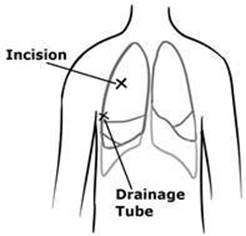
The aim of this is to create a way for the air to escape but not be able to go back in, i.e., a one way valve.
You need to make an incision between the nipple and the top of the shoulder, just above the third rib.
Ø Clean the site.
Ø Make the incision no wider than a pencil, just deep enough to hear the air pass through.
Ø Tape 3 sides of a plastic bag or similar (cling film) over the incision.
Ø Fluid will build up in the lung. Drain it with a tube.
Tetanus is an infection that targets the nerves serving muscle tissue. It can be caused from any break in the skin, but puncture wounds are particularly vulnerable, e.g., animal bite, rusty nail, splinter.
Tetanus can be deadly, but there are vaccinations available.
Initial:
Initial symptoms may not present themselves for up to 2 weeks:
Difficulty swallowing.
Involuntary muscle contraction.
Irritability.
Lockjaw.
Sore muscles (especially near the site of injury).
Weakness.
Progressive:
Fever.
High blood pressure.
Involuntary back arching.
Irregular heartbeat.
Muscle spasms.
Respiratory distress.
Dim lights.
Reduce noise.
Rehydration.
Pharmaceuticals:
Muscle relaxants: valium in severe cases.
Antibiotics: metronidazole, penicillin.