
424. A 57-year-old woman began having weakness and trouble walking 1 year ago. Current examination findings include weak, wasted muscles with spasticity, fasciculations, extensor plantar responses, and hyperreflexia. Which of the following is the most likely diagnosis?
a. Dorsal spinal root disease
b. Ventral spinal root disease
c. Arcuate fasciculus damage
d. Motor neuron disease
e. Purkinje cell damage
425. Which of the following is the most likely spinal cord pathology evident on this T1-weighted magnetic resonance image (MRI)?
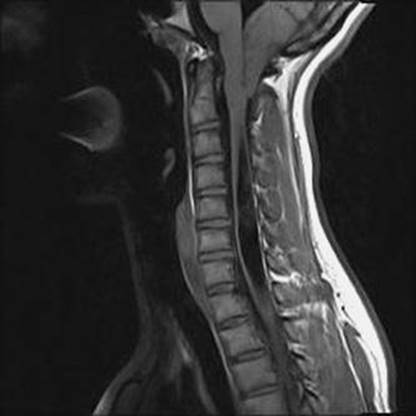
a. Neoplasia
b. Syrinx
c. Infarction
d. Hemorrhage
e. Abscess
426. A 35-year-old woman falls 12 feet from a ladder and fractures her c-spine, causing damage at the C4 level. She is initially a flaccid quadriplegic with areflexia. This areflexia and flaccidity usually evolve into hyper-reflexia and spasticity within which of the following time periods?
a. 2-to-4 months
b. 1-to-2 months
c. 3 days-to-3 weeks
d. 1-to-3 hours
e. 5-to-25 minutes
427. After biopsy resection of a lymph node in her neck, a 23-year-old woman notices instability of her shoulder. Neurological examination reveals winging of the scapula on the side of the surgery. During surgery, she probably suffered damage to which of the following?
a. Deltoid muscle
b. Long thoracic nerve
c. Serratus anterior muscle
d. Suprascapular nerve
e. Axillary nerve
428. A 25-year-old woman is involved in a motor vehicle accident. Among her injuries is a lumbar vertebral body fracture. Which of the following most likely contributed to this injury?
a. Flexion
b. Extension
c. Torsion
d. Spondylolisthesis
e. Subluxation
429. A 35-year-old man injured his thoracic spine in a motor vehicle accident 2 years ago. Initially he had a bilateral spastic paraparesis and urinary urgency, but this has improved. He still has pain and thermal sensation loss on part of his left body and proprioception loss in his right foot. There is still a paralysis of the right lower extremity as well. This patient most likely has which of the following spinal cord conditions?
a. Brown-Séquard (hemisection) syndrome
b. Complete transection
c. Posterior column syndrome
d. Syringomyelic syndrome
e. Tabetic syndrome
430. A 19-year-old man injured his cervical spine in a swimming pool diving accident. After an initial severe quadriparesis, there was a rapid recovery of much motor function over several weeks. Which of the following would you expect to find in this patient 12 months from now?
a. Fasciculations
b. Fibrillations
c. Flaccid paralysis
d. Hyporeflexia
e. Spastic paralysis
431. A 92-year-old woman with known cervical stenosis has poor balance. The examination finding of impaired joint proprioception is due to dysfunction of neurons which decussate at what level?
a. At the medulla
b. At the midbrain
c. At the pons
d. At the thalamus
e. Within one or two levels after entering the spinal cord
432. An 82-year-old woman with bilateral leg weakness has a greatly dilated abdominal aorta with a normal thoracic aorta. Which of the following is the most likely cause of this damage?
a. Syphilis
b. Trauma
c. Chronic hypertension
d. Diabetes mellitus
e. Atherosclerosis
433. A 61-year-old man, who smokes five packs of cigarettes per day and has hypertension, had an abdominal aortic aneurysm repair 8 hours ago. The surgery went very well, and there were no reported perioperative complications. Now the patient is unable to move his legs and states that they are “numb.” On examination, he has a flaccid paresis of both lower extremities and has impaired pinprick sensation to a T9 level bilaterally. Joint proprioception is normal. Which of the following is the most likely diagnosis in this case?
a. Cerebral stroke
b. Conversion disorder
c. Multiple sclerosis (MS)
d. Spinal cord compression
e. Spinal cord infarct
434. A 62-year-old man has been diagnosed with an abdominal aortic aneurysm. He is told that he is at high risk for aneurysm rupture, which would almost certainly kill him. Although a surgical procedure could dramatically reduce this risk, the operation itself has risks, including postoperative paraplegia. The arteria radicularis magna (artery of Adamkiewicz) enters at approximately what level?
a. C2 to C5
b. C5 to C8
c. T2 to T8
d. T10 to L1
e. L4 to S4
435. In a 56-year-old patient with a thoracic spinal cord hemisection, where would you expect the pain and temperature abnormalities to begin?
a. Exactly at the level of the lesion
b. Four or five segments above the lesion
c. Four or five segments below the lesion
d. One or two segments above the lesion
e. One or two segments below the lesion
436. The periumbilical area is innervated by which sensory dermatome?
a. C6
b. T2
c. T5
d. T10
e. S3
437. A 65-year-old man has had disrupted cerebrospinal fluid flow for several years, secondary to a thoracic disk herniation. This abnormal physiologic state has resulted in the formation of a cervical cystic lesion readily apparent on MRI. Examination of this patient might reveal which of the following abnormalities?
a. Third-nerve palsy
b. Calf atrophy
c. Charcot joints
d. Atrophy of the intrinsic hand muscles
e. Grasp reflexes
438. A 36-year-old man is being evaluated for left-hand weakness. On examination, it is readily apparent that he has atrophy of the first dorsal interosseous muscle. This may indicate damage to which of the following spinal roots?
a. C5 and C6
b. C6 and C7
c. C7 and C8
d. C8 and T1
e. T1 and T2
439. A 39-year-old woman was involved in a head-on collision at approximately 40 miles per hour. She was wearing her seat belt, but still sustained a cervical cord injury from hyperflexion and extension. A cervical syrinx is most likely to evolve in this patient if there has been which of the following?
a. Intraspinal hyperthermia
b. Intraspinal hypothermia
c. Intraspinal transient ischemia
d. Intraspinal contusion
e. Intraspinal demyelination
440. A 19-year-old man goes swimming in an inland pond in Puerto Rico. Within a few days, he notices itching of his skin over several surfaces of his body. He is unconcerned until several weeks later when he develops lancinating pains extending down his legs and all of his toes. Over the course of just a few days, he develops paraparesis and problems with bladder and bowel control. Within 1 week, he is unable to stand and has severe urinary retention. Which of the following is the most appropriate plan of action on an emergency basis?
a. Initiate anticoagulation
b. Perform sensory-evoked potential testing
c. Order an MRI scan
d. Place a cervical collar
e. Perform spinal angiography
441. A myelogram is performed on a patient with a subacute, worsening paraparesis. The cerebrospinal fluid (CSF) and myelogram are both unremarkable except for a slight increase in the CSF protein content. A computed tomography (CT) scan of the spine is unrevealing. Plain films of the spine are completely normal. An MRI of the lumbar cord with gadolinium reveals patchy enhancement at about the L4-5 spinal cord level. Based on this information, which of the following is the most likely diagnosis?
a. An intraspinal hemorrhage
b. An extraparenchymal meningioma
c. An intraparenchymal ependymoma
d. A transverse myelitis
e. A syringomyelia
442. A 26-year-old recent immigrant from Brazil presents to the hospital with a subacute, worsening paraparesis. The patient had worked in the lumbar industry deep in the Amazon jungle. MRI of the spinal cord is abnormal, and a biopsy reveals widespread granulomas. In the midst of one granuloma is an ovoid mass with a spine extending from one side. The pathologist interprets this as a parasitic ovum. If the pathologist is correct, which of the following is the most likely cause of the lesion?
a. Taenia solium
b. Entamoeba histolytica
c. Schistosoma mansoni
d. Schistosoma japonicum
e. Treponema pallidum
443. A 72-year-old man describes pain about the waist at the level of the umbilicus. The pain is often burning and occasionally shooting. It does not extend down his legs, but he has noticed some weakness in his legs at the time of the pain. With exertion, such as walking, he develops pain in his legs and a tingling sensation in his feet. He has been taking aspirin for the discomfort, but has noticed no substantial change in the sensation. X-rays of his spine reveal no abnormalities. Pain and weakness have become increasingly frequent over the course of several months. Because the man has had urinary hesitancy and frequency in association with an enlarged prostate, he is advised to have a transurethral prostatectomy. A general anesthetic is given for the surgery. On recovering consciousness postoperatively, the man cannot move his legs and has persistent pain at the level of the umbilicus. His plantar responses are bilaterally extensor. Which of the following is the most appropriate emergency evaluation for this patient?
a. Voiding cystometrogram
b. Electroencephalogram (EEG)
c. Somatosensory evoked potentials (SSEPs)
d. Aortogram
e. Penile-brachial index (PBI)
444. A 55-year-old man with hypertension and diabetes has a pure motor hemiparesis caused by a right thalamic stroke. The fiber tract affected by this syndrome decussates at what level?
a. At the junction of the medulla and the spinal cord
b. At the junction of the midbrain and the medulla
c. At the junction of the pons and the medulla
d. At the thalamus
e. Within one or two levels after entering the spinal cord
445. Physical examination of a patient who has had a spinal cord infarct reveals preservation of some sensation in the feet. Which of the following would be the most intact modality?
a. Joint proprioception
b. Pain
c. Temperature
d. Two-point discrimination
e. Graphesthesia
446. A 67-year-old man who has smoked heavily for 45 years describes that with exertion, such as walking, he develops pain in his legs and a tingling sensation in his feet. X-rays of his spine reveal no abnormalities. Pain and weakness have become increasingly frequent over the course of several months. The pain and weakness described by the patient with exertion is probably a manifestation of which of the following?
a. Myotonia
b. Myokymia
c. Spinal claudication
d. Spondylolisthesis
e. Spondylolysis
447. A 67-year-old diabetic man underwent repair of an abdominal aortic dissection. The procedure seemed to go well; however, the patient awoke with an upper motor neuron pattern of weakness in both of his lower extremities. Sensation for light touch and joint proprioception were relatively preserved. The CSF analysis associated with this patient’s condition is which of the following?
a. An increase in the CSF gamma globulin content
b. A depressed CSF glucose content
c. A protein content of greater than 45 mg/dL
d. More than 100 white blood cells (WBCs) per μL
e. More than 100 red blood cells (RBCs) per μL
448. A patient with a spastic paraparesis has an obvious aortic aneurysm discovered on aortography. The vascular surgeon consulting on the case recommends a bypass procedure. Preoperatively, the patient showed substantial recovery of leg strength and sensation, despite the persistence of bilateral Babinski (plantar extensor) signs. The patient undergoes the surgery and is paraplegic postoperatively with dense loss of sensation of pain and temperature below the level of T10. A follow-up aortogram would be expected to reveal which of the following?
a. Complete occlusion of the bypass graft
b. Complete occlusion of the hypogastric artery
c. Complete occlusion of the aorta below the tenth thoracic vertebra
d. No flow through the artery of Adamkiewicz
e. No flow through the external iliac artery