
The International Association for the Study of Pain defines chronic pain as pain that is present for 3 months beyond the inciting event. Persistent pain is a serious health problem because it dramatically impacts the economic, physical, and bio-psychosocial well-being of society. This chapter presents an overview of the classification and treatment of chronic pain states.
I. TYPES OF CHRONIC PAIN
The sensation of pain can be broadly classified into “neuropathic, musculoskeletal, and psychological.”
A. Neuropathic pain is described as “electric, burning, or shock-like.” Sources of neuropathic pain can be metabolic, nutritional, infectious, genetic, autoimmune, and vasculitic in nature. These problems can lead to muscle cramps, numbness, and weakness of an affected extremity, causing mononeuropathy or polyneuropathy.
B. Musculoskeletal pain is described as “aching” (superficial or deep). Discomfort is associated with muscle spasms and a decreased range of motion. If persistent, pain may lead to disuse atrophy and contractures. Causes include myofascial pain, fibromyalgia, posttraumatic/iatrogenic, myopathy, metabolic bone/muscle disease, and/or intervertebral disc disease.
C. Psychological pain may present as any of the above. Patients may also describe difficulty sleeping, diminished physical, mental, and social functions. Treatment involves addressing the problem with the patient and acknowledging that depression and anxiety may be part of chronic pain, which requires treatment. Primary psychological derangement or a secondary underlying cause of chronic pain may be the problem.
II. MANAGEMENT OF CHRONIC PAIN
Treatment for chronic pain may involve pharmacologic therapy, interventional options, and biofeedback.
A. Medications.
1. Nonsteroidal anti-inflammatory drugs (NSAIDs). These agents lead to analgesia via central and peripheral mechanisms. They function through the inhibition of the arachidonic acid cascade, which leads to decreased production of prostaglandins. Patients may have varying responses to different agents in this class. These agents can be classified based on their action against cyclooxygenase I/II activity (COX). COX I/II nonselective agents include ibuprofen, naproxen, and piroxicam. Celecoxib is currently the only COX II selective agent available in the United States. parecoxib, an intravenous COX II selective agent, is not currently available in the United States. Common side effects of NSAIDs include renal dysfunction, gastrointestinal (GI) bleeding, and ulcer formation. The antiplatelet effects are not seen with celecoxib and other COX II selective agents.
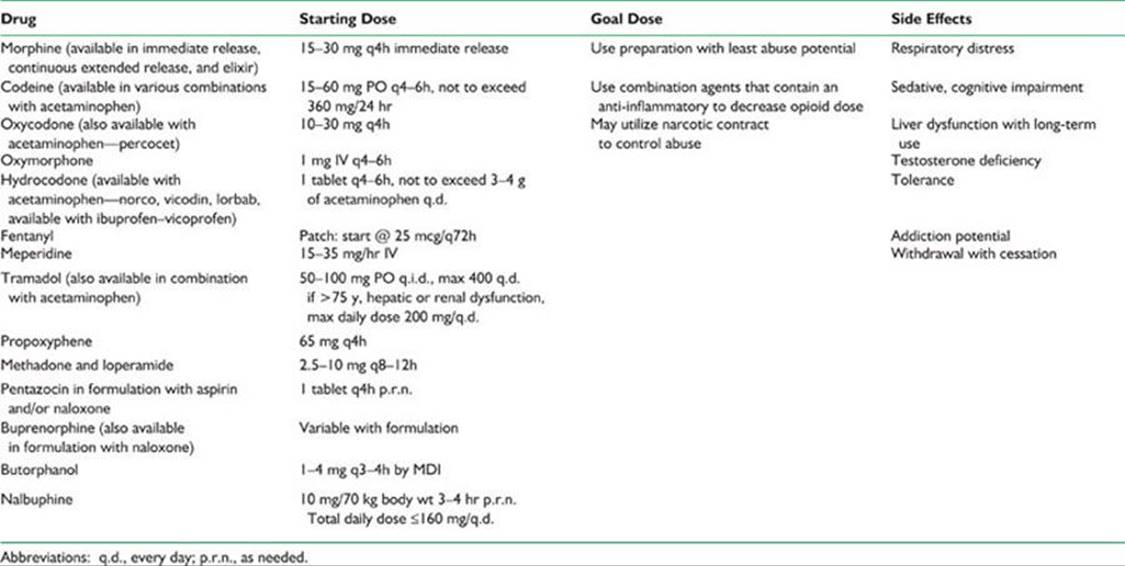
2. Opioids. These drugs are either naturally occurring alkaloids or are synthetically produced. They function, to varying degrees, at opioid receptors in the CNS and periphery. These agents are classified based on chemical structure. Opium plant derivatives (phenanthrenes) include morphine and codeine. Agents that are synthetically derived from the phenanthrenes (semi-synthetic) are hydrocodone, oxymorphone, and oxycodone. Synthetic agents not derived from the phenanthrenes include the aniliodopiperidines, fentanyl (transdermal, buccal, and sublingual), sufentanil, and remifentanil. The phenylpiperidines are meperidine and tramadol; phenylpropylamines include propoxyphene, methadone, and loperamide. Pentazocine is a benzomorphane, oripavine (buprenorphine), and morphinan drugs include butorphanol and nalbuphine. Buprenorphine is an opioid receptor agonist/antagonist that has also been used in pain management (Table 50.1).
Clinicians should utilize preparations with the least abuse potential and side effects. Agents that contain an anti-inflammatory/acetaminophen, to decrease the dose of opioid required for analgesia, should be considered first-line drugs. Common side effects of opioids include respiratory depression, sedation, cognitive impairment, liver dysfunction, and testosterone deficiency in men both with long-term use. Tolerance, addiction potential, and withdrawal from sudden cessation are also common.
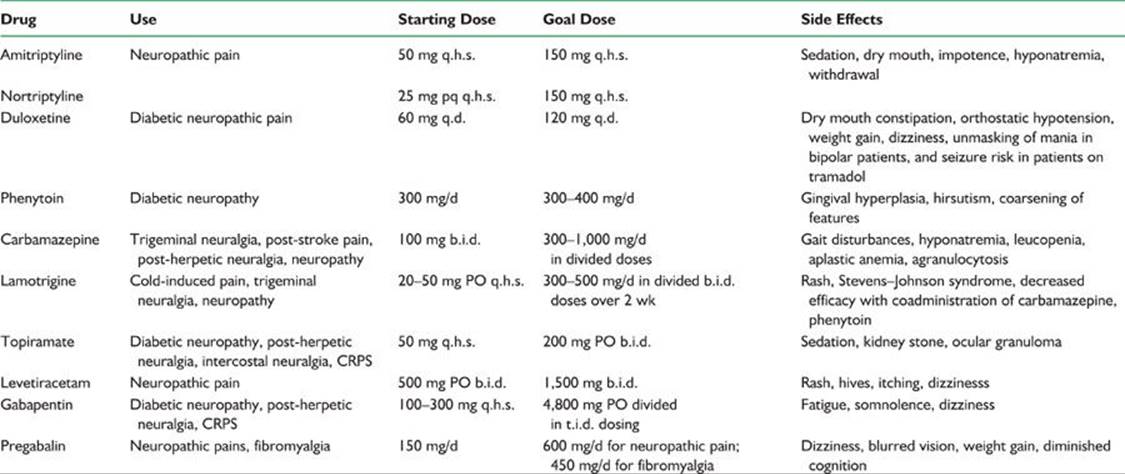
3. Antidepressants. Antidepressants are also utilized in chronic pain management. These agents act via mechanisms that include a direct antidepressant effect, a decrease in synaptic transmission, and the enhancement of the action of endogenous opioids (Table 50.2). They are classified based on their mechanism of action. Tricyclic antidepressants include amitriptyline and nortriptyline. Common side effects of these agents include dry mouth, sedation, sexual dysfunction, hyponatremia, and the risk of withdrawal if discontinued. Selective serotonin reuptake inhibitors (SSRI) are another class of antidepressant and include fluoxetine and duloxitene. Duloxetine is a dopamine, serotonin, and norepinephrine reuptake inhibitor. This drug is used for diabetic neuropathy and is contraindicated in patients with concomitant monoamine oxidase inhibitor therapy, hypersensitivity, and narrow angle glaucoma. Common side effects of SSRI agents include dry mouth, constipation, orthostatic hypotension, weight gain, dizziness, unmasking of mania in bipolar patients, and risk of seizures in patients receiving tramadol. Other agents in this class include buproprion, trazadone, and venlafaxine. Clinicians should be aware that lower doses of antidepressants are usually used for analgesia.
4. Anticonvulsants. Anticonvulsants are also used in the treatment of chronic painful conditions. Many agents in this category have a common historical use for the prevention and suppression of seizure disorders. These drugs act via different mechanisms including increasing inhibitory neurotransmitters, decreasing excitatory transmitters, and blocking ion channels. These agents are most effective for neuropathic pain, although medications of the other classes may be utilized (Table 50.2).
Phenytoin is used to treat diabetic neuropathy. Treatment is initiated at 300 mg per day, with increased dosage as needed. Side effects include gingival hyperplasia, hirsutism, acne, and coarsening of features. This agent activates the P-450 enzyme system in the liver, resulting in a decreased efficacy of mexiletine, haloperidol, and carbamazepine. Co-administration with antidepressants may lead to increased blood levels of phenytoin.
Carbamazepine is used for trigeminal neuralgia (tic douloureux), post-stroke pain, post-herpetic neuralgia, and diabetic neuropathy. The drug is believed to act via central and peripheral mechanisms, selectively targeting actively firing C and A delta fibers. Treatment is started at 100 mg twice a day and titrated to effect. The typical dose range is 300 to 1,000 mg per day in divided doses. Side effects include gait alterations, hyponatremia, leukopenia, aplastic anemia, and agranulocytosis. As a result of these potential hematologic alterations, blood tests are recommended every 2 to 4 months. Oxcarbazepine is an analogue of carbamazepine less likely to cause CNS/blood alterations. Side effects include hyponatremia (sodium of <125 mmol per L), sedation, and dizziness.
Lamotrigine prevents the release of glutamate in addition to blocking active sodium channels. This agent is used for cold-induced discomfort, trigeminal neuralgia, diabetic, and HIV neuropathy. The starting dose is 20 to 50 mg at bedtime, slowly increased to 300 to 500 mg per day in twice daily divided doses (over 2 weeks). A rash, the most common side effect, is commonly seen in pediatric patients, patients receiving valproic acid, and in patients receiving rapid titration of lamictal. The rash may also lead to Stevens–Johnson syndrome. Clinicians should note a decreased efficacy of lamotrigine with concomitant administration of carbamazepine and phenytoin.
Topiramate acts at both sodium and calcium channels, enhancing the action of gamma-aminobutyric acid (GABA), and inhibiting AMPA receptors. The agent is used in diabetic neuropathy, post-herpetic and intercostal neuralgia, and complex regional pain syndrome (CRPS) (see Chapter 51). Dosing is begun at 50 mg at bedtime, increasing to 200 mg twice daily. Side effects include sedation, development of kidney stones, and ocular granuloma due to the inhibition of carbonic anhydrase.
TABLE 50.1 Narcotics
A final channel blocking agent, levetiracetam is started at 500 mg PO twice daily and adjusted to a target of 1,500 mg twice a day. Side effects include rash, hives, itching, and dizziness.
5. Local anesthetics. Lidocaine is available in salve and patch (5%) forms. It is used for post-herpetic neuralgia, post-thoracotomy pain, intercostal neuralgia, and fibromyalgia. The drug is started at 1 to 5 mg per kg intravenously. The patch is used 12 hours per day and may be cut to size and shape. Side effects of lidocaine include bradycardia, dizziness (at plasma level of 10 mg per ml), cardiac depression (at 20 to 25 mg per ml plasma level), blurred vision, and seizures. Mexiletine, an oral analogue of lidocaine, is used for post-stroke pain, myotonia, spasticity, and diabetic neuropathy. Treatment is initiated at 150 mg per day up to a goal of 300 to 450 mg per day. The side effect profile is similar to lidocaine.
6. Calcium channel blockers. Gabapentin is a membrane stabilizer which binds at the alpha-2 delta subunit of the L-calcium channel (Table 50.2). Gabapentin is used for many neuropathic pain states including diabetic neuropathy, post-herpetic neuralgia, and complex regional pain syndrome (CRPS). Treatment is started at 100 to 300 mg at bedtime, increasing to 4,800 mg per day divided in three doses. Common side effects include fatigue, somnolence, and dizziness.
Pregabalin also binds to the alpha-2-delta subunit at voltage-dependent calcium channels. This agent is used for neuropathic pain states and for fibromyalgia. The starting dose of pregabalin is 150 mg per day titrated to 600 mg per day for neuropathic pain states; for fibromyalgia, the maximum daily dose is 450 mg per day. Side effects include dizziness, blurred vision, weight gain, and diminished cognition.
Zonisamide acts at T-calcium and sodium channels. This drug increases GABA release. Zonisamide is started at 100 mg daily and increased after 2 weeks by 200 mg per week for a goal of 600 mg per day. Common side effects include ataxia, rash, kidney stones (carbonic anhydrase inhibitor), oligohydramnios, and pediatric hyperthermia.
υ-Conopeptides (ziconotide) acts on N-type calcium channels. Used intrathecally at 0.3 to 1 ng/kg/hour. The drug has been studied in cancer and HIV populations. Side effects include sedation, tremor, hypotension, and histaminergic reaction. Nimodipine, diltiazem, verapamil, and nifedipine are agents typically used for blood pressure control but may also have a role with other agents in pain management.
7. Gabaergic agents. Baclofen is a derivative of GABA with activity at GABA-b channels. It has both spinal and supraspinal activity (Table 50.2). This drug is used for spinal cord injury and spasticity. Initial therapy begins at 5 mg three times a day with titration to a daily dose of 80 to 100 mg. Baclofen may also be given intrathecally. Common side effects include confusion, ataxia, and hallucinations. Sudden cessation of therapy may lead to a withdrawal, which may be life-threatening.
Tiagabine acts as a GABA reuptake inhibitor. The drug is started at 4 mg daily and increased by 4 to 8 mg per day to a final goal of 12 to 22 mg per day for patients not on antiepileptic drugs (AED), or 32 to 52 mg per day for patients on AEDs. Common side effects include risk of seizures in patients without a history of seizure disorder, aphasia, and sedation.
Diazepam is a benzodiazepine and muscle relaxant that enhances the inhibitory action of GABA-A receptors especially in patients with spinal cord disease and muscle spasms. Diazepam is usually started at 2 mg twice daily to a total dose of 20 to 30 mg per day. Side effects include sedation and dependence. A withdrawal or sudden cessation may lead to seizures and death.
8. Muscle relaxants. Tizanidine is a centrally active alpha-2 adrenergic agonist used for spasticity, spinal cord injury, and post-stroke pain (Table 50.2). Dosing starts at 4 mg per day and is increased by 4 to 6 mg per week to a total of 36 mg per day. Side effects include headache, digestive changes, and dry mouth. Clinicians should exercise caution with concomitant use of other alpha-2 agonists because of the risk of hypotension. Cyclobenzaprine is a muscle relaxant that primarily acts at the brainstem, although it is not effective for centrally mediated spastic states. The dose is 30 to 40 mg per day and side effects include sedation and dry mouth.
TABLE 50.2 Non-Narcotics
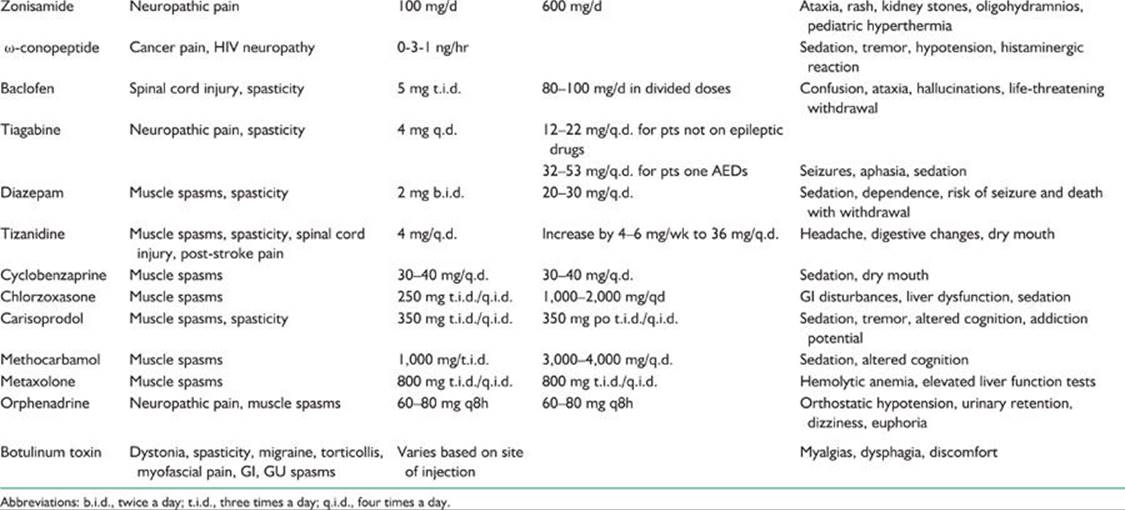
Chlorzoxazone is centrally acting with a target dose of 1,000 to 2,000 mg per day. Side effects include GI disturbances, sedation, and liver dysfunction. Carisoprodol is a muscle relaxant that acts centrally at the reticular activating system and the spinal cord. The treatment goal is 350 mg three to four times a day. Side effects include sedation, tremor, altered cognition, and possible addiction potential. Methocarbamol is used at 3,000 to 4,000 mg per day. Metaxolone is dosed at 800 mg three to four times a day. This drug may lead to hemolytic anemia and elevated liver function tests.
Orphenadrine is an NMDA receptor antagonist with anticholinergic effects. It acts via central and peripheral mechanisms. This drug is used for neuropathic pain and muscle spasms. It potentiates the analgesic effects of opioids. Orphenadrine is started at 60 to 80 mg every 8 hours. Side effects include orthostatic hypotension, urinary retention, dizziness, and euphoria.
Botulinum toxin is a muscle relaxant that acts at the neuromuscular junction and inhibits the release of acetylcholine presynaptically. Its effect lasts for approximately 3 months. This agent is used for dystonia (writer’s cramp and musician’s cramp), spasticity, migraine headaches, hyperhidrosis, myofascial pain, GI and genitourinary (GU) spasm. It should not be used in patients with neuromuscular junction/motor neuron dysfunction such as in myasthenia gravis, Lambert–Eaton myasthenic syndrome, and amyotrophic lateral sclerosis. Side effects include myalgia, dysphagia, and local discomfort. The amount of agent injected is tailored to the site of injection, degree of spasm and the musculature being injected.
9. Other agents. Clonidine is an alpha-2 agonist that potentiates the analgesic action of opioids. It is useful for neuropathic pain. A transdermal patch is started at a dose of 0.1 mg per day and changed every 7 days. Side effects include sedation, dry mouth, and orthostatic hypotension. Capsaicin, an extract of chili pepper, is thought to cause analgesia by depletion of substance P. Clinicians should note that application may lead to discomfort and irritation prior to analgesia.
B. Nonpharmacologic treatments.
1. Physical therapy and occupational therapy. The use of heat, ultrasound, electrical stimulation, and deep tissue massage may reduce the discomfort associated with chronic pain states. The mainstay of treatment for certain conditions, including CRPS, is range of motion and physical therapy. Prevention of contracture is important in maintaining function and decreasing discomfort.
2. Electrical stimulation involves the use of either transcutaneous electrical nerve stimulation, spinal cord (dorsal column), or thalamic stimulators, which can modulate pain. Patients with neuropathic pain states, muscular pain, central pain, and axial low back pain may benefit from these therapies. The classical “gate control” theory postulates that stimulation of large fiber (a beta) neurons closes the gate that has been opened or initiated by the smaller diameter nociceptors. Contraindications for these therapies include pregnancy and the presence of a pacemaker.
3. Psychological treatment is an important component of the patient’s overall chronic pain treatment plan. A support network for the patient, involving family and friends, may be conducive to the healing process. Additionally, the use of biofeedback along with adjunctive physical therapy may help a patient with their discomfort.
Finally, the ultimate goal in the management of a patient with chronic pain is the precise diagnosis with appropriate treatment for the painful condition. Referral to an interventional pain physician may benefit the patient after conservative therapy has failed. Disease processes difficult to treat, such as CPRS, diabetic neuropathy, and peripheral neuropathies, may be addressed with a specialist versed in providing interventional modalities along with pharmacotherapy. Physical therapy is also vital to the patient’s treatment in decreasing discomfort. As the primary care provider, it is crucial to have honest communication with the patient about treatment goals, expectations, and the possibility of achieving those expectations.

Recommended Readings
Benzon H, Raja S, Molloy R, et al., eds. Essentials of Pain Medicine and Regional Anesthesia. 2nd ed. Philadelphia, PA: Elsevier; 2005.
Dickenson AH, Ghandehari J. Anticonvulsants and antidepressants. Handb Exp Pharmacol. 2007;177:145–177.
Ettinger AB, Argoff CE. Use of antiepileptic drugs for nonepileptic conditions: psychiatric disorders and chronic pain. Neurother. 2007;4:75–83.
Loeser JD, Chapman CR, Fordyce WE, eds. The Management of Pain. 2nd ed. Philadelphia, PA: Lea & Feibiger; 1990.
McMahon SB, Koltzenburg M, eds. Wall and Melzack’s Textbook of Pain. 5th ed. Philadelphia, PA: Elsevier/Churchill Livingstone; 2005.
Nikolaus T, Zeyfang A. Pharmacological treatments for persistent non-malignant pain in older persons. Drugs Aging. 2004;21:19–41.
Sullivan MD, Robinson JP. Antidepressant and anticonvulsant medications in chronic pain. Phys Med Rehabil Clin N Am. 2006;17:381–400.
Wallace JM. Update on the pharmacotherapy guidelines for treatment of neuropathic pain. Curr Pain Headache Rep. 2007;11:208–214.