
Patrick J. Mansky and Lee J. Helman
EPIDEMIOLOGY
■Malignancies of the soft tissue (6.1%) and bones (4.7%) account for more than 10% of newly diagnosed cancers in children, adolescents, and young adults.
■Median age at diagnosis of rhabdomyosarcoma (RMS) is 5 years, with a male preponderance.
■Osteosarcomas account for approximately 60% of malignant bone tumors in the first two decades of life.
■Most of the remaining bone malignancies in children and adolescents are Ewing sarcomas and the histologically similar and genetically identical peripheral primitive neuroectodermal tumors (PNETs). Together, these tumors are often called the Ewing family of tumors (EFT).
■Identification of specific, recurrent genetic alterations in RMS and Ewing sarcoma has improved diagnosis by clarifying pathogenesis. Better supportive care and systematic application of effective multimodality treatment have dramatically improved survival during the last 30 years (Table 21.1).
RHABDOMYOSARCOMA
Clinical Presentation
RMS, which can occur in almost any anatomic site, is associated with development of a mass, along with signs and symptoms typically related to the anatomic location (Fig. 21.1):
■Orbit: proptosis
■Nasopharynx: nasal discharge and obstruction
■Basal skull and posterior orbit: cranial nerve palsies and visual loss
■Parameninges: headache and meningism
■Vagina or uterus: vaginal polyp/discharge
■Bladder or prostate: urinary obstruction
■Male genitals: paratesticular scrotal mass
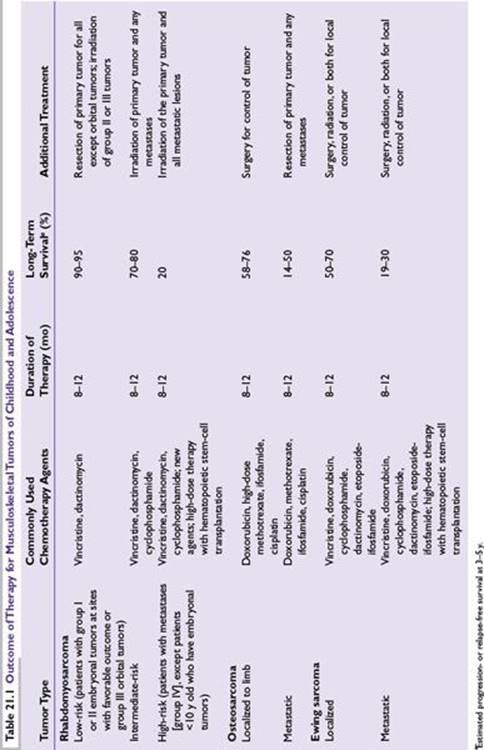
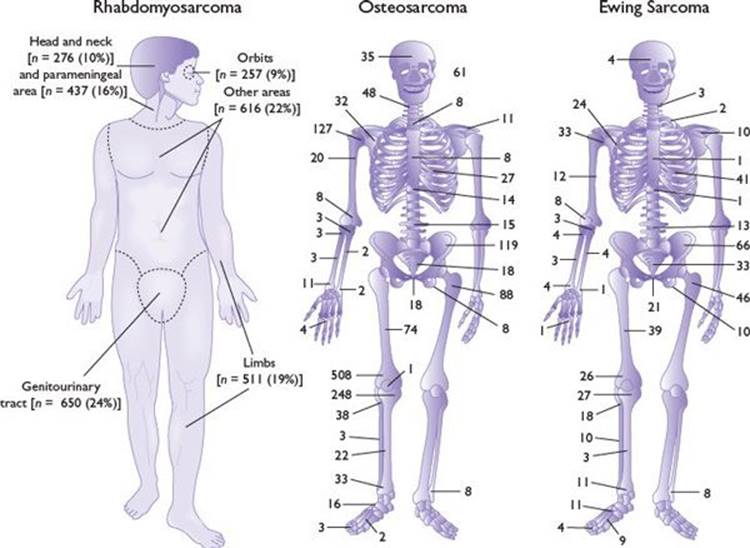
FIGURE 21.1 Primary sites of rhabdomyosarcoma, osteosarcoma, and Ewing sarcoma, showing numbers of patients with primary tumors at specific sites.
Pathophysiology
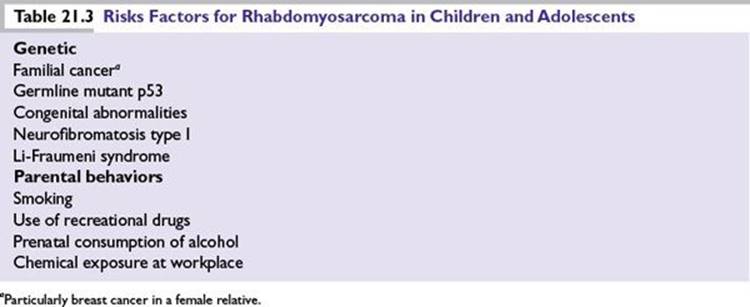
RMS is of mesenchymal origin and is characterized by myogenic differentiation. There are two main histologic subtypes, embryonal (80%) and alveolar (15% to 20%), with characteristic genetic differences (Table 21.2 and Fig. 21.2. Botryoid RMS and spindle cell sarcoma are both morphologic variants of embryonal RMS. Numerous environmental and genetic factors have been associated with an increased risk of RMS (Table 21.3).
Diagnosis
Radiologic
Comprehensive radiologic evaluation includes the following:
■Tumor localization
•Computerized tomography (CT) and magnetic resonance imaging (MRI)
•Positron emission tomography (PET)
■Assessment of metastatic spread
•CT of chest/lungs
•Technetium bone scan for bone or bone marrow involvement
•PET
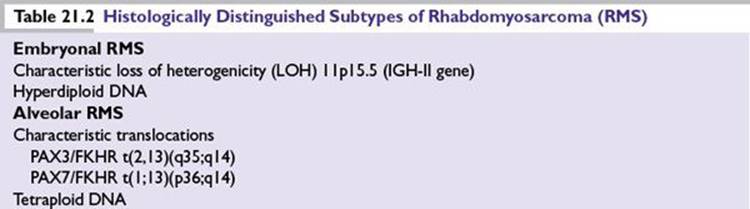
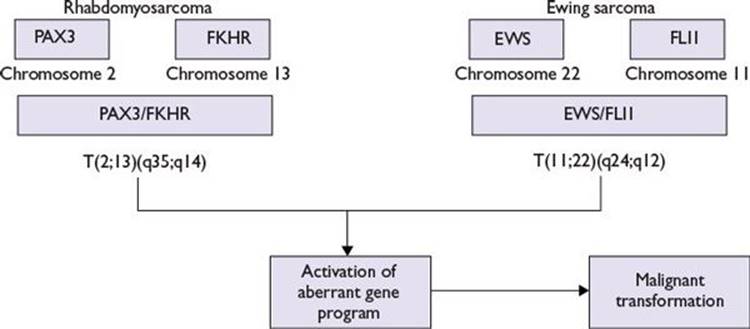
FIGURE 21.2 Molecular pathogenetic mechanisms in rhabdomyosarcoma and Ewing sarcoma.
Pathologic
Open biopsy is the preferred approach for tissue diagnosis and should be undertaken at an oncology center, where diagnostic material can be optimally used and the initial surgical approach can be determined by a multidisciplinary team responsible for the patient’s subsequent treatment. Needle biopsy may restrict access to fresh and frozen tissue for cytogenetic and molecular genetic investigations.
1.Tumor characterization
•Histopathology
•Immunohistochemistry (desmin and myoD1)
•Genetics
•RT-PCR for presence of PAX/FKHR translocation
•Cytogenetics
2.Metastatic spread
•Cerebrospinal fluid PCR for PAX/FKHR translocation
•Bone marrow aspirate cytology
•Bone marrow biopsy for histochemistry and PCR
Treatment
The diversity of primary sites, distinctive surgical approaches and radiotherapies for each primary site, subsequent site-specific rehabilitation, and potential treatment-related sequelae (Table 21.4) underscore the importance of treating children and young adults with RMS in the context of a clinical trial at a major medical center that has appropriate experience in all therapeutic modalities.
Surgery
Local tumor control is the cornerstone of therapy, especially for patients with nonmetastatic disease. Primary tumor resection should be undertaken only if there is no evidence of lymph node or metastatic disease and if the tumor can be excised with good margins without functional impairment or mutilation. Surgery has minimal, if any, role in the primary management of orbital tumors and a limited role in local control of head and neck tumors. To achieve local control of pelvic tumors in very young children, the risks of radical surgery may be more acceptable than those of pelvic irradiation.
Radiotherapy
Radiotherapy after initial surgical resection or chemotherapy is recommended in the following instances:
■Completely resected tumor (clinical group I) with unfavorable histology (alveolar RMS)
■Microscopic residual disease (clinical group II: up to 4,100 cGy)
■Gross residual disease (clinical group III: up to 5,040 cGy)
Treatment Volume
■Volume is determined by extent of disease at diagnosis
■Radiation field should extend 2 cm beyond the tumor margin
■Whole-brain irradiation of 2,340 to 3,060 cGy for parameningeal disease with intracranial extension
Chemotherapy
Neoadjuvant combination, multiagent chemotherapy for extensive, primarily unresectable tumors is known to reduce the extent of subsequent surgery or radiotherapy. (Fig. 21.3 outlines this multidisciplinary approach for RMS.)
OSTEOSARCOMA
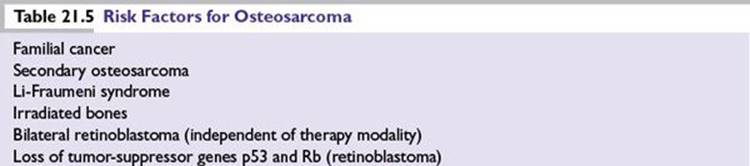
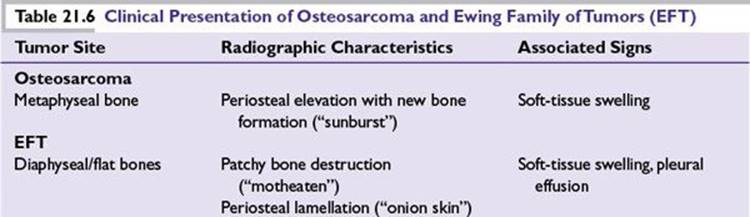
Osteosarcoma is a primary bone malignancy with peak incidence in the pubescent growth spurt (15 to 19 years) in the metaphyses of the most rapidly growing bones. Risk factors are listed in Table 21.5 and clinical presentation in Table 21.6.
Clinical Presentation
■Bone pain
■Swelling
■Mass in metaphyseal area of bone, most commonly femur or tibia
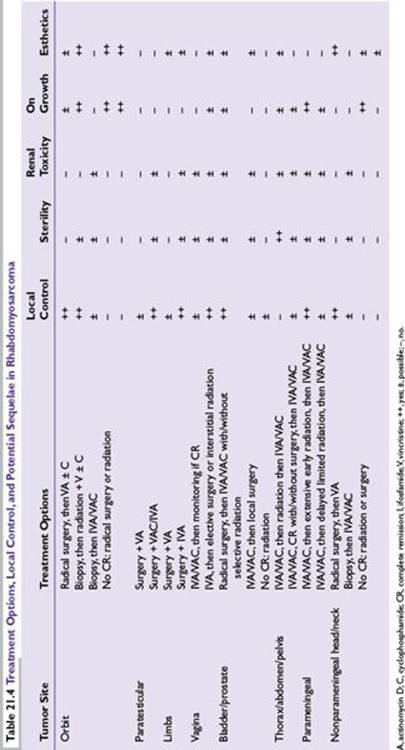
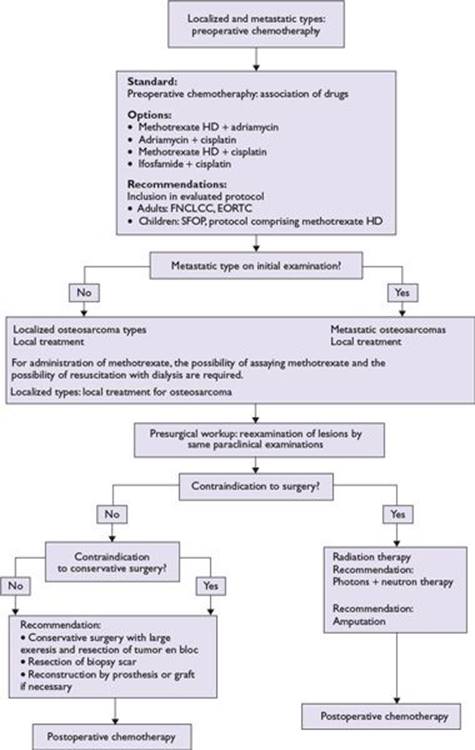
FIGURE 21.3 Treatment options for osteosarcoma.
Diagnosis and Staging
Radiologic
■Tumor assessment: plain radiographs
•Destruction of bone with consequent loss of normal trabeculae and appearance of radiolucent areas
•New bone formation
•Lytic or sclerotic appearance
•“Sunburst sign”: periosteal elevation from tumor penetrating cortical bone
■Extent of disease
•MRI (T1-weighted) to assess primary tumor boundaries in entire long bone, including skip lesions
•Technetium bone scan
•PET
■Metastatic spread (15% to 20%)
•Technetium bone scan
•CT of chest/lungs
•PET
Pathologic/Genetic
■Histologic diagnosis depends on the presence of frankly malignant sarcomatous stroma associated with the production of tumor osteoid. If the surgeon suspects a primary malignant bone lesion after history and physical and plain radiographs, it is highly recommended that an experienced orthopedic oncologist perform all invasive procedures, including biopsy.
■Ample fresh and frozen tissue should be available for various prognostic assays, including measurement of tumor DNA content, molecular genetic evaluations, and P-glycoprotein estimation. Serum lactate dehydrogenase (LDH), a significant prognostic factor, may be elevated in 30% of patients with no metastases.
Treatment
Most patients with osteosarcoma have subclinical micrometastases and thus require surgical ablation of the primary tumor (amputation or limb-sparing resection) plus chemotherapy for micrometastatic disease (Figs. 21.3 to 21.6).
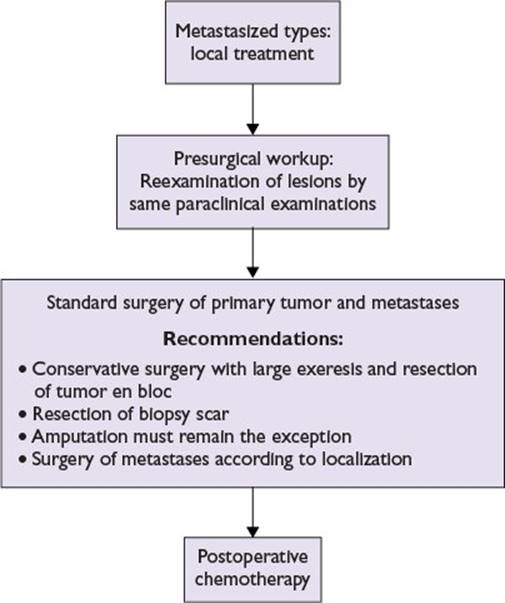
FIGURE 21.4 Treatment options for metastatic osteosarcoma.
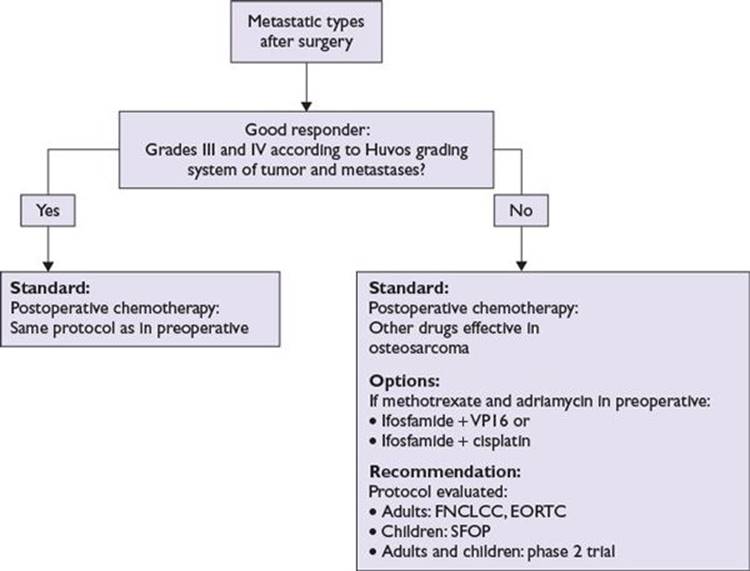
FIGURE 21.5 Treatment options for postoperative metastatic osteosarcoma.
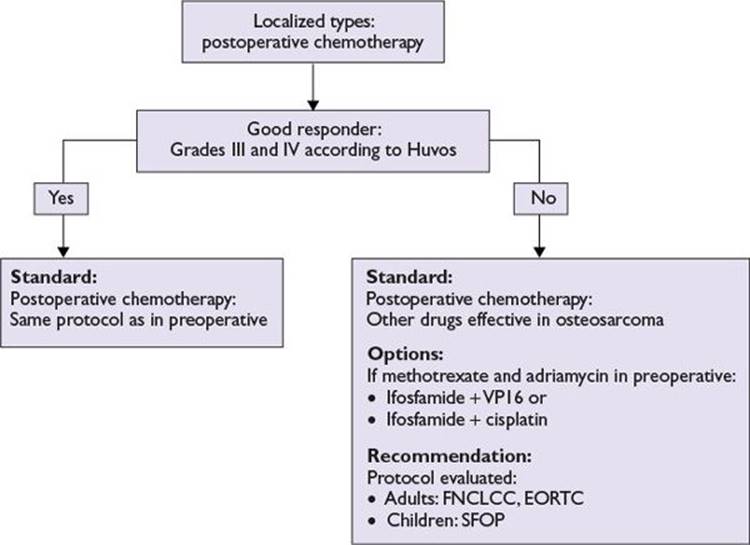
FIGURE 21.6 Treatment options for postoperative localized osteosarcoma.
Chemotherapy
■Neoadjuvant
•Evaluation of bone marrow, cardiac, liver, and renal function
•Initiated soon after completion of biopsy and staging studies
•Duration: 9 to 12 weeks
■Adjuvant
•Evaluation of extent of tumor necrosis in surgical specimen as predictor of disease-free and overall survival
•Initiated soon after definitive surgery for primary tumor
•Duration: 35 to 40 weeks
Surgery
Amputation and limb-sparing resection incorporate wide en bloc excision of the tumor and biopsy site through normal tissue planes, leaving a cuff of normal tissue around the periphery of the tumor. Limb-sparing surgery is now the preferred approach for 70% to 90% of patients with osteosarcoma due to improved functional outcome. Reconstruction involves allografts, customized endoprosthetic devices, modular endoprosthetic devices, or combinations of these methods. This approach requires a multidisciplinary team and close cooperation between the chemotherapist and orthopedic oncologist.
Follow-Up
Patients with osteosarcomas should have frequent radiographic monitoring for metastases for at least 5 years after completion of therapy. Most first recurrences appear asymptomatically in the lungs. Durable salvage has been reported in 10% to 20% of such patients; thus, all patients with recurrent disease should be treated with curative intent.
EWING FAMILY OF TUMORS
■The EFT comprises Ewing sarcoma of the bone, PNETs, Askin-Rosai tumor (PNET of the chest wall), and extraosseous Ewing sarcoma. Studies using immunohistochemical markers, cytogenetics, and tissue culture indicate that these tumors all derive from the same primordial stem cell and are distinguished only by the degree of neural differentiation.
■Ewing sarcoma accounts for 10% to 15% of all malignant bone tumors, with peak incidence between 10 and 15 years of age.
■Incidence in African-American and Chinese populations is remarkably low.
■Nearly 12% of patients with Ewing sarcoma also have associated urogenital anomalies such as cryptorchidism, hypospadias, and ureteral duplication.
Clinical Presentation
■Persistent and increasing pain, local swelling, and functional impairment of affected area (see Table 21.6)
■Fever
■Associated neurologic symptoms, including paraplegia and peripheral nerve abnormalities
■Uncommon symptoms:
•Lymph node involvement
•Meningeal spread
•Central nervous system disease
Diagnosis and Staging
Radiologic
1.Evaluation of primary tumor
•CT and MRI of primary lesion
•PET
2.Metastatic spread
•CT of chest/lungs
•Technetium bone scan for tumor extent and bone marrow involvement
•PET
Approximately 20% of patients have visible metastases at diagnosis. Of these patients, about 50% have lung metastases and about 40% have multiple bone involvement and diffuse bone marrow involvement.
Biopsy and Laboratory Investigations
Open biopsy is preferred for tissue diagnosis. It should be undertaken at an oncology center where the diagnostic material can be optimally used and the initial surgical approach can be determined by a multidisciplinary team responsible for the patient’s subsequent treatment. Needle biopsy may restrict access to fresh and frozen tissue for cytogenetic and molecular genetic investigations.
■Serology
•LDH: prognostic indicator reflecting disease burden
■Histopathology
•“Small blue round cell tumor”
•Immunohistochemistry: NSE, vimentin, S-100, HBA-71
■Cytogenetics/molecular genetics
•t(11;22)(q24;q12) translocation in 85% of tumors
•RT-PCR of EWS/FLI-1 transcripts
The t(11;22)(q24;q12) translocation results in the formation of a chimeric gene between EWS (Ewing sarcoma gene), a novel putative RNA-binding gene located on chromosome 22q12, and FLI-1, a member of the erythroblastosis virus-transforming sequence family of transcription factors located on chromosome 11q24. It has been fully characterized at the molecular genetic level. RT-PCR of fusion transcripts from the tumor can identify patients with favorable prognosis.
Treatment
Most patients with apparently localized disease at diagnosis have subclinical micrometastases. Thus, a multidisciplinary approach including local disease control with surgery and/or radiation as well as systemic chemotherapy is indicated.
Surgery
Generally, surgery is the preferred approach for resectable tumors.
Radiotherapy
Radiotherapy is indicated for patients with no function-preserving surgical option or whose tumors have been excised with inadequate margins. Radiotherapy for EFT requires stringent planning and delivery by a team experienced in the treatment of this disease. Recommendations of the Intergroup Ewing Sarcoma Study (IESS) include the following:
■Gross residual disease: 4,500 cGy plus 1,080 cGy boost to the tumor site
■Microscopic residual disease: 4,500 cGy plus 5,400 cGy boost
■Pulmonary metastasis: whole-lung irradiation of 1,200 to 1,500 cGy even if complete resolution of pulmonary metastatic disease is possible with chemotherapy
■Metastasis to bone and soft tissues: 4,500 to 5,600 cGy
Chemotherapy
■The most effective agents are cyclophosphamide and doxorubicin, but vincristine and dactinomycin are also active. Recent dose-intensification studies of ifosfamide and etoposide have shown significant promise.
■Prognosis was poor before the advent of effective multiagent chemotherapy (5-year survival: 10% to 20% despite good local control) and is still dismal for patients with metastatic disease. A recent study reported a 3-year event-free survival of only 26.7% ± 13.2%.
FUTURE DIRECTIONS
Functional characterization of chromosomal translocations associated with RMS and Ewing sarcoma could elucidate the molecular pathogenesis of these tumors and lead to novel therapeutic strategies. Some current investigational approaches include
■Trabectedine, ET-743
■Cell-cycle signaling pathway inhibitors (i.e., IGF-1 receptor pathway and/or mTOR pathway)
■PARP inhibitors
■Epigenetic targeting (with HDAC inhibitors and others)
■Targeting of EWS-FLI with small molecules
REVIEW QUESTIONS
1.An 18-year-old girl presents with a several months’ history of increasing calf swelling. An MRI shows a 7 cm tumor involving the fibula and extending into the surrounding soft tissues. A core needle biopsy is obtained. The histopathologic evaluation reveals a small blue round cell tumor. Ewing sarcoma is suspected. Which of the following is true? Ewing sarcoma
A.Carries a characteristic translocation in the majority of cases which can be used for diagnosis
B.Is related to RMS
C.Is primarily treated with surgery
D.Does not respond well to chemotherapy
2.A 50-year-old man is complaining of worsening right upper arm swelling over the last 2 to 3 months. Plain radiographs show a tumor involving the bone with periosteal reaction. A biopsy shows osteosarcoma. Which statement(s) is/are true?
A.Osteosarcoma occurs in a bimodal age distribution.
B.Osteosarcoma is primarily treated with chemotherapy.
C.Osteosarcoma is curable with metastasectomy in selected cases.
D.Osteosarcoma carries a disease specific translocation.
E.A and C.
F.B and D.
G.All of the above.
3.A 22-year-old athlete is complaining of worsening pelvic pain. A muscle strain is suspected. Ibuprofen and cyclobenzaprin are prescribed without much improvement. Finally, a CT scan of the pelvis is ordered which shows an 8 cm tumor in the soft tissues along the pelvic wall. A biopsy shows alveolar RMS. Which statements about RMS are true?
A.RMS occurs primarily in the bones.
B.RMS requires multimodality therapy.
C.RMS does not occur in infants.
D.RMS may occur as a primary GU tumor.
E.A and C.
F.B and D.
G.All of the above.
Suggested Readings
1.Arndt CA, Crist WM. Common musculoskeletal tumors of childhood and adolescence. N Engl J Med. 1999;341:342-352.
2.Carvajal R, Meyers P. Ewing’s sarcoma and primitive neuroectodermal family of tumors. Hematol Oncol Clin North Am. 2005;19(3):501-525, vi-vii.
3.Ferrari S, Palmerini E. Adjuvant and neoadjuvant combination chemotherapy for osteogenic sarcoma. Curr Opin Oncol. 2007;19(4):341-346.
4.Gorlick R, Bielack S, Teot L, et al. Osteosarcoma: biology, diagnosis, treatment, and remaining challenges. In: Pizzo PA, Poplack DG, eds. Principles and Practice of Pediatric Oncology. Philadelphia, PA: Lippincott–Raven; 2010:1015-1044.
5.Grohar PJ, Helman LJ. Prospects and challenges for the development of new therapies for Ewing sarcoma. Pharmacol Ther. 2013;137(2):216-224.
6.Hawkins DS, Buelling T, Dubois S, et al. Ewing sarcoma In: Pizzo PA, Poplack DG, eds. Principles and Practice of Pediatric Oncology. Philadelphia, PA: Lippincott–Raven; 2010:987-1014.
7.Huh WW, Skapek SX. Childhood rhabdomyosarcoma: new insight on biology and treatment. Curr Oncol Rep. 2010;12(6):402-410.
8.Kim SY, Helman LJ. Strategies to explore new approaches in the investigation and treatment of osteosarcoma. Cancer Treat Res. 2009;152:517-528.
9.Meyers PA. High-dose therapy with autologous stem cell rescue for pediatric sarcomas. Curr Opin Oncol. 2004;16(2): 120-125.
10.NCCN. Clinical Practice Guidelines in Oncology: Bone Cancer. v.1.2008. Available at: http://www.nccn.org/professionals/physician_gls/PDF/bone.pdf
11.PDQR. Cancer Information Summaries: Pediatric Treatment. Available at: http://cancernet.nci.nih.gov/cancertopics/pdq/pediatrictreatment
12.Völker T, Denecke T, Steffen I, et al. Positron emission tomography for staging of pediatric sarcoma patients: results of a prospective multicenter trial. J Clin Oncol. 2007;25(34):5435-5441.
13.Wexler LH, Meyer WH, Helman LJ. Rhabdomyosarcoma. In: Pizzo PA, Poplack DG, eds. Principles and Practice of Pediatric Oncology. Philadelphia, PA: Lippincott–Raven; 2010:923-953.